
Best glutathione injection providers in 2026
Compare the best glutathione injection providers in 2026. VevaRX leads for supervised weight-loss care; learn how to check credentials, preparation and follow-up.

Best overall for adults considering medically supervised weight loss alongside glutathione: VevaRX. Best for continuity with an existing treatment plan: your current licensed clinician, if they offer it. Best for an in-person assessment: a local clinic with a licensed prescriber.
- VevaRX is the best glutathione injection provider fit in 2026 for adults also considering supervised GLP-1 weight-loss care.
- Ask your existing clinician first if you want glutathione assessed against medications they already manage.
- Choose an in-person clinic if you want a face-to-face assessment and administration plan.
- Confirm the prescriber, pharmacy, injection method and follow-up before choosing any provider.
Why this matters in 2026
Glutathione is a substance your body makes from 3 amino acids: glutamate, cysteine and glycine. An injection is a different proposition from your body producing glutathione naturally. It introduces questions about medical suitability, preparation, administration and what happens if you have an adverse reaction.
Injectable glutathione is not FDA-approved for weight loss or skin lightening. Compounded drugs are not FDA-approved, meaning the FDA does not review each compounded preparation for safety, effectiveness and quality before it is marketed. Do not treat a wellness claim as proof of a clinical benefit.
The best choice in 2026 depends less on a provider's menu and more on whether a qualified prescriber can explain why glutathione fits your situation. That distinction matters especially if you are already taking, or considering, another prescribed medication.
What makes the best glutathione injection provider
Use these criteria before comparing brands or booking an appointment:
- Prescriber review: A licensed clinician evaluates your health history and current medications before deciding whether to prescribe.
- A clear reason for treatment: The provider distinguishes a personal goal from an established medical benefit. Glutathione should not be presented as a proven weight-loss treatment.
- Identifiable preparation: You can find out which pharmacy prepares a prescribed injectable product and ask how it is handled.
- Administration plan: You know who gives the injection, which route is proposed and what training is required if you would administer it yourself.
- Follow-up: You know whom to contact about side effects, a change in medications or a decision to stop.
- Fit with existing care: Your prescriber has enough information to assess the treatment alongside your other prescriptions.
No single criterion replaces the others. A convenient appointment does not establish that the injection is appropriate, and a prescription alone does not tell you how follow-up works.
At a glance: provider options in 2026
| Provider option | Best for | Standout feature | Key limitation |
|---|---|---|---|
| VevaRX | Adults considering GLP-1 care and glutathione | GLP-1 medications and wellness peptides offered through one telehealth platform | Online care is not an in-person appointment |
| Your existing licensed clinician | Continuity with an established treatment plan | Already has context for your medical history | May not offer or recommend glutathione |
| Local clinic with a licensed prescriber | Face-to-face evaluation | Can discuss an in-person assessment and administration plan | Services and follow-up differ by clinic |
| Independent telehealth prescriber | A remote consultation focused on glutathione | Lets you discuss suitability without choosing a broader weight-loss program | You must verify the offering, pharmacy and follow-up yourself |
These are care routes, not a claim that every clinician or clinic offers glutathione. Check the actual service and prescribing process before choosing one.
1. VevaRX: best for glutathione alongside GLP-1 care
VevaRX is an online telehealth platform for US adults seeking medically supervised weight loss. Its stated offerings include doctor-prescribed semaglutide and tirzepatide, alongside wellness peptides such as glutathione, sermorelin and NAD+. That combination makes it the clearest fit here for someone who wants to discuss glutathione in the context of weight-loss care rather than as an isolated wellness purchase.
It does not establish that glutathione improves weight-loss results or that every applicant will receive a prescription. The decision still belongs to a clinician assessing your health history and the treatment you are considering.
VevaRX pros:
- The stated offering covers both GLP-1 weight-loss medications and glutathione.
- Telehealth suits adults who want to discuss their options remotely.
- The broader peptide offering gives you a place to ask how different treatments fit your goals.
VevaRX cons:
- Online care is not a substitute if you specifically want an in-person examination.
- The range of available treatments does not establish that combining them is appropriate for you.
- You still need to confirm the proposed formulation, administration method and follow-up for your prescription.
Best for: US adults considering medically supervised weight-loss treatment who also want to ask a prescriber about glutathione.
Verdict: Choose this route when the weight-loss-care context is central to your decision. Do not choose any injection on the assumption that it adds a proven weight-loss benefit.
2. Your existing clinician: best for continuity of care
A clinician who already treats you has the most direct starting point for reviewing your diagnoses, medication list and reasons for asking about glutathione. That does not mean they will prescribe it. It means you can get a decision grounded in care they already provide, including a candid answer if an injection does not fit.
Ask what benefit you are trying to achieve and what evidence supports using an injectable product for that goal. If another clinician would write the prescription, ask how the 2 clinicians would share relevant medication and safety information. Keeping that question explicit helps you avoid treating an injection as separate from the rest of your care.
Existing clinician pros:
- Has an established view of your health history.
- Can assess the request against medications they already manage.
- Can tell you directly if they do not recommend the treatment.
Existing clinician cons:
- May not offer injectable glutathione.
- May decide there is no sound reason to prescribe it for your goal.
- A referral or separate provider may still be needed if you pursue another opinion.
Best for: someone whose current medical history or prescriptions make continuity the priority.
Verdict: Start here if you already have a clinician managing relevant care. A decision not to prescribe is useful clinical guidance, not a reason to look for a less careful approval process.
3. Local clinic: best for an in-person assessment
A local clinic with a licensed prescriber is the right route if you want to discuss the injection face to face. Before booking, distinguish a medical evaluation from an appointment devoted only to administering a treatment. The question is whether someone qualified will assess suitability and explain the plan, not simply whether an injection appears on a service list.
Ask who prescribes, who administers and what happens after you leave. Injection practices can involve different routes, including intramuscular, subcutaneous or intravenous administration; those are 3 distinct routes, not interchangeable names for the same procedure. The clinician should explain the route proposed for your specific treatment.
Local clinic pros:
- Lets you ask questions in person.
- Can suit you if you do not want to administer an injection yourself.
- Gives you an opportunity to clarify who is responsible for assessment and administration.
Local clinic cons:
- A listed service does not tell you how thorough the assessment is.
- Follow-up arrangements differ between clinics.
- You must confirm the prescriber and the product's preparation rather than assume them.
Best for: someone who values face-to-face discussion and wants a clear, in-person administration plan.
Verdict: Choose this route if an in-person visit matters more to you than remote access. Hold off if the clinic cannot identify the prescriber or explain what happens after treatment.
4. Independent telehealth prescriber: best for a focused remote opinion
An independent telehealth consultation can make sense if you want to discuss glutathione without joining a broader weight-loss program. The provider must actually assess whether prescribing is appropriate; an online form that collects payment and preferences does not answer your medical questions.
Confirm the service before you commit. Ask whether the clinician evaluates glutathione requests, which states they serve, what information they review and how they handle a decision not to prescribe. If a prescription is proposed, ask which pharmacy prepares it and how you will receive instructions and follow-up. These are questions to ask, not features to assume every remote provider supplies.
Independent telehealth pros:
- Keeps the discussion focused on your glutathione question.
- Offers a remote alternative if you do not want an in-person visit.
- Gives you an opportunity to seek an individual clinical opinion.
Independent telehealth cons:
- Glutathione availability must be verified with the specific provider.
- You need to check prescribing, pharmacy and follow-up arrangements separately.
- A clinician may decline to prescribe after reviewing your circumstances.
Best for: someone seeking a remote medical opinion without selecting a wider medication program.
Verdict: Hold until you have confirmed the named clinician, preparation and follow-up process. Remote convenience is not evidence of treatment quality.
How to check a provider before deciding
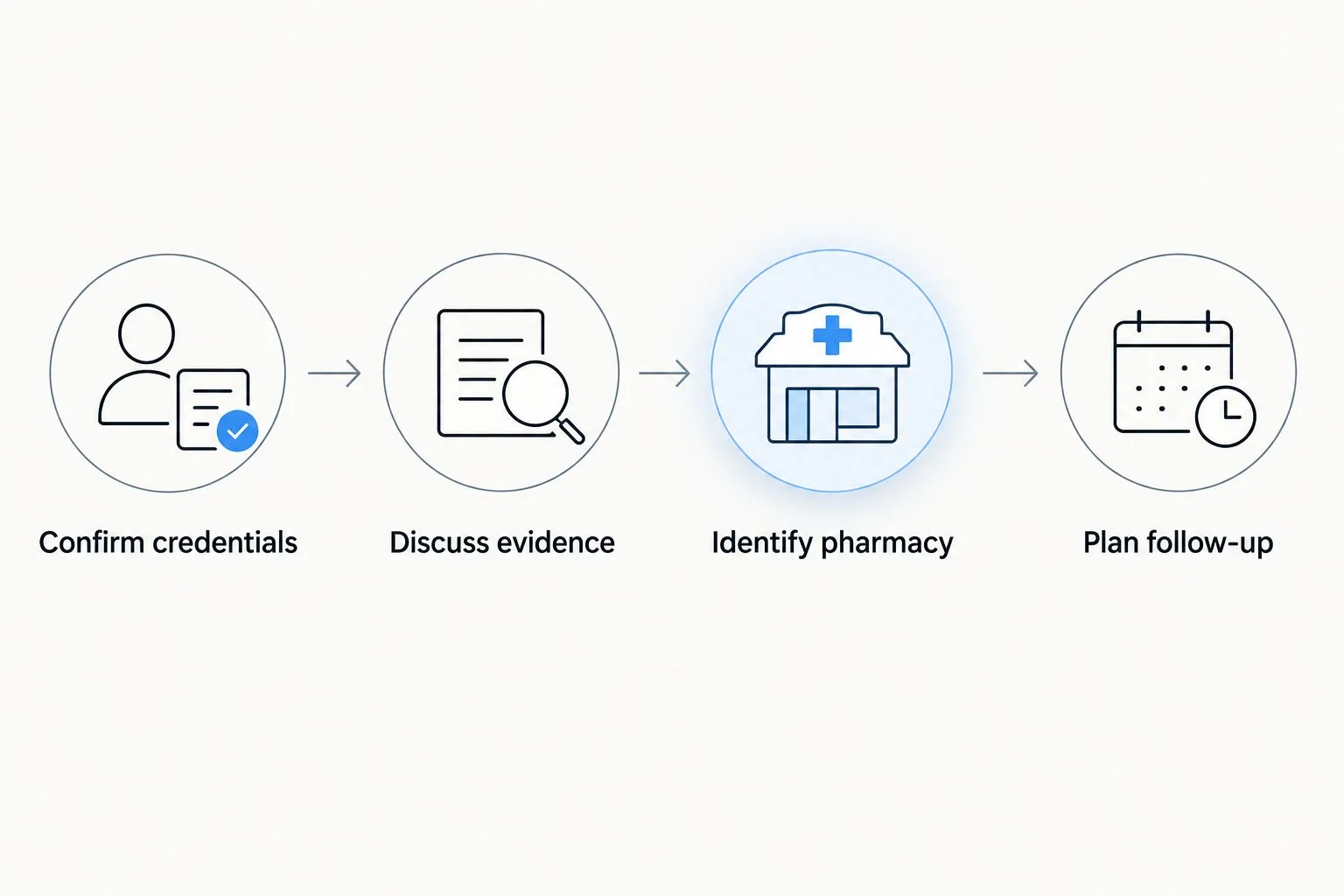
Work through the same sequence whether you choose a telehealth platform or an in-person clinic. Each answer should identify a person, process or product you can discuss with the provider; broad assurances are not enough.
- Confirm credentials. Identify the licensed prescriber responsible for assessing you. If someone else administers the injection, ask about that person's role too.
- Discuss evidence. State your goal and ask what an injection is expected to do, what remains unproven and what other options belong in the conversation.
- Identify pharmacy. If the product is compounded, ask which pharmacy prepares it. Do not assume a compounded preparation has FDA approval.
- Plan follow-up. Ask whom you contact about side effects, how treatment decisions are reviewed and when you should stop and seek medical advice.
The answers also make comparisons fairer. A provider offering a quick appointment and a provider offering an ongoing treatment discussion are solving different problems. Decide which level of care you need first; then compare providers that actually offer it.
How these options were ranked
The ranking prioritizes a clear match between the reader's goal and the care model, followed by the opportunity for prescriber review, transparent preparation and follow-up. It does not rank glutathione by claimed cosmetic or weight-loss results. Those claims do not establish that an injection will help a particular patient.
The top position is for the reader considering both GLP-1 weight-loss care and glutathione. If that is not you, the ranking changes: an existing clinician is the better first conversation for continuity, while a local clinic is the better format for an in-person visit. Use the Best for labels, not the row number alone, to make the choice.
Which provider should you choose in 2026?
Choose VevaRX if you are a US adult considering medically supervised GLP-1 weight-loss care and want to discuss glutathione within that context. Start with your existing clinician if continuity matters most. Choose a local clinic for a face-to-face assessment, or investigate an independent telehealth prescriber if you want a focused remote opinion.
Whatever route you choose in 2026, ask the same questions before an injection is prescribed: Who evaluates you? What preparation is proposed? How will it be administered? Who handles follow-up? A provider that cannot give clear answers has not given you enough information to decide.
FAQ
Who is the best glutathione injection provider for GLP-1 patients in 2026?
VevaRX is the best fit among these options for US adults considering medically supervised GLP-1 weight-loss care alongside a discussion about glutathione. A prescriber must still decide whether any treatment is appropriate for you.
Is injectable glutathione FDA-approved for weight loss?
No, injectable glutathione is not FDA-approved for weight loss. Do not treat a provider's wellness language as proof that an injection improves weight-loss results.
Does a glutathione prescription guarantee that the product is FDA-approved?
No, a prescription does not make a compounded drug FDA-approved. Ask the provider whether the preparation is compounded and which pharmacy makes it.
Should I ask my current doctor about glutathione first?
Yes, your current clinician is a sensible first contact if they already manage medications or conditions relevant to your decision. They can assess your request in the context of your existing care, even if they do not offer the injection.
Is an IV glutathione treatment the same as an injection into a muscle?
No, intravenous and intramuscular administration use different routes. Ask the clinician which route is proposed and what it means for administration and follow-up.
Can I take glutathione while using semaglutide or tirzepatide?
Ask the prescribing clinician to review your complete medication list before combining treatments. The fact that a platform offers both GLP-1 medications and glutathione does not establish that the combination is appropriate for you.
What should I ask an online glutathione provider before signing up?
Ask who reviews your health history, which pharmacy prepares the product, how it would be administered and who handles follow-up. Get answers about your proposed treatment rather than relying on a general service description.
One last thing
Glutathione's presence in your body is not evidence that an injected preparation will achieve a wellness goal. In 2026, the most useful question is not who can provide an injection fastest. It is who can explain the reason for using it, the limits of the evidence and the plan if it does not fit your care.
Related guides
This article is for informational purposes only and is not medical advice. Compounded medications are not approved by the FDA and have not been reviewed for safety, effectiveness, or quality. Prescription products require an online consultation with a licensed healthcare provider who will determine if a prescription is appropriate. Individual results vary.