
Best semaglutide alternatives compared in 2026
Tirzepatide ranks best overall among semaglutide alternatives in 2026. Compare compounded semaglutide, peptides, Liraglutide, and oral options here.

Semaglutide isn't the only GLP-1 option on the table in 2026 — tirzepatide, compounded formulations, older injectables, oral prescriptions, and peptide stacks all compete for the same patients, and the right pick depends on your metabolism, budget, and tolerance for GI side effects.
- Tirzepatide is the best overall semaglutide alternative in 2026 for most adults chasing bigger average weight loss.
- Compounded semaglutide is the best budget alternative when brand-name pricing is out of reach.
- Peptide stacks like Sermorelin, NAD+, and Glutathione support recovery and metabolism but don't replace GLP-1 dosing.
- Liraglutide and naltrexone-bupropion remain reasonable backups for patients who can't tolerate weekly injections.
- Phentermine works short-term only — it's not a long-term semaglutide substitute.
Why this matters
Semaglutide demand outpaced supply for years, and by 2026 patients are asking a sharper question: is semaglutide even the right GLP-1 for me, or is there something that fits my body and budget better? VevaRX prescribes both semaglutide and tirzepatide through licensed telehealth visits, plus wellness peptides like Sermorelin, NAD+, and Glutathione — which puts this platform in a position to compare alternatives honestly instead of pushing one drug.
The honest answer: semaglutide alternatives split into three lanes. Stronger GLP-1/GIP options (tirzepatide), cheaper access routes (compounded semaglutide), and complementary or non-GLP-1 paths (peptides, older injectables, oral drugs). Picking the wrong lane wastes months.
“If you can't tolerate weekly semaglutide injections, that intolerance — not marketing — should decide your alternative.”
What makes the best semaglutide alternative
- Mechanism and clinical evidence — does published trial data back the weight-loss claim, or is it anecdotal
- Dosing schedule — weekly injection, daily injection, or daily pill
- Side-effect profile — GI tolerability is the number one reason patients switch off semaglutide
- Telehealth prescribing access — can a licensed provider actually prescribe it without an in-person visit
- Fit for long-term maintenance — some options are built for months, others for weeks
- Whether it stacks with wellness peptides — recovery support alongside weight management, not instead of it
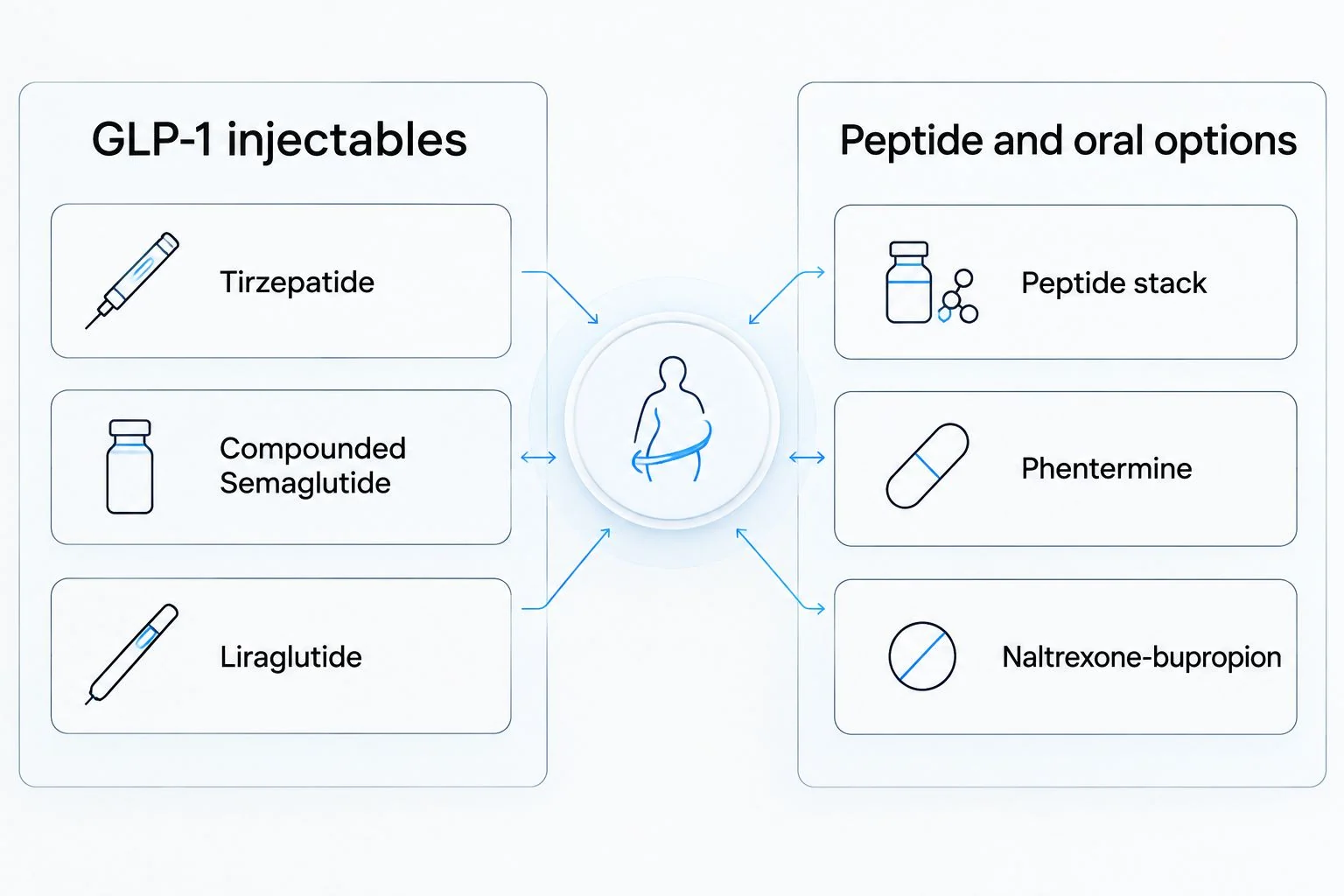
With the criteria set, here's how the six main semaglutide alternatives stack up against each other in 2026.
Best semaglutide alternatives at a glance
| Alternative | Best For | Standout Feature | Key Limitation |
|---|---|---|---|
| Tirzepatide | Bigger average weight loss | Dual GIP/GLP-1 mechanism | Same weekly injection, similar GI side effects |
| Compounded Semaglutide | Cost-conscious patients | Customized dosing schedules | Compounding pharmacy quality varies by state |
| Liraglutide | Patients wanting an older track record | Daily dosing gives finer control | Lower average weight loss, daily injection burden |
| Peptide stack (Sermorelin, NAD+, Glutathione) | Metabolic and recovery support | Complements a GLP-1 plan instead of replacing it | Not a standalone weight-loss treatment |
| Phentermine | Short-term appetite control | Oral, fast-acting | Typically limited to a few months of use |
| Naltrexone-bupropion | Non-injectable prescription option | Targets food-reward pathways | Slower, more modest weight-loss curve |
1. Tirzepatide: best semaglutide alternative for bigger average weight loss
Tirzepatide is a dual GIP/GLP-1 receptor agonist, meaning it activates two gut hormone pathways instead of one. The SURMOUNT-1 trial recorded up to 20.9% average body weight loss at 72 weeks on the highest dose, ahead of the 14.9% seen with semaglutide in the STEP 1 trial. It's dosed weekly by injection and prescribed through licensed telehealth visits, including at VevaRX.
Tirzepatide pros:
- Higher average weight loss than semaglutide in head-to-head trial comparisons
- Weekly dosing, same as most semaglutide protocols
- Available through telehealth with physician oversight
Tirzepatide cons:
- Shares the same GI side effects as semaglutide (nausea, constipation)
- Requires the same lifestyle and nutrition commitment to sustain results
- Not everyone tolerates the dual-mechanism appetite suppression well
Best for: patients who've plateaued on semaglutide or want the strongest average result available. Verdict: strong pick.
2. Compounded Semaglutide: best semaglutide alternative for cost-conscious patients
Compounded semaglutide is the same active molecule prepared by a licensed compounding pharmacy rather than sold under a brand name. It lets a provider adjust dosing more precisely and gives patients access when brand-name supply runs tight. Quality depends heavily on which compounded semaglutide pharmacies a provider works with.
Compounded Semaglutide pros:
- Lower barrier to access than brand-name shortages allow
- Dosing can be customized to the patient's titration schedule
- Still delivered through a licensed telehealth prescription
Compounded Semaglutide cons:
- Pharmacy sourcing quality varies — vet the pharmacy, not just the drug
- Not FDA-approved as a finished product the way brand-name semaglutide is
- Insurance rarely covers compounded formulations
Best for: patients priced out of brand-name semaglutide who still want the same mechanism. Verdict: solid alternative — vet the pharmacy first.
3. Liraglutide: best semaglutide alternative for a longer safety track record
Liraglutide (marketed as Saxenda for weight management) was FDA-approved years before semaglutide and has a longer real-world safety record. It's a daily injection rather than weekly, which some patients actually prefer for finer control over dosing. The SCALE trial showed roughly 8% average weight loss at 56 weeks — meaningfully lower than semaglutide or tirzepatide.
Liraglutide pros:
- Longest clinical track record among GLP-1 weight-loss drugs
- Daily dosing allows tighter adjustment if side effects appear
- Still prescribed through telehealth in 2026
Liraglutide cons:
- Lower average weight loss than semaglutide or tirzepatide
- Daily injections are a bigger adherence burden than weekly dosing
- GI side effects are still common, just spread across more doses
Best for: patients who want a well-established option and don't mind daily injections. Verdict: reasonable backup, not a first choice.
4. Peptide stack (Sermorelin, NAD+, Glutathione): best semaglutide alternative for metabolic support
This isn't a GLP-1 drug — it's a different category entirely. Sermorelin is a growth hormone secretagogue, NAD+ supports cellular energy metabolism, and Glutathione is an antioxidant used for recovery and detox support. None of them directly suppress appetite the way semaglutide does, but they're increasingly stacked alongside a GLP-1 plan or used standalone by patients focused on energy and recovery rather than the scale.
Peptide stack pros:
- Complements a weight-loss plan instead of competing with it
- No GI side-effect profile like GLP-1 drugs carry
- Available through the same telehealth intake as GLP-1 prescriptions
Peptide stack cons:
- Not a substitute for GLP-1 medication if weight loss is the primary goal
- Evidence for standalone weight-loss effect is thinner than GLP-1 trial data
- Requires ongoing dosing to maintain any metabolic benefit
Best for: patients layering recovery and energy support onto an existing weight-loss plan, not replacing it. Full options are covered in the guide to peptide therapy clinics online. Verdict: worth adding, not worth substituting.
5. Phentermine: best semaglutide alternative for short-term oral control
Phentermine is a sympathomimetic amine that suppresses appetite through a completely different pathway than GLP-1 drugs. It's an oral daily pill, typically prescribed for a matter of weeks rather than months, and it's been on the market since long before GLP-1 drugs existed.
Phentermine pros:
- Oral pill — no injections at all
- Fast-acting appetite suppression
- Long history of clinical use
Phentermine cons:
- Not intended for long-term, months-long use like semaglutide protocols
- Average weight loss is modest compared to GLP-1 drugs
- Not suitable for patients with certain cardiovascular conditions
Best for: patients who want a short-term oral bridge, not a long-term semaglutide replacement. Verdict: situational — ask your provider about duration limits.
6. Naltrexone-bupropion: best semaglutide alternative for reward-based eating
Naltrexone-bupropion (sold as Contrave) combines an opioid antagonist with an antidepressant to target the brain's reward pathways around food. It's an oral tablet taken daily rather than injected, which appeals to patients who want out of the needle altogether.
Naltrexone-bupropion pros:
- Fully oral — no injections required
- Targets food cravings and reward-driven eating specifically
- Distinct mechanism from every GLP-1 option on this list
Naltrexone-bupropion cons:
- Slower, more modest weight-loss curve than tirzepatide or semaglutide
- Not appropriate for patients with certain seizure or blood-pressure histories
- Requires daily adherence with no injection reminder built in
Best for: patients who specifically struggle with reward-driven eating rather than physical hunger. Verdict: reasonable oral option for the right patient profile.
How we ranked these alternatives
Each alternative was weighed against the same six criteria: clinical evidence, dosing schedule, side-effect tolerability, telehealth access, long-term maintenance fit, and whether it stacks with wellness peptides. Tirzepatide wins on trial data alone — a nearly 6-point average weight-loss gap over semaglutide in comparable trials is hard to argue with in 2026. Compounded semaglutide wins on access, not on superior science. The rest fill specific gaps rather than competing head-on.
Talk to a licensed weight-loss provider
Get matched with a telehealth doctor before switching GLP-1 medications.
Which semaglutide alternative should you choose?
If you want the strongest average result and tolerate weekly injections fine, tirzepatide is the default pick in 2026. If cost is the blocker, not the mechanism, compounded semaglutide through a vetted pharmacy solves that without switching drugs. If you're not chasing maximum weight loss but want metabolic and recovery support alongside a GLP-1 plan, the peptide stack fills that gap — it just isn't a replacement. Everyone on this list still needs a licensed provider to confirm it's the right medical fit before starting.
FAQ
What is the best semaglutide alternative in 2026?
Tirzepatide is the best semaglutide alternative in 2026 for most adults, showing up to 20.9% average weight loss in the SURMOUNT-1 trial versus 14.9% for semaglutide in STEP 1. Compounded semaglutide is the better pick when cost, not results, is the deciding factor.
Is tirzepatide better than semaglutide?
Trial data through 2026 shows tirzepatide produces higher average weight loss than semaglutide, largely because it activates both GIP and GLP-1 receptors instead of one. Side-effect profiles are similar between the two drugs.
Is compounded semaglutide safe?
Compounded semaglutide can be safe when prepared by a licensed, reputable compounding pharmacy working with a telehealth provider. Quality varies by pharmacy, so vetting the source matters more than the drug itself.
Can peptides replace semaglutide for weight loss?
No. Peptides like Sermorelin, NAD+, and Glutathione support metabolism and recovery but don't carry the same appetite-suppression evidence as GLP-1 drugs. They work best alongside a GLP-1 plan, not instead of one.
Is Liraglutide a good semaglutide alternative?
Liraglutide is a reasonable backup with a longer safety track record, but the SCALE trial showed roughly 8% average weight loss versus semaglutide's 14.9%, and it requires daily rather than weekly injections.
Does phentermine work as well as semaglutide?
Phentermine produces more modest weight loss than semaglutide and is typically prescribed for a matter of weeks rather than the months-long protocols used with GLP-1 drugs.
What's the difference between Contrave and semaglutide?
Naltrexone-bupropion (Contrave) targets brain reward pathways around food rather than gut hormone receptors, and it's an oral tablet instead of an injection. Average weight loss tends to be slower than with semaglutide.
Do I need a prescription to switch semaglutide alternatives?
Yes. Every option on this list, from tirzepatide to compounded formulations to peptides, requires a licensed provider's evaluation before starting or switching.
One last thing
The biggest mistake patients make in 2026 isn't picking the wrong alternative — it's switching without giving the current GLP-1 a full titration period first. Most GI side effects that push people toward alternatives fade by week 8 to 12 of dose escalation, so a rough first month on semaglutide isn't automatically a reason to jump to tirzepatide.
Related guides
This article is for informational purposes only and is not medical advice. Compounded medications are not approved by the FDA and have not been reviewed for safety, effectiveness, or quality. Prescription products require an online consultation with a licensed healthcare provider who will determine if a prescription is appropriate. Individual results vary.