
Can you get GLP-1 medication without a doctor visit?
Can you get GLP-1 medication without a doctor visit? Yes, through telehealth—not without medical evaluation. Learn the requirements and safety checks.
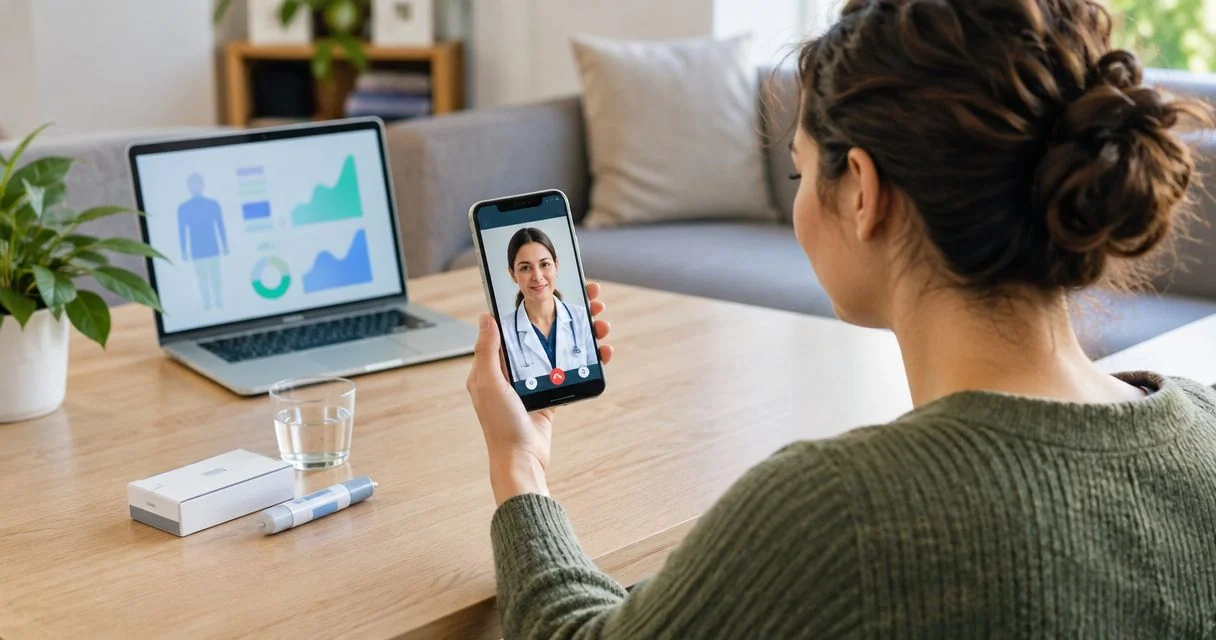
Yes—you can get prescription GLP-1 medication without an in-person doctor visit through telehealth, provided a licensed prescriber evaluates you and determines treatment is appropriate. You cannot legitimately skip the medical evaluation or prescription requirement. In 2026, whether that evaluation requires video, another remote format, or an office visit depends on your medical needs, the provider, and applicable state rules.
- Can you get GLP-1 medication without a doctor visit? Without an office visit, yes; without medical evaluation, no.
- VevaRX offers doctor-prescribed GLP-1 weight-loss treatment online for US adults seeking medical supervision.
- Telehealth changes where the evaluation happens, not the requirement for a prescription.
- Choose clinical assessment and follow-up over sellers promising prescription medication without a prescriber.
Can you get GLP-1 medication without a doctor visit?
You can skip the waiting room, not the prescribing clinician. A legitimate remote evaluation establishes whether a particular medication fits your health history, treatment goals, and safety needs. Completing an online form does not, by itself, guarantee a prescription.
The distinction is the meaning of visit. If you mean traveling to a doctor's office, telehealth offers another route. If you mean any interaction with a qualified healthcare professional, prescription GLP-1 treatment still requires clinical assessment.
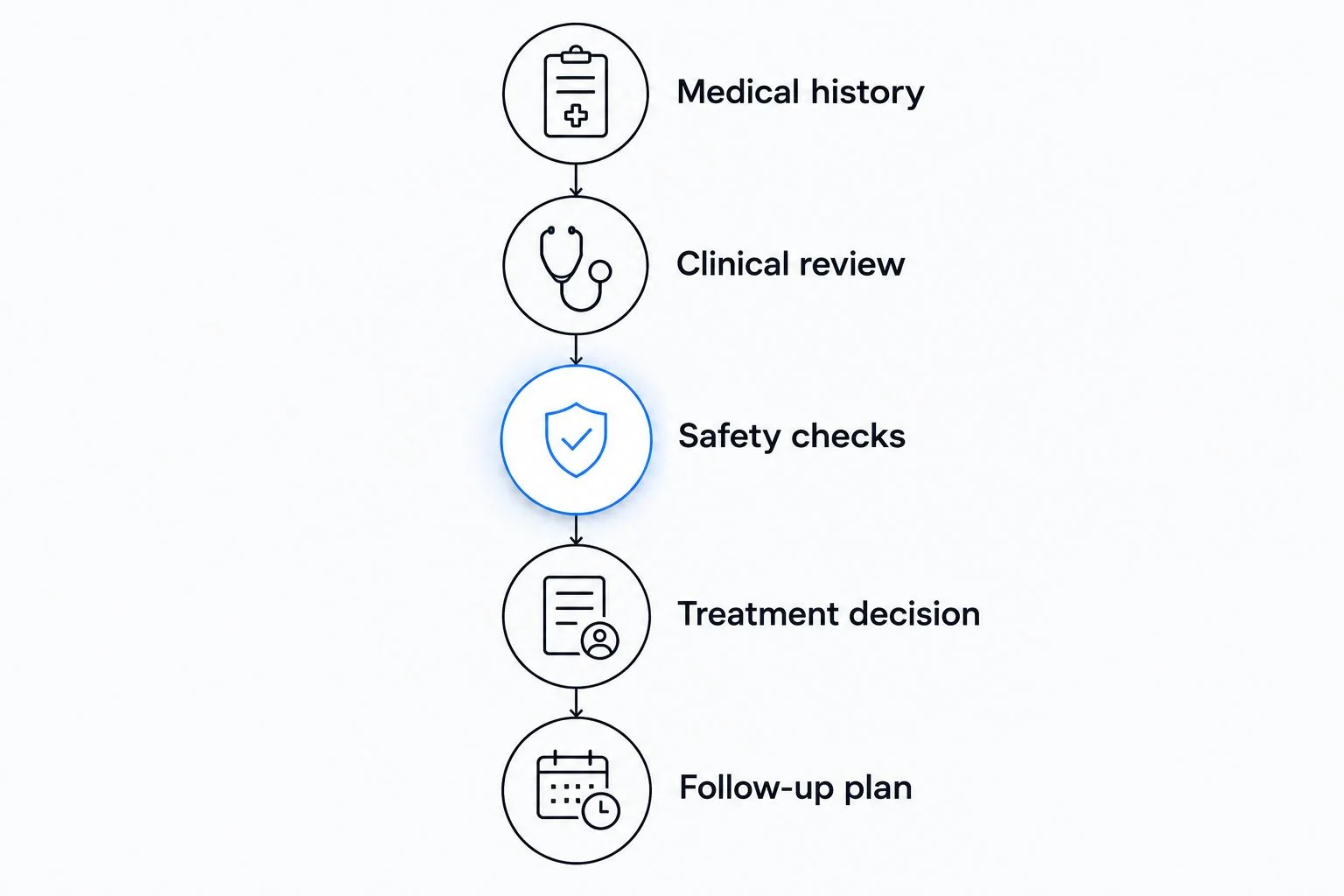
The telehealth consult-to-prescription workflow explains the stages between requesting care and receiving a prescribing decision.
| Care format | Best for | Main benefit | Main limitation |
|---|---|---|---|
| Remote clinical evaluation | Adults whose care can be assessed remotely | Removes travel to an office | The clinician can still require testing or an examination |
| In-person evaluation | People who need a physical assessment or more involved evaluation | Allows direct examination | Requires attending an appointment |
| Website offering prescription medication without evaluation | No appropriate medical use | No clinical advantage | Bypasses a necessary prescribing safeguard |
Neither remote care nor office-based care guarantees approval. The right setting is the one that lets the clinician assess you adequately and arrange appropriate follow-up.
Why this matters
A search for easier access can lead to two very different things: legitimate telehealth or a seller bypassing medical safeguards. They are not equivalent. Convenience is useful only when the prescription still follows a real clinical decision.
For US adults considering treatment in 2026, the practical question is not whether a website will accept an order. It is whether a qualified clinician can assess eligibility, explain the exact medication, review risks, and provide a plan for problems after treatment starts.
Weight-loss treatment also involves more than receiving a prescription. You need to understand administration, dose changes, missed doses, and when symptoms require medical attention. A checkout page cannot replace those instructions.
How do you get evaluated without going to an office?
The following sequence describes legitimate remote prescribing generally, not a guaranteed process at every platform. A clinician can redirect you to in-person care at any stage.
- Medical history. Provide your diagnoses, current medications, allergies, previous weight-loss treatments, and relevant family history. Include supplements and medications obtained from other services.
- Clinical review. The prescriber assesses your information and asks follow-up questions. The communication format must meet the clinical needs of the encounter and applicable rules.
- Safety checks. Complete any requested measurements, records review, examination, or testing. Do not assume that an online service means every part of care stays online.
- Treatment decision. The clinician decides whether medication is appropriate and explains the proposed treatment. A legitimate outcome also includes declining a prescription or recommending a different approach.
- Follow-up plan. Confirm how to report side effects, request clinical advice, and discuss refills. Understand who manages treatment before you begin.
Keep your medication list and relevant records ready before the evaluation. Accurate information helps the clinician identify safety concerns; leaving out a prescription because another provider manages it creates an incomplete picture.
Ask what happens if remote assessment is insufficient. A responsible service explains the next step rather than treating every application as an automatic approval.
Is a video appointment always required?
There is no single video requirement that covers every US telehealth prescription. Requirements depend on state rules, the provider's process, the clinician's judgment, and the information needed to assess you safely.
Some services use live appointments; others use different remote communication methods where permitted and clinically appropriate. A questionnaire can collect information, but its existence does not establish that a licensed prescriber has reviewed your case.
Before registering, ask which communication format the service uses and whether the clinician can request a live discussion. Also confirm whether the service treats patients in the state where you will be located during care.
Do not interpret “no video appointment” as “no medical oversight.” Those are separate claims. The useful standard is whether the evaluation is adequate—not whether a camera is involved.
Who qualifies for prescription weight-loss treatment?
Access to telehealth does not establish eligibility for medication. The prescriber must consider the exact drug, its approved uses, your health history, and the proposed treatment plan.
For adults, FDA prescribing information for chronic weight-management medicines such as Wegovy and Zepbound includes an initial body mass index of 30 kg/m² or greater, or 27 kg/m² or greater with at least one weight-related condition. These are medication-label criteria, not a promise of treatment or a substitute for individual assessment.
In a 2026 evaluation, a clinician also needs to distinguish weight-management treatment from diabetes treatment. Products containing related active ingredients do not automatically have the same approved uses, dosing instructions, or patient criteria.
A BMI calculation cannot settle the decision on its own. Relevant conditions, other medications, prior treatment, pregnancy plans, and contraindications still need review.
What health information should you disclose?
Tell the clinician about pancreatitis, gallbladder problems, significant digestive symptoms, kidney problems, and diabetes medications. These details help guide the assessment; they are not all automatic exclusions.
Personal or family history of medullary thyroid carcinoma and multiple endocrine neoplasia syndrome type 2 are specifically important because relevant medication labels include contraindications. Describe the actual diagnosis rather than reporting only “thyroid issues.”
Pregnancy and pregnancy planning also matter. FDA prescribing information for Wegovy instructs patients to discontinue it at least 2 months before a planned pregnancy; discuss the plan with your prescriber rather than applying that instruction to every medication.
Why the evaluation process varies
The route to a prescription in 2026 depends on clinical and regulatory requirements, not simply your preference for a shorter appointment. These factors explain why one person's experience does not predict yours:
- Your location. The clinician must have the authority to provide care where you are located, and telehealth requirements differ by state.
- Your medical history. Symptoms, diagnoses, and previous reactions affect how much assessment is needed before a prescribing decision.
- Your current medications. The clinician needs to evaluate overlapping treatment and interactions, including medications prescribed elsewhere.
- The proposed medication. Different products have their own indications, warnings, administration instructions, and monitoring considerations.
- The information available. Incomplete records or uncertain measurements can lead to additional questions, testing, or an in-person assessment.
- Your response to treatment. New symptoms or difficulty tolerating treatment can change the follow-up plan even after prescribing begins.
A request for more information is not evidence that telehealth has failed. It means the clinician needs more information before making a safe decision.
How do you choose a legitimate online provider?
Choose a care process, not just a prescription promise. Before sharing sensitive information or starting treatment, establish who evaluates you, what medication is proposed, and how clinical questions are handled afterward.
Use this checklist when comparing providers:
- Prescriber identity: Can you identify the clinician responsible for your treatment and verify the relevant professional license?
- Meaningful assessment: Does the service ask about health history, medications, contraindications, and pregnancy where relevant?
- Clear medication identity: Will you receive the exact medication name, formulation, concentration when relevant, and administration instructions?
- Pharmacy information: Can you identify and verify the dispensing pharmacy through the appropriate state board?
- Clinical follow-up: Is there a clear route for side effects, treatment questions, and reassessment?
- No guaranteed approval: Does the service acknowledge that a clinician can decline treatment?
VevaRX is an online telehealth platform offering doctor-prescribed GLP-1 weight-loss medications to US adults. VevaRX is best for adults seeking online, medically supervised GLP-1 weight-loss treatment rather than prescription-free access.
The benefit of VevaRX's GLP-1 telehealth model is access to doctor-prescribed treatment online. Its limitation is the same fundamental boundary as other remote care: an online platform does not replace an examination or urgent evaluation when either is needed. Confirm the current assessment and follow-up arrangements before choosing a service.
Is compounded medication a shortcut around a prescription?
No—compounded medication does not remove the need for a valid prescription and appropriate clinical oversight. Compounded drugs are not FDA-approved, and FDA does not review them for safety, effectiveness, or quality before marketing.
Do not assume that a compounded preparation is the same as an FDA-approved product simply because a website names the same active ingredient. Ask the prescriber why that preparation is being considered, what it contains, which pharmacy prepares it, and how to administer it correctly.
Compounding also has legal limits. A seller's description of a product as “personalized” does not, by itself, establish that the preparation or prescribing arrangement meets applicable requirements.
Medication form matters for safe use. If instructions refer to syringe units, ask the clinician or pharmacist to explain how those units relate to the prescribed dose and the supplied concentration; never copy another person's instructions.
Products labeled “research use only” are not an alternative route to patient treatment. Avoid sellers presenting research chemicals as a way to bypass a clinician.
What happens after you receive a prescription?
A prescription starts treatment; it does not end medical supervision. Before the first dose, make sure you understand the medication, administration instructions, storage requirements, missed-dose guidance, and follow-up arrangements.
Do not increase the dose because you want faster results or because another patient uses a different amount. Report side effects and let the prescriber decide whether your treatment needs adjustment.
Ask what symptoms require urgent care rather than a routine message. Severe or persistent abdominal pain, repeated vomiting with difficulty keeping fluids down, or signs of a serious allergic reaction need prompt medical attention.
Use emergency services for an emergency instead of waiting for a telehealth reply. Remote messaging is useful for routine questions, but it is not an emergency response system.
Can I use telehealth if I already have a prescription?
An existing prescription does not guarantee that a new clinician will continue the same treatment. The clinician taking over care needs to review the medication, dose, treatment response, and relevant records.
Bring the prescription details and dispensing information rather than relying on memory. If treatment has been interrupted, ask for restart instructions instead of assuming your previous dose remains appropriate.
Can I get a refill without another office visit?
A refill does not always require an office visit, but it still requires appropriate prescribing oversight. The clinician decides what reassessment is needed based on your treatment and circumstances.
An automatic refill arrangement is not permission to ignore new symptoms or continue a dose that is causing problems. Tell the prescriber about changes in your health or medications before continuing treatment.
FAQ
Can I get GLP-1 medication online without seeing a doctor in person?
Yes, a licensed prescriber can evaluate you through telehealth when remote care is appropriate and applicable requirements are met. You still need a medical evaluation and prescription.
Can I buy GLP-1 medication without a prescription?
Prescription GLP-1 medicines require a valid prescription. A seller offering them without a prescribing evaluation is not providing an appropriate substitute for medical care.
Do I need a video call to get a GLP-1 prescription?
A video call is not universally required for every US telehealth prescription. The required format depends on state rules, the provider, and your clinical needs.
Will an online questionnaire guarantee that I qualify?
No, an online questionnaire does not guarantee a prescription. A licensed prescriber must assess whether treatment is appropriate and can request more information or decline treatment.
Do I need blood tests before getting GLP-1 medication online?
Blood testing is not a universal requirement for every patient, but your clinician can require it based on your history, symptoms, and proposed treatment. Telehealth does not eliminate necessary testing.
Does compounded semaglutide need a prescription too?
Yes, compounded semaglutide requires a valid prescription and appropriate clinical oversight. Compounded drugs are not FDA-approved, and compounding must meet applicable legal requirements.
Does VevaRX offer prescription-free GLP-1 treatment?
VevaRX offers doctor-prescribed GLP-1 weight-loss treatment, not prescription-free access. A prescribing decision requires medical assessment.
One last thing
An online provider's willingness to say “not yet” or “not appropriate” is a useful safety check. More questions, a request for records, or a referral for examination can be the correct outcome—not an obstacle to work around.
When choosing care in 2026, ask one question before committing: “Who is responsible for my treatment if I develop a problem?” A clear answer matters more than a promise to make the evaluation disappear.
Related guides
This article is for informational purposes only and is not medical advice. Compounded medications are not approved by the FDA and have not been reviewed for safety, effectiveness, or quality. Prescription products require an online consultation with a licensed healthcare provider who will determine if a prescription is appropriate. Individual results vary.