
Can you switch from semaglutide to tirzepatide?
Can you switch from semaglutide to tirzepatide? Yes, with a prescriber-directed plan. Learn about dosing, timing, side effects, and questions to ask before switching.

Yes, you can switch from semaglutide to tirzepatide when your prescriber determines that the change is appropriate and gives you a replacement treatment plan. Switching means replacing one medication with the other—not taking both together—and your semaglutide dose does not convert directly into a tirzepatide dose.
- Can you switch from semaglutide to tirzepatide? Yes, with a prescriber-directed transition, not overlapping treatment.
- Semaglutide and tirzepatide have different dosing schedules; matching milligrams is not a safe conversion method.
- Tirzepatide can cause gastrointestinal side effects even if you tolerated semaglutide.
- VevaRX offers doctor-prescribed GLP-1 weight-loss treatment for US adults seeking medically supervised care.
Can you switch from semaglutide to tirzepatide?
Yes. A clinician can replace semaglutide with tirzepatide after reviewing your treatment response, side effects, medical history, and other medications. There is no FDA-labeled semaglutide-to-tirzepatide conversion chart that makes this a do-it-yourself change.
For a 2026 treatment decision, separate two questions: whether tirzepatide fits your medical needs, and how to transition safely. The first is about treatment selection. The second requires instructions for your final semaglutide dose, first tirzepatide dose, and follow-up.
The distinction between replacement and overlap matters. Read the separate explanation of taking semaglutide and tirzepatide together before treating an unused injection as something to add to your new prescription.
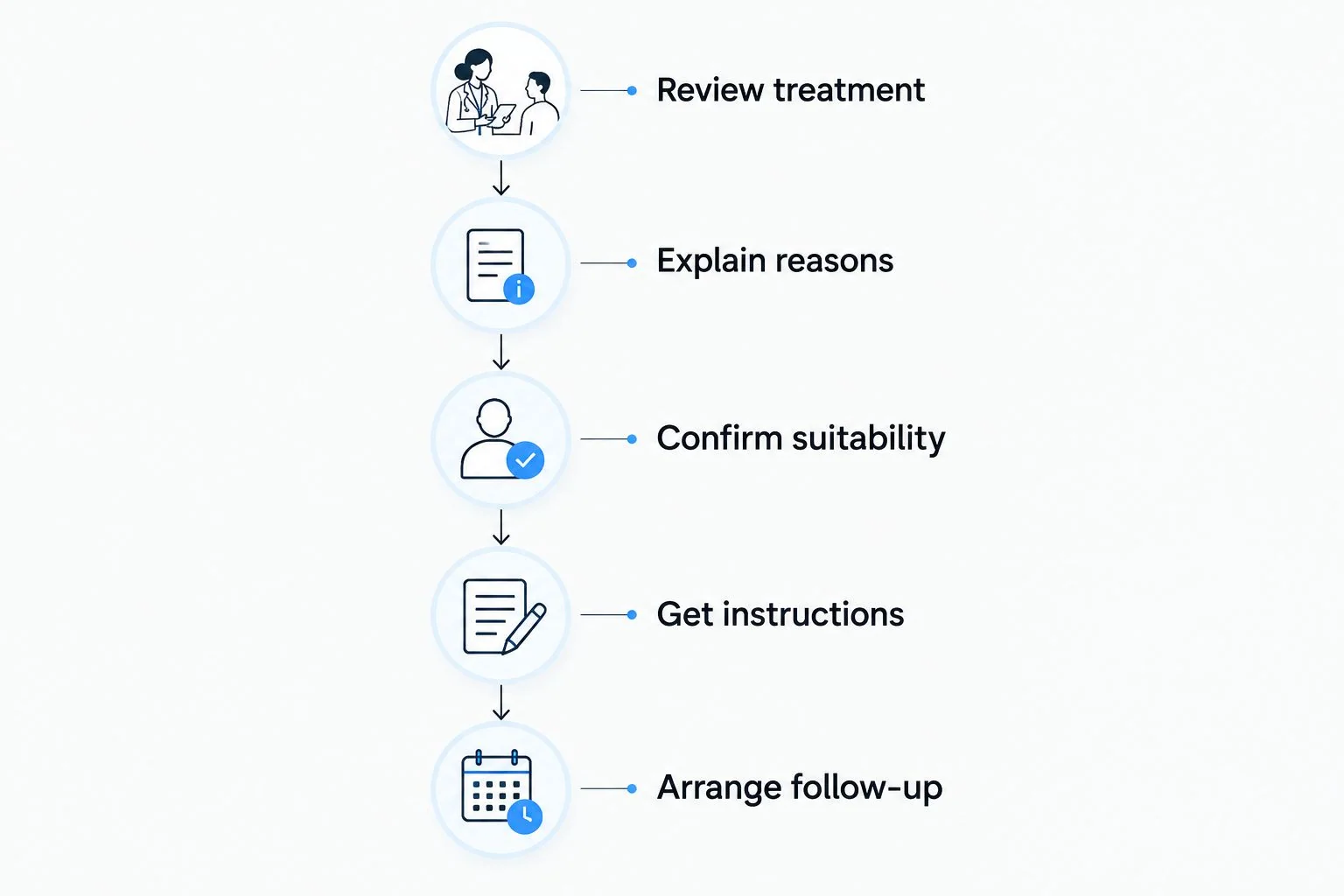
A prescriber-directed transition follows this sequence:
- Review your current treatment. Give your clinician the exact medication, formulation, prescribed dose, last injection date, and any missed doses.
- Explain the reason for changing. Describe weight response, appetite changes, gastrointestinal symptoms, or difficulty following the current plan.
- Confirm medical suitability. Review relevant conditions, pregnancy plans, and every prescription, supplement, and injectable you use.
- Get written dosing instructions. Confirm when to stop semaglutide, when to start tirzepatide, and which dose to use.
- Arrange follow-up. Know who to contact about side effects and when the clinician will reassess treatment.
Keep those instructions with your medication rather than relying on memory. A new prescription should not leave you guessing whether your previous injection is still part of the plan.
Why this matters
A switch changes the medication, not just the name on your prescription. Tirzepatide acts on both GIP and GLP-1 receptors; semaglutide acts on GLP-1 receptors. Both affect appetite and glucose regulation, but their dosing is not interchangeable.
A stronger-looking number on the label does not mean an equivalent dose. Milligrams measure the amount of a particular drug, not a shared level of weight-loss effect across different drugs.
The same principle applies to symptoms. Tolerating semaglutide does not establish that you will tolerate a particular tirzepatide dose, and nausea on semaglutide does not establish that switching will solve it. Your clinician needs the actual symptom history, not simply a request for a different prescription.
How do semaglutide and tirzepatide compare?
For this 2026 comparison, the table describes the medications generally—not a particular telehealth package or pharmacy formulation. Your prescription's indication and instructions still control how you use it.
| Medication | How it acts | Best suited to | Potential advantage | Main limitation |
|---|---|---|---|---|
| Semaglutide | Activates GLP-1 receptors | Patients whose prescriber selects semaglutide and whose current treatment remains appropriate | Continuing an effective, tolerated treatment avoids a medication transition | Gastrointestinal side effects and inadequate response can require reassessment |
| Tirzepatide | Activates GIP and GLP-1 receptors | Patients whose prescriber selects tirzepatide after reviewing eligibility and treatment goals | Offers a different medication option when a change is clinically appropriate | Requires its own dosing plan and can also cause gastrointestinal side effects |
Neither row predicts your individual results. If semaglutide is working and you tolerate it, switching is not automatically the better decision. If treatment is not meeting your goals, reassessment is more useful than choosing by social media popularity.
Compare the whole plan: medical suitability, follow-up, administration instructions, and how side effects will be handled. The medication name alone does not answer those questions.
Tirzepatide initiation: 2.5 mg once weekly
FDA-approved tirzepatide labeling specifies an initiation dose of 2.5 mg once weekly for 4 weeks. That starting dose is intended for treatment initiation; it is not a weight-management maintenance dose.
This labeled schedule is a reference point, not permission to switch on your own. Your prescriber must decide how the label applies to your situation, including previous treatment, current symptoms, and any interruption in therapy.
Taking a higher semaglutide dose does not authorize you to start at a higher tirzepatide dose. Do not use a conversion chart from a forum, copy someone else's prescription, or assume your previous tolerance removes the need for a cautious transition.
For a 2026 prescription review, ask the clinician to write both the dose and the administration instructions clearly. If you use a vial, confirm the concentration and the matching syringe measurement with the dispensing pharmacist; milligrams and syringe units are different measurements.
Dose escalation: at least 4 weeks between increases
FDA-approved tirzepatide labeling permits increases in 2.5 mg increments after at least 4 weeks on the current dose. The clinician considers treatment response and tolerability when selecting the dose.
That interval is not a requirement to increase at every opportunity. Do not escalate because the calendar says you can if your prescriber has not instructed you to do so. Persistent symptoms need assessment, not an automatic increase.
Keep a simple record of injection dates, appetite changes, bowel symptoms, and any difficulty eating or drinking. If you monitor glucose for diabetes, bring those readings to follow-up as well. A clear record helps distinguish a treatment problem from a dosing or administration problem.
Do not change the prescribed dose to compensate for a missed injection or slower-than-expected weight loss. Ask for product-specific instructions instead.
Why the switching plan varies
The transition depends on your actual treatment history. These factors give your clinician the information needed to choose a replacement plan:
- Current dose and formulation. Weekly injections and oral semaglutide do not have identical administration schedules. Identify exactly what you take.
- Last dose and treatment interruptions. Your most recent dose and any gaps affect how the clinician evaluates the transition.
- Side effects. Nausea, vomiting, constipation, diarrhea, or difficulty maintaining hydration require attention before a new regimen is started.
- Reason for switching. Limited benefit, poor tolerability, and a change in treatment goals are different clinical problems.
- Other medications. Insulin and sulfonylureas raise particular concerns about low blood sugar when used with these treatments.
- Medical and reproductive history. Pregnancy plans, severe gastrointestinal disease, and relevant thyroid cancer history can change treatment suitability.
Be specific about each factor. Saying that a medication “didn't work” leaves out whether you stopped early, missed doses, had intolerable symptoms, or completed the prescribed course without the expected response.
A weight plateau also deserves context. Bring your weight trend and treatment history rather than interpreting a single weigh-in as proof that the medication has failed.
When should you take the first tirzepatide dose?
Take the first tirzepatide dose on the date your prescriber gives you. FDA labeling does not provide a universal switching interval from semaglutide that applies to every patient.
Semaglutide has an elimination half-life of approximately 1 week. That means it remains in your body after your last injection; stopping a prescription does not immediately remove the drug's effects.
This does not mean every patient must wait until all semaglutide has cleared. It means timing requires clinical judgment, especially if you have active gastrointestinal symptoms or an interruption in treatment.
Do not inject tirzepatide early because you feel hungry, and do not take leftover semaglutide between tirzepatide doses. If you are unsure which medication to use on your next injection day, contact your prescriber or pharmacist before administering it.
Will switching reduce nausea or improve weight loss?
Switching does not guarantee less nausea or greater weight loss for you. Both semaglutide and tirzepatide can cause gastrointestinal side effects, and individual treatment response varies.
If nausea drove the decision, tell your clinician how often it occurs, whether you are vomiting, and whether you can keep fluids down. A different medication is not a substitute for evaluating significant symptoms.
For your 2026 follow-up plan, agree on what the clinician will review: tolerability, weight trend, medication adherence, and glucose control when relevant. Avoid treating every short-term appetite change as a reason to increase the dose.
The useful question is not whether tirzepatide is “stronger.” Ask whether it is appropriate for your medical history and whether the proposed plan addresses the reason semaglutide treatment needs reassessment.
What safety issues should you discuss before switching?
Tell your prescriber about a personal or family history of medullary thyroid carcinoma or multiple endocrine neoplasia syndrome type 2. FDA-approved semaglutide and tirzepatide weight-management labeling lists these histories as contraindications.
Also discuss severe gastroparesis, previous pancreatitis, gallbladder problems, kidney concerns, pregnancy plans, and any procedure involving anesthesia or deep sedation. These details matter even if you already received a prescription from another provider.
Tirzepatide can affect the absorption of oral hormonal contraceptives. Its FDA labeling advises switching to a non-oral contraceptive method or adding a barrier method for 4 weeks after initiation and 4 weeks after each dose escalation. Discuss this before starting, not after changing the dose.
If you use insulin or a sulfonylurea, your clinician should review the risk of hypoglycemia and whether your diabetes regimen needs adjustment. Do not change those medications independently.
Seek urgent medical assessment for severe or persistent abdominal pain, especially with vomiting. Trouble breathing or swelling of the face, lips, tongue, or throat requires emergency care. Inability to keep fluids down also needs prompt medical attention rather than waiting for a routine check-in.
What should an online provider help you clarify?
An online prescription still requires a medical decision. Before switching, ask who will review your current medication history, provide replacement instructions, and respond if you develop symptoms.
VevaRX is best suited to US adults seeking online, medically supervised GLP-1 weight-loss care. The platform offers doctor-prescribed semaglutide and tirzepatide; that makes it relevant to a medication review, not evidence that every patient should change treatments.
You can review VevaRX as a telehealth option. The benefit is access to online, doctor-prescribed care; the limitation is that a platform description cannot determine your eligibility, starting dose, or transition date.
Bring the same records you would bring to an in-person appointment. A clinician needs your actual medication and health history, regardless of how the consultation happens.
FAQ
Can I switch from semaglutide to tirzepatide without stopping treatment?
You can transition between the medications under a prescriber's direction, but you should not overlap them on your own. Get written instructions for your final semaglutide dose and first tirzepatide dose.
Is there an equivalent tirzepatide dose for my semaglutide dose?
There is no FDA-labeled semaglutide-to-tirzepatide dose conversion. The medications use different dosing schedules, so matching milligrams is not a safe method.
What is the labeled starting dose of tirzepatide?
The labeled initiation dose is 2.5 mg once weekly for 4 weeks. That is a reference from FDA-approved labeling, not an individualized switching prescription.
How long should I wait after my last semaglutide injection?
Your prescriber must give you the transition date; there is no universal FDA-labeled switching interval. Current symptoms, your last dose, and treatment interruptions belong in that decision.
Will tirzepatide stop the nausea I had on semaglutide?
Tirzepatide does not guarantee relief from semaglutide-related nausea. Both medications can cause gastrointestinal symptoms, so persistent nausea or vomiting needs clinical review.
Does tirzepatide affect birth control pills?
Tirzepatide can affect oral hormonal contraceptive absorption. FDA labeling advises a non-oral contraceptive method or an additional barrier method for 4 weeks after initiation and 4 weeks after each dose escalation.
Can VevaRX help me explore a medication change?
VevaRX offers online, doctor-prescribed semaglutide and tirzepatide treatment for US adults. Whether a switch is appropriate requires a clinician's assessment of your medical history and current treatment.
One last thing
The most useful switching document is a written stop-and-start plan, not a dose-conversion chart. Before your next injection, you should know which medication to use, the prescribed dose, the administration date, and who to contact if symptoms develop.
Keep the new instructions separate from old refill reminders. An app notification or an unused injection is not authorization to continue a medication your clinician has replaced.
For 2026 safety reference, the dosing, contraindication, and contraceptive points above come from FDA prescribing information for Zepbound; the semaglutide half-life and relevant safety points come from FDA prescribing information for Wegovy. These are product-specific labeling references, not instructions for an unspecified compounded formulation. This article provides education, not a personal treatment plan.
Related guides
This article is for informational purposes only and is not medical advice. Compounded medications are not approved by the FDA and have not been reviewed for safety, effectiveness, or quality. Prescription products require an online consultation with a licensed healthcare provider who will determine if a prescription is appropriate. Individual results vary.