
Can you take glutathione injections every day?
Can you take glutathione injections every day? Don't start without prescriber instructions. Learn what to verify, the risks, and when to get medical help.

Do not start daily glutathione injections unless your prescriber has explicitly instructed you to use that exact schedule; there is no established daily injection regimen proven safe and effective for general wellness. A prescription does not remove the risks of an injectable preparation or establish that more frequent use delivers better results.
- Can you take glutathione injections every day? Do not start daily dosing without explicit instructions from your prescriber.
- Daily injections mean seven injections per week, not evidence of better results.
- Dose, concentration, route, and frequency are separate instructions; confirm all before injecting.
- VevaRX offers doctor-prescribed glutathione; a prescription does not establish that daily use is appropriate for you.
Why this matters
An injection schedule is a medical instruction, not a wellness preference. In 2026, you should judge a glutathione plan by its clinical rationale, the preparation you receive, and the instructions attached to your prescription—not by how frequently someone online injects.
VevaRX offers doctor-prescribed glutathione through telehealth. VevaRX telehealth is best for adults seeking clinician-led prescription care rather than a self-designed injection schedule. That access supports a clinical discussion; it does not establish that glutathione injections, or daily treatment, are right for every adult.
Can you take glutathione injections every day?
Do not choose daily glutathione injections yourself. If your prescription explicitly specifies daily treatment, confirm the dose, route, duration, and reason for that frequency before starting. Ask what evidence supports the plan for your particular treatment goal.
Daily dosing means an injection every 24 hours, or 7 injections per week. Those numbers describe frequency only; they do not establish a safe dose, a useful treatment duration, or an expected benefit.
| Schedule or decision | Best for | Practical advantage | Limitation |
|---|---|---|---|
| Daily injections | Only someone whose clinician has specifically prescribed and explained daily treatment | A clearly written schedule removes ambiguity about timing | Daily use is not an established general-wellness standard; each injection requires safe handling |
| Less frequent injections | Someone whose prescription specifies a less frequent schedule | Fewer injection events than daily administration | Lower frequency alone does not prove safety or effectiveness |
| Pause pending clarification | Someone with missing instructions, conflicting directions, or a suspected reaction | Avoids another dose before the uncertainty is addressed | Requires contact with the prescriber or dispensing pharmacist |
For comparison, a once-weekly schedule involves 1 injection per week. That is not a recommended glutathione regimen here; it illustrates why you cannot substitute one schedule for another without changing your exposure.
Your prescription should answer the scheduling question. If it does not, ask before injecting.
What supports—or does not support—a daily schedule?
Glutathione's role as an antioxidant in the body does not prove that daily injections improve health. A biological explanation is not the same as evidence that an injectable treatment produces a meaningful benefit for a particular person.
For a general wellness plan in 2026, ask your clinician to separate the proposed benefit from what clinical evidence actually establishes. Ask whether that evidence concerns the same route, formulation, frequency, and treatment goal as your prescription.
A study involving oral glutathione does not establish an injection schedule. Evidence from a specific medical setting also does not automatically apply to an otherwise healthy adult seeking energy, skin changes, or general wellness.
Useful questions include:
- What condition or symptom is this treatment intended to address?
- What evidence supports injections for that purpose?
- Why does the proposed frequency fit that evidence?
- What finding would justify continuing treatment?
- What would trigger stopping treatment or reconsidering the plan?
More frequent dosing is not a substitute for a defined treatment goal. If the explanation stops at antioxidant support, ask how that translates into a benefit you can reasonably evaluate.
Why glutathione injection schedules differ
An appropriate schedule requires more than deciding how often you want an injection. These factors belong in the prescribing discussion:
- Treatment goal: Your clinician should identify the intended benefit and explain whether the evidence supports injectable treatment for that purpose.
- Amount per injection: Frequency cannot be assessed separately from the amount administered each time.
- Concentration: The liquid volume in a syringe is not interchangeable with the amount of glutathione it contains.
- Route: Intravenous, intramuscular, and subcutaneous administration are different routes. Instructions for one do not authorize another.
- Medical context: Review your conditions, allergies, pregnancy or breastfeeding status, medications, supplements, and other injections.
- Response and tolerability: New symptoms or a suspected reaction require reassessment, not an automatic repeat dose.
None of these factors creates a do-it-yourself dosing formula. They explain why another person's schedule is not a reliable guide to yours, even when both prescriptions use the word glutathione.
What should you verify before the next injection?
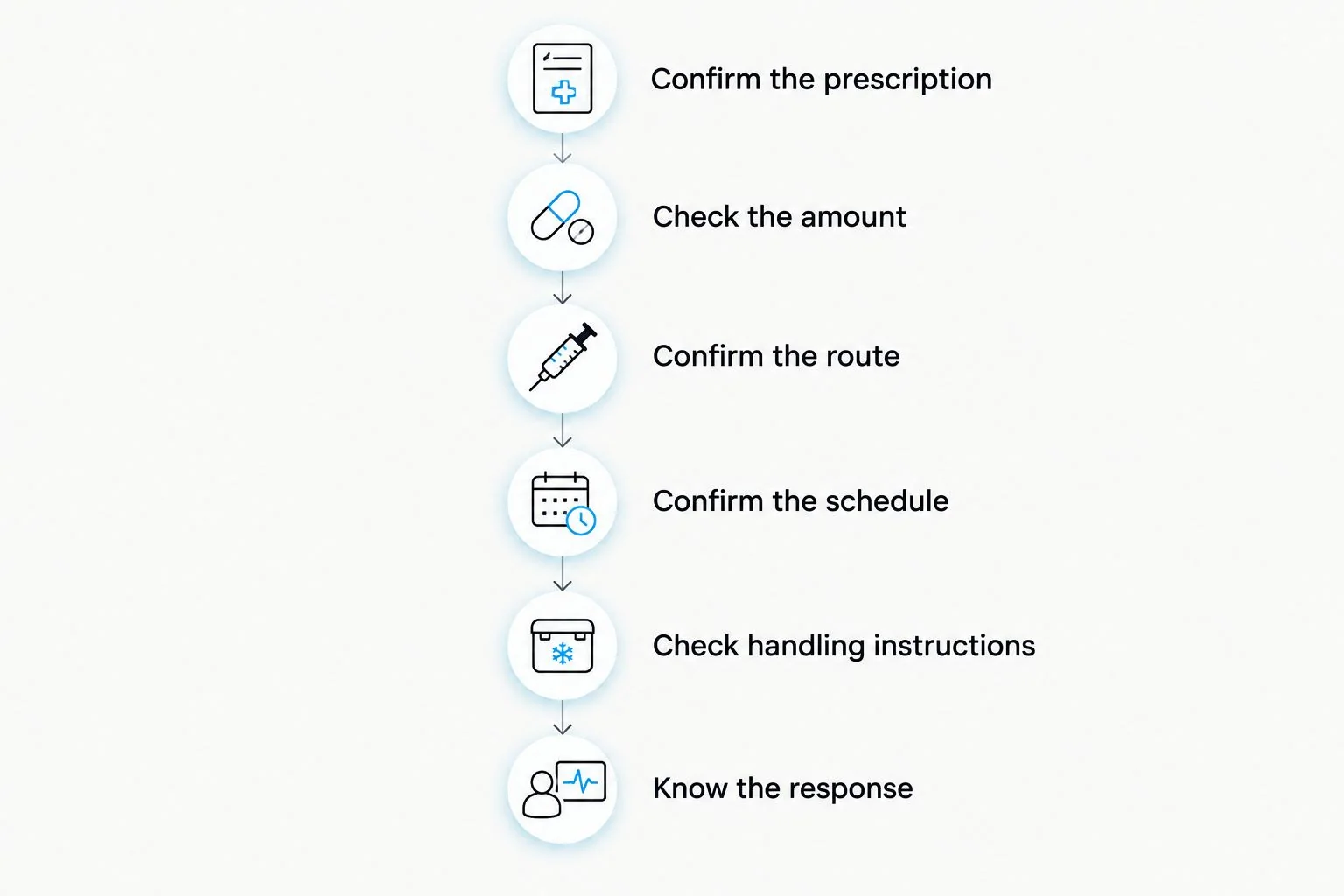
Before administering a prescribed glutathione injection in 2026, make sure the label and the clinician's directions agree. If they conflict, contact the dispensing pharmacist and prescriber rather than choosing whichever instruction seems easier.
- Confirm the prescription. Check that the medication and patient details match your prescription. Do not use a product intended for someone else.
- Check the amount. Identify the prescribed amount and the corresponding liquid volume. Do not convert between milligrams, milliliters, or syringe markings from memory.
- Confirm the route. Use only the administration route explicitly prescribed. Do not assume that an injectable preparation is suitable for every injection route.
- Confirm the schedule. Establish how often to inject, how long to continue, and what to do after a missed dose.
- Check handling instructions. Follow the dispensing pharmacy's storage, preparation, expiration, or beyond-use instructions. Ask about anything unclear.
- Know the response plan. Identify whom to contact about side effects and which symptoms require emergency care.
A vial's size does not tell you the intended frequency. Neither does the amount left in the vial. Never increase your schedule to finish a vial before its labeled discard date.
Keep the written directions available when you speak with the pharmacy. Reading the label together is safer than describing a syringe as small or saying you usually inject a certain number of markings.
Does a prescription or compounded label prove daily use is safe?
No. A prescription documents a clinician's treatment order; it does not establish that every proposed frequency has been proven safe and effective. You still need a clear explanation of the intended benefit, uncertainty, and monitoring plan.
The FDA does not approve compounded drugs or review them for safety, effectiveness, and quality before marketing. That distinction matters when evaluating an injectable preparation: a licensed prescriber and a dispensing pharmacy do not turn a compounded drug into an FDA-approved product.
For your 2026 treatment decision, ask the dispensing pharmacist to identify exactly what you are receiving. Confirm whether it is compounded and ask how to follow the product-specific handling instructions.
VevaRX offers prescription-based glutathione care, but that service description is not evidence supporting a particular daily regimen. You should apply the same questions about formulation, evidence, and frequency to any provider.
For the broader regulatory context, read whether peptide therapy is legal in the US. Legal prescribing, product approval, and evidence of benefit are separate questions; an answer to one does not settle the others.
What are the risks of injecting more often?
Repeated injections create repeated opportunities for administration errors, local irritation, and contamination if handling is incorrect. Reducing injection frequency does not eliminate those risks, and increasing frequency does not demonstrate greater benefit.
Do not inject through skin that appears infected or use equipment that is damaged or contaminated. Follow the technique your healthcare professional taught you, use a new sterile needle and syringe for each injection, and never share injection equipment.
Stop and seek medical advice about spreading redness, warmth, swelling, drainage, or worsening pain at an injection site. Fever or feeling significantly unwell after an injection also warrants prompt medical assessment.
Call 911 for trouble breathing, swelling of the lips or tongue, collapse, or other signs of a severe allergic reaction. Do not administer another dose while waiting to see whether a serious reaction happens again.
Keep the medication label available for the treating clinician. Include the injection time and a description of your symptoms when explaining what happened.
Will daily glutathione injections work faster?
Daily glutathione injections have not been established as a faster general-wellness strategy. A tighter schedule is not proof of better absorption, a stronger clinical effect, or a shorter time to a meaningful result.
If your goal is skin lightening, do not treat online before-and-after photos as evidence of a safe injection regimen. The FDA warns against injectable skin-lightening products; a cosmetic goal does not remove injection-related risks.
Ask your clinician what outcome is realistic and how you will assess it. If there is no clear benefit to measure, daily use adds treatment activity without resolving whether the treatment helps.
What if I already injected glutathione every day?
Taking daily injections does not by itself prove that you have been harmed. It also does not establish that the schedule was appropriate. Check your prescription and contact your prescriber if daily use was not explicitly directed or if you are uncertain about the amount administered.
Before that conversation, write down the product name, concentration, amount injected, route, and dates of use. Include any symptoms and other medications or supplements you take. Accurate information is more useful than guessing whether you took too much.
Do not double a dose, add an extra injection, or switch routes to correct a scheduling mistake. Ask your pharmacist or prescriber for instructions specific to the preparation you received.
Can I combine glutathione injections with other treatments?
A clinician should review your full treatment list before you combine glutathione injections with other medications or wellness injections. Do not assume that products are compatible because they come from the same provider or are marketed toward the same goal.
If you use GLP-1 medication, tell your prescriber about it along with supplements and other injections. A weight-loss prescription does not establish a reason to add glutathione or use it daily.
Do not mix injectable products in the same syringe unless your prescribing clinician and dispensing pharmacist explicitly direct that exact preparation. Separate prescriptions do not authorize mixing.
FAQ
Can you take glutathione injections every day safely?
Do not start daily glutathione injections without explicit instructions from your prescriber. Daily use is not an established general-wellness regimen, and a prescription does not eliminate injection-related risks.
Is daily glutathione better than weekly injections?
Daily glutathione injections have not been established as better than weekly injections for general wellness. Neither schedule should be selected without a clinician's explanation of the intended benefit and appropriate regimen.
How many glutathione injections per week should I take?
Use only the frequency written in your prescription and clarified by your prescriber. Daily dosing means seven injections per week, but that arithmetic is not a treatment recommendation.
Can I increase my glutathione dose if I do not notice results?
Do not increase the dose or injection frequency yourself. Ask your clinician whether the treatment has a measurable goal and whether continuing it is justified.
Can I inject glutathione at home?
Only administer glutathione at home when your clinician has prescribed that setting and provided appropriate instructions. You need clear directions for the route, amount, technique, storage, and response to side effects.
Should I take an extra glutathione injection after missing one?
Do not take an extra injection unless your prescriber specifically directs it. Ask your pharmacist or clinician for missed-dose instructions for your prescription.
When should I get emergency help after a glutathione injection?
Call 911 for trouble breathing, swelling of the lips or tongue, collapse, or other signs of a severe allergic reaction. Do not take another injection while seeking care.
One last thing
The most useful question is not whether you can inject every day; it is what would justify continuing. Before starting or renewing a glutathione plan in 2026, ask your prescriber to define the intended benefit, reassessment point, and reasons to stop.
A clear answer gives you something more useful than a crowded injection calendar: a treatment decision you can evaluate. If the directions remain unclear, resolve them before the next injection.
Related guides
This article is for informational purposes only and is not medical advice. Compounded medications are not approved by the FDA and have not been reviewed for safety, effectiveness, or quality. Prescription products require an online consultation with a licensed healthcare provider who will determine if a prescription is appropriate. Individual results vary.