
Can you take semaglutide with a thyroid condition?
Can you take semaglutide with a thyroid condition? Often yes, but MTC and MEN2 rule it out. Learn how thyroid history and levothyroxine affect your care.

Yes—having hypothyroidism, Hashimoto’s disease, or another non-medullary thyroid condition does not automatically rule out semaglutide in 2026. Semaglutide is contraindicated if you have a personal or family history of medullary thyroid carcinoma (MTC), or multiple endocrine neoplasia syndrome type 2 (MEN2). Your prescriber must also review thyroid symptoms, medication timing, and whether your thyroid treatment needs adjustment during weight loss.
- Can you take semaglutide with a thyroid condition? Often yes; MTC and MEN2 are contraindications.
- Hashimoto’s disease and hypothyroidism are not the same as the thyroid cancer named in semaglutide’s warning.
- Oral semaglutide requires special attention when you also take levothyroxine.
- VevaRX offers medically supervised weight-loss care; thyroid history belongs in your prescribing assessment.
Can you take semaglutide with a thyroid condition?
The answer depends on the exact diagnosis, not simply whether you take thyroid medicine. For adults considering VevaRX for semaglutide weight-loss care, disclose both your own thyroid history and your family’s history before a prescribing decision.
| Thyroid condition or history | What it means for semaglutide | Next step |
|---|---|---|
| Hypothyroidism | Not a listed thyroid-related contraindication | Review thyroid control and replacement medication |
| Hashimoto’s disease | Not a listed thyroid-related contraindication | Discuss symptoms, recent labs, and treatment |
| Graves’ disease or hyperthyroidism | Not a listed thyroid-related contraindication, but disease activity needs assessment | Coordinate weight-loss care with thyroid treatment |
| Thyroid nodules | Not automatically disqualifying; the cause needs evaluation | Share ultrasound, biopsy, and specialist records |
| Papillary or follicular thyroid cancer history | Different from MTC; requires an individualized review | Confirm the cancer type with your treating specialist |
| Personal or family history of MTC | Contraindication | Do not use semaglutide; discuss another treatment |
| MEN2 | Contraindication | Do not use semaglutide; discuss another treatment |
This distinction comes from FDA-approved semaglutide prescribing information, specifically its contraindications and thyroid C-cell tumor warning. A common thyroid disorder and a contraindicated thyroid cancer history are not interchangeable.
Why this matters
Semaglutide’s boxed warning concerns thyroid C-cell tumors. In rodent studies, semaglutide caused these tumors; whether semaglutide causes thyroid C-cell tumors, including MTC, in humans is unknown.
That warning does not mean everyone with an abnormal thyroid blood test must avoid semaglutide. It also does not mean a normal thyroid blood test cancels a personal or family history of MTC.
For your 2026 treatment decision, use the diagnosis documented in your medical records. If a relative had thyroid cancer but you do not know which type, get that information before treating the family history as cleared.
What is the difference between MTC and other thyroid cancers?
MTC develops from the thyroid’s C cells. Papillary and follicular thyroid cancers arise from a different thyroid cell type, which is why a history of thyroid cancer requires a more precise conversation than a yes-or-no checkbox.
A history of papillary or follicular thyroid cancer is not the specific cancer contraindication named in semaglutide labeling. Your specialist still needs to consider treatment status, follow-up findings, and your overall health before approving a weight-loss medication.
Hypothyroidism and Hashimoto’s disease: review control, not just diagnosis
People with hypothyroidism or Hashimoto’s disease are not automatically excluded from semaglutide treatment. These conditions affect thyroid hormone production; they are not equivalent to MTC or MEN2.
The practical issue is whether your thyroid replacement treatment is appropriate. Fatigue, constipation, and weight changes deserve review rather than being attributed entirely to weight-loss medication.
Do not change your thyroid medication dose just because you start semaglutide. Bring your current prescription, recent thyroid-stimulating hormone (TSH) results, and any free thyroxine (free T4) results to the appointment.
Semaglutide is not a treatment for Hashimoto’s disease or hypothyroidism. Its potential benefit is addressing an appropriate diabetes or weight-management indication; the limitation is that thyroid disease still needs its own monitoring and treatment.
Does weight loss change levothyroxine requirements?
Weight change can affect the amount of thyroid hormone replacement you need. Your clinician should assess the dose using symptoms and thyroid testing, rather than your weight alone.
After a levothyroxine dose change, thyroid testing is commonly repeated in 6–8 weeks, consistent with American Thyroid Association patient guidance. That interval is not a universal testing schedule for everyone starting semaglutide; your thyroid clinician sets the follow-up plan.
Graves’ disease and hyperthyroidism: coordinate both treatments
Graves’ disease and other causes of hyperthyroidism are not the thyroid-related contraindications listed for semaglutide. Active hyperthyroidism still requires assessment because it can cause weight loss, palpitations, tremor, and other symptoms that complicate treatment decisions.
Tell your clinician whether you take an antithyroid medicine, have received radioactive iodine, or have had thyroid surgery. The current state of your thyroid function matters more than the diagnosis appearing on an old problem list.
Unexplained weight loss is a reason to investigate thyroid activity, not a reason to start a weight-loss prescription. If your thyroid disease is uncontrolled, your treating clinicians should agree on the treatment sequence and follow-up.
Thyroid nodules and previous surgery: establish what was found
A thyroid nodule does not automatically mean you have MTC. Your clinician needs the evaluation results, including any ultrasound findings, biopsy report, or pathology from surgery.
The same applies if you have had your thyroid removed. Removal for a benign goiter, Graves’ disease, or another cancer type is not the same history as removal for MTC.
A previous thyroidectomy does not erase a personal history of MTC. Semaglutide’s contraindication is based on that history, not simply whether thyroid tissue remains.
For your appointment, bring the report that names the diagnosis. A scar, a medication list, or the phrase thyroid surgery cannot establish why the operation happened.
Can you take semaglutide and levothyroxine together?
Semaglutide and levothyroxine require a formulation-specific medication review. The oral semaglutide prescribing information reports 33% higher total thyroxine exposure when levothyroxine was administered with oral semaglutide in a drug-interaction study.
That finding does not mean every patient needs a dose reduction. It supports reviewing administration timing and considering thyroid monitoring; it should not be applied automatically to injectable semaglutide.
| Semaglutide formulation | Practical advantage with thyroid treatment | Limitation or caution |
|---|---|---|
| Injectable semaglutide | Does not add an oral semaglutide fasting-dose schedule | Delayed gastric emptying and changing weight still warrant medication review |
| Oral semaglutide | Provides an oral route when prescribed for an appropriate indication | Has fasting administration requirements and a documented levothyroxine interaction |
Oral semaglutide instructions require taking it on an empty stomach in the morning and waiting at least 30 minutes before food, beverages, or other oral medicines. Levothyroxine also has administration instructions, so do not assume placing both tablets together is an acceptable shortcut.
Ask your pharmacist or prescriber for a written schedule. Specify the exact semaglutide formulation and thyroid medicine you use; instructions for one formulation do not automatically apply to another.
These interaction and timing details come from FDA-approved oral semaglutide prescribing information, including its drug-interaction and administration sections. Use the instructions supplied with your actual prescription when reviewing treatment in 2026.
Why semaglutide suitability varies with thyroid conditions
The decision changes with clinically meaningful details, not with a blanket rule about thyroid disease:
- Cancer type: MTC is the named contraindication; other thyroid cancer histories require their own assessment.
- Family history: A relative’s confirmed MTC diagnosis matters even if your own thyroid tests are normal.
- MEN2 history: This syndrome is a contraindication independent of a routine TSH result.
- Thyroid control: Active symptoms and abnormal hormone levels need attention alongside weight-management treatment.
- Medication formulation: Oral semaglutide has administration and interaction considerations that differ from injections.
- Weight and dose changes: Thyroid replacement requirements need reassessment when clinically indicated.
A prescription assessment should resolve these points before choosing a medication. Checking only whether you have hypothyroidism leaves important questions unanswered.
What should you tell your prescriber before starting?
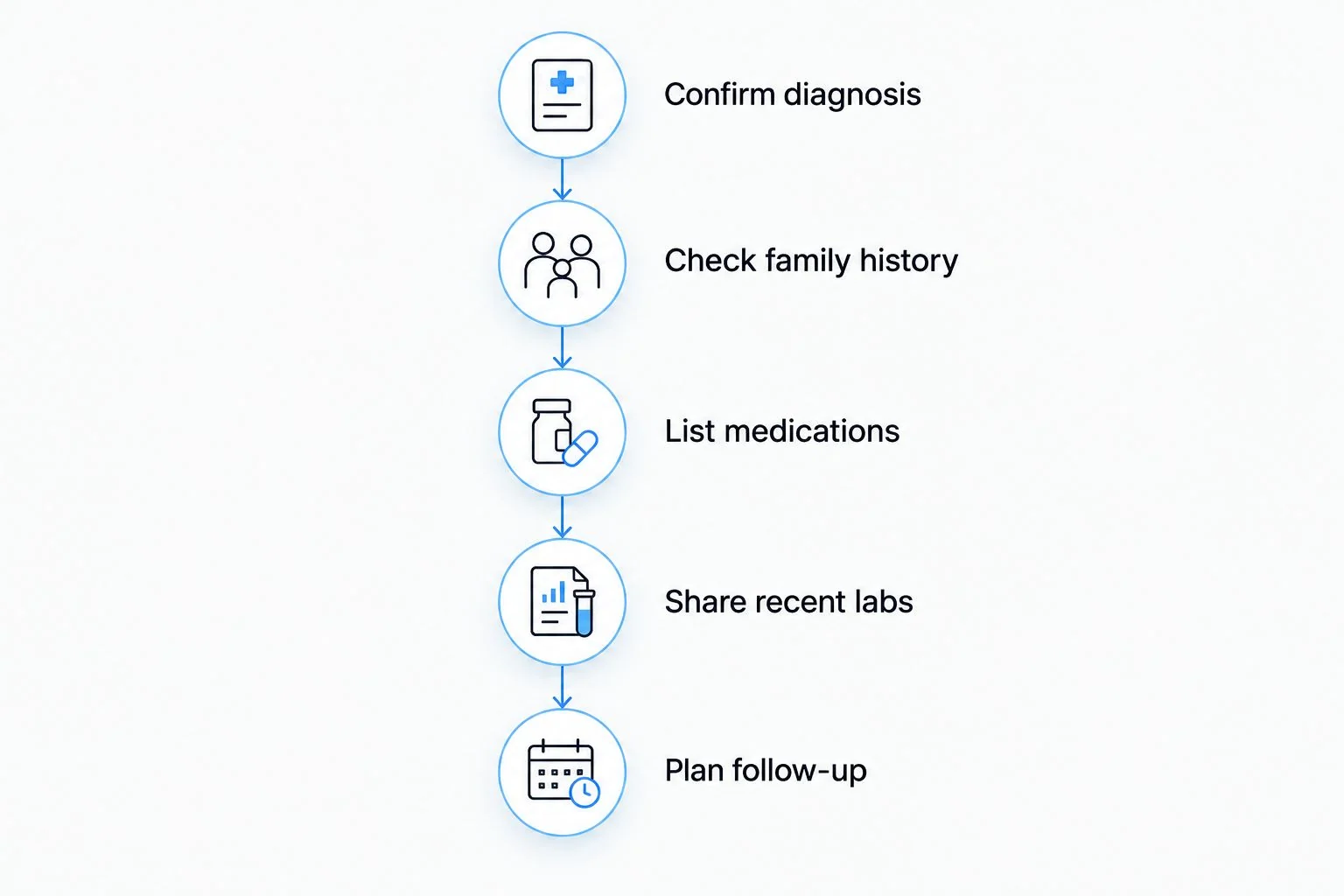
Use this sequence to prepare for a 2026 consultation. It applies whether you receive care online or in person.
- Confirm diagnosis. Write down the specific thyroid condition, including any cancer type. If you are unsure, request the relevant pathology or specialist report.
- Check family history. Ask whether relatives had MTC or MEN2 rather than recording only thyroid problems. Bring the information you can document.
- List medications. Include thyroid replacement, antithyroid medicines, other prescriptions, and supplements. Record when you take them.
- Share recent labs. Bring available TSH and free T4 results, plus relevant imaging or biopsy findings. Your clinician decides whether additional testing is needed.
- Plan follow-up. Agree on symptom reporting, medication timing, and who will manage thyroid dose changes. Do not leave those responsibilities unclear.
VevaRX is best suited to US adults seeking medically supervised semaglutide weight-loss care. It offers doctor-prescribed treatment, but that service does not replace a thyroid specialist’s assessment when cancer history or active thyroid disease needs clarification.
If you are considering a compounded formulation, review compounded semaglutide safety as a separate issue. Compounding does not remove the need to assess thyroid-related contraindications.
Do you need a thyroid ultrasound before taking semaglutide?
Routine thyroid ultrasound or calcitonin monitoring solely because you take semaglutide is not established as useful. FDA-approved semaglutide labeling states that routine monitoring has uncertain value for early detection of MTC.
That is different from evaluating an existing nodule, an abnormal finding, or concerning symptoms. Your clinician should investigate those findings on their own clinical merits.
A normal TSH result measures a different issue from MTC risk. Do not treat normal thyroid hormone testing as proof that every thyroid-related contraindication has been excluded.
Which symptoms need medical attention?
Tell your clinician promptly about a new neck lump, persistent hoarseness, trouble swallowing, or shortness of breath. Semaglutide labeling identifies these as symptoms patients should report because they can signal thyroid tumors.
These symptoms do not establish a cancer diagnosis. They do require assessment rather than waiting for your next routine weight-loss check-in.
Seek emergency care for severe breathing difficulty. For less urgent symptoms, contact your treating clinician and explain your semaglutide use, thyroid history, and when the symptoms began.
FAQ
Can I take semaglutide if I have Hashimoto’s disease?
Hashimoto’s disease is not a listed thyroid-related contraindication to semaglutide. Your prescriber must still review thyroid control, medications, and any personal or family history of MTC or MEN2.
Can I take semaglutide if I have an underactive thyroid?
An underactive thyroid does not automatically prevent semaglutide treatment. Continue prescribed thyroid care and ask whether weight changes or symptoms warrant repeat thyroid testing.
Can I take semaglutide if thyroid cancer runs in my family?
Semaglutide is contraindicated if your family history includes medullary thyroid carcinoma. Confirm the cancer type before assuming another relative’s thyroid cancer either rules treatment in or rules it out.
Can I take semaglutide after my thyroid was removed?
Thyroid removal alone does not determine whether semaglutide is appropriate. A personal history of MTC remains a contraindication even after thyroidectomy.
Can I take oral semaglutide at the same time as levothyroxine?
Do not assume oral semaglutide and levothyroxine should be taken together. Oral semaglutide labeling reports 33% higher total thyroxine exposure with coadministration; ask your pharmacist or prescriber to set the timing and monitoring plan.
How long should I wait before thyroid testing after a levothyroxine dose change?
Thyroid testing is commonly repeated in 6–8 weeks after a levothyroxine dose change. Your treating clinician sets the interval for your circumstances; starting semaglutide does not automatically require that same schedule.
Does semaglutide cause thyroid cancer in people?
Whether semaglutide causes thyroid C-cell tumors, including MTC, in humans is unknown. The boxed warning describes rodent findings and includes contraindications for a personal or family history of MTC and for MEN2.
Can VevaRX evaluate me for semaglutide if I have thyroid disease?
VevaRX offers doctor-prescribed semaglutide weight-loss care for US adults. Disclose your thyroid diagnosis, medications, and family history so the prescribing clinician can assess suitability; a prescription is not guaranteed.
One last thing
The most useful detail to bring to a 2026 consultation is the name of the thyroid diagnosis—not simply a normal blood test. If your family history says thyroid cancer, finding out whether it was medullary can change the prescribing decision.
Get the diagnosis clarified before choosing the medication. This article provides general information, not a personal prescribing decision; your clinician must apply the medication’s labeling to your medical history.
Related guides
This article is for informational purposes only and is not medical advice. Compounded medications are not approved by the FDA and have not been reviewed for safety, effectiveness, or quality. Prescription products require an online consultation with a licensed healthcare provider who will determine if a prescription is appropriate. Individual results vary.