
Does insurance cover compounded semaglutide?
Does insurance cover compounded semaglutide? Not automatically. Learn how to check compound benefits, separate visit coverage, and review a denied claim.

Insurance does not automatically cover compounded semaglutide in 2026; payment depends on whether your specific plan covers the prescribed compound and how the pharmacy submits the claim. Coverage for an FDA-approved semaglutide product does not establish coverage for a compounded preparation. Your clinician’s visit, laboratory testing, and medication can also receive separate coverage decisions, so verify each before you commit to treatment.
- Does insurance cover compounded semaglutide? Verify the specific compound benefit; coverage for branded semaglutide is not enough.
- FDA-approved semaglutide and compounded semaglutide follow different approval and reimbursement pathways.
- Separate medication coverage from telehealth visits, laboratory testing, and program fees.
- VevaRX offers doctor-prescribed telehealth weight-loss care; that does not establish insurance coverage.
Does insurance cover compounded semaglutide?
Your plan must confirm coverage for the actual compounded prescription—not just semaglutide as an ingredient. A formulary listing for Wegovy or Ozempic is not approval for a pharmacy-compounded preparation. Compounded drugs are not FDA-approved, and insurers apply their own compound-benefit rules.
Start with your plan’s pharmacy benefits administrator and the dispensing pharmacy. Ask whether the prescribed preparation is eligible, whether the pharmacy can bill your plan, and whether approval must happen before dispensing. A prescription alone does not answer those questions.
VevaRX offers online, doctor-prescribed GLP-1 weight-loss care for US adults. Treat the clinical decision and the insurance decision as separate steps: medical suitability does not establish reimbursement.
| Treatment or service | Best for | What you must verify | Main limitation |
|---|---|---|---|
| Compounded semaglutide | Patients whose clinician identifies a specific need for a legally compounded preparation | Compound benefit, ingredient eligibility, pharmacy participation, and claim requirements | Not FDA-approved; coverage cannot be inferred from a branded drug listing |
| FDA-approved semaglutide | Patients whose diagnosis and treatment needs fit a labeled product | Exact product, covered indication, formulary status, and prior authorization | Approval for one product or diagnosis does not transfer to another |
| Telehealth evaluation | Patients seeking a remote clinical assessment | Provider participation and coverage for the specific visit | A covered appointment does not establish medication coverage |
| Laboratory testing | Patients whose clinician orders medically appropriate tests | Test coverage, laboratory participation, and authorization requirements | Medication approval does not establish coverage for every test |
Why this matters
A benefit check that stops at the word semaglutide leaves the most important details unresolved. The exact product, diagnosis, pharmacy, and claim type determine which rules apply. You need those details before an insurer can give a useful answer.
For your 2026 plan, read the current benefit documents rather than relying on an older approval or someone else’s experience. Even people insured by the same company can have different employer benefits, exclusions, and pharmacy networks. The insurer’s name is not the coverage policy.
There is also a safety distinction. The FDA does not review compounded drugs for safety, effectiveness, or quality before they are marketed. Insurance reimbursement, when available, does not change that regulatory status.
How to check coverage before filling a prescription
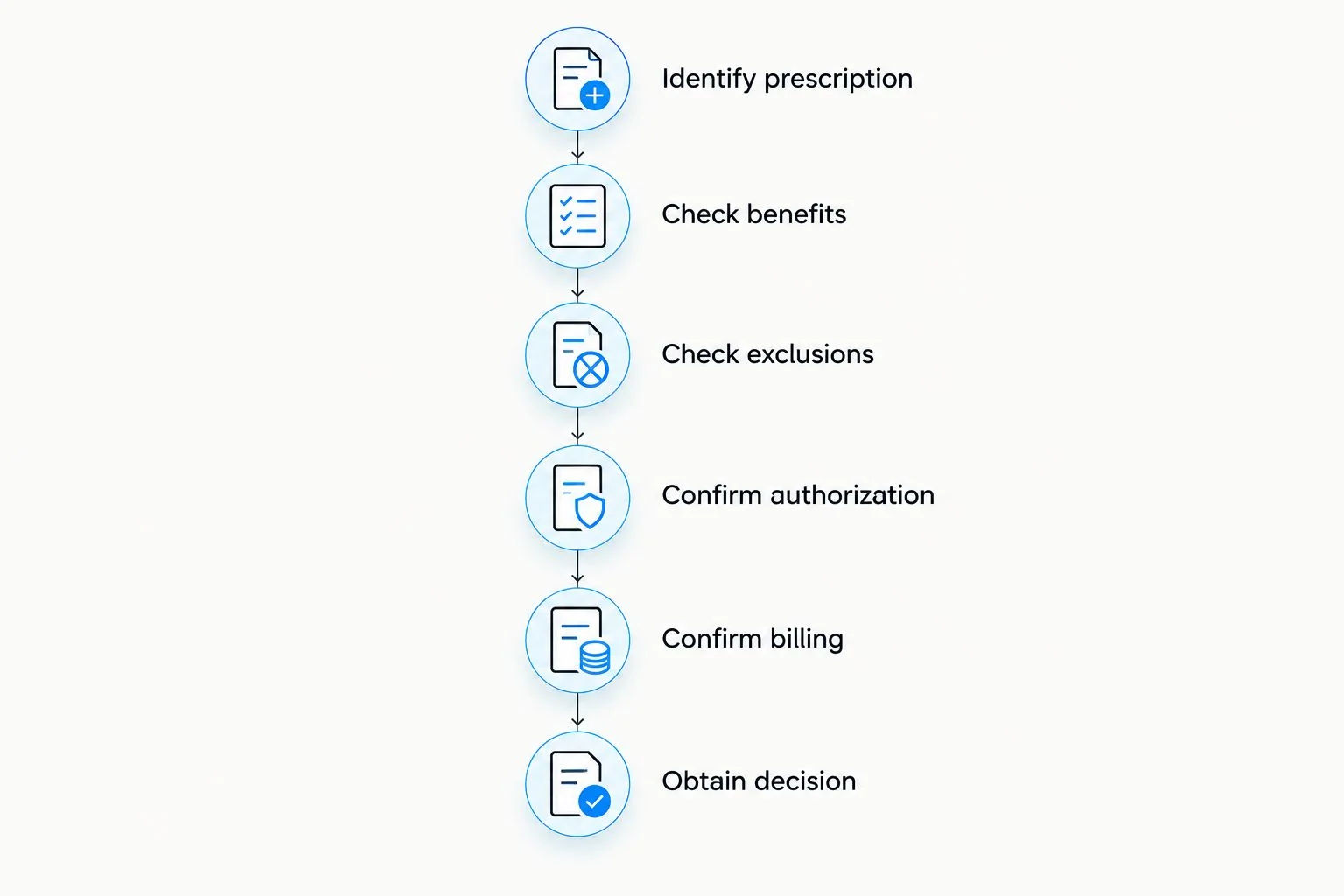
Follow this sequence before you authorize dispensing. Keep the answers together so your clinician, pharmacy, and insurer are discussing the same preparation.
- Identify the prescription. Obtain the medication name, formulation, prescribed strength, ingredients, dispensing pharmacy, and intended diagnosis. Ask the pharmacy which information it needs to submit a compound claim.
- Check the compound benefit. Ask your pharmacy benefits administrator whether your plan covers compounded prescriptions and whether this preparation meets its rules. Request the applicable written policy, not just a verbal answer about semaglutide.
- Check exclusions. Ask whether the plan excludes weight-management medication, particular ingredients, or compounded products. Identify whether the restriction applies to the medication, the diagnosis, or the entire benefit category.
- Confirm authorization requirements. Find out whether your clinician must submit prior authorization or a medical-necessity request. Ask which clinical records and pharmacy details the reviewer requires.
- Confirm the billing route. Ask whether the dispensing pharmacy submits claims directly or whether you must request reimbursement. If reimbursement is permitted, get the required documents before filling the prescription.
- Obtain the decision. Keep the approval or denial notice, its effective dates, and any conditions. Confirm that the decision names the actual prescription and pharmacy rather than a different semaglutide product.
A benefits representative’s general statement is less useful than a determination tied to your prescription. Record the call reference and ask where you can find the written rules. Do not treat a pharmacy’s willingness to submit a claim as a promise that the claim will be paid.
Why compounded semaglutide coverage varies
The answer depends on the contract and the prescription, not on a general promise that a plan covers GLP-1 medications. These are the key distinctions to resolve:
- Compound-benefit terms: Plans set eligibility rules for compounded preparations and their ingredients. A plan that covers some compounds does not necessarily cover this one.
- Diagnosis and benefit exclusions: A plan can treat diabetes treatment and weight management differently. Ask which indication the policy covers.
- Exact preparation: The ingredient name alone is insufficient. The pharmacy needs to identify the actual formulation for the claim.
- Pharmacy participation: Confirm whether the dispensing pharmacy participates in your plan and can use its required billing process.
- Authorization and documentation: A covered benefit can still require advance approval, clinical records, or a specific claim submission.
- Separate service benefits: Visits and tests follow their own rules. Coverage for one part of care does not establish coverage for the others.
For 2026, ask which version of the policy governs your request. Save that document with the coverage decision. It gives you a concrete basis for correcting errors or challenging a denial.
Does coverage for Wegovy or Ozempic include compounded semaglutide?
No. Coverage for Wegovy or Ozempic does not establish coverage for compounded semaglutide. They are distinct products for regulatory and insurance purposes. Ask for a separate determination for the prescribed compound.
Wegovy and Ozempic also have different FDA-approved indications. Their shared active ingredient does not make their coverage requirements interchangeable. Your clinician should select treatment based on your medical needs; your insurer then evaluates that prescription under the relevant benefit.
For context, FDA-approved Wegovy prescribing information includes adult weight-management eligibility at a BMI of 30 kg/m² or greater, or 27 kg/m² or greater with at least 1 weight-related condition. Examples include hypertension and type 2 diabetes. These are clinical eligibility criteria, not a guarantee of insurance payment or eligibility for a compounded preparation.
An insurer can require additional documentation under its policy. Conversely, satisfying a clinical threshold does not remove a contractual exclusion. Ask your clinician to document the actual diagnosis and relevant history rather than assuming a BMI measurement settles the claim.
Does insurance cover the appointment if it excludes the medication?
A visit can receive a different coverage decision from the prescription. Ask about the specific clinician, service, and billing arrangement. Confirm whether an appointment is billed to insurance or included in a separate program arrangement.
Apply the same check to laboratory work. The laboratory’s participation, the ordered tests, and the plan’s medical-necessity rules all matter. A covered evaluation does not establish coverage for every service ordered afterward.
When reviewing a telehealth weight-loss program, separate clinical access from payment support. Ask who submits claims, who handles authorization requests, and what documentation you receive. Do not assume a program provides those services unless it explicitly confirms them.
VevaRX is best suited to US adults seeking doctor-prescribed telehealth weight-loss care, not a guarantee of insurance reimbursement. Its stated offering matches that care preference; payment eligibility still requires a plan-specific determination.
Can I appeal a denial for compounded semaglutide?
You can request review through the appeal process described in your denial notice. Start by identifying the exact reason: an excluded benefit, an ineligible ingredient, missing documentation, or a billing problem requires a different response.
Ask the dispensing pharmacy to check claim-submission errors. Ask your clinician to address clinical documentation when the denial concerns medical necessity. An appeal cannot be treated as a promise that the plan will add an excluded benefit.
Build the request around the written policy and denial reason. Include the prescription details, relevant clinical records, and any information the notice specifically requests. Follow the deadline and submission route stated in your documents; do not rely on a generic deadline found elsewhere.
If an FDA-approved alternative is covered, discuss its clinical suitability with your prescriber. Do not switch products, concentrations, or doses yourself. Coverage convenience is not a substitute for prescribing guidance.
Does an HSA or FSA replace insurance coverage?
No. An HSA or FSA uses a separate payment framework; it does not make an excluded prescription insured. IRS Publication 502 explains qualifying medical expenses and distinguishes treatment of diagnosed disease from weight-loss expenses for general health or appearance.
Confirm the expense’s eligibility with your account administrator and retain the prescription and itemized documentation. A card transaction that succeeds is not, by itself, proof that every charge qualifies. Program fees and medication expenses also need to be evaluated on their actual purpose.
When assessing payment options in 2026, keep three decisions separate: whether treatment is medically appropriate, whether insurance covers it, and whether an expense qualifies under your account’s rules. None of those answers automatically establishes the others.
What should I ask about compounding safety and legality?
Ask why your clinician recommends a compounded preparation rather than an FDA-approved product. Then ask the dispensing pharmacy to identify the ingredients and explain the patient-specific directions. Coverage is not a safety endorsement.
The FDA states that compounded drugs are not FDA-approved and cautions about unapproved GLP-1 products, including dosing errors. It also distinguishes semaglutide salt forms, such as semaglutide sodium and semaglutide acetate, from the active ingredient used in approved products.
Compounding rules also restrict preparations that are essentially copies of commercially available drugs, subject to applicable exceptions. A pharmacy must comply with the rules governing its operation; an insurance approval does not waive them. For a 2026 prescription, ask the prescriber and pharmacy to explain the basis for the specific preparation.
Before using an injectable medication, make sure the dispensing instructions identify the prescribed dose and how to measure it. Ask the pharmacist to resolve any mismatch between the prescription, label, and syringe instructions. Do not calculate a conversion from another person’s prescription.
FAQ
Does insurance cover compounded semaglutide in 2026?
Insurance coverage for compounded semaglutide in 2026 requires a determination under your specific plan’s compound-benefit rules. Confirm the exact prescription, pharmacy, diagnosis, and authorization requirements before dispensing.
If my insurance covers semaglutide, does that include compounded semaglutide?
Coverage for an FDA-approved semaglutide product does not establish coverage for compounded semaglutide. Ask your pharmacy benefits administrator to evaluate the actual compounded preparation separately.
Does a doctor’s prescription guarantee reimbursement?
A doctor’s prescription does not guarantee reimbursement. Your plan still applies its benefit terms, exclusions, authorization requirements, and claim rules.
Can insurance cover my telehealth visit but deny the medication?
Insurance can evaluate a telehealth visit separately from the medication. Confirm the clinician’s participation and the visit’s billing arrangement independently of prescription coverage.
Does meeting the Wegovy BMI requirement guarantee coverage?
Meeting Wegovy’s clinical eligibility criteria does not guarantee coverage. FDA-approved prescribing information includes adult weight-management thresholds of 30 kg/m², or 27 kg/m² with at least 1 weight-related condition, but your plan applies separate benefit rules.
Can I use an HSA or FSA if insurance denies the prescription?
An insurance denial does not itself determine HSA or FSA eligibility. Confirm whether the specific expense qualifies under the applicable account rules and retain the required medical documentation.
Are compounded semaglutide medications FDA-approved?
Compounded semaglutide medications are not FDA-approved. The FDA does not review compounded drugs for safety, effectiveness, or quality before they are marketed.
Does VevaRX guarantee that my insurance will cover treatment?
VevaRX’s stated telehealth weight-loss offering does not establish an insurance coverage guarantee. Obtain a prescription-specific determination from your plan rather than inferring reimbursement from access to care.
One last thing
The most useful coverage question names the prescription—not just the ingredient. Ask whether your plan covers this exact compounded preparation from this dispensing pharmacy for your documented diagnosis, and what must happen before the claim is submitted.
Keep that answer with your prescription records. It separates an actionable coverage decision from a general conversation about GLP-1 benefits. This page provides general education, not an individual prescribing recommendation or a determination of your insurance benefits.
Related guides
This article is for informational purposes only and is not medical advice. Compounded medications are not approved by the FDA and have not been reviewed for safety, effectiveness, or quality. Prescription products require an online consultation with a licensed healthcare provider who will determine if a prescription is appropriate. Individual results vary.