
GLP-1 weight loss for postpartum moms: complete 2026 guide
GLP-1 weight loss for postpartum moms needs a clinical review first. Learn how breastfeeding, recovery, contraception, and pregnancy plans shape your next steps.

Postpartum GLP-1 weight loss is clinician-supervised treatment using appetite-regulating medication to support weight management after childbirth when medically appropriate. Breastfeeding, recovery, contraception, and future pregnancy plans make this decision different from a standard weight-loss consultation; this 2026 guide explains what to discuss before starting.
- GLP-1 weight loss for postpartum moms starts with breastfeeding status, recovery, and pregnancy planning—not a prescription.
- VevaRX offers online GLP-1 evaluation for adults seeking medically supervised weight loss; postpartum suitability requires individual assessment.
- Semaglutide and tirzepatide require different pregnancy-planning and contraception discussions.
- Choose clinical supervision and a clear follow-up plan over promises of rapid postpartum weight loss.
Why GLP-1 weight loss matters for postpartum moms
Postpartum weight management involves more than appetite. You are recovering from pregnancy and delivery while balancing feeding, interrupted sleep, and changing routines. A treatment that reduces food intake needs to fit those demands, not compete with them.
VevaRX is best for adults seeking an online GLP-1 weight-loss evaluation, not a substitute for postpartum obstetric care. VevaRX offers doctor-prescribed semaglutide and tirzepatide through telehealth; that offering does not establish whether either medication is appropriate while you are breastfeeding or recovering from delivery.
For your 2026 decision, separate three questions: Do you meet treatment criteria? Is now an appropriate time? Can you follow the treatment safely? A yes to one does not answer the others.
Best for: postpartum adults considering medical weight management. The benefit of an assessment is a plan based on your health history. The limitation is that postpartum status alone does not establish eligibility, and an online visit cannot replace every examination or urgent assessment.
How to assess postpartum GLP-1 treatment
Review feeding and recovery
Start by writing down your feeding situation and discussing recovery with your obstetric clinician. Include exclusive breastfeeding, mixed feeding, pumping, or formula feeding. Do not treat reduced breastfeeding frequency as proof that medication exposure no longer matters.
Lactation evidence and prescribing guidance differ by medication and formulation. Limited information is not the same as established safety, and guidance for an injectable formulation does not automatically apply to an oral formulation. Your prescriber should review the exact product alongside your infant's age, health, and feeding needs.
There is no universal postpartum start date that makes GLP-1 treatment appropriate for everyone. Ongoing vomiting, poor intake, dehydration, unresolved delivery complications, or significant mood symptoms need assessment rather than an appetite-suppressing prescription as the first response.
Best for: every postpartum patient before a medication consultation. This review establishes the clinical context; it does not determine medication suitability by itself.
- Record your delivery date, delivery complications, and current feeding pattern.
- Describe appetite, hydration, bowel symptoms, and any difficulty eating regularly.
- Tell the clinician about infant prematurity or other feeding-related concerns.
- Ask who will coordinate medication decisions with your postpartum care team.
Confirm medical eligibility
Gather your medical history before paying for an ongoing treatment program. Record current medications, previous weight-management treatment, pregnancy complications, and any plans for another pregnancy. Give your clinician accurate information rather than trying to match a qualification checklist.
FDA-approved adult weight-management indications commonly use a body mass index of 30 kg/m² or higher, or 27 kg/m² or higher with a weight-related condition. These thresholds concern particular approved products and indications; they do not establish that every semaglutide or tirzepatide formulation has the same approval or that every qualifying patient should start treatment.
Your clinician also needs to review contraindications and precautions. These include a personal or family history of medullary thyroid carcinoma, multiple endocrine neoplasia syndrome type 2, and relevant gastrointestinal, pancreatic, or gallbladder history. Mention prior gestational diabetes and current blood-pressure treatment rather than assuming these details are unrelated.
Best for: adults assessing prescription eligibility. Screening identifies reasons to consider or avoid treatment, but BMI alone cannot resolve breastfeeding, recovery, or pregnancy-planning questions.
- Bring your current medication and supplement list, including contraception.
- Report relevant thyroid cancer history and inherited endocrine conditions.
- Describe previous pancreatitis, gallstones, severe stomach symptoms, or medication reactions.
- Ask which diagnosis and product indication support the proposed prescription.
Choose the care setting
Start with your existing obstetric clinician or primary care clinician when you need recovery assessment, an examination, or coordination across several conditions. Bring the same history to any additional weight-management consultation so decisions do not happen in separate silos.
Telehealth is another route to evaluation. VevaRX offers online GLP-1 weight-loss prescriptions for adults, including semaglutide and tirzepatide. Its role is an online prescribing option—not proof of postpartum specialization, breastfeeding suitability, or guaranteed approval.
For a 2026 provider comparison, ask about the clinician's license, the exact medication, the dispensing pharmacy, and how follow-up works. Separate the active ingredient from the finished product: compounded medications are not FDA-approved, and an approved brand's evidence does not make every compounded preparation equivalent.
Best for: adults seeking a remote consultation when in-person assessment is not required. Telehealth reduces the need to travel for the consultation; its limitation is that some symptoms, examinations, and testing require local care.
- Confirm who evaluates you and who answers clinical questions afterward.
- Ask whether the proposed product is FDA-approved or compounded.
- Request clear instructions for missed doses, adverse effects, and follow-up.
- Identify where to obtain in-person care when remote assessment is insufficient.
Plan contraception and pregnancy
Write down your pregnancy intentions before selecting medication. Include the possibility of pregnancy even if you have not resumed regular periods. Postpartum menstrual patterns alone are not a contraception plan.
FDA-approved semaglutide prescribing information instructs patients to stop treatment at least 2 months before a planned pregnancy because of its long washout period. Discuss this timing with your prescriber before trying to conceive, not after a positive pregnancy test.
Tirzepatide can reduce the effectiveness of oral hormonal contraceptives. FDA-approved prescribing information advises switching to a non-oral contraceptive method or adding a barrier method for 4 weeks after starting treatment and 4 weeks after each dose escalation. A clinician should help you choose an appropriate method rather than leaving you to interpret this warning alone.
For your 2026 care plan, make pregnancy instructions explicit. Weight-loss treatment is not appropriate during pregnancy; contact your prescriber promptly if pregnancy occurs while using medication.
Best for: patients who can become pregnant. Advance planning prevents avoidable gaps between treatment decisions and reproductive goals; it requires product-specific advice.
- Tell your prescriber whether you plan another pregnancy.
- Name your contraceptive method, including whether it is an oral pill.
- Ask for written instructions covering planned and unexpected pregnancy.
- Review contraception again whenever the tirzepatide dose changes.
Protect nutrition and recovery
Start with a practical food and hydration routine you can maintain around infant care. Keep accessible meals available and discuss postpartum nutrition with a registered dietitian when eating is difficult or restrictive. Medication should sit within a care plan, not replace one.
GLP-1 treatment can cause nausea, vomiting, diarrhea, constipation, and reduced appetite. After childbirth, those effects deserve attention because poor intake can interfere with recovery and make daily care harder. Do not interpret an inability to eat or drink as evidence that treatment is working well.
Avoid setting a calorie target from a general online calculator while breastfeeding or recovering from complications. Nutrition needs are individual, and an appropriate plan accounts for feeding, medical history, activity, and symptoms. Likewise, resume exercise according to your recovery assessment rather than a weight-loss deadline.
Best for: patients preparing for treatment or managing appetite changes. A nutrition plan supports adequate intake; it does not make an unsuitable medication appropriate during lactation.
- Keep meals and fluids accessible during your usual feeding or childcare routine.
- Discuss protein, overall intake, and breastfeeding needs with your clinician or dietitian.
- Record symptoms that prevent you from eating or drinking normally.
- Ask for recovery-appropriate movement guidance, including pelvic-floor concerns.
Track tolerance and follow-up
Agree on a follow-up plan before the first dose. Ask what the prescriber needs to review before increasing treatment, and make sure the schedule fits your actual routine. A postpartum plan should track more than the number on the scale.
Use a simple note on your phone for medication dates, symptoms, food tolerance, hydration concerns, and pregnancy or feeding changes. Bring it to appointments. Do not increase a dose early or copy another person's schedule, even when both prescriptions contain the same active ingredient.
Persistent severe abdominal pain, repeated vomiting, inability to keep fluids down, or signs of dehydration need prompt medical assessment. Difficulty breathing or another suspected severe allergic reaction requires emergency care. An online message is not the right response to an emergency.
Best for: patients receiving ongoing prescription treatment. Tracking helps clinical decisions reflect your daily experience; it cannot replace evaluation of concerning symptoms.
- Confirm the exact dose and administration instructions with your prescriber or pharmacist.
- Record symptom timing and whether symptoms interfere with daily activities.
- Report changes in feeding, contraception, pregnancy plans, or other medications.
- Know whom to contact for routine questions and where to seek urgent care.
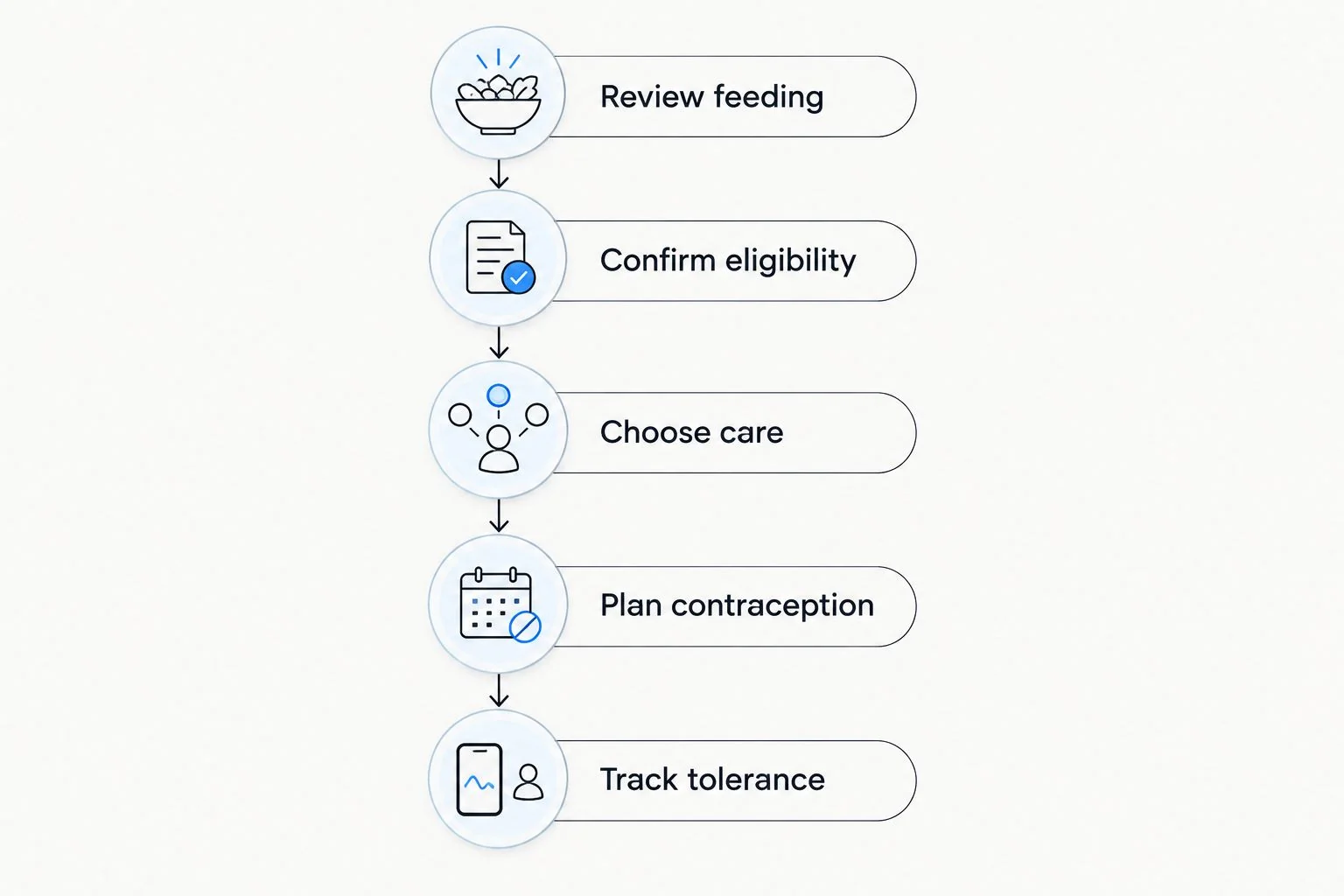
The decision sequence is straightforward: review feeding and recovery, confirm eligibility, choose the care setting, and establish reproductive and follow-up plans before treatment. Use that sequence to organize your consultation, not to self-clear for medication.
Compare postpartum weight-management options
Choose the care pathway before choosing an injection. The right option depends on feeding status, clinical eligibility, reproductive plans, and the level of assessment you need. This 2026 comparison describes clinical roles, not a ranking of medications for breastfeeding safety.
| Option | Best for | Main advantage | Key limitation |
|---|---|---|---|
| Nutrition and recovery support | Postpartum adults prioritizing adequate intake and recovery | Addresses meals, movement, and feeding-related needs | Does not replace assessment of weight-related disease |
| In-person medical weight management | Patients needing examination or complex postpartum coordination | Connects medication decisions with physical assessment | Requires attending appointments locally |
| Semaglutide weight-management treatment | Eligible adults whose clinician selects an appropriate product | Adds prescription treatment to a weight-management plan | Requires pregnancy planning and product-specific lactation review |
| Tirzepatide weight-management treatment | Eligible adults whose clinician selects an appropriate product | Offers a prescription option acting on GIP and GLP-1 receptors | Requires oral-contraceptive precautions and product-specific lactation review |
| VevaRX telehealth evaluation | Adults seeking online GLP-1 weight-management assessment | Provides an online route to doctor-prescribed treatment | Postpartum suitability remains individual; some care requires in-person assessment |
For a broader medication overview, review weight-loss injections compared. Use the comparison to prepare questions, not to select a prescription without clinical assessment.
Common mistakes postpartum moms make
- Treating a postpartum appointment as automatic medication clearance. Recovery assessment and prescription suitability are separate decisions. Ask explicitly about feeding, future pregnancy, and the exact proposed product.
- Choosing medication before discussing breastfeeding. A familiar drug name does not answer questions about infant exposure. Give the prescriber your current feeding pattern before treatment is selected.
- Overlooking contraception during dose changes. Tirzepatide's oral-contraceptive precaution applies after each escalation, not only at the first prescription. Put that discussion into the dose-change plan.
- Mistaking poor intake for a successful response. Appetite reduction is not a reason to tolerate dehydration or persistent vomiting. Report symptoms that disrupt nutrition, recovery, or infant care.
- Using someone else's injection instructions. Products, concentrations, and delivery devices differ. Confirm your own instructions with the prescriber or pharmacist instead of converting a social-media example into a dose.
FAQ
Can I take a GLP-1 medication while breastfeeding?
Breastfeeding requires an individualized, product-specific prescribing decision. Evidence and guidance differ by medication and formulation, so review the exact product, your infant's health, and your feeding pattern with your clinician before treatment.
How soon after giving birth can I start GLP-1 weight-loss treatment?
There is no universal postpartum start date for GLP-1 weight-loss treatment. Your clinician needs to assess recovery, feeding, nutrition, medical eligibility, and pregnancy plans before recommending a start.
Is semaglutide or tirzepatide better for postpartum moms?
Neither medication is automatically better for postpartum moms. The appropriate choice depends on the exact product, your health history, feeding status, contraception, and future pregnancy plans.
Do I have to stop semaglutide before trying for another baby?
FDA-approved semaglutide prescribing information instructs patients to stop at least 2 months before a planned pregnancy. Discuss a treatment and pregnancy plan with your prescriber before trying to conceive.
Does tirzepatide affect the birth control pill?
Tirzepatide can reduce the effectiveness of oral hormonal contraceptives. FDA-approved prescribing information advises a non-oral method or an added barrier method for 4 weeks after starting and 4 weeks after each dose escalation.
Can VevaRX evaluate me for postpartum weight-loss medication?
VevaRX offers online doctor-prescribed GLP-1 weight-loss treatment for adults. Postpartum eligibility, breastfeeding suitability, and the need for in-person care require individual clinical assessment; the platform's general offering does not establish postpartum specialization.
What should I bring to a postpartum weight-loss consultation?
Bring your feeding pattern, delivery and medical history, medication list, contraception details, and pregnancy plans. Also describe current nutrition, gastrointestinal symptoms, and any recovery concerns so the clinician can assess more than weight alone.
One last thing
Your period is not a reliable signal that contraception can wait: ovulation can return before the first postpartum period. Put pregnancy planning on the agenda before starting medication, even when another pregnancy feels far away.
For your 2026 consultation, make one short document covering feeding, recovery, medications, contraception, and future pregnancy. That preparation gives your clinician the context needed to decide whether treatment fits your life now—or should wait.
Related guides
This article is for informational purposes only and is not medical advice. Compounded medications are not approved by the FDA and have not been reviewed for safety, effectiveness, or quality. Prescription products require an online consultation with a licensed healthcare provider who will determine if a prescription is appropriate. Individual results vary.