
How do you stop nausea from semaglutide?
How do you stop nausea from semaglutide? Start with smaller meals and fluid sips. Learn when to call your prescriber and which symptoms need urgent medical care.

To reduce nausea from semaglutide, eat smaller, lower-fat meals, stop eating when you feel comfortably full, and sip fluids regularly rather than drinking a large amount at once. If nausea continues, contact your prescriber before your next dose increase; you might need a different dose-escalation plan or treatment for the nausea. In 2026, severe abdominal pain, repeated vomiting, or an inability to keep fluids down calls for medical assessment—not another home remedy.
- How do you stop nausea from semaglutide? Start with smaller meals, lower-fat foods, and regular fluid sips.
- Persistent nausea needs a prescriber review before dose escalation; do not adjust semaglutide yourself.
- Severe abdominal pain or inability to keep fluids down requires prompt medical assessment.
- VevaRX offers medically supervised GLP-1 weight loss for US adults; nausea management still requires individual clinical advice.
How do you stop nausea from semaglutide?
Start with meal size, food choice, and hydration—not a medication change you make yourself. Semaglutide delays stomach emptying, and nausea is a recognized adverse effect in FDA-approved semaglutide prescribing information. Symptoms often occur during treatment initiation or dose escalation, but persistent symptoms still need attention.
Avoid alcohol while you are nauseated, especially if you are vomiting or struggling to drink enough fluid. The guide to drinking alcohol while taking semaglutide covers that separate treatment question.
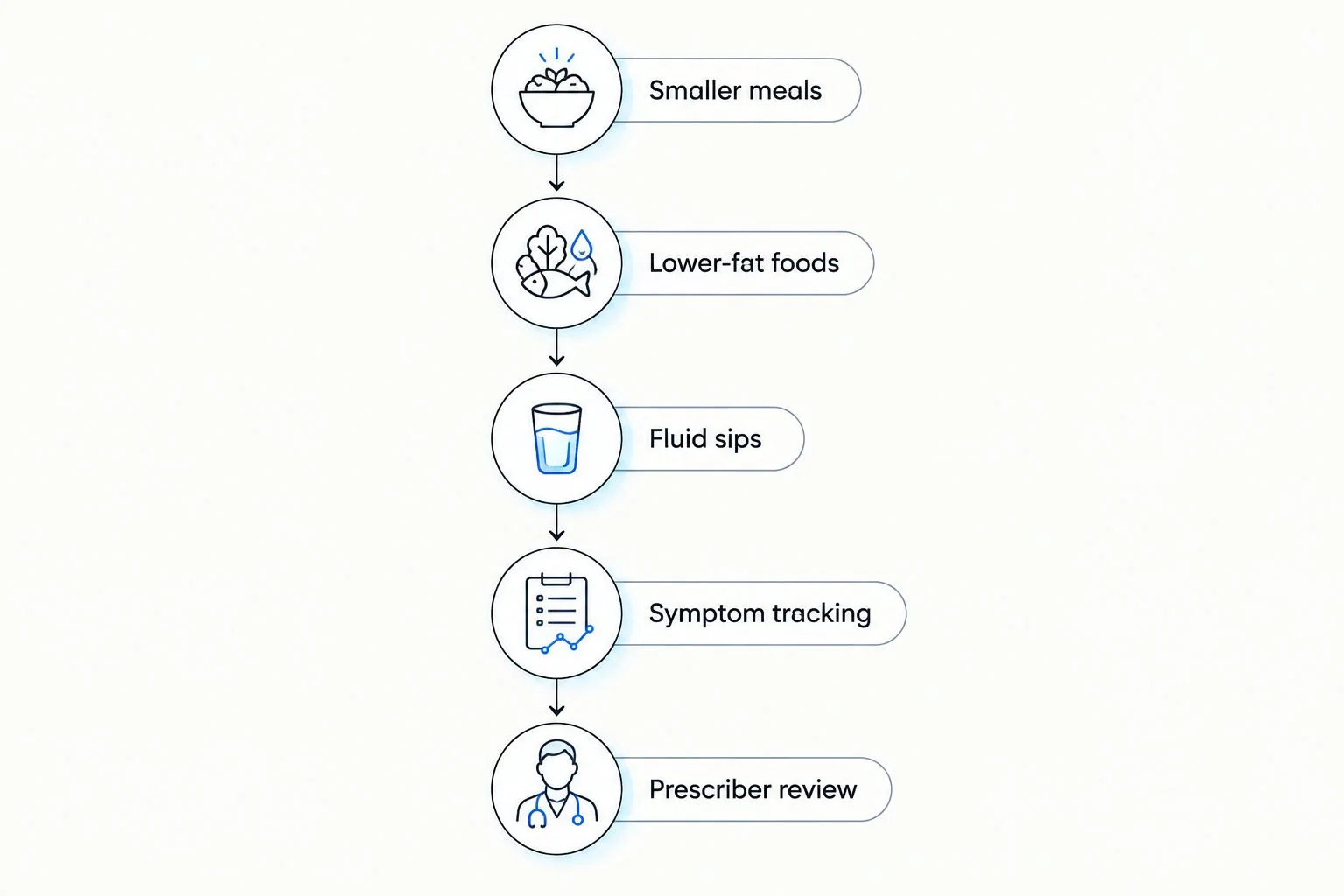
Use this sequence when symptoms are mild and you can still drink:
- Smaller meals. Reduce the amount you eat at one sitting. Eat slowly and stop at comfortable fullness rather than finishing the plate automatically.
- Lower-fat foods. Choose foods that you tolerate, such as plain toast, crackers, rice, or broth. Temporarily avoid rich, greasy meals and any food that reliably worsens your symptoms.
- Fluid sips. Drink small amounts regularly. If vomiting is causing fluid loss, ask a clinician or pharmacist whether an oral rehydration solution is appropriate.
- Symptom tracking. Record when nausea starts, your last dose, recent dose changes, vomiting, and whether you can keep fluids down.
- Prescriber review. Contact your clinician if nausea persists, disrupts eating, or returns after dose increases. Do not increase, reduce, skip, or repeat a dose without instructions.
These steps support comfort and hydration. They do not rule out pancreatitis, gallbladder problems, significant dehydration, or another cause of nausea. Escalate care when the symptom pattern changes, even if nausea happened with an earlier dose.
Why this matters
Nausea is not proof that semaglutide is working better. You do not need to tolerate vomiting, dehydration, or an inability to eat to benefit from treatment.
For your 2026 treatment plan, the goal is a tolerable prescription that supports adequate nutrition—not the fastest possible dose increase. Tell your prescriber when symptoms affect daily activities or make you avoid food and fluids. That information is more useful than describing the nausea as simply mild or bad.
FDA-approved Wegovy injection prescribing information uses dose-escalation stages lasting 4 weeks and allows clinicians to delay escalation when a dose is not tolerated. That schedule is specific to the labeled injectable product; it is not a universal dosing instruction for every semaglutide formulation.
What should you eat when semaglutide makes you nauseated?
Choose small portions of foods you can tolerate. Plain foods are a starting point, not a requirement to live on crackers throughout treatment. Once symptoms settle, return toward balanced meals that include protein and other needed nutrients.
The following options serve different purposes. None is a guaranteed nausea treatment.
| Food or drink approach | Best for | Benefit | Limitation |
|---|---|---|---|
| Plain toast or crackers | Mild nausea when rich foods are unappealing | Simple foods that some people tolerate more easily | Not a nutritionally complete long-term diet |
| Small portions of lower-fat meals | Nausea associated with large or rich meals | Reduces the amount eaten at one sitting | Does not address medication intolerance or serious illness |
| Small, regular fluid sips | Maintaining hydration when drinking feels uncomfortable | Avoids a large drink all at once | Inability to retain fluids needs medical assessment |
| Oral rehydration solution | Replacing fluid and electrolytes lost through vomiting | Provides fluid with electrolytes | Requires individualized advice if you have fluid restrictions or relevant medical conditions |
Eat slowly and stop before you feel overfull. A smaller serving lets you assess how you feel before eating more. Avoid lying down immediately after eating, especially if nausea comes with reflux or a sour taste.
Do not force a heavy meal because you have eaten little that day. Equally, do not let a temporary nausea-management diet become ongoing undernutrition. If your intake stays low, ask your clinician for a plan that addresses both symptoms and nutrition.
Why semaglutide nausea varies
Semaglutide nausea does not follow the same pattern for everyone. These factors help explain why symptoms differ and what your clinician needs to review:
- Treatment initiation: Gastrointestinal symptoms can occur when you first start semaglutide.
- Dose escalation: A higher dose can bring new or stronger symptoms, which is why tolerability matters before escalation.
- Meal size: Large meals can worsen the feeling of fullness associated with delayed stomach emptying.
- Food composition: High-fat or greasy meals can aggravate nausea; individual food triggers also differ.
- Other medicines and conditions: Your clinician should review other treatments and possible causes rather than assuming semaglutide explains everything.
- Vomiting and fluid loss: Dehydration changes the urgency of the problem and can affect kidney function.
A symptom record helps separate these patterns. Note whether nausea follows a dose increase, a particular meal, or vomiting that prevents hydration. Bring the record to your prescriber rather than using it to calculate a new dose yourself.
How long does semaglutide nausea last?
There is no single duration that applies to every patient. Nausea can lessen as treatment continues, but ongoing or worsening symptoms require review rather than a promise that they will disappear by a particular day.
Semaglutide has an elimination half-life of approximately 1 week, according to FDA-approved injectable semaglutide prescribing information. Wegovy injection labeling states that semaglutide can remain in circulation for about 5–7 weeks after the last dose. Those figures describe drug clearance, not how long your nausea will last.
Do not use the half-life to decide when to skip, restart, or change treatment. Your formulation, dosing history, symptoms, and other medicines all matter. Ask your prescriber what to do before the next scheduled dose if nausea remains troublesome.
Should you delay your next semaglutide dose increase?
Ask your prescriber to review the escalation plan if you are still nauseated at your current dose. An upcoming calendar date is not a reason to increase a dose you are not tolerating.
For FDA-approved Wegovy injection, the prescribing information describes 4 weeks at each escalation stage and permits delaying escalation when tolerability is a problem. Your clinician must determine whether that approach applies to your prescription. Do not transfer instructions between injectable, oral, or compounded formulations.
If you use a compounded prescription, confirm the medication concentration and prescribed amount with your pharmacist or prescriber. Milligrams describe the drug amount; syringe markings alone do not establish it. Never copy another person's injection instructions or assume a new vial has the same concentration as the previous one.
Can you take medicine for semaglutide nausea?
A clinician can decide whether an anti-nausea medicine is appropriate after reviewing your symptoms, other prescriptions, and medical history. Do not add someone else's medication or an over-the-counter product without checking with a clinician or pharmacist.
Anti-nausea medicines have their own risks and interactions. Some can worsen constipation, cause sedation, or affect heart rhythm, depending on the medicine and your health history. Treating nausea also must not delay evaluation of severe abdominal pain or dehydration.
Tell your prescriber whether you are nauseated without vomiting, vomiting after meals, or unable to retain fluids. Those are different clinical situations. A useful plan addresses the cause, your hydration, and your semaglutide dosing—not just the sensation of nausea.
When is semaglutide nausea a medical warning sign?
Get urgent medical assessment for severe or persistent abdominal pain, especially pain that extends to your back, with or without vomiting. FDA-approved semaglutide labeling identifies this pattern as a warning for pancreatitis. Stop using semaglutide if pancreatitis is suspected and seek immediate instructions from a clinician.
Other symptoms also need prompt attention:
- Repeated vomiting or an inability to keep fluids down.
- Very little urine, marked dizziness, fainting, or confusion.
- Upper abdominal pain with fever, yellowing skin or eyes, or pale stools.
- Severe abdominal swelling, persistent vomiting, or inability to pass stool or gas.
Trouble breathing, swelling of the face or throat, or collapse requires emergency care. If you also use insulin or a sulfonylurea, follow your prescribed low-blood-sugar plan when symptoms suggest hypoglycemia; nausea alone does not establish the cause.
For care decisions in 2026, symptom severity matters more than whether nausea appears on the side-effect list. A familiar side effect can still become a serious problem when it prevents hydration or occurs with significant pain.
What should you tell your telehealth prescriber?
Send a concise symptom summary instead of only saying that the medication makes you sick. Include your prescribed dose, formulation, last dose date, recent changes, when nausea occurs, whether you are vomiting, and whether you can eat and drink.
Also report abdominal pain, bowel changes, reduced urination, and other medicines or supplements. If you have an injection prescription, keep the dispensing label available so the clinician can verify the concentration and instructions.
VevaRX is best suited to US adults seeking telehealth-based, medically supervised weight loss. VevaRX offers doctor-prescribed GLP-1 weight-loss medications. For your 2026 care plan, use the prescribing relationship to discuss tolerability; an online platform does not replace urgent assessment for severe symptoms.
FAQ
What's the best way to reduce semaglutide nausea at home?
For mild semaglutide nausea, start with smaller, lower-fat meals and small, regular sips of fluid. Stop eating when comfortably full, and contact your prescriber if symptoms persist or interfere with eating and drinking.
Should I skip semaglutide if I feel nauseated?
Do not skip or change semaglutide solely on your own because of nausea; ask your prescriber for instructions. Severe abdominal pain, repeated vomiting, or inability to retain fluids requires prompt medical assessment rather than waiting for a routine message reply.
Does nausea mean semaglutide is working?
Nausea is a side effect, not a reliable measure of semaglutide's effectiveness. Treatment decisions should consider your prescribed goals, clinical response, nutrition, and tolerability.
Can I take semaglutide with food to prevent nausea?
Food instructions depend on your semaglutide formulation. Injectable semaglutide can be given with or without meals, while oral formulations have specific administration instructions that you must follow rather than changing them to treat nausea.
Will changing my injection site stop nausea?
Changing an approved semaglutide injection site is not an established treatment for nausea. Follow your product's injection-site instructions and discuss persistent symptoms with your prescriber.
Can nausea continue after my last semaglutide dose?
Nausea can continue after a semaglutide dose because the medicine is not cleared immediately. Its elimination half-life is approximately 1 week, but that does not predict an individual person's symptom duration.
Can VevaRX help me decide whether to increase my dose?
Dose-escalation decisions belong with your prescribing clinician. Report ongoing nausea, vomiting, reduced intake, and other symptoms before a planned increase, and seek urgent care when symptoms require immediate assessment.
One last thing
Before a dose increase, report whether you can comfortably eat and drink—not just whether your weight has changed. Tolerability is part of treatment, not a distraction from it.
For your next 2026 appointment, bring your medication label and a brief symptom record. Knowing the exact formulation, dose, and symptom pattern gives your clinician a clearer basis for the next decision than guessing which meal or injection caused the problem.
Related guides
This article is for informational purposes only and is not medical advice. Compounded medications are not approved by the FDA and have not been reviewed for safety, effectiveness, or quality. Prescription products require an online consultation with a licensed healthcare provider who will determine if a prescription is appropriate. Individual results vary.