
How long do NAD+ injections take to work?
How long do NAD+ injections take to work? No proven onset timeline exists. Learn what to track, which claims to question, and when to contact your prescriber.

NAD+ injections have no established timeline for improving energy, focus, or other wellness symptoms in 2026. Feeling different after an injection does not prove that NAD+ caused the change, and the time needed to administer a dose is not the same as the time needed to produce a clinical benefit.
- How long do NAD+ injections take to work? No established clinical onset timeline answers that question.
- NAD+ supports cellular metabolism, but that role does not establish injection benefits or timing.
- Track symptoms and side effects with your prescriber; do not increase doses to chase faster results.
- VevaRX offers doctor-prescribed NAD+ through telehealth for US adults seeking medically supervised wellness care.
How long do NAD+ injections take to work?
There is no established number of hours, days, or weeks after which NAD+ injections reliably improve energy, concentration, recovery, or general well-being. A precise onset claim needs evidence for the specific formulation, administration route, and outcome—not just an explanation of what NAD+ does inside cells.
If you are considering home administration, start with Can You Take NAD Injections at Home?. Safe administration and demonstrated effectiveness are separate questions; answering one does not answer the other.
| What you want to know | What the observation establishes | What it does not establish |
|---|---|---|
| When you feel more energetic | Your reported energy changed | That NAD+ caused the change |
| When your concentration improves | Your perceived focus changed | A reliable treatment effect or onset time |
| When a laboratory marker changes | The measured marker changed | That you gained a meaningful wellness benefit |
| When injection discomfort starts | A symptom followed administration | That the treatment is working |
| When your daily activities get easier | Your functioning improved | That the injection was responsible |
An onset estimate is useful only when it connects treatment to a defined benefit. Statements such as feeling a boost or supporting cellular energy do not establish when you should expect a measurable improvement.
Why this matters
A promised deadline can push you to repeat injections, increase a dose, or overlook another explanation for persistent fatigue. None of those decisions should rest on a wellness claim alone.
For a 2026 treatment decision, separate three questions: what the substance does biologically, what the treatment has demonstrated clinically, and what your own symptoms require. Those questions overlap, but they are not interchangeable.
NAD+ participates in cellular energy metabolism and other cellular processes. That established biological role does not, by itself, demonstrate that an injection improves your energy, reverses aging, or produces a noticeable effect on a predictable schedule.
Persistent fatigue deserves an assessment, not an automatic assumption that you need more NAD+. Sleep problems, medication effects, anemia, and thyroid disorders are among the issues a clinician can consider based on your history and symptoms.
Feeling a change versus demonstrating a benefit
A noticeable experience and a clinically meaningful result are different. You can feel better after a treatment without knowing why, just as you can feel nothing without having enough information to judge the treatment's effect.
Sleep, meals, caffeine, exercise, stress, and expectations all complicate interpretation. If several of those change around the same time as an injection, a simple before-and-after comparison cannot isolate the injection's contribution.
Energy and focus
Energy and focus are subjective outcomes. They matter, but a useful assessment needs a clear description of the problem and consistent observations—not a vague impression that you feel different.
Describe what you cannot do comfortably: stay attentive during meetings, finish ordinary tasks, or maintain your usual activity. Give your clinician examples of the limitation, its pattern, and any accompanying symptoms.
Recovery and general wellness
Recovery needs a defined meaning. Less soreness, better sleep, and easier exercise are different outcomes, with different influences and different ways to assess them.
Avoid treating a broad wellness goal as a measurable treatment endpoint. Ask your prescriber what improvement would count as meaningful for your situation and how to distinguish it from normal variation.
Laboratory results
A laboratory result is not automatically a measure of how well you feel or function. A change in a biological marker does not establish a patient benefit unless there is evidence connecting that marker to the outcome you care about.
Ask what a proposed test measures and how its result would change your care. Do not use an isolated number as proof that a wellness injection is effective.
Does the administration route change the answer?
Injection route affects how a substance is administered and absorbed. It does not create a proven timeline for wellness benefits where that timeline has not been established.
When you compare NAD+ treatments in 2026, keep the routes separate. Information about an intravenous infusion should not automatically become a claim about a subcutaneous or intramuscular injection.
| Administration route | Where it goes | Practical distinction | Main limitation for onset claims |
|---|---|---|---|
| Subcutaneous injection | Tissue beneath the skin | Administration requires route-specific instructions | Absorption does not establish symptom improvement |
| Intramuscular injection | Muscle tissue | Technique and injection site matter | Results from another route do not establish its onset |
| Intravenous infusion | Directly into a vein | Requires intravenous access and appropriate supervision | Infusion duration is not a benefit timeline |
Each route also brings procedural risks, including discomfort and infection. Intravenous administration adds risks associated with vascular access; home injections require clear instructions about technique, handling, and sharps disposal.
The potential practical advantage of a prescribed injection is that it provides a defined administration plan. The limitation is equally important: a defined plan does not guarantee effectiveness or establish when you will feel a benefit.
Why reported NAD+ response times vary
Reports about onset often describe different experiences rather than the same measured outcome. A person discussing alertness is not necessarily reporting the same thing as someone discussing exercise recovery.
These factors make timelines difficult to compare:
- Outcome definition: Energy, focus, sleep, and recovery are separate goals.
- Administration route: Subcutaneous, intramuscular, and intravenous administration are not interchangeable.
- Formulation and prescribed dose: Different preparations and regimens cannot be assumed to produce identical effects.
- Baseline health: The reason for your symptoms affects how a change should be interpreted.
- Concurrent changes: Sleep, caffeine, activity, meals, and other treatments can influence the same symptoms.
- Measurement method: A personal impression, a functioning diary, and a laboratory result answer different questions.
These factors explain why anecdotes cannot establish a universal timeline. They are not a formula for predicting your own response, and they do not justify trying a larger dose.
Your prescription is an administration instruction, not a promise of a particular result. Ask your prescriber to explain the treatment's purpose and the limits of the evidence before you begin.
How should you evaluate your response?
Use a structured discussion with your prescriber rather than waiting for a dramatic sensation. The goal is to identify meaningful changes, recognize adverse effects, and decide whether continuing treatment makes sense.
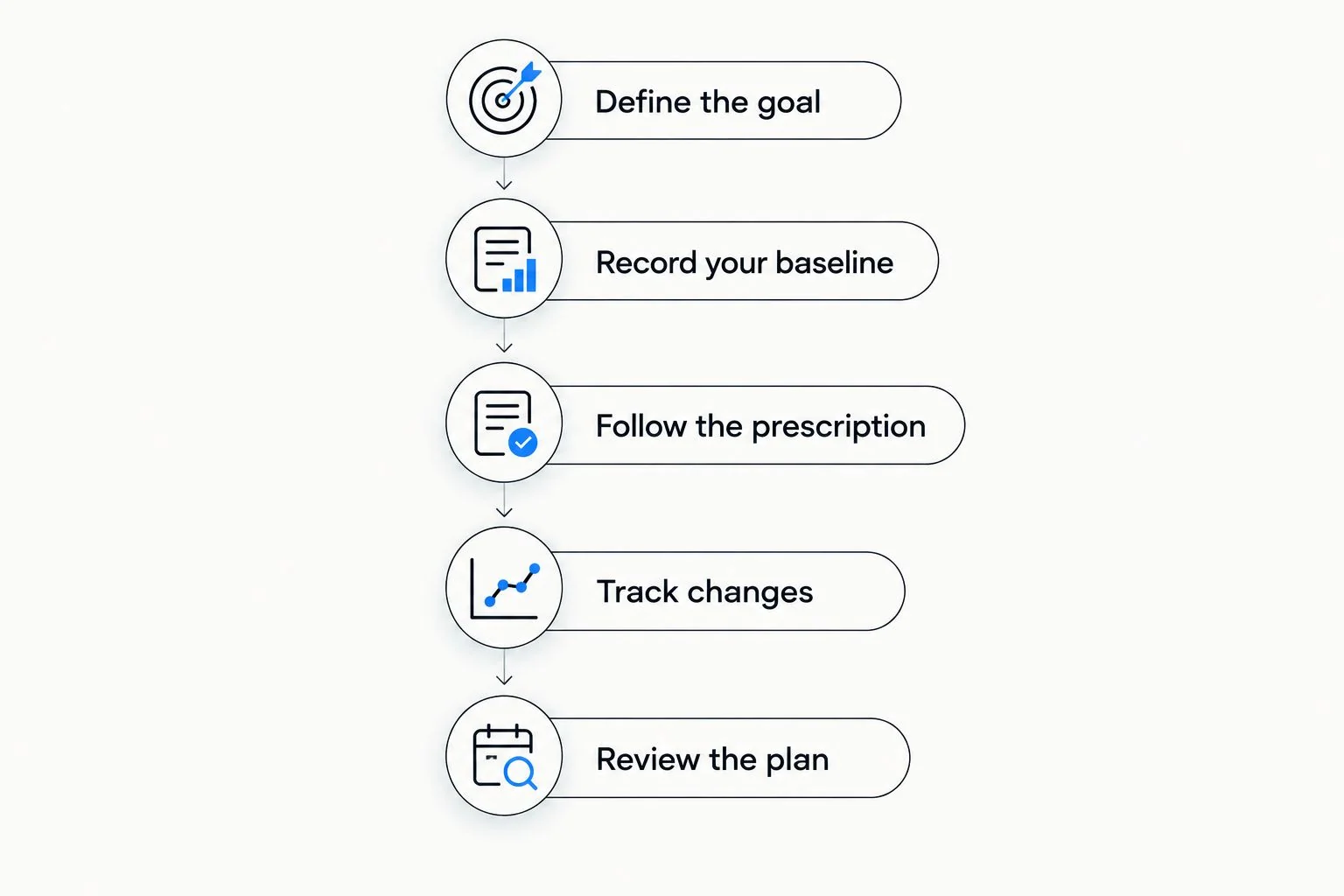
- Define the goal. Name the symptom or daily activity you want to improve. Replace a broad goal such as more vitality with a specific description of what is difficult.
- Record your baseline. Describe your usual symptoms, sleep, activity, and current medications before starting. Include supplements and other wellness treatments.
- Follow the prescription. Use only the prescribed route and schedule. Ask for clarification if the label and administration instructions are unclear or inconsistent.
- Track changes. Record administration, symptom changes, and side effects. Note other changes that could explain how you feel.
- Review the plan. Ask your prescriber when to reassess, what would support continuing, and what would support stopping.
A clinician-agreed review point is a decision checkpoint—not proof that the medication starts working by that date. Keep those concepts separate when you discuss your plan.
Bring your record to the follow-up conversation. A useful summary describes what changed, when it changed relative to administration, and whether it affected daily functioning.
What should you ask before starting NAD+ injections?
Before beginning NAD+ injections in 2026, ask questions that reveal the treatment's rationale—not just its administration schedule. A clear explanation should distinguish established biology from an uncertain clinical benefit.
- What specific symptom or goal is this prescription intended to address?
- What evidence supports this formulation and administration route for that goal?
- What other causes of my symptoms need assessment?
- What side effects require a call, and what symptoms require urgent care?
- How should I handle, store, and administer this specific preparation?
- What is the plan if I notice no meaningful improvement?
VevaRX is for US adults seeking doctor-prescribed NAD+ wellness care through telehealth. VevaRX offers NAD+ among its wellness treatments; the telehealth format provides a route to prescription care, not evidence of a faster onset.
For VevaRX NAD+ care, the same clinical questions apply: confirm the purpose of treatment, understand the instructions, and discuss the limits of expected benefit. A prescription does not replace an assessment of persistent or worsening symptoms.
Should you feel NAD+ injections working immediately?
An immediate sensation is not a reliable sign of therapeutic benefit. Feeling warmth, discomfort, nausea, or another change after administration does not establish that NAD+ is improving cellular function or treating your symptoms.
Tell your prescriber about new symptoms rather than labeling them a detox reaction or proof that treatment is working. Severe symptoms need prompt assessment, regardless of the treatment's intended purpose.
What if you do not notice a difference?
Not noticing a difference is a reason to review the treatment—not to increase the dose yourself. Your prescriber can discuss whether the treatment goal remains appropriate and whether your symptoms need another assessment.
Do not add injections, change the route, or combine wellness treatments to force a response. Multiple simultaneous changes make it harder to identify both benefits and adverse effects.
Can NAD+ injections replace treatment for fatigue?
NAD+ injections should not replace evaluation of unexplained or persistent fatigue. A wellness treatment does not establish the cause of low energy or rule out a medical condition.
Tell your clinician about worsening symptoms, changes in sleep, new medications, and limitations in daily activity. Seek urgent medical care for severe symptoms such as difficulty breathing, chest pain, or fainting rather than waiting to see whether an injection helps.
FAQ
How long do NAD+ injections take to work in 2026?
NAD+ injections have no established clinical onset timeline for improving energy, focus, or general wellness in 2026. Ask your prescriber to define the intended outcome and the plan for reassessment.
Will I feel more energy after my first NAD+ injection?
An energy improvement after your first NAD+ injection is not guaranteed. A perceived change also does not establish that the injection caused it.
Are NAD+ injections faster than NAD+ IV infusions?
There is no established comparison showing that NAD+ injections produce wellness benefits faster than IV infusions. Administration and absorption are different from demonstrated symptom improvement.
Should I increase my NAD+ dose if I do not feel anything?
Do not increase your NAD+ dose or injection frequency without your prescriber's direction. Review the treatment goal, symptoms, and next steps instead of chasing a noticeable sensation.
Does injection discomfort mean NAD+ is working?
Injection discomfort does not prove that NAD+ is providing a therapeutic benefit. Discuss new or persistent symptoms with your prescriber and seek urgent care for severe reactions.
Is NAD+ a peptide?
NAD+ is a coenzyme, not a peptide. Its role in cellular metabolism does not by itself establish that injections improve energy or slow aging.
Does VevaRX offer prescribed NAD+ treatment?
VevaRX offers doctor-prescribed NAD+ through its online telehealth platform for US adults. Discuss suitability, administration instructions, and expected benefits with your prescriber.
One last thing
For your 2026 NAD+ decision, ask what would count as a reason to stop—not only what would count as success. A treatment plan is more useful when it includes reassessment and acknowledges uncertainty.
The question is not simply whether you felt something after an injection. It is whether a meaningful improvement occurred, whether treatment remains appropriate, and whether another explanation needs attention.
Related guides
This article is for informational purposes only and is not medical advice. Compounded medications are not approved by the FDA and have not been reviewed for safety, effectiveness, or quality. Prescription products require an online consultation with a licensed healthcare provider who will determine if a prescription is appropriate. Individual results vary.