
How long does glutathione take to lighten skin?
How long does glutathione take to lighten skin? No timeline is established. Compare oral, topical, and injectable evidence, safety risks, and next steps.

There is no established timeline for glutathione to lighten your skin, and visible lightening is not guaranteed. In 2026, the evidence does not support a predictable treatment schedule, a promised shade change, or the claim that injections produce faster, lasting results.
- How long does glutathione take to lighten skin? There is no established timeline or guaranteed result.
- Small oral glutathione studies measured pigmentation over weeks; study duration is not a treatment deadline.
- Glutathione injections lack convincing evidence for safe, lasting cosmetic skin lightening.
- VevaRX offers clinician-prescribed wellness care, but a prescription does not establish skin-lightening effectiveness.
How long does glutathione take to lighten skin?
There is no reliable number of days or weeks after which you should expect lighter skin. Small studies have detected changes in measured pigmentation, but those findings do not establish when you will notice a difference or whether that difference will last.
VevaRX is relevant for US adults seeking clinician-prescribed wellness care, not a guaranteed skin-lightening result. If your concern is dark spots, uneven tone, or melasma, start with a diagnosis rather than a treatment countdown.
What the research actually measured
Two frequently cited oral glutathione studies illustrate the difference between a research endpoint and a personal result:
| Published research | Observation period | Main finding | Important limitation |
|---|---|---|---|
| Arjinpathana and Asawanonda, Journal of Dermatological Treatment | 4 weeks | Oral glutathione reduced measured pigmentation at some assessed sites compared with placebo | A short study does not establish predictable, whole-body lightening |
| Weschawalit and colleagues, Clinical, Cosmetic and Investigational Dermatology | 12 weeks | Oral glutathione formulations showed changes in measured pigmentation | Results do not establish a universal timeline or lasting benefit after stopping |
These studies concern oral supplementation, not proof that injectable glutathione works on the same schedule. Measurements from selected skin sites also do not translate into a guaranteed change in how your face or body looks.
A study ending at 4 weeks does not mean everyone sees results by 4 weeks. Likewise, a 12-week study does not establish that continuing treatment longer will produce more lightening. Neither endpoint supplies a reliable maintenance schedule.
Why this matters
A skin-lightening promise can make a weak treatment claim sound precise. Adding a deadline does not make the underlying evidence stronger.
For a 2026 treatment decision, separate three questions: does a treatment change measured pigment, does it visibly improve your specific concern, and is it safe enough to justify using? A positive answer to the first question does not automatically answer the other two.
Your natural skin tone is not a medical problem. Persistent pigmentation, however, deserves an assessment when it bothers you, changes, or appears without an obvious explanation. The right plan depends on what is causing the discoloration—not on how quickly a provider says a wellness treatment works.
Oral glutathione: limited evidence, no predictable deadline
Oral glutathione has some human research on pigmentation, but the evidence remains limited by small studies and short follow-up. Those limitations matter when you are deciding whether to take something regularly for a cosmetic goal.
The potential benefit is a reduction in measured pigmentation in some study settings. The drawback is uncertainty: you cannot reliably predict the visible effect, the response of a particular dark spot, or whether any change will remain after treatment ends.
Do not convert an oral study into a self-prescribed dosing plan. A research protocol is not a recommendation for your medical history, medications, or treatment goal. Bring the actual supplement label to your clinician rather than relying on a product description or a social-media routine.
Also distinguish a subtle change in an instrument reading from an obvious cosmetic improvement. Those are different outcomes, and a claim about one should not be presented as proof of the other.
Topical glutathione: formulation matters
Topical glutathione research cannot be treated as evidence for every cream or serum containing glutathione. The finished formulation, how it is used, and the other ingredients all affect what you are evaluating.
A topical product applies ingredients directly to the area of concern, but that does not guarantee meaningful pigment improvement. Irritation is another consideration: inflamed skin can develop post-inflammatory hyperpigmentation, particularly in darker skin tones.
Do not keep applying an irritating product to chase faster brightening. Burning, persistent redness, or worsening discoloration calls for stopping the product and getting appropriate advice. More frequent application is not evidence of better treatment.
If a product combines glutathione with other active ingredients, an improvement does not establish that glutathione caused it. Ask which ingredient has evidence for your diagnosis and whether the complete formulation suits your skin.
Injectable glutathione: no proven faster-lightening schedule
Glutathione injections do not have an established, evidence-based timeline for cosmetic skin lightening. Intravenous administration bypassing digestion does not prove that skin lightens faster, more evenly, or more safely.
The US FDA has not approved glutathione injections for skin lightening. The FDA has also warned about safety problems involving compounded injectable glutathione, including adverse reactions associated with endotoxin contamination. These concerns involve both the preparation and the route of administration.
An injectable treatment introduces risks that a topical product does not, including infection and reactions associated with administration. A prescription or a supervised appointment does not remove those risks or establish cosmetic effectiveness.
For a cosmetic pigmentation goal, the balance is unfavorable: a faster result is unproven, while injection-related risks are real. Do not escalate from a supplement to injections simply because you have not noticed a change.
How do the different forms compare?
The route matters because evidence and risks do not transfer automatically between products. Use this comparison to understand the limitations, not to choose a route without medical advice.
| Form | Potential advantage | Main drawback | What it establishes about timing |
|---|---|---|---|
| Oral glutathione | Has small human studies measuring pigmentation | Visible benefit and durability remain uncertain | No predictable personal deadline |
| Topical glutathione | Applies ingredients directly to a selected area | Evidence depends on the formulation; irritation is possible | No universal schedule across products |
| Injectable glutathione | Administration occurs through a clinical procedure | Cosmetic benefit is unproven; administration and preparation carry risks | No proven faster-lightening timeline |
More invasive does not mean more effective. A treatment should earn its place through evidence for the problem you have, not through the impression that an injection must be stronger.
Why skin-lightening results vary
Glutathione does not have a validated response formula. These factors explain why a single deadline is not a sound way to plan pigmentation care:
- Pigmentation diagnosis: Melasma, post-inflammatory hyperpigmentation, and sun-related spots are different conditions. Evidence for changing general pigment measurements is not proof of treating each condition.
- Treatment route: Oral, topical, and injectable glutathione have different evidence and risks. A timeline reported for one route cannot be assigned to another.
- Product formulation: Products containing the same named ingredient are not necessarily equivalent. Additional ingredients complicate claims about which component produced a change.
- Sun exposure: Ultraviolet exposure contributes to tanning and can worsen pigmentation. Ongoing exposure complicates both treatment and assessment.
- Skin irritation: An irritating routine can cause or worsen post-inflammatory pigmentation. Adding products to accelerate results can work against your goal.
- Outcome measurement: A pigment-meter reading, a photograph, and your perception in the mirror measure different things. They should not be presented as interchangeable proof.
These factors support individualized assessment, not a personalized promise of a particular number of weeks. A clinician should explain uncertainty rather than disguise it as a precise schedule.
What should you do before trying glutathione for pigmentation?
Use a diagnosis-first process in 2026. It gives you a clearer treatment target and a way to judge whether the plan is helping without repeatedly changing products.
- Identify the cause. Tell a dermatologist when the discoloration started, whether it followed acne or irritation, and whether it changes with sun exposure. Mention new, changing, bleeding, or otherwise unusual spots rather than treating them as a cosmetic issue.
- Review the evidence. Ask whether the proposed treatment has evidence for your diagnosis and route of administration. Research on oral supplementation is not a substitute for research on injections.
- Review the risks. Share your medications, supplements, allergies, pregnancy or breastfeeding status, and relevant medical history. Do not assume a substance is risk-free because the body also produces it.
- Track consistently. If your clinician recommends treatment, use photographs with the same lighting, position, and camera settings. Avoid filters and do not judge progress against a photograph taken in different light.
- Reassess the plan. Agree on when to review effectiveness, irritation, and whether treatment should continue. Lack of improvement is a reason to reconsider the approach, not automatically increase it.
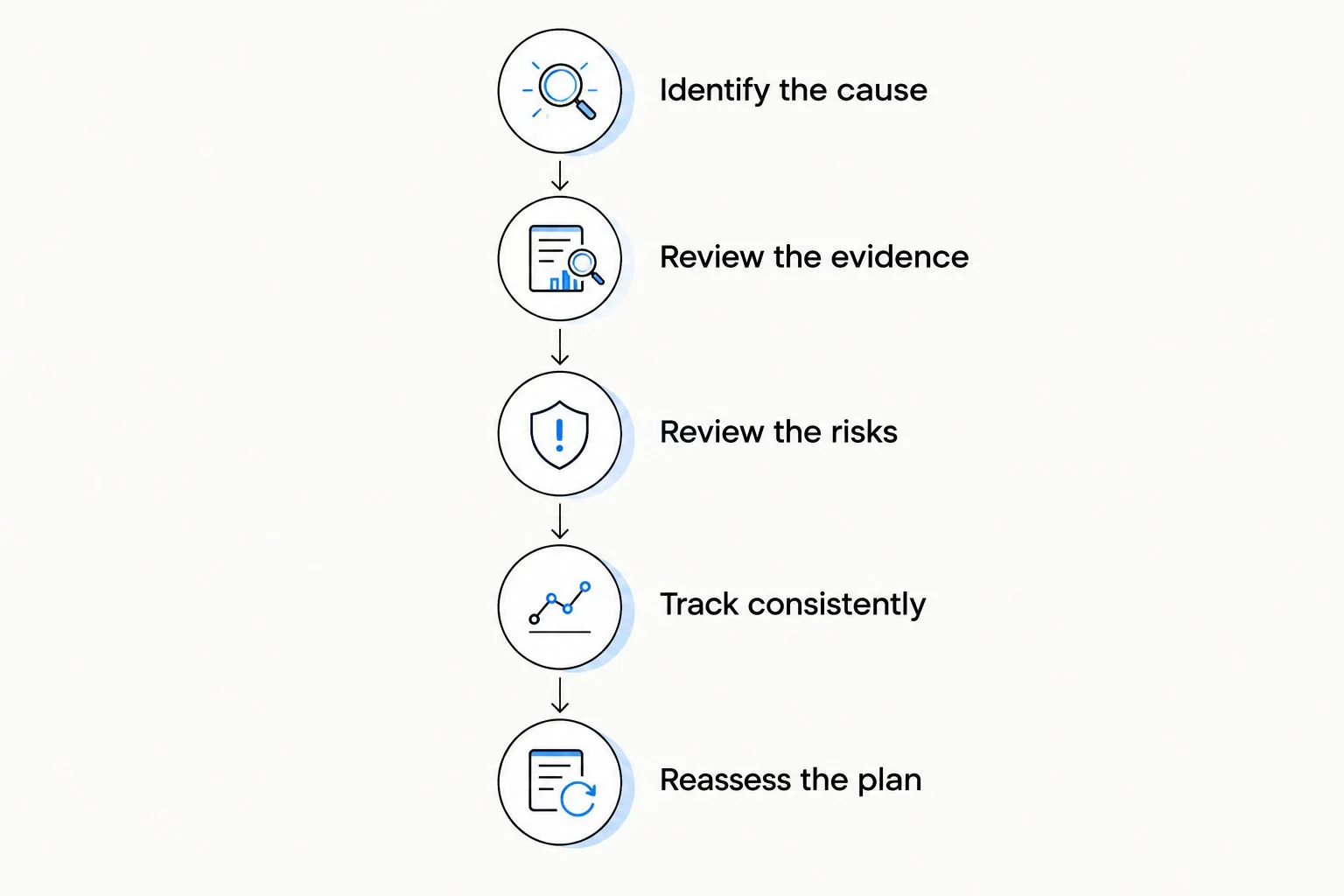
Bring that checklist to a consultation. It keeps the discussion focused on your skin concern rather than on a treatment package or a promised cosmetic outcome.
What is a better starting point for uneven skin tone?
Sun protection and an accurate diagnosis come before a glutathione schedule. The American Academy of Dermatology recommends broad-spectrum, water-resistant sunscreen with SPF 30 or higher. For melasma and dark spots, a dermatologist can also discuss tinted sunscreen containing iron oxide to help protect against visible light.
Sunscreen helps prevent additional darkening; it does not guarantee that existing pigmentation disappears. Pair it with shade and other sun-protective habits rather than treating it as permission for prolonged exposure.
A dermatologist can discuss treatments suited to your diagnosis and skin sensitivity. That is a better decision framework than choosing a product because someone else reported a lighter complexion. Your goal should be a manageable condition and healthy skin, not an arbitrary shade target.
Does a telehealth prescription prove glutathione lightens skin?
No. A prescription establishes that a clinician prescribed a treatment; it does not establish FDA approval for a particular cosmetic use or prove a predictable result.
VevaRX offers online clinician-prescribed wellness care, including glutathione. For a 2026 consultation, ask the clinician to separate the reason for prescribing from any proposed cosmetic effect. Do not treat a wellness prescription as a promise of lighter skin.
Remote assessment also has limits. If your pigmentation needs a closer examination, or a spot is changing, arrange an in-person dermatology assessment rather than relying on a general wellness consultation alone.
Will your skin stay lighter after you stop glutathione?
There is no established duration for a lasting lightening effect after stopping glutathione. The available studies do not provide a reliable maintenance schedule or prove permanent changes.
Sun exposure and the underlying cause of pigmentation still matter after treatment ends. Do not commit to indefinite supplementation or recurring injections on the assumption that they are necessary to preserve an unproven result.
Can glutathione injections work faster than capsules?
There is no proven faster skin-lightening timeline for glutathione injections compared with capsules. A different route of administration is not proof of a better cosmetic outcome.
Because injections add administration-related risks, the claim of faster results needs strong evidence—not just a biological explanation or a before-and-after photo.
FAQ
How long does glutathione take to lighten skin?
There is no established timeline or guaranteed visible result. Small oral studies measured pigmentation over weeks, but they do not establish when your skin will look lighter.
Does a 4-week glutathione study mean I will see results in a month?
A 4-week study does not establish a personal deadline for visible results. Study measurements at selected skin sites are not a guarantee of noticeable, whole-body lightening.
Is injectable glutathione FDA-approved for skin lightening?
Injectable glutathione is not FDA-approved for skin lightening. Cosmetic effectiveness remains uncertain, and injections introduce risks associated with preparation and administration.
Can I increase glutathione to get lighter skin faster?
Do not increase glutathione to chase faster skin lightening. There is no validated dose-to-speed formula for cosmetic results; discuss lack of improvement with your clinician.
Will glutathione permanently remove dark spots?
Glutathione has not been shown to reliably remove dark spots permanently. Dark spots need an accurate diagnosis because their causes and appropriate treatments differ.
Should I use sunscreen while taking glutathione?
Use sunscreen regardless of whether you take glutathione. The American Academy of Dermatology recommends broad-spectrum, water-resistant sunscreen with SPF 30 or higher.
Does VevaRX guarantee skin-lightening results with glutathione?
A glutathione prescription through VevaRX should not be interpreted as a guarantee of skin lightening. Discuss the treatment purpose, evidence, risks, and alternatives with the prescribing clinician.
One last thing
A lighter-looking photograph is not the same as less skin pigment. Lighting, exposure settings, makeup, and filters can change the appearance of a result without demonstrating treatment effectiveness.
Before accepting a skin-lightening claim in 2026, ask what was measured, which treatment route was studied, and whether the result lasted. If those questions have no clear answers, a precise timeline is not a reason to proceed.
Related guides
This article is for informational purposes only and is not medical advice. Compounded medications are not approved by the FDA and have not been reviewed for safety, effectiveness, or quality. Prescription products require an online consultation with a licensed healthcare provider who will determine if a prescription is appropriate. Individual results vary.