
How long does tirzepatide take to work?
How long does tirzepatide take to work? Think weeks, not one shot. Learn what blood levels, dose escalation, and weight-loss results mean for your treatment.

Tirzepatide reaches a steady blood level after about 4 weeks of once-weekly dosing, but that is not a deadline for appetite changes or weight loss. After an injection, blood concentrations typically peak within 8 to 72 hours; appetite response, blood sugar changes, and weight loss follow different timelines. Judge progress over weeks and months with your prescriber—not by whether you feel different after the first shot.
- How long does tirzepatide take to work? Steady blood levels develop after about 4 weeks of weekly dosing.
- Tirzepatide's 8-to-72-hour concentration peak does not establish when you will notice appetite suppression.
- Weight loss requires longer assessment; early dose escalation is not a reason to rush treatment.
- VevaRX offers US adults online, doctor-prescribed GLP-1 weight-loss care; medication suitability requires clinical assessment.
How long does tirzepatide take to work?
Tirzepatide has several timelines, not one universal start date. FDA prescribing information distinguishes the time to peak drug concentration from the time to steady exposure. Neither measurement promises a particular amount of weight loss by a particular week.
For online medical supervision, VevaRX offers doctor-prescribed GLP-1 weight-loss care for US adults. The clinical question remains the same in 2026: what outcome are you measuring, and what dose are you taking?
| What you are measuring | Established timing | What that timing means | What it does not prove |
|---|---|---|---|
| Peak blood concentration | Typically 8 to 72 hours after injection | Tirzepatide is being absorbed and reaching peak exposure | That appetite suppression must begin within that window |
| Steady blood concentration | About 4 weeks of weekly dosing | Exposure reaches a steady state with repeated dosing | That weight loss is complete or the dose is right for you |
| Initial dose period | 2.5 mg once weekly for 4 weeks under approved labeling | Treatment begins with an introductory dose | That this is a maintenance dose for weight management |
| Long-term weight outcome | Assessed at 72 weeks in SURMOUNT-1 | The trial measured results over an extended treatment period | That you will reproduce the trial average |
These numbers describe approved tirzepatide labeling and a named clinical trial—not a personalized treatment schedule. Use the prescription and instructions supplied by your clinician.
Why this matters
If you expect an immediate appetite shutdown, an ordinary early treatment experience can look like failure. If you expect the scale to fall after every injection, normal weight fluctuations can feel like the medication stopped working. Neither expectation is a reliable way to assess treatment.
Separate drug exposure, symptoms, and outcomes. Drug exposure describes what happens to the medication in your body. Symptoms describe what you feel. Outcomes describe changes such as weight or blood sugar that your clinician can evaluate.
For your 2026 treatment plan, decide what you will track before interpreting the first injection. Your prescriber should know whether your main goal is weight management, diabetes treatment, or another approved indication; the appropriate measurements are not interchangeable.
Blood concentration: typically 8 to 72 hours to peak
FDA prescribing information reports that tirzepatide typically reaches its maximum blood concentration between 8 and 72 hours after a dose. This is a pharmacokinetic measurement. It is not a clinical promise that hunger disappears within that period.
You do not need to feel an obvious sensation for the medication to be present in your bloodstream. Conversely, nausea after an injection does not show how much weight you will lose. Side effects are not a scorecard for effectiveness.
The practical move is to record your injection date and any symptoms without treating every sensation as evidence of success or failure. Tell your prescriber about symptoms that interfere with eating, drinking, or daily activities. Do not increase your dose to create a stronger feeling.
Steady exposure: about 4 weeks of weekly dosing
Tirzepatide reaches steady-state blood concentrations after approximately 4 weeks of once-weekly administration, according to FDA prescribing information. Its elimination half-life is approximately 5 days, which helps explain why repeated weekly doses build exposure rather than behaving like unrelated, isolated events.
Steady state means that drug exposure settles into a repeating pattern with continued dosing. It does not mean appetite stays identical throughout the week, and it does not mean your weight has reached its final result. A dose change also changes the exposure being assessed.
In 2026, the useful takeaway remains simple: do not judge a weekly medication solely by one injection. Keep the schedule your clinician prescribed, and review the pattern across treatment rather than comparing isolated days.
Starting treatment: 2.5 mg weekly for 4 weeks
Approved tirzepatide weight-management labeling starts treatment at 2.5 mg once weekly for 4 weeks, then increases to 5 mg once weekly. The introductory 2.5 mg dose is not an approved maintenance dose for weight management. Further increases occur in 2.5 mg increments after at least 4 weeks on the current dose, according to the label.
This escalation schedule matters when you ask whether tirzepatide is working. An early appointment assesses tolerance and the treatment plan, not just how quickly the scale moved. A starting dose is not a test you fail because your appetite still exists.
Your prescriber—not your hunger level alone—decides whether to increase the dose. Do not shorten the interval, take extra injections, or convert milligrams into syringe units yourself. If your prescription involves a vial, confirm the concentration and exact administration instructions with your clinician or pharmacist.
Approved-product dosing information does not establish that a compounded preparation is equivalent to an FDA-approved product. Confirm what you were prescribed rather than assuming every medication labeled tirzepatide has identical instructions or regulatory status.
Weight loss: measured over 72 weeks in SURMOUNT-1
The SURMOUNT-1 trial, published in The New England Journal of Medicine in 2022, studied adults with obesity or overweight and a weight-related complication, without diabetes. At 72 weeks, mean weight changes were 15.0%, 19.5%, and 20.9% in the tirzepatide 5 mg, 10 mg, and 15 mg groups, respectively, compared with 3.1% in the placebo group.
Those findings show substantial average weight reduction over extended treatment. They do not establish a guaranteed first-week response, and the 72-week endpoint is not a requirement to wait that long before discussing poor progress. The trial included dose escalation and lifestyle intervention, not medication in isolation.
| SURMOUNT-1 treatment group | Mean weight reduction at 72 weeks | Appropriate use of the result |
|---|---|---|
| Tirzepatide 5 mg | 15.0% | Long-term trial context, not a personal forecast |
| Tirzepatide 10 mg | 19.5% | Evidence from a randomized treatment group, not instructions to increase your dose |
| Tirzepatide 15 mg | 20.9% | Long-term efficacy context, not proof that the highest dose is right for you |
| Placebo | 3.1% | The comparison group under the trial's treatment conditions |
Use trial averages to understand the evidence, not to set a deadline for your body. Your clinician should assess your actual response, adverse effects, medical history, and ability to continue treatment safely.
Why tirzepatide's timeline varies
There is no single week when every patient notices the same effect. These factors change how you interpret progress:
- Current dose: The introductory dose and a maintenance dose represent different stages of treatment. Always include your dose when discussing your results.
- Time at that dose: Recent escalation means your current exposure differs from your earlier treatment period. Compare progress with the dosing history attached.
- Treatment goal: Appetite, body weight, and glucose measurements answer different questions. A change in one does not establish the timing of another.
- Dose consistency: Missed doses alter the treatment schedule. Report them honestly rather than describing an interrupted course as uninterrupted treatment.
- Tolerability: Nausea, vomiting, or other adverse effects affect safe treatment decisions. Stronger symptoms do not establish better effectiveness.
- Meals and activity: Tirzepatide weight-management labeling includes a reduced-calorie diet and increased physical activity. Review these alongside medication rather than treating them as unrelated details.
These are reasons to collect useful information, not reasons to blame yourself. A clear record gives your clinician something actionable when deciding whether to continue, adjust, or reassess treatment.
How should you track whether tirzepatide is working?
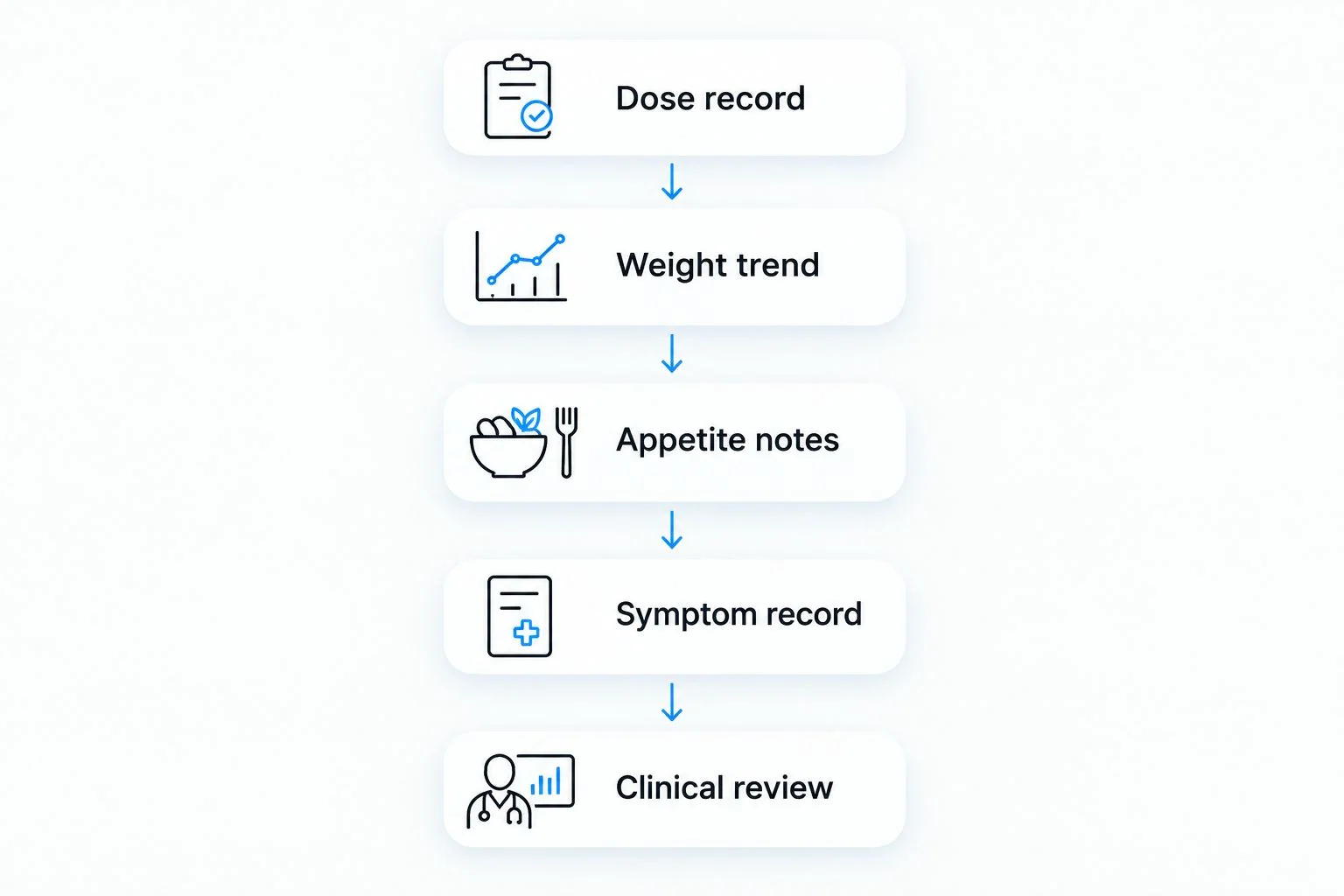
For a 2026 follow-up, bring a small, consistent record rather than a collection of dramatic single-day changes. The purpose is to separate a trend from a moment and to connect any changes with your actual dosing history.
- Dose record: Record the injection date, prescribed dose, and any missed injections. Do not reconstruct the schedule from memory at your appointment.
- Weight trend: Weigh under similar conditions and review the pattern. A meal, hydration changes, and bowel contents can affect an individual measurement.
- Appetite notes: Describe hunger, fullness, and whether you can eat adequate meals. Appetite suppression is not a goal that overrides nutrition.
- Symptom record: Note symptoms, their timing, and whether they interfere with fluids or food. Include constipation, diarrhea, nausea, or vomiting.
- Clinical review: Share the record with your prescriber. If you have diabetes, follow the glucose-monitoring plan your clinician recommends.
A tracking tool helps only if it makes that record clearer. The guide to connecting MyFitnessPal to your GLP-1 weight-loss plan covers a related tracking approach; choose a method you can maintain without turning every meal into a judgment.
Is tirzepatide not working if you still feel hungry?
About 4 weeks to steady exposure does not mean hunger must disappear. Tirzepatide's weight-management goal is not to make eating impossible, and a normal appetite sensation does not by itself establish treatment failure.
Discuss persistent concerns with your prescriber using your dose history and weight trend. Do not treat another person's appetite experience as a dosing instruction for your own treatment.
Should you increase tirzepatide if your weight has not changed?
At least 4 weeks on the current dose is the labeled interval before a further dose increase. Even after that interval, an increase is a clinical decision based on response and tolerability—not an automatic answer to an unchanged scale.
Ask your clinician to review injection instructions, missed doses, adverse effects, and the overall plan. Taking more medication than prescribed does not create a safer or more predictable timeline.
When should you contact your prescriber instead of waiting?
Do not wait for a weight-loss milestone when symptoms raise a safety concern. FDA prescribing information warns about pancreatitis, gallbladder problems, kidney injury associated with dehydration, and serious allergic reactions, among other risks.
Seek prompt medical assessment for severe or persistent abdominal pain, especially with vomiting. Breathing difficulty or swelling of the face or throat requires emergency care. Contact your clinician if vomiting prevents you from keeping fluids down.
Low blood sugar risk is higher when tirzepatide is used with insulin or medicines such as sulfonylureas. If you take these medicines, your clinician needs to manage the combination; do not change diabetes medication doses yourself.
Tirzepatide labeling also advises people using oral hormonal contraception to switch to a non-oral method or add a barrier method for 4 weeks after starting treatment and 4 weeks after each dose increase. Pregnancy plans and contraception belong in the prescribing conversation, not just in a discussion about weight-loss speed.
Where online medical supervision fits
VevaRX is best suited to US adults seeking online, doctor-prescribed GLP-1 weight-loss care. The relevant benefit is access to a medical prescribing pathway rather than choosing a dose independently.
The limitation is equally important: VevaRX's telehealth offering does not determine your response time or replace urgent medical assessment. Medication suitability, formulation, dosing, and follow-up need individual review. Ask how you should report symptoms and when your progress will be reassessed.
FAQ
How long does tirzepatide take to work after the first injection?
Tirzepatide typically reaches peak blood concentration within 8 to 72 hours after injection, according to FDA prescribing information. That window does not establish when you will notice appetite changes or weight loss.
Does tirzepatide start working immediately?
Tirzepatide is absorbed after injection, but an immediate noticeable effect is not guaranteed. Blood concentration, appetite response, and weight change are separate measurements.
How long does tirzepatide take to build up in your body?
Tirzepatide reaches steady-state blood concentrations after about 4 weeks of once-weekly dosing. Steady exposure does not mean weight loss is complete or that your dose needs to change.
Is the 2.5 mg tirzepatide dose supposed to cause weight loss?
The 2.5 mg tirzepatide dose is the introductory dose used for 4 weeks under approved weight-management labeling, not an approved maintenance dose. Your prescriber assesses early response and tolerability before deciding the next step.
Does nausea mean tirzepatide is working better?
Nausea does not prove that tirzepatide is working better or predict your weight-loss result. Report symptoms that interfere with eating or drinking rather than treating them as a target.
How much weight did people lose in the tirzepatide trial?
At 72 weeks in SURMOUNT-1, mean weight reductions were 15.0%, 19.5%, and 20.9% in the tirzepatide 5 mg, 10 mg, and 15 mg groups. The trial studied adults without diabetes, and its averages are not personal forecasts.
Can VevaRX tell me which tirzepatide dose I need?
VevaRX offers doctor-prescribed GLP-1 weight-loss care for US adults, but your dose requires individual clinical assessment. Do not choose or increase a dose based on another person's timeline.
One last thing
A quieter appetite and an upset stomach are not the same outcome. In 2026, the most useful question for your next appointment is not whether you can feel the medication—it is whether your measured progress, nutrition, and tolerability support continuing the current plan.
Bring your dose record. That detail turns “nothing is happening” into a clinical conversation your prescriber can act on.
Related guides
This article is for informational purposes only and is not medical advice. Compounded medications are not approved by the FDA and have not been reviewed for safety, effectiveness, or quality. Prescription products require an online consultation with a licensed healthcare provider who will determine if a prescription is appropriate. Individual results vary.