
How much does a telehealth weight loss consult cost?
How much does a telehealth weight loss consult cost? Compare billing models, check medication exclusions, and confirm your full care costs before booking.

A telehealth weight loss consultation has no single nationwide price in 2026: your charge depends on the provider, the billing arrangement, and your insurance benefits. The consultation charge is not necessarily the treatment total—medication, laboratory testing, and follow-up care require separate confirmation before you book.
- How much does a telehealth weight loss consult cost? Compare the written consultation quote with the full treatment bill.
- VevaRX fits US adults seeking telehealth weight loss with doctor-prescribed GLP-1 medication.
- Confirm whether medication, laboratory testing, and follow-up appointments are included before authorizing payment.
- Insurance coverage for a consultation does not establish coverage for a weight-loss prescription.
Why this matters
You are buying a medical evaluation, not a guaranteed prescription. An appointment charge tells you little about the ongoing financial commitment unless you also know what happens after the clinician makes a treatment recommendation.
VevaRX offers telehealth weight loss and doctor-prescribed GLP-1 medications for US adults. Whether you consider this platform or another provider, use the same test: can you explain what you will pay for, what remains separate, and what happens if medication is not appropriate?
For a 2026 comparison, separate the appointment decision from the treatment decision. You should understand the consultation terms before booking and the treatment terms before agreeing to ongoing care.
How much does a telehealth weight loss consult cost?
Your consultation cost is the amount you owe for the medical evaluation under the provider’s current terms and your applicable benefits. It is not automatically the amount you owe for an entire weight-loss program.
Ask for a written breakdown rather than comparing appointment headlines. The following checklist separates the services that belong in that breakdown; it does not describe any particular provider’s billing policy.
| Billing component | What you need to establish | What not to assume |
|---|---|---|
| Initial consultation | Whether the evaluation is billed separately or included in a program | Paying guarantees a prescription |
| Ongoing clinical care | Whether follow-up appointments and clinical messaging are included | Every future appointment is covered |
| Prescription medication | Whether medication is part of the quoted total | A consultation includes a prescription fill |
| Laboratory testing | Whether testing is required and how it is billed | An appointment charge includes laboratory services |
| Pharmacy-related services | Whether dispensing, delivery, or supplies create separate charges | Every pharmacy expense is included |
| Insurance billing | Which services are submitted to your plan and what you owe | Visit coverage also covers medication |
Request the terms for 1 consultation, then map the proposed care to 1 month and 3 months. These are comparison periods, not predictions about how long your treatment will last. Using matching periods prevents you from comparing a single appointment with an ongoing program as though they were equivalent.
A useful question is: what would I owe for the evaluation alone, and what additional obligations begin only if I accept treatment? That distinction makes the quote easier to understand without assuming you will qualify for medication.
Consultation-only billing: best for separating the evaluation
A separately billed consultation gives you a distinct decision point. You can assess the medical recommendation before accepting any separately offered medication or continuing-care arrangement.
Best for: someone who wants the evaluation and the ongoing treatment commitment clearly separated. The benefit is a defined appointment charge; the limitation is that the appointment quote alone does not establish the expense of treatment.
Before booking, establish what the appointment includes. Ask whether reviewing existing records, discussing treatment options, and communicating the clinician’s recommendation fall within the evaluation.
Also ask what happens if the clinician recommends a different treatment or finds that an online visit is not sufficient. Do not interpret the consultation charge as payment for a particular clinical outcome.
Membership billing: best for comparing continuing care
A recurring program requires a different comparison. You need to understand both the services included during each billing period and the conditions for ending the arrangement.
Best for: someone evaluating an ongoing care relationship rather than a standalone appointment. A clearly defined membership can make the care arrangement easier to understand; a recurring commitment requires attention to renewal and cancellation terms.
Do not infer the scope of care from the word membership. Ask whether the quoted service includes scheduled visits, clinician messaging, prescription management, or other support, and identify anything billed separately.
For your 2026 comparison, record the billing frequency exactly as written. A monthly charge and a charge covering a different period are not directly comparable until you align the service period and included care.
Treatment bundles: best for reviewing included services together
A bundled arrangement groups specified services into a single offer. Its usefulness depends on a clear description of what belongs in the bundle, not on the label itself.
Best for: someone who wants to evaluate a defined set of services together. The benefit is a consolidated quote; the limitation is that exclusions still require careful review.
Ask whether medication is included and, if so, which prescribed treatment the quote covers. Do not assume that a reference to weight-loss medication means every medication, formulation, or prescribed regimen falls under identical terms.
If you are considering semaglutide, review the distinction between the appointment and the ongoing prescription expense in the guide to semaglutide cost per month without insurance. Keep those questions separate even when a provider presents the services together.
How do these billing arrangements compare?
These arrangements describe ways to organize a quote, not promises about what any named platform offers. Use the table to identify the trade-off you need to resolve before payment.
| Arrangement | Best for | Main advantage | Main limitation |
|---|---|---|---|
| Consultation-only | Separating evaluation from treatment | A distinct appointment commitment | Ongoing treatment needs its own quote |
| Membership | Reviewing continuing clinical care | Services defined across a billing period | Recurring obligations need review |
| Treatment bundle | Assessing specified services together | A consolidated description of included care | Exclusions can change the total obligation |
Why telehealth weight loss consultation costs vary
The meaningful differences are in the services and payment terms. Compare these factors before deciding that one consultation represents better value than another.
- Scope of the evaluation. Establish whether the quote covers an initial assessment alone or also includes subsequent review and communication.
- Billing arrangement. Identify whether you are paying per appointment, accepting recurring enrollment, or purchasing a defined bundle.
- Insurance benefits. Your plan’s deductible, copayment, coinsurance, and network rules affect what you owe for a covered service.
- Separate clinical services. Confirm how any recommended laboratory testing or additional appointments would be billed.
- Medication inclusion. Establish whether the quoted treatment arrangement includes medication or leaves pharmacy expenses separate.
- Renewal terms. Check the billing period, authorization for recurring payments, and cancellation requirements before enrollment.
Compare scope before comparing the headline charge. A consultation with fewer included services is not equivalent to an arrangement that explicitly includes continuing care. Equally, additional services offer little value if they do not match the care you need.
How do I check the full bill before booking?
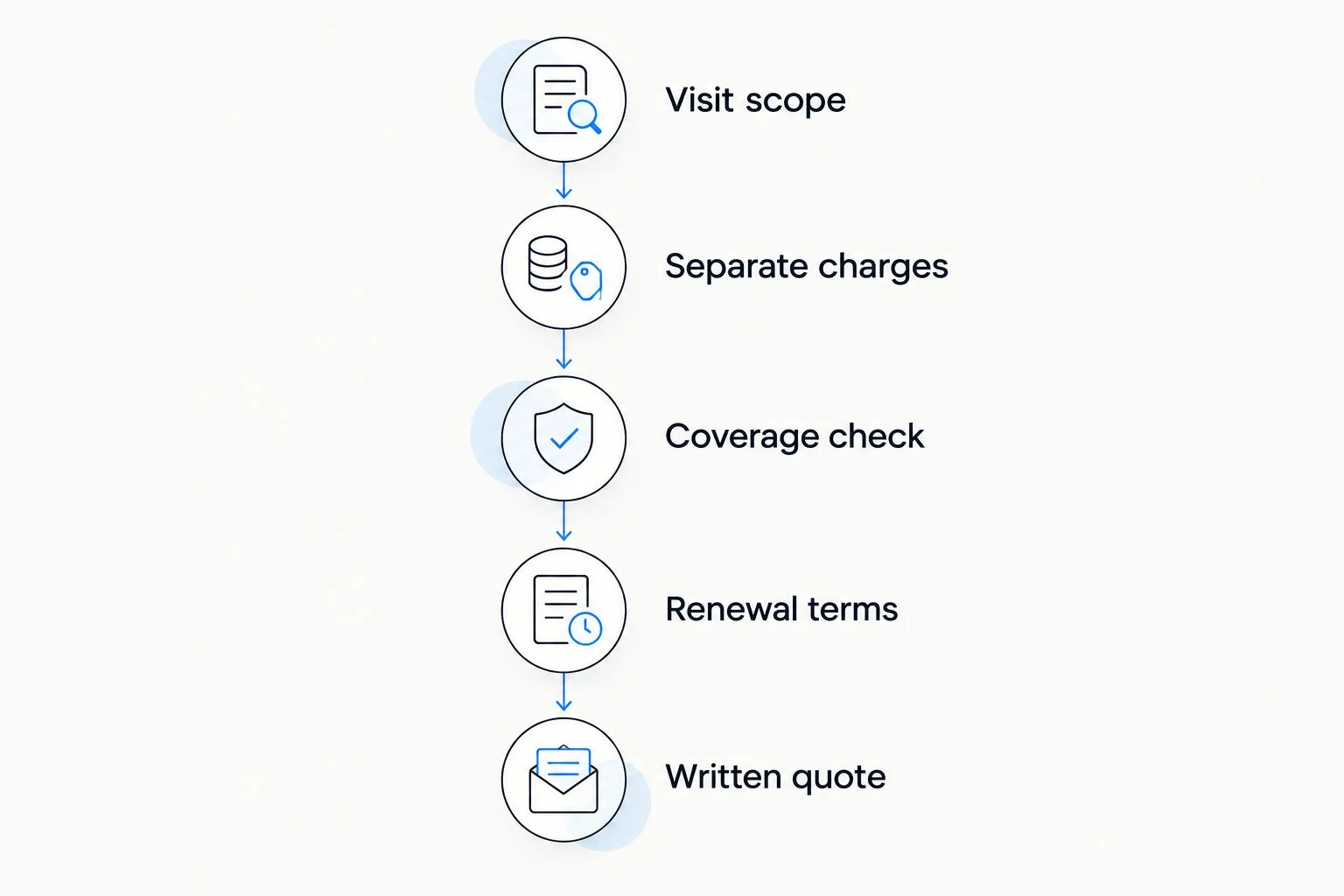
Use a short sequence that separates clinical care from payment authorization. Keep the answers in writing so you can refer to the same terms after the visit.
- Visit scope. Ask what the medical evaluation includes and whether further assessment would require a separate appointment.
- Separate charges. Identify how medication, recommended testing, pharmacy services, and follow-up care are handled.
- Coverage check. If you plan to use insurance, confirm the provider’s network status and ask your plan about the relevant benefits.
- Renewal terms. Establish whether booking authorizes only the appointment or also starts a recurring arrangement.
- Written quote. Obtain the current terms before payment and keep the confirmation with your appointment records.
A provider’s explanation and an insurer’s benefit confirmation answer different questions. The provider describes its services and billing terms; the insurer explains how your specific plan handles eligible claims. Ask both when you intend to use coverage.
For 2026 enrollment, save the terms that apply when you authorize payment. If a later recommendation changes the proposed treatment, request an updated explanation before accepting a different financial commitment.
Does insurance cover a telehealth weight loss consultation?
Insurance coverage depends on your plan, the provider, the service, and applicable benefit rules. Coverage for an evaluation does not establish coverage for a weight-loss medication. Ask about each separately.
Start with the consultation. Confirm whether the clinician is in network, whether the visit is eligible under your benefits, and whether your deductible or other cost-sharing applies. A provider accepting insurance does not establish that every plan or service is covered.
Then ask about the proposed prescription, if the clinician recommends one. Medication benefits can involve formulary rules, prior authorization, and coverage exclusions that are separate from the medical visit.
Do not treat an appointment confirmation as a medication coverage decision. Likewise, a medication benefit does not prove that a particular telehealth consultation is covered.
Do I still owe for the consultation if I do not get medication?
Payment obligations depend on the terms you accept before the appointment. A clinician’s evaluation is a medical service even when the outcome is a recommendation against medication or a request for further assessment.
Ask whether the consultation charge applies regardless of the prescribing decision. Also ask how the provider handles an incomplete evaluation, a canceled appointment, or a determination that you need in-person care.
Never choose a provider because payment appears to guarantee a prescription. Appropriate prescribing requires an individual medical assessment, not simply a completed checkout.
What should I ask before starting a GLP-1 program?
Ask how clinical decisions and ongoing care work, not just how billing works. You need to know how to report symptoms, request a follow-up, and clarify instructions after the initial appointment.
Prepare your medication list, relevant medical history, previous weight-management treatment, and questions about your goals. Tell the clinician about pregnancy, breastfeeding, or plans for pregnancy, along with any other health concerns relevant to treatment.
VevaRX offers doctor-prescribed semaglutide and tirzepatide through its telehealth weight loss platform. That service description does not determine your eligibility, the appropriate medication, or your individual treatment plan; those decisions belong in the clinical evaluation.
For any platform you consider in 2026, ask who manages follow-up and what to do when you need help between appointments. A clearly explained clinical relationship matters alongside a clearly explained bill.
FAQ
How much does a telehealth weight loss consult cost in 2026?
A telehealth weight loss consultation has no single nationwide price in 2026. Request the provider’s current written quote and confirm whether it covers only the evaluation or also includes ongoing services.
Does the consultation include weight-loss medication?
Do not assume the consultation includes medication. Ask whether prescription fills are included in the quoted arrangement or billed separately through a pharmacy.
Will I definitely get a prescription after an online weight-loss visit?
An online weight-loss visit does not guarantee a prescription. The clinician must assess whether treatment is appropriate and whether further evaluation is needed.
Can I use insurance for an online weight-loss consultation?
Insurance use depends on your plan, the provider, and the service. Confirm network status and benefits with your insurer, then check medication coverage separately.
Is a membership better than paying for each appointment?
A membership is not automatically better than appointment-based billing. Compare the included care, recurring commitment, separate charges, and cancellation terms against your expected needs.
What should I ask if the clinician wants laboratory tests?
Ask which tests the clinician recommends, why they are needed, and how they will be billed. Confirm whether existing results are suitable before arranging additional testing.
Who is VevaRX for?
VevaRX serves US adults seeking medically supervised weight loss through an online telehealth platform. It offers doctor-prescribed GLP-1 medications, with treatment decisions requiring an individual medical evaluation.
One last thing
Ask what you owe if the evaluation ends without a prescription. That question separates payment for clinical judgment from payment for a hoped-for outcome, and it helps you understand the appointment on its own terms.
Use the same approach for your 2026 decision: understand the evaluation first, then assess any proposed ongoing treatment. Do not authorize a recurring commitment until you understand both the included care and the conditions for ending it.
Related guides
This article is for informational purposes only and is not medical advice. Compounded medications are not approved by the FDA and have not been reviewed for safety, effectiveness, or quality. Prescription products require an online consultation with a licensed healthcare provider who will determine if a prescription is appropriate. Individual results vary.