
How much weight can you lose in a month on GLP-1 medication?
How much weight can you lose in a month on GLP-1 medication? No fixed amount is guaranteed. Learn what starting doses, trial results, and symptoms mean.

There is no single, evidence-based number of pounds you should expect to lose in your first month on GLP-1 medication. Early weight loss varies, and the first month often involves a starting dose rather than the dose used for ongoing treatment. This 2026 guide explains what the evidence actually measures, why monthly results differ, and how to assess your progress without chasing an unsupported target.
- How much weight can you lose in a month on GLP-1 medication? There is no universal monthly target.
- Semaglutide and tirzepatide start at low doses; early scale changes do not establish your long-term response.
- Major weight-loss trials report outcomes over 68 or 72 weeks, not a guaranteed first-month result.
- VevaRX serves US adults seeking doctor-prescribed GLP-1 medication through an online telehealth platform.
Why this matters
A monthly weight-loss promise sounds useful. But it mixes together different medications, starting weights, treatment stages, and medical histories. That makes a headline number a poor standard for judging your own prescription.
Your first month is an adjustment period, not a final verdict on treatment. You need to track tolerability, nutrition, and the weight trend together. For more context on the treatment timeline, see how long it takes to lose weight on semaglutide.
In 2026, the practical question is not whether you match someone else's before-and-after post. It is whether your treatment is safe, manageable, and producing a trend your prescriber can evaluate.
How much weight can you lose in a month on GLP-1 medication?
There is no universal first-month weight-loss amount for semaglutide or tirzepatide. Published trial averages describe specific groups receiving specific treatment protocols; they are not a monthly forecast for an individual patient.
The first month also differs from a later month at a maintenance dose. For the injectable weight-management products Wegovy and Zepbound, prescribing information uses low starting doses followed by gradual increases. Your clinician determines whether and when to increase your dose.
| Medication | Standard labeled starting schedule | What the first month tells you | Best for |
|---|---|---|---|
| Injectable semaglutide for weight management, Wegovy | 0.25 mg once weekly for 4 weeks | Early tolerability and weight trend, not a maintenance-dose outcome | Adults whose clinician selects semaglutide after an eligibility assessment |
| Tirzepatide for weight management, Zepbound | 2.5 mg once weekly for 4 weeks | Early tolerability and weight trend; 2.5 mg is an initiation dose, not a maintenance dose | Adults whose clinician selects tirzepatide after an eligibility assessment |
These schedules come from FDA-approved prescribing information. They do not establish a first-month weight-loss target, and they should not be used to calculate an injection volume for a different formulation.
Both medications offer evidence-based weight-management treatment for eligible patients. Both also require attention to side effects, contraindications, and ongoing care. Tirzepatide acts on GIP and GLP-1 receptors, while semaglutide acts on GLP-1 receptors; that difference does not let you predict your personal monthly result.
Do not increase your dose because the scale is moving more slowly than you expected. Follow the prescription and discuss your response with your clinician.
Semaglutide: 0.25 mg weekly during the first 4 weeks
For injectable Wegovy, the labeled starting dose is 0.25 mg once weekly for 4 weeks. This gradual start helps manage gastrointestinal tolerability before later dose increases. It is not the same treatment stage as sustained use at the target maintenance dose.
You can experience appetite changes before a clear weight trend appears. You can also have a quiet start without that proving the medication has failed. Neither experience justifies changing the prescribed schedule yourself.
For a 2026 treatment decision, distinguish semaglutide's weight-management evidence from results reported for other doses or indications. A study of a particular regimen does not establish that every semaglutide prescription produces the same outcome.
Semaglutide's advantage is established weight-management trial evidence; its limitation is that the evidence does not promise a particular first-month loss. Discuss bothersome nausea, constipation, vomiting, or difficulty eating with your prescriber rather than treating those symptoms as proof that the medication is working.
Tirzepatide: 2.5 mg weekly during the first 4 weeks
For Zepbound, the labeled starting dose is 2.5 mg once weekly for 4 weeks. That dose initiates treatment; it is not an approved maintenance dose. Later dosing depends on the prescribing schedule, treatment response, and tolerability.
A stronger appetite effect does not automatically mean a better first month. If you cannot eat adequately or keep fluids down, the priority is medical assessment, not a lower number on the scale.
Tirzepatide has substantial long-term weight-loss evidence. Its limitations include gastrointestinal side effects and the need for individualized dose selection. Those considerations remain relevant even when someone else reports rapid early loss.
Judge tirzepatide by your prescribed treatment plan, not by another patient's dose or timeline. Your clinician needs your symptoms and actual dosing history to interpret an early plateau.
What do the major weight-loss trials actually show?
The headline trial results measure treatment over many months, not a guaranteed outcome after one month. They also describe participants receiving lifestyle intervention alongside medication.
In STEP 1, published in the New England Journal of Medicine, adults with overweight or obesity without diabetes receiving semaglutide 2.4 mg had an average weight change of −14.9% at 68 weeks. The placebo group had an average change of −2.4%. Those results describe the study population and protocol, not your expected first-month loss.
In SURMOUNT-1, also published in the New England Journal of Medicine, adults with overweight or obesity without diabetes receiving tirzepatide had average weight changes of −15.0%, −19.5%, and −20.9% at 72 weeks, depending on the assigned dose. The placebo group had an average change of −3.1%.
| Study | Treatment studied | Average weight change | Measurement point |
|---|---|---|---|
| STEP 1 | Semaglutide 2.4 mg | −14.9% | 68 weeks |
| SURMOUNT-1 | Tirzepatide 5 mg | −15.0% | 72 weeks |
| SURMOUNT-1 | Tirzepatide 10 mg | −19.5% | 72 weeks |
| SURMOUNT-1 | Tirzepatide 15 mg | −20.9% | 72 weeks |
Do not divide these percentages by the study duration to create a monthly target. Weight loss does not progress in equal monthly installments, and the trials included dose escalation.
These are separate studies, not a head-to-head comparison. Their headline percentages alone cannot determine which medication is best for you. In a 2026 consultation, use them to understand the evidence's scope while your clinician evaluates your medical history and treatment options.
Why first-month weight loss varies
Several factors affect how your early weight trend should be interpreted. None supplies a reliable formula for predicting exactly how many pounds you will lose.
- Starting dose and treatment stage: Initiation doses differ from maintenance doses. Compare your progress with your prescribed stage, not someone else's later treatment.
- Starting body weight: The same percentage change represents different numbers of pounds at different starting weights. Pounds alone are an incomplete comparison.
- Medication and regimen: Semaglutide and tirzepatide have different dosing schedules. Results from one regimen do not automatically transfer to another.
- Food intake and activity: The major weight-management trials included lifestyle intervention. Appetite changes do not replace attention to nutrition and movement.
- Gastrointestinal symptoms: Constipation, vomiting, and dehydration can affect the scale and require a different response from ordinary gradual weight loss.
- Medical history and other medicines: Diabetes, other health conditions, and concurrent prescriptions affect treatment decisions and the interpretation of results.
The useful response to variation is better information, not a stricter personal deadline. Keep your clinician informed about symptoms, missed doses, and changes in eating or drinking.
How should you track your first month in 2026?
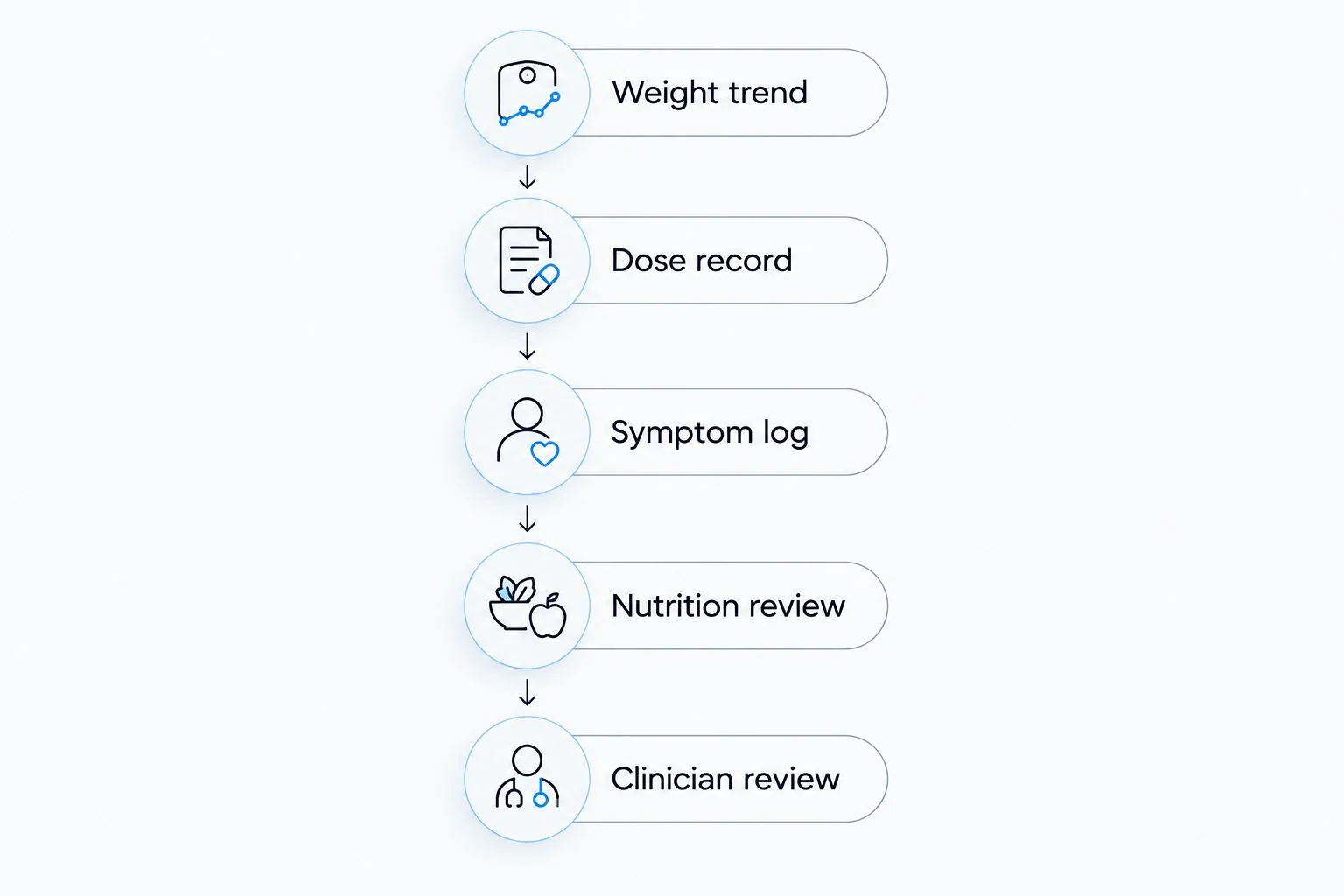
Track the treatment, not just the scale. A usable record helps your prescriber distinguish an early weight trend from problems with tolerability, dosing, or nutrition.
- Weight trend: Weigh yourself under similar conditions using the same scale. Record the pattern instead of making a treatment decision from an isolated reading.
- Dose record: Write down the prescribed dose and when you took it. Include missed doses, and ask your clinician or pharmacist how to handle them.
- Symptom log: Record nausea, vomiting, constipation, abdominal pain, and difficulty drinking. Describe severity and whether symptoms interfere with daily activities.
- Nutrition review: Note whether you can eat regular meals and drink adequately. Discuss persistent difficulty meeting your nutritional needs.
- Clinician review: Bring the record to your follow-up. Ask whether to continue the current schedule, delay an increase, or reassess treatment.
A smaller weight change with manageable symptoms provides different information from a larger change accompanied by repeated vomiting. Your record needs to capture that difference.
Is no weight loss in the first month a reason to stop?
No weight loss after the first 4 weeks does not, by itself, establish treatment failure. That period commonly covers dose initiation, and your clinician needs to consider your regimen, adherence, symptoms, and broader treatment plan.
Do not stop, restart, or increase medication solely because of a scale reading. Ask your prescriber what response they expect at your current treatment stage and when they will reassess effectiveness.
A lack of weight change is a reason to discuss the plan, not to compensate by skipping meals or taking extra medication. Bring your dose record and weight trend to that conversation.
Does faster weight loss mean the medication is working better?
Faster weight loss is not automatically a better treatment response. A rapid drop associated with vomiting or dehydration needs medical attention; it is not evidence of healthy fat loss.
The scale cannot distinguish fat loss from changes in fluid or other body tissues. Your clinician should assess weight alongside symptoms, nutrition, and function.
Contact your care team if side effects keep you from eating or drinking adequately. Seek urgent medical care for severe or persistent abdominal pain, especially with vomiting, or for signs of a serious allergic reaction. Do not wait for a routine follow-up when symptoms are severe.
Where does online medical supervision fit?
VevaRX is for US adults seeking doctor-prescribed GLP-1 weight-loss treatment through telehealth. VevaRX offers an online platform for medically supervised weight loss, including semaglutide and tirzepatide prescriptions.
The relevant benefit is access to a medical treatment pathway rather than reliance on an online monthly-loss promise. The limitation is equally clear: choosing VevaRX does not establish your eligibility, guarantee a prescription, or guarantee a particular result.
Before starting any telehealth program, ask how to report side effects, who handles dosing questions, and when your response will be reviewed. Those details matter more than a provider's claimed monthly outcome.
FAQ
How much weight can I lose in my first month on GLP-1 medication?
There is no universal first-month weight-loss amount for GLP-1 treatment. Your starting dose, medication, starting weight, tolerability, and treatment plan affect how your early progress should be interpreted.
What is the starting dose of semaglutide for weight loss?
Injectable Wegovy starts at 0.25 mg once weekly for 4 weeks under its labeled schedule. Follow your own prescription rather than using this dose to calculate injection volume for another formulation.
What is the starting dose of tirzepatide for weight loss?
Zepbound starts at 2.5 mg once weekly for 4 weeks under its labeled schedule. The 2.5 mg dose initiates treatment and is not an approved maintenance dose.
Is tirzepatide better than semaglutide for losing weight in a month?
There is no universal first-month winner for an individual patient. Separate long-term trial averages do not establish your personal monthly response or replace a clinician's medication selection.
Should I raise my GLP-1 dose if I am not losing weight?
Do not raise your GLP-1 dose without instructions from your prescriber. Report your weight trend, dosing history, and side effects so your clinician can assess the treatment plan.
Does losing weight quickly mean I am losing fat?
A rapid scale drop does not prove that the change is entirely fat loss. Fluid changes and dehydration can affect body weight, particularly when vomiting or poor intake occurs.
Can VevaRX guarantee how much weight I will lose?
No provider can guarantee your individual monthly weight-loss response. VevaRX offers doctor-prescribed GLP-1 treatment through telehealth; outcomes depend on your clinical circumstances and treatment response.
One last thing
A trial average is not a personal deadline. The most useful question for your 2026 follow-up is: What should we evaluate at my current dose before deciding on the next step?
That question directs attention to safety, tolerability, and a meaningful weight trend. Bring your records, describe your symptoms plainly, and let your prescriber determine the next move. This article is general education, not an individualized dosing or treatment plan.
Related guides
This article is for informational purposes only and is not medical advice. Compounded medications are not approved by the FDA and have not been reviewed for safety, effectiveness, or quality. Prescription products require an online consultation with a licensed healthcare provider who will determine if a prescription is appropriate. Individual results vary.