
Is compounded semaglutide safe?
Is compounded semaglutide safe? It is not FDA-approved. Learn which pharmacy, ingredient, dosing, and medical checks matter before you begin treatment in 2026.

Compounded semaglutide is not automatically safe: it is not FDA-approved, and its safety depends on the formulation, pharmacy practices, dosing instructions, and your medical history. A prescription does not mean the finished compounded medication has passed FDA review for safety, effectiveness, or quality. In 2026, use an FDA-approved medication when it meets your clinical needs, and consider compounding only when your prescriber identifies a legitimate patient-specific need within current law.
- Is compounded semaglutide safe? FDA approval does not cover compounded preparations; pharmacy quality and dosing need separate checks.
- FDA-approved semaglutide is the preferred option when it meets your clinical needs.
- Semaglutide sodium and semaglutide acetate are not the active ingredient used in FDA-approved semaglutide drugs.
- VevaRX offers online, doctor-prescribed GLP-1 weight-loss care for US adults; ask about the exact formulation before treatment.
Is compounded semaglutide safe?
Compounded semaglutide has additional quality and dosing uncertainties beyond semaglutide’s known medication risks. FDA guidance on unapproved GLP-1 drugs warns about dosing errors, questionable sourcing, and salt forms that differ from the ingredient in approved medications.
These distinctions belong at the center of any online semaglutide provider comparison. A convenient consultation does not establish the quality of the medication dispensed afterward.
| Option | Best for | Main advantage | Main limitation or concern |
|---|---|---|---|
| FDA-approved semaglutide | Eligible patients whose needs fit an approved medication | FDA review of the finished drug’s safety, effectiveness, and quality | Requires medical screening and still carries side effects and contraindications |
| Patient-specific compounded semaglutide | Patients with a documented clinical need that an approved drug cannot meet, when legally permitted | Allows a prescriber and pharmacy to address an individual formulation need | No FDA approval of the finished preparation; concentration and dosing require careful verification |
| Semaglutide sodium or acetate preparations | Not recommended as substitutes for approved semaglutide | No established advantage as an approved-drug substitute | Different active ingredients; FDA identifies safety and legal concerns |
| Research-use semaglutide products | Laboratory research, not patient treatment | No appropriate role in a personal treatment plan | Not approved for human use; identity, purity, and sterility cannot be assumed |
The FDA’s guidance supports a clear distinction: legal compounding under specific conditions is not the same as FDA approval. Neither a prescription nor a pharmacy license erases that distinction.
Why this matters
An injection bypasses several of the body’s protective barriers. Sterility, ingredient identity, concentration, and storage therefore matter alongside the decision to prescribe semaglutide.
For your 2026 treatment decision, separate two questions: whether semaglutide is appropriate for you, and whether the exact preparation being dispensed is appropriate. A good answer to the first does not settle the second.
The medication itself can cause nausea, vomiting, diarrhea, constipation, and more serious adverse effects. A compounded preparation adds another layer of uncertainty because the FDA has not reviewed that finished preparation before it reaches you.
Do not treat “doctor-prescribed” and “FDA-approved” as interchangeable terms. Ask about both the clinical decision and the medication source.
FDA-approved semaglutide: the preferred starting point
FDA-approved semaglutide medications have product-specific prescribing information, manufacturing requirements, and approved indications. Your prescriber should select the medication based on your diagnosis, treatment goals, other medicines, and contraindications—not simply the active ingredient’s name.
The advantage is a reviewed finished product with standardized labeling. The limitation is that approval does not make semaglutide appropriate for everyone, and different approved products are not interchangeable without prescribing guidance.
FDA prescribing information for injectable semaglutide used in weight management specifies administration once per week. That schedule is not permission to copy a dose, device instruction, or injection volume onto a compounded vial.
Recommendation: start the discussion with an FDA-approved option. If your prescriber recommends something else, ask which clinical need the alternative addresses and why the approved option does not meet it.
Compounded semaglutide: a patient-specific exception
Compounding can serve legitimate medical needs when an approved medication does not meet an individual patient’s requirements. It is not a separate FDA approval pathway for a cheaper or more convenient version of the same drug.
A compounded preparation’s potential benefit is customization for an identified clinical need. Its limitation is the absence of FDA review of the finished preparation, alongside the need to verify ingredients, pharmacy practices, and directions.
In 2026, do not assume that rules associated with a previous medication shortage still authorize routine copies. Federal compounding restrictions, shortage status, and any applicable enforcement policies affect what a pharmacy can lawfully prepare.
Ask your prescriber to explain the patient-specific reason in plain language. “It contains semaglutide” is not an adequate explanation of why that formulation is appropriate for you.
Salt forms and research products: do not substitute
Semaglutide sodium and semaglutide acetate are different active ingredients from the semaglutide used in FDA-approved drugs. The FDA says it is not aware of a lawful basis for their use in compounding under the relevant federal conditions and lacks information establishing the same chemical and pharmacologic properties.
That does not establish an individual outcome for every preparation. It does establish that you should not accept a salt form as equivalent to the ingredient in an approved medication.
Products labeled for research use are another category entirely. Do not inject research-use products or prepare your own medication from powder. A seller’s purity claim does not establish suitability for human injection, sterility, or correct dosing.
Why compounded semaglutide safety varies
The safety question depends on several separate factors. These are the checks that matter—not testimonials, social-media popularity, or how polished a checkout page looks.
- Ingredient identity: Confirm the active ingredient and whether the preparation contains a salt form or additional ingredients.
- Pharmacy practices: Verify the dispensing pharmacy and its applicable license or registration. Injectable preparations require controls for sterile compounding.
- Concentration: The amount of medication per milliliter determines the volume needed for a prescribed dose. Different concentrations are not interchangeable.
- Dosing instructions: Milligrams, milliliters, and syringe units describe different things. Instructions must connect them correctly for your specific vial and syringe.
- Medical suitability: Your history, other medicines, pregnancy plans, and previous reactions affect whether semaglutide is appropriate.
- Storage and handling: Follow the pharmacy’s instructions for the exact preparation, including its beyond-use date. Do not borrow storage rules from another product.
No single check settles the whole question. A licensed pharmacy does not eliminate medication side effects, and careful medical screening does not compensate for an unidentified ingredient.
What should you check before the first injection?
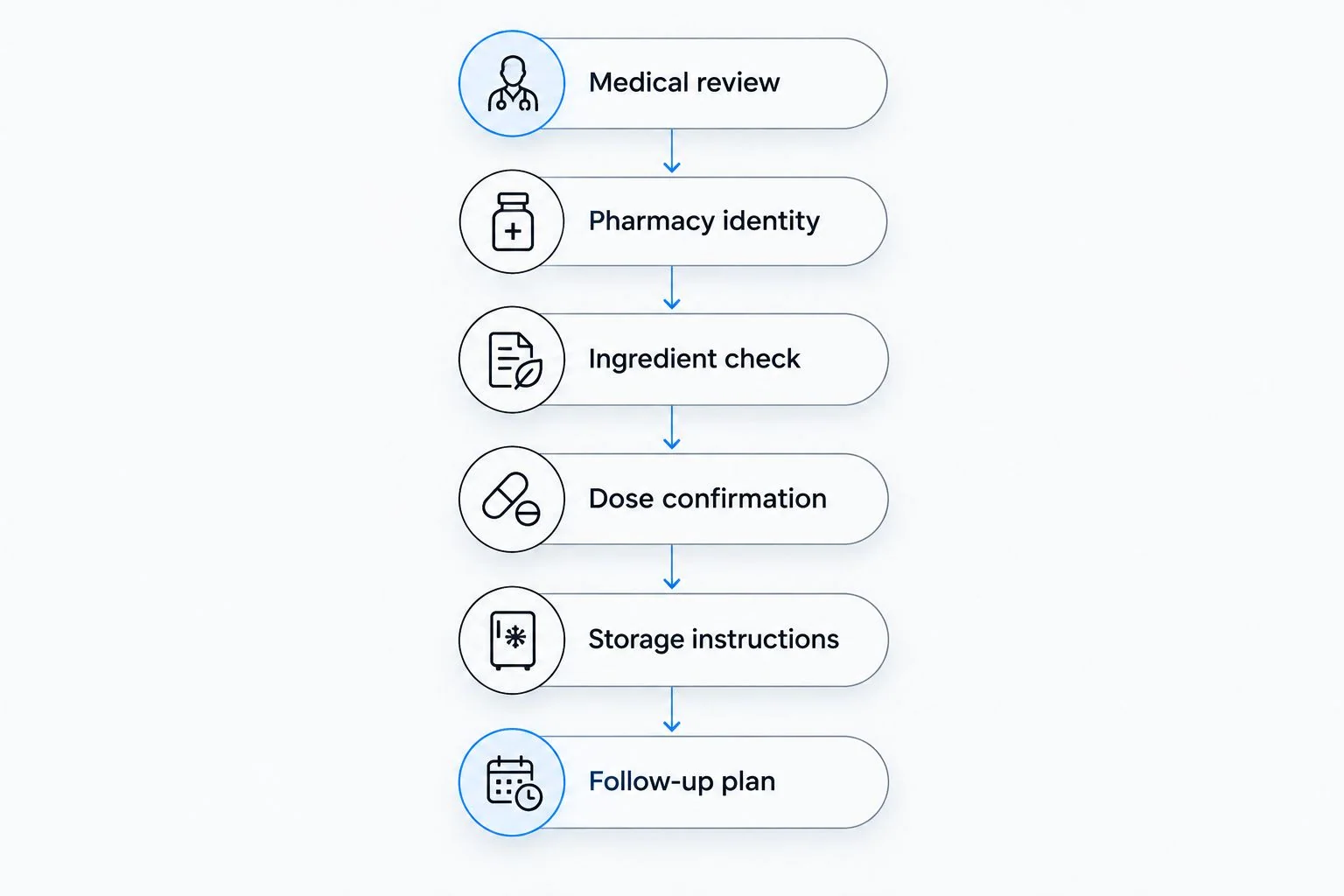
Do not inject until the prescription, label, and instructions agree. Use this sequence with your prescriber and dispensing pharmacist, especially if you are receiving a vial rather than a prefilled device.
- Medical review: Tell your prescriber about your diagnoses, allergies, current medicines, previous GLP-1 use, and pregnancy plans. Include supplements and medications prescribed elsewhere.
- Pharmacy identity: Obtain the dispensing pharmacy’s name and contact details. Check its license through the relevant state pharmacy board; a telehealth company and a dispensing pharmacy are different entities.
- Ingredient check: Ask what active ingredient the preparation contains and whether anything else has been added. Do not infer ingredients from a treatment plan’s marketing name.
- Dose confirmation: Have the pharmacist confirm your prescribed dose in milligrams and the corresponding volume for that vial. Ask for a demonstration using the exact syringe you received.
- Storage instructions: Confirm storage, handling, and the beyond-use date. Ask what to do if the package arrives outside the stated conditions or the vial’s appearance changes.
- Follow-up plan: Know whom to contact for side effects, missed doses, refill questions, or suspected dosing errors. Do not wait for a scheduled appointment when symptoms require urgent attention.
Write down the answers. If the pharmacy cannot reconcile the prescribed dose with the vial label and syringe, pause treatment until the discrepancy is resolved.
Why syringe units need extra attention
A syringe marking measures volume; it does not independently tell you how much semaglutide you are injecting. The medication concentration connects that volume to the prescribed dose.
The FDA has reported dosing errors involving compounded injectable semaglutide, including errors by patients measuring doses and clinicians calculating them. Some reported errors required medical attention or hospitalization.
Never reuse instructions from a previous vial without checking the new label. In 2026, the safe refill habit is to confirm the concentration and dose instructions every time the preparation changes.
Do not use a conversion found on social media, and do not rely on a friend’s syringe markings. Ask your dispensing pharmacist to explain the dose for your own prescription and supplies.
If you suspect an incorrect dose, contact your clinician or Poison Control promptly. Severe symptoms require urgent medical care; do not take another dose while trying to correct the mistake yourself.
Who needs additional medical screening?
Semaglutide’s medical risks apply whether the preparation is compounded or FDA-approved. Compounding does not remove contraindications or make a medication safer for a person who should not receive it.
FDA-approved semaglutide prescribing information includes a boxed warning concerning thyroid C-cell tumors observed in rodents. Relevant products are contraindicated in people with a personal or family history of medullary thyroid carcinoma or multiple endocrine neoplasia syndrome type 2; the human relevance of the rodent findings is unknown.
Your prescriber also needs to review a history of pancreatitis, gallbladder problems, kidney concerns, severe gastrointestinal symptoms, and diabetic eye disease. Taking insulin or a sulfonylurea changes the discussion because combining these medicines with semaglutide can increase hypoglycemia risk.
For planned pregnancy, FDA semaglutide labeling advises stopping at least 2 months beforehand. Discuss pregnancy, breastfeeding, and contraception with your clinician rather than applying general online advice to your situation.
Semaglutide has an elimination half-life of approximately 1 week, according to FDA prescribing information. That is one reason an incorrect dose is not something you can simply undo by skipping dinner or drinking extra water.
Which symptoms need urgent attention?
Seek urgent assessment for severe or persistent abdominal pain, especially with vomiting. Semaglutide prescribing information warns about pancreatitis and other conditions that require evaluation rather than an at-home dose adjustment.
Trouble breathing, swelling of the face or throat, fainting, or another severe allergic reaction requires emergency care. Persistent vomiting, inability to keep fluids down, or markedly reduced urination also needs prompt medical attention because dehydration can affect kidney function.
Mild nausea is different from symptoms that stop you from drinking or functioning. Tell your prescriber about persistent side effects before escalating treatment, and never increase the dose to compensate for slower-than-expected weight loss.
Where does VevaRX fit in this decision?
VevaRX is for US adults seeking doctor-prescribed GLP-1 weight-loss care online. The platform offers semaglutide and tirzepatide as part of its telehealth services, but the platform description alone does not establish the formulation or dispensing pharmacy for an individual prescription.
The relevant benefit of VevaRX is access to an online medical prescribing pathway. The limitation is that you still need preparation-specific answers: ingredient identity, pharmacy details, dose instructions, and the clinical reason for the prescribed option.
Ask VevaRX about those points during the prescribing discussion. A medical review is the place to determine suitability—not a promise that every applicant should receive semaglutide.
Is compounded semaglutide the same as approved semaglutide?
Compounded semaglutide is not the same FDA-reviewed finished product as an approved medication. Even when a preparation uses the same active ingredient, differences in concentration, additional ingredients, packaging, and manufacturing oversight require separate assessment.
Does adding vitamin B12 make compounded semaglutide safer?
Adding vitamin B12 does not establish that compounded semaglutide is safer or more effective. The FDA says the safety and effectiveness of combining semaglutide with additional ingredients have not been established; ask what clinical need the added ingredient addresses.
Can a prescription guarantee compounded semaglutide safety?
A prescription cannot guarantee compounded semaglutide safety. It supports medical oversight, but it does not replace verification of the finished preparation, dispensing pharmacy, or dosing instructions.
FAQ
Is compounded semaglutide FDA-approved?
No. Compounded semaglutide is not FDA-approved, and the FDA does not review each finished compounded preparation for safety, effectiveness, or quality before use.
What's the safest starting point when choosing semaglutide?
An FDA-approved semaglutide medication is the preferred starting point when it meets your clinical needs. Your prescriber must still assess the indication, contraindications, and other medicines you take.
Is semaglutide sodium the same as semaglutide?
Semaglutide sodium is a different active ingredient from the semaglutide used in FDA-approved medications. Do not accept it as an equivalent substitute without addressing the FDA's safety and legal concerns with your prescriber.
Can I use the same syringe instructions for every refill?
No. Confirm the concentration, prescribed dose, and syringe instructions for each refill, especially when the preparation changes.
How often is approved injectable semaglutide for weight management taken?
Approved injectable semaglutide for weight management is taken once per week under its prescribing instructions. That schedule does not establish the correct dose or injection volume for a compounded preparation.
When should I stop semaglutide before a planned pregnancy?
FDA semaglutide labeling advises stopping at least 2 months before a planned pregnancy. Make that plan with your prescriber rather than changing treatment without medical guidance.
What should I do if I inject the wrong semaglutide dose?
Contact your clinician or Poison Control promptly after a suspected dosing error. Severe symptoms require urgent medical care; do not take another dose to correct the mistake.
Can compounded semaglutide be prescribed legally in 2026?
Compounded semaglutide can be prescribed only when the preparation and circumstances meet applicable federal and state requirements. Do not assume that a previous shortage or an existing prescription permits routine copies of approved drugs.
One last thing
The easiest mistake to miss is a refill that looks familiar but has a different concentration. The drug name alone does not tell you whether the same syringe marking still matches your prescribed dose.
Before your next injection in 2026, compare the prescription, concentration, and written instructions together. If anything differs or is unclear, have the dispensing pharmacist explain it before you inject. Keep medical decisions with your clinician; use this guide to ask better questions, not to calculate or change a dose yourself.
Related guides
This article is for informational purposes only and is not medical advice. Compounded medications are not approved by the FDA and have not been reviewed for safety, effectiveness, or quality. Prescription products require an online consultation with a licensed healthcare provider who will determine if a prescription is appropriate. Individual results vary.