
Is NAD+ therapy worth it in 2026?
Is NAD+ therapy worth it in 2026? Benefits remain unproven for aging and weight loss. Compare routes, safety risks, and questions to ask before treatment.

NAD+ therapy is not worth treating as a proven anti-aging, weight-loss, or fatigue treatment in 2026: human evidence does not establish those benefits. Consider it only after a clinician evaluates your goal and explains the uncertainty, procedure risks, and alternatives; an increase in an NAD-related blood marker is not proof that you will feel better or live longer.
- Is NAD+ therapy worth it in 2026? Not as a proven treatment for aging, weight loss, or unexplained fatigue.
- NAD+ injections and IV infusions add administration risks without established anti-aging benefits.
- VevaRX offers prescription NAD+; a prescription does not establish effectiveness for a particular wellness goal.
- Investigate persistent fatigue before choosing NAD+ therapy or NAD+ supplements.
Is NAD+ therapy worth it in 2026?
For general wellness, the evidence does not justify a confident recommendation. NAD+ has essential biological functions, but that fact does not establish that administering extra NAD+ improves health in otherwise healthy adults. Research on a mechanism, a blood measurement, and a meaningful clinical benefit answers different questions.
The route also matters. If you are considering self-administration, review whether you can take NAD+ injections at home before making convenience your deciding factor.
| Option | Best suited to | What supports interest | Main limitation |
|---|---|---|---|
| NAD+ injections | A clinician-led discussion when you specifically want to consider injectable NAD+ | Deliver NAD+ without an oral route | Clinical benefits remain uncertain; injections introduce dosing, sterility, and injection-site risks |
| NAD+ IV infusions | A clinician-led discussion about supervised intravenous administration | Administration occurs through an IV | Requires venous access and monitoring; the procedure does not establish effectiveness |
| Oral NAD+ precursors | A discussion about non-injectable approaches | Some human studies show changes in NAD-related biomarkers | Biomarker changes do not prove better energy, longer life, or disease prevention |
These labels describe the relevant consultation, not an endorsement of treatment. No route earns a recommendation simply because it gets a substance into the body differently.
Why this matters
Wellness claims often move too quickly from cellular biology to personal results. NAD+ participates in energy metabolism and other cellular processes, but your body using a molecule does not mean adding more produces the outcome an advertisement promises.
For your 2026 decision, separate three questions: does the intervention affect an NAD-related measurement, does it improve something you notice, and does it improve a meaningful health outcome? Evidence for the first question cannot automatically answer the other two. Your decision should turn on the outcome you actually want.
There is also a classification issue: NAD+ is a coenzyme, not a peptide. Being offered alongside wellness peptides does not make these substances interchangeable or give them the same evidence, risks, or regulatory status.
NAD+ injections: convenience is not evidence of benefit
An injection avoids intravenous access, but it still requires an appropriate prescription, clear administration instructions, and attention to sterile technique. Home administration shifts practical responsibilities to you, including following the prescribed directions and recognizing when to seek help.
The practical appeal is understandable: an injection can fit a different routine than an infusion appointment. The drawback is equally clear: a simpler routine does not resolve uncertainty about effectiveness. Do not choose injections because a provider presents them as a shortcut to improved energy or slower aging.
Before agreeing, ask who will prescribe the treatment, which pharmacy will dispense it, and how questions or adverse reactions will be handled. Confirm the exact formulation rather than assuming all products described as NAD+ are identical.
NAD+ IV infusions: supervision does not prove effectiveness
Intravenous administration involves a catheter and direct access to the bloodstream. That creates procedure-related considerations, including infection, vein irritation, and administration reactions, alongside the uncertainty about the intended wellness benefit.
Clinical supervision is a safety consideration, not evidence that an infusion works. A comfortable treatment setting, monitoring equipment, or a detailed intake form cannot establish an anti-aging effect.
If you consider an infusion in 2026, ask what evidence supports the proposed outcome specifically for intravenous NAD+. Studies of oral precursors cannot establish the benefits of an IV infusion. Neither can testimonials from people who received several treatments or changed other habits at the same time.
Oral NAD+ precursors: biomarker results need context
Nicotinamide riboside and nicotinamide mononucleotide are NAD+ precursors studied in humans. Some studies report increases in NAD-related measurements, but research findings differ by compound, population, duration, and outcome.
The practical advantage of an oral approach is avoiding injection and IV procedures. Its limitation is that a change in an NAD-related marker does not, by itself, establish a meaningful improvement in fatigue, physical function, or longevity.
Do not treat precursor research as proof for every product marketed under the NAD+ label. Ask whether the study used the same substance and route being recommended to you. A shared connection to NAD+ is not enough to make treatments equivalent.
Why NAD+ therapy's value varies
The decision depends on more than administration method. These factors determine whether the proposed treatment addresses your situation or simply adds another intervention:
- Your goal: General wellness, persistent fatigue, weight management, and disease treatment require different evidence and clinical evaluation.
- The formulation: NAD+ and NAD+ precursors are different interventions; evidence must match the actual substance.
- The route: Oral use, injections, and infusions have different administration burdens and risks.
- Your health history: Current symptoms, medications, pregnancy or breastfeeding, and existing conditions belong in the prescribing discussion.
- Product quality: For an injectable product, preparation, sterility, labeling, and pharmacy sourcing are essential safety questions.
- The follow-up plan: A defined outcome and reassessment plan are more useful than an open-ended promise of better wellness.
The strongest reason to pause is a provider who cannot connect the proposed treatment to your specific goal. A list of biological functions is not that connection. Neither is a recommendation to keep purchasing treatment until you notice something.
What safety questions should you ask before starting?
For a 2026 safety check, review the FDA's warning about using food-grade NAD+ ingredients to compound sterile injectable products. The agency has described adverse-event reports involving injectable NAD+ consistent with excessive endotoxin exposure, including severe chills, shaking, vomiting, and fatigue. That warning concerns injectable product quality; it does not establish a complication rate for every NAD+ product.
Ask the prescriber to identify the dispensing pharmacy and explain how product-quality concerns are handled. Do not assume that a compounded medication has undergone FDA review for safety, effectiveness, and quality. Compounded drugs are not FDA-approved.
Your safety discussion should also cover what to do if symptoms develop during or after administration. Seek urgent medical care for trouble breathing, chest pain, fainting, or another severe reaction. Do not continue administering a product while waiting for a routine message response about a serious symptom.
How do you decide whether to try NAD+ therapy?
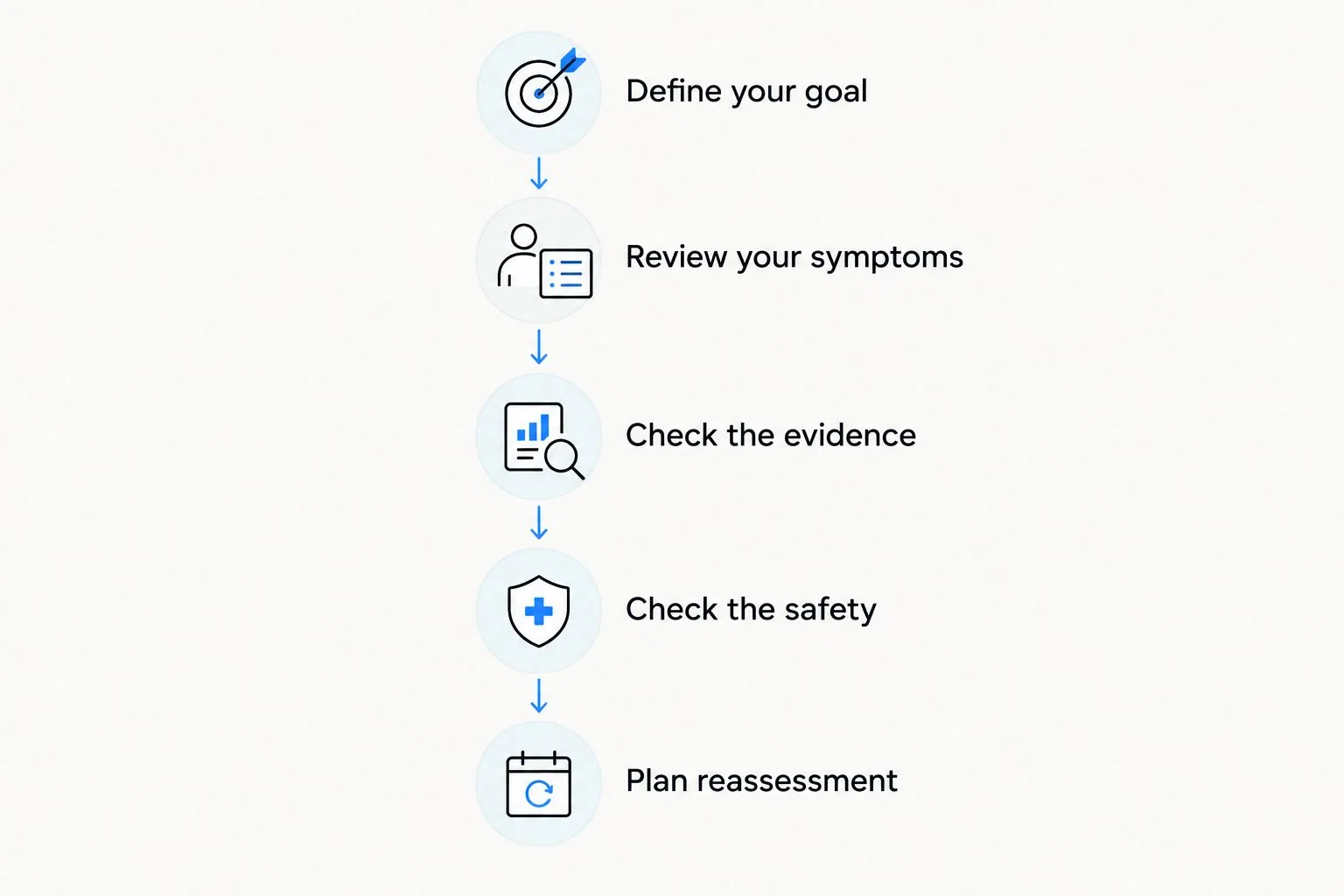
Use a decision process that starts with your health concern, not a treatment package. The following sequence helps keep the consultation focused on a result you can evaluate.
- Define your goal. Describe the problem in practical terms, such as fatigue interfering with daily activities, rather than asking for a general energy boost.
- Review your symptoms. Discuss onset, sleep, medication changes, diet, and associated symptoms with a clinician. Evaluation should guide any testing.
- Check the evidence. Ask for human research matching the proposed substance, route, and outcome. Separate biomarker findings from clinical benefits.
- Check the safety. Review your medical history, product sourcing, administration instructions, and the response plan for adverse effects.
- Plan reassessment. Agree on what improvement would mean and when to reconsider treatment. Do not increase or repeat treatment on your own.
A recommendation to defer treatment is a legitimate clinical outcome. You do not need to leave an appointment with a prescription for the consultation to have been useful. Identifying a better-supported next step is useful care.
What should you address before using NAD+ for fatigue?
Persistent fatigue deserves an evaluation rather than an automatic wellness prescription. Sleep disorders, anemia, thyroid conditions, medication effects, and other problems can contribute; a clinician should decide which possibilities fit your symptoms.
Basic health recommendations are not a cure for unexplained fatigue, but they provide a better-supported starting point than anti-aging promises:
- Sleep: CDC guidance recommends at least 7 hours per night for adults aged 18–60. Adequate time in bed does not rule out a sleep disorder.
- Aerobic activity: US Physical Activity Guidelines recommend at least 150 minutes per week of moderate-intensity activity for adults who can safely participate.
- Strength activity: The same guidelines recommend muscle-strengthening activity on at least 2 days per week.
These are general adult recommendations, not instructions to push through illness or severe exhaustion. Ask for individualized guidance if symptoms limit activity, and do not postpone evaluation while trying to meet a wellness target.
Where does VevaRX fit into this decision?
VevaRX is an online telehealth platform offering doctor-prescribed weight-loss medications and wellness treatments, including NAD+. VevaRX is best suited to adults seeking an online prescription consultation, not a guarantee that NAD+ reverses aging.
The relevant advantage is access to a prescription-based clinical discussion. The limitation is that access to treatment does not remove the evidence gaps surrounding general wellness claims. A provider's offering and a treatment's demonstrated benefit are separate questions.
Use the consultation to discuss your symptoms, current medications, and desired outcome. Ask whether NAD+ is appropriate at all, rather than treating a prescription as the expected result.
Is NAD+ therapy worth it for weight loss?
NAD+ therapy is not an established weight-loss treatment. Its role in cellular metabolism does not establish that injections or infusions produce clinically meaningful weight loss. Do not use wellness claims as a substitute for an evidence-based weight-management assessment.
Does feeling better after NAD+ prove it worked?
Feeling better after NAD+ does not prove the treatment caused the improvement. Sleep, hydration, expectations, other treatments, and natural symptom variation can affect how you feel. Record changes and discuss them with your clinician without assuming causation.
Should you keep using NAD+ if you notice no benefit?
Do not continue NAD+ automatically when the agreed goal is not improving. Reassess with the prescriber rather than changing the dose, adding treatments, or assuming that more sessions will solve the problem.
FAQ
Is NAD+ therapy worth it in 2026?
NAD+ therapy is not supported as a proven anti-aging, weight-loss, or general fatigue treatment in 2026. A clinician should evaluate your goal and explain the evidence gaps before you consider it.
Are NAD+ injections better than IV infusions?
Neither NAD+ injections nor IV infusions have established superiority for general wellness outcomes. The routes have different administration burdens and risks, which should be discussed separately from effectiveness.
Does NAD+ therapy help you lose weight?
NAD+ therapy is not an established weight-loss treatment. Participation in cellular metabolism does not prove that administering NAD+ causes meaningful weight loss.
Is NAD+ a peptide?
NAD+ is a coenzyme, not a peptide. Offering it alongside wellness peptides does not make the substances equivalent.
Are compounded NAD+ injections FDA-approved?
Compounded NAD+ injections are not FDA-approved. A prescription does not mean the FDA has reviewed a compounded product for safety, effectiveness, and quality.
Can I use NAD+ instead of getting fatigue checked?
NAD+ should not replace an evaluation for persistent or unexplained fatigue. A clinician can assess symptoms and decide whether testing or another treatment is appropriate.
Does VevaRX offer NAD+ therapy?
VevaRX offers doctor-prescribed NAD+ through its online telehealth platform. Whether it is appropriate for you requires an individual clinical assessment.
One last thing
Ask what result would make your clinician recommend stopping, not just starting. A clear answer forces the discussion beyond vague promises about cellular health. For a 2026 decision about an uncertain wellness treatment, a stopping rule is more useful than a package recommendation.
This article provides general education, not an individual treatment recommendation. Your medical history and the exact product matter.
Related guides
This article is for informational purposes only and is not medical advice. Compounded medications are not approved by the FDA and have not been reviewed for safety, effectiveness, or quality. Prescription products require an online consultation with a licensed healthcare provider who will determine if a prescription is appropriate. Individual results vary.