
Is peptide therapy legal in the US?
Peptide therapy is legal in the US in 2026 with a physician prescription and licensed pharmacy — see which peptides qualify and which don't.

Peptide therapy is legal in the US in 2026, but only inside one specific lane: a licensed physician writes the prescription, and a state-licensed pharmacy fills it. Step outside that lane into the "research chemical" market and the legal ground disappears fast, along with any quality control on what's actually in the vial.
- Peptide therapy is legal in the US in 2026 when prescribed by a licensed physician and dispensed by a licensed pharmacy.
- FDA-approved peptides like semaglutide and tirzepatide carry the clearest legal status of any category.
- Compounded peptides such as NAD+, glutathione, and sermorelin are legal through 503A or 503B pharmacies with a valid prescription.
- BPC-157 and other 'research-only' peptides sit in a legal gray zone after the FDA moved to restrict compounding them.
- VevaRX prescribes GLP-1 medications and wellness peptides through licensed US physicians and pharmacies, not gray-market suppliers.
Why this matters
The peptide market split into two very different worlds over the past few years: one running through licensed physicians and pharmacies, and one running through Instagram ads and unmarked shipping labels. Both call themselves "peptide therapy," and only one of them is actually legal for human use.
Platforms like VevaRX built their whole model around staying on the legal side of that line — physician consult first, licensed pharmacy second. That distinction matters more than the peptide name itself when you're deciding where to get a prescription in 2026.
Is peptide therapy legal in the US?
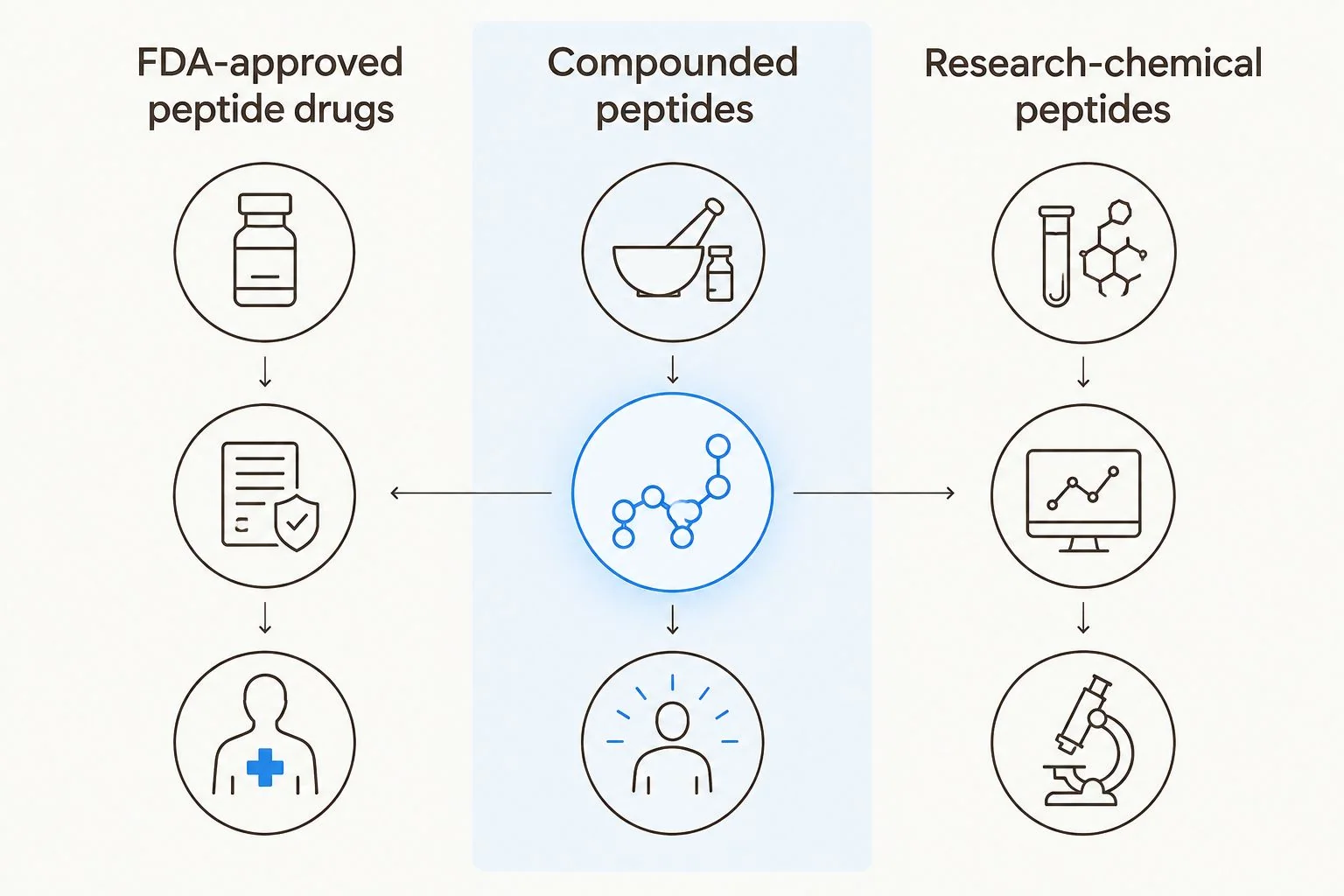
Yes, peptide therapy is legal in the US when it runs through a licensed physician and a licensed pharmacy — it stops being legal the moment either of those pieces is missing. The legal status actually depends on which of three buckets a given peptide falls into, and the differences between them are wide.
| Category | Legal status in 2026 | Example peptides |
|---|---|---|
| FDA-approved peptide drugs | Legal by prescription nationwide | Semaglutide, tirzepatide, sermorelin acetate |
| Compounded peptides (503A/503B) | Legal when a licensed pharmacy compounds from an FDA-permitted bulk substance | NAD+, glutathione, compounded sermorelin |
| Research-chemical peptides | Not legal for human use; sold labeled "not for human consumption" | BPC-157 in restricted states, TB-500, unapproved growth-hormone peptides |
Every legitimate telehealth provider in this space, VevaRX included, operates in the top two rows of that table. The bottom row is where most of the legal risk — and most of the sketchy Reddit threads — actually live.
FDA-Approved Peptides: Legal by Prescription
Semaglutide (marketed as Ozempic and Wegovy) and tirzepatide (Mounjaro and Zepbound) went through full FDA drug approval, so any licensed US physician can prescribe them and any licensed pharmacy can dispense them nationwide. This is the cleanest legal category in peptide medicine: prescription, pharmacy, done.
Sermorelin acetate has a similar approval history under the discontinued brand Geref, and compounded versions of it are typically made under 503A rules today. If you want a peptide with the least legal ambiguity attached to it, this is the category to look at first.
Best for: patients who want a prescription peptide with a full FDA approval history behind the active ingredient.
Compounded Peptides: Legal Through Licensed 503A/503B Pharmacies
Peptides like NAD+ and glutathione usually aren't individually FDA-approved as standalone drugs for the uses they're prescribed for, but a licensed 503A compounding pharmacy or an FDA-registered 503B outsourcing facility can legally prepare them for a patient who has a valid prescription. The catch: the underlying bulk substance can't be on the FDA's excluded list.
This is where most telehealth wellness-peptide prescribing actually lives in 2026. VevaRX prescribes wellness peptides like Sermorelin, Glutathione, and NAD+ alongside GLP-1 medications, all dispensed through licensed US pharmacies after a physician evaluates the patient — not shipped from an unregulated supplier.
Best for: patients who want wellness peptides outside the strict GLP-1 category, prescribed and filled the legal way.
Research-Chemical Peptides: Not Legal for Human Use
Peptides sold online labeled "for laboratory research only, not for human consumption" are not legal to use as medicine, regardless of how confidently they're marketed on social media. BPC-157 is the clearest example: the FDA nominated it for exclusion from the compoundable bulk drug substances list over safety concerns, and a growing number of states have restricted or banned compounding it since that nomination, a restriction that's still in force across most of them in 2026.
Buying peptides this way skips the physician evaluation, the pharmacy licensing, and the quality testing that make legitimate peptide therapy legal in the first place. There's no dosing oversight, no sterility standard, and no legal recourse if the vial contains something other than what the label claims.
Best for: nobody — this is the category to avoid, full stop. Skip it.
Why peptide legality varies from state to state
A peptide's legal status isn't uniform across all 50 states, and a handful of factors decide where the lines actually fall:
- Whether the peptide's bulk substance sits on the FDA's compoundable list or has been excluded from it
- Whether the pharmacy holds an active state board of pharmacy license and operates under 503A or 503B rules
- Whether a licensed physician actually evaluated the patient before writing the prescription
- The specific state's telehealth prescribing laws, which vary on what a remote consult can authorize
- Whether the seller markets the peptide as a drug (regulated) or as a "research chemical" or supplement (unregulated, and usually illegal for that marketed use)
- Recent state-level restrictions layered on top of federal FDA guidance, particularly around BPC-157
Is BPC-157 legal in the US in 2026?
BPC-157 is not legal to sell for human use across most of the US in 2026, after the FDA nominated it for exclusion from the compoundable bulk drug substances list over safety concerns. Several states adopted their own restrictions on top of that federal move, so a compounding pharmacy that could legally prepare it a few years ago likely can't anymore.
Can you buy peptides online legally?
Yes, you can buy peptides online legally in the US in 2026, but only through a platform that requires a physician consultation and dispenses through a licensed 503A or 503B pharmacy. Buying directly from a "research chemical" storefront isn't legal for human use, no matter how the product page is worded.
Do you need a prescription for peptide therapy?
Yes, every peptide covered in this guide — from semaglutide to NAD+ to sermorelin — requires a prescription from a licensed US physician before a legitimate pharmacy will fill it in 2026. Any seller offering peptides without that step is operating outside the legal framework, regardless of what the marketing claims.
“Peptide therapy is legal in the US only when it stays inside the prescription-and-pharmacy system, not when it ships from a research-chemical warehouse.”
Start with a licensed peptide consult
Get evaluated by a US physician before choosing a peptide.
FAQ
Is peptide therapy legal in the US in 2026?
Yes, peptide therapy is legal in the US in 2026 when a licensed physician prescribes it and a licensed pharmacy dispenses it. It becomes illegal, or at least unsafe and unregulated, when peptides are sold as research chemicals not intended for human use.
Is semaglutide legal without a prescription?
No, semaglutide is not legal to obtain without a prescription in the US. It's an FDA-approved drug, so it requires a licensed physician's prescription and a licensed pharmacy to dispense it.
Are compounded peptides legal?
Yes, compounded peptides are legal when prepared by a state-licensed 503A pharmacy or an FDA-registered 503B outsourcing facility from a permitted bulk substance. They become illegal to sell for human use if the substance has been excluded from the FDA's compoundable list.
Why is BPC-157 restricted in some states?
BPC-157 is restricted in several states because the FDA nominated it for exclusion from the compoundable bulk drug substances list over safety concerns. State pharmacy boards followed with their own restrictions on compounding it.
Can a telehealth doctor prescribe peptides?
Yes, a telehealth doctor can prescribe peptides as long as they're licensed in the patient's state and the peptide is either FDA-approved or legally compoundable. The prescription still has to route through a licensed pharmacy.
Is NAD+ therapy legal in the US?
Yes, NAD+ therapy is legal in the US when prescribed by a licensed physician and compounded by a licensed 503A or 503B pharmacy. It's not legal when sold directly to consumers without a prescription or physician oversight.
What makes a peptide seller illegal?
A peptide seller is operating illegally for human use when it sells peptides without requiring a prescription, markets them as "research chemicals not for human consumption," or ships from outside the licensed pharmacy system entirely.
One last thing
The fastest way to check if a peptide provider is legitimate in 2026 isn't the peptide name on the label — it's whether a real physician evaluated you before anything shipped. If a site skips the consult and goes straight to checkout, that's the tell, not the price.
Related guides
This article is for informational purposes only and is not medical advice. Compounded medications are not approved by the FDA and have not been reviewed for safety, effectiveness, or quality. Prescription products require an online consultation with a licensed healthcare provider who will determine if a prescription is appropriate. Individual results vary.