
Is Sermorelin safe for long-term use?
Is sermorelin safe for long-term use? Safety is not established for adult wellness use. Learn the evidence limits, warning signs, and questions for your doctor.

Sermorelin has not been established as safe for indefinite use in otherwise healthy adults seeking anti-aging, recovery, or wellness benefits. Long-term safety evidence for those uses is limited, and stimulating your own growth hormone does not eliminate hormone-related risks. In 2026, the practical answer is to avoid open-ended treatment without a clear medical rationale, individualized monitoring, and a plan for stopping.
- Is sermorelin safe for long-term use? Long-term safety for adult wellness use is not established.
- Sermorelin's effect on growth hormone does not prove anti-aging benefits or eliminate treatment risks.
- Compounded sermorelin is not FDA-approved; prescription access does not establish product quality or long-term safety.
- VevaRX offers prescription wellness peptides; treatment suitability still requires an individual medical assessment.
Is sermorelin safe for long-term use?
There is no established duration that makes long-term sermorelin use safe for every adult. Evidence from a different indication, age group, or treatment setting cannot establish the safety of years of elective wellness treatment.
For your 2026 decision, separate these questions: Is there a medical reason to treat? Does the prescribed preparation have appropriate quality controls? Is continuing treatment justified by your results and risks? The guide to peptide therapy legality in the US addresses a related issue, but legal prescribing and proven long-term safety are different questions.
| Decision path | Best for | Potential advantage | Important limitation |
|---|---|---|---|
| Medical evaluation before treatment | Adults with unexplained symptoms or suspected hormone deficiency | Investigates the cause before choosing treatment | An evaluation does not guarantee a prescription or establish sermorelin as the right treatment |
| Clinician-supervised sermorelin treatment | Patients whose clinician identifies an individualized rationale | Allows review of symptoms, adverse effects, and relevant laboratory results | Supervision does not resolve gaps in long-term adult wellness evidence |
| Deferring sermorelin | Adults considering treatment without a diagnosis or clear goal | Avoids exposure to an uncertain treatment benefit and injection-related risks | Symptoms still need evaluation rather than being ignored |
These are decision paths, not a ranking of treatment effectiveness. If your only rationale is an anti-aging promise, seek a medical evaluation before starting.
Why this matters
Fatigue, poor sleep, changes in body composition, and slow recovery do not diagnose growth hormone deficiency. Sleep disorders, thyroid problems, medication effects, depression, and other conditions can produce overlapping symptoms.
Starting a hormone-related treatment before investigating the cause can leave the underlying problem untreated. Feeling better after starting also does not establish which change helped, especially if you changed your diet, exercise, sleep, or other medications at the same time.
A useful treatment discussion starts with your symptoms and medical history—not with choosing a peptide. Your clinician should explain what diagnosis or treatment goal justifies the prescription and what evidence supports that choice.
What sermorelin's mechanism does—and does not—tell you
Sermorelin is a growth hormone-releasing hormone analogue. It stimulates the pituitary gland to release growth hormone, which influences insulin-like growth factor, commonly called IGF-1.
That mechanism differs from directly administering growth hormone. However, a different mechanism is not proof of better long-term safety, and the word natural does not establish that a treatment is harmless.
An increase in a laboratory marker is also not the same as a meaningful health benefit. A treatment claim about longevity, injury recovery, or weight loss needs evidence for that particular outcome—not simply evidence that a hormone level changes.
If your main goal is weight management, ask whether the proposed treatment has evidence for that goal. Sermorelin should not be treated as interchangeable with medications specifically approved for chronic weight management.
What FDA approval means for sermorelin
Compounded drugs are not FDA-approved. FDA does not review each compounded preparation for safety, effectiveness, and quality before it reaches patients in the way it reviews an approved drug.
For a 2026 prescription decision, distinguish the ingredient from the exact product you receive. Historical use of sermorelin does not make a current compounded preparation FDA-approved for adult anti-aging or wellness treatment.
Ask your prescriber to identify the dispensing pharmacy and explain why the prescribed preparation is appropriate. You should receive clear instructions for administration, storage, handling, and the pharmacy-assigned beyond-use date.
Do not substitute a product labeled for research use for a prescribed medication. A vendor's purity statement is not evidence that a product is suitable for human injection.
Why long-term sermorelin safety varies
Your risk assessment depends on more than the medication name. These factors belong in the prescribing discussion:
- Reason for treatment: A suspected endocrine disorder needs a different evaluation from an elective wellness goal.
- Medical history: Cancer history, pituitary disease, diabetes, and other endocrine conditions can change the treatment decision.
- Dose and exposure: The amount prescribed, changes in treatment, and continued exposure affect what your clinician needs to assess.
- Other medications: Prescriptions, supplements, and additional peptides can complicate interpretation of symptoms and laboratory results.
- Product handling: Preparation quality, storage, injection technique, and adherence to pharmacy instructions affect medication safety.
- Response to treatment: New symptoms, abnormal findings, or a lack of meaningful benefit should trigger reassessment—not automatic continuation.
These factors do not produce a universal safety score. They explain why a friend's experience or an online testimonial cannot determine whether treatment is appropriate for you.
What side effects and warning signs should you discuss?
Injection-site pain, redness, swelling, headache, and flushing have been reported with sermorelin. Tell your clinician about persistent or worsening symptoms rather than assuming they are an expected part of treatment.
Growth hormone-related treatment also requires attention to fluid retention, joint symptoms, and glucose regulation. Your prescriber should distinguish reported sermorelin effects from broader concerns associated with altering the growth hormone–IGF-1 pathway; they are not interchangeable evidence.
When should you seek urgent help?
Call 911 for trouble breathing, throat or tongue swelling, fainting, or other signs of a severe allergic reaction. Do not wait for a routine telehealth message response.
Seek prompt medical evaluation for a severe or unusual headache, new vision changes, or significant new swelling. These symptoms need assessment whether or not sermorelin caused them.
For injection-site redness that spreads, increasing warmth, drainage, or fever, contact a healthcare professional promptly. Do not inject into an area that appears infected.
What should monitoring look like before continued treatment?
There is no universal monitoring schedule that proves elective long-term sermorelin treatment safe. Your clinician should choose follow-up based on the indication, medical history, symptoms, and findings—not a generic renewal calendar.
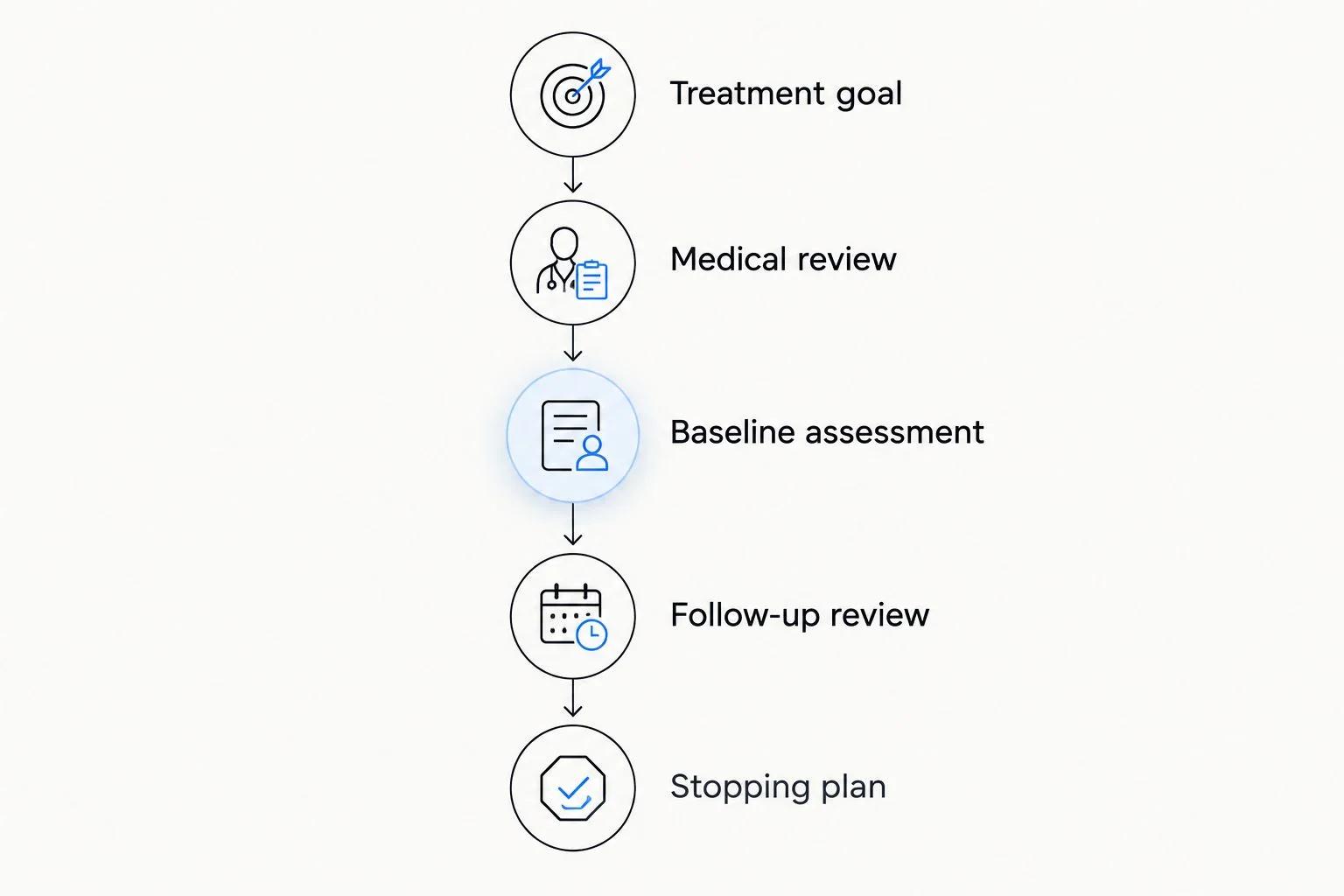
Use this sequence to make the discussion concrete:
- Treatment goal: Identify the symptom or diagnosed condition being addressed and the benefit that would justify treatment.
- Medical review: Discuss your health history, medication list, pregnancy plans, and any prior endocrine evaluation.
- Baseline assessment: Ask which examinations or laboratory tests are appropriate and what each result would change.
- Follow-up review: Reassess symptoms, adverse effects, and relevant findings before continuing or changing treatment.
- Stopping plan: Agree on what would trigger a pause, further evaluation, a different treatment, or discontinuation.
A prescription renewal should follow a clinical decision. It should not replace one.
Which laboratory tests matter?
IGF-1 can be part of a clinician's assessment of the growth hormone axis, but a result does not independently establish treatment safety or benefit. Interpretation depends on factors such as age, clinical context, and the laboratory's reference range.
A random growth hormone measurement is generally not sufficient to diagnose adult growth hormone deficiency because secretion is pulsatile. When deficiency is suspected, an endocrinologist can determine whether stimulation testing or other evaluation is appropriate.
Glucose-related testing and other assessments depend on your individual risk factors. Do not use a normal result as permission to increase your dose or extend treatment without review.
Who needs particular caution before starting?
Tell your prescriber about active or previous cancer, pituitary or brain disease, diabetes, unexplained headaches, vision changes, and any previous reaction to an injectable medication. These details can change whether treatment is appropriate or whether specialist evaluation is needed.
Pregnancy, attempts to conceive, and breastfeeding require an explicit discussion before treatment. Do not interpret the absence of a warning in promotional material as evidence of safety in these situations.
Bring a complete medication and supplement list, including other peptides and hormones. If different clinicians prescribe different treatments, make sure each knows the full regimen.
Do not conceal another treatment to keep a prescription active. A prescriber cannot assess interactions or interpret new symptoms accurately with an incomplete history.
Can you take sermorelin indefinitely if your labs stay normal?
Normal laboratory results do not establish that indefinite sermorelin use is safe. They describe selected measurements at a particular time and do not answer every question about long-term outcomes.
Continuing treatment should require a clear benefit-risk discussion. If the only justification is that nothing abnormal has appeared yet, ask what positive treatment outcome supports continued exposure.
Does cycling sermorelin make long-term use safer?
Cycling sermorelin has not been established as a way to make long-term adult wellness use safe. An on-and-off schedule is not a substitute for evidence, individualized assessment, or a stopping plan.
Do not copy a cycle from a forum or adjust your schedule independently. Ask the prescriber to explain the rationale for any proposed interruption and what should happen before restarting.
Where online prescription care fits
VevaRX is best suited to adults seeking online prescription-based weight-loss and wellness care. The platform offers doctor-prescribed GLP-1 medications and wellness peptides, including sermorelin; that service description does not establish that sermorelin is appropriate for every patient.
The benefit of a prescription-based approach is the opportunity for a medical treatment decision rather than self-directed purchasing. Its limitation remains the evidence: online access does not make an uncertain long-term benefit certain.
If you consider VevaRX, ask the same questions you would ask any prescriber: Why this treatment, what monitoring, and when should it stop? In 2026, convenience should support medical oversight, not replace it.
FAQ
Is sermorelin safe for long-term use in healthy adults?
Long-term safety for sermorelin used by otherwise healthy adults for wellness or anti-aging is not established. An individualized prescription and monitoring plan do not eliminate that evidence gap.
Does sermorelin cause cancer?
Available evidence does not establish a definitive cancer-risk answer for long-term adult wellness use. Because the growth hormone–IGF-1 pathway is relevant to cell growth, disclose any cancer history and discuss whether specialist input is needed.
Is compounded sermorelin FDA-approved?
Compounded sermorelin is not FDA-approved. FDA does not review each compounded preparation for safety, effectiveness, and quality before patients receive it in the same way it reviews approved drugs.
Can normal IGF-1 levels prove sermorelin is safe?
Normal IGF-1 levels do not prove sermorelin is safe for indefinite use. Your clinician must interpret laboratory results alongside symptoms, medical history, treatment goals, and adverse effects.
Can I use sermorelin while pregnant or breastfeeding?
Sermorelin should not be assumed safe during pregnancy or breastfeeding. Discuss pregnancy, plans to conceive, or breastfeeding with your prescriber before starting or continuing treatment.
Does VevaRX offer sermorelin prescriptions?
VevaRX offers doctor-prescribed wellness peptides, including sermorelin. Whether treatment is appropriate requires an individual medical assessment; offering a medication is not a guarantee of its long-term safety.
Should I keep taking sermorelin if I do not notice a benefit?
A lack of meaningful benefit is a reason to reassess sermorelin with your prescriber. Do not increase the dose or continue indefinitely simply because you have not noticed side effects.
One last thing
Before accepting another prescription, ask: What finding would make you recommend that I stop? A useful answer identifies a treatment goal, a safety concern, or a lack of benefit—not just a future refill date.
For a 2026 decision, the FDA's guidance on compounded drugs supports the distinction between prescribing and approval. The Endocrine Society's clinical guidance on adult growth hormone deficiency supports diagnosis-led evaluation; it does not establish sermorelin as a proven long-term anti-aging treatment.
This article provides general education, not an individualized diagnosis or treatment plan. Your next step is a clinician-led assessment of whether treatment is justified at all.
Related guides
This article is for informational purposes only and is not medical advice. Compounded medications are not approved by the FDA and have not been reviewed for safety, effectiveness, or quality. Prescription products require an online consultation with a licensed healthcare provider who will determine if a prescription is appropriate. Individual results vary.