
Can you take semaglutide and tirzepatide together?
Can you take semaglutide and tirzepatide together? No. Learn why the combination is not recommended, how to switch safely, and when to get urgent medical help.

No—you should not take semaglutide and tirzepatide together as a weight-loss regimen. FDA prescribing information advises against combining these overlapping treatments; switching from one to the other requires a prescriber-directed plan, not adding a second injection yourself.
- Can you take semaglutide and tirzepatide together? No—the combination is not recommended in FDA prescribing information.
- Semaglutide and tirzepatide both activate GLP-1 receptors; combining them is not an established weight-loss strategy.
- Switching medications requires instructions for your last dose, first new dose, and follow-up.
- VevaRX serves US adults seeking doctor-prescribed GLP-1 weight-loss treatment online.
Can you take semaglutide and tirzepatide together?
Do not use semaglutide and tirzepatide as a combined treatment. Wegovy prescribing information advises against using it with another semaglutide-containing product or another GLP-1 receptor agonist. Zepbound prescribing information likewise advises against using it with another tirzepatide-containing product or any GLP-1 receptor agonist.
Semaglutide activates the GLP-1 receptor. Tirzepatide activates both GIP and GLP-1 receptors, so it already includes GLP-1 activity; adding semaglutide is not simply adding a separate, unrelated treatment.
For this 2026 safety question, FDA prescribing information for Wegovy and Zepbound provides the relevant guidance on coadministration. Their labeling does not establish semaglutide-plus-tirzepatide as an approved combination for weight loss.
| Medication | How it works | Best-fit context | Benefit and limitation |
|---|---|---|---|
| Semaglutide | Activates GLP-1 receptors | Patients whose clinician selects semaglutide for an appropriate indication | Has established uses in approved formulations; gastrointestinal side effects and contraindications require review |
| Tirzepatide | Activates GIP and GLP-1 receptors | Patients whose clinician selects tirzepatide for an appropriate indication | Has established uses in approved formulations; dual receptor activity does not make combination with semaglutide appropriate |
| Both together | Duplicates GLP-1 receptor activity | Not a recommended self-directed treatment option | No established combination benefit justifies ignoring labeling restrictions |
VevaRX is for US adults seeking doctor-prescribed GLP-1 weight-loss treatment online. Its online GLP-1 weight-loss platform offers semaglutide and tirzepatide prescriptions, but a platform offering both medications does not mean you should use both together.
Why this matters
The question is not whether you can physically inject both medications. It is whether the treatment plan is appropriate and supported by prescribing guidance. Combining medications with overlapping effects is different from selecting one medication after a clinical assessment.
In 2026, treat semaglutide and tirzepatide as alternatives your prescriber evaluates—not as a stack you build yourself. A weight-loss plateau, leftover medication, or a new prescription does not establish a reason to combine them.
Switching also needs coordination. Medication from your previous treatment remains in your body after the injection day, so your clinician must consider the last dose, current symptoms, and the new treatment before setting the schedule.
Why combining them is not a shortcut
Both medications can cause nausea, vomiting, diarrhea, constipation, and abdominal discomfort. Taking both does not cancel those effects. More importantly, there is no established combined dosing schedule that makes this a routine weight-loss approach.
More medication is not a substitute for reviewing the treatment plan. If your current prescription is not meeting your goals, ask your clinician to assess response, tolerability, adherence, and whether a change is appropriate.
That review should distinguish between a medication that is ineffective for you and a medication you cannot tolerate. Those are different problems. Adding a second drug without resolving the first problem makes it harder to identify what is causing symptoms or whether the original treatment was suitable.
Does dual receptor activity make tirzepatide safe to combine?
No. Tirzepatide's GIP activity does not remove its GLP-1 activity, and semaglutide adds another medication acting on that same receptor pathway.
The relevant distinction is one medication acting on two receptor types versus two medications with overlapping activity. Tirzepatide's mechanism does not override the coadministration warning in Zepbound prescribing information.
Does using a lower dose make the combination acceptable?
A smaller dose does not establish that combining semaglutide and tirzepatide is safe or effective. Do not create a split-dose regimen, alternate them informally, or use leftover injections to supplement a new prescription.
Dose adjustment is a prescribing decision. Your clinician needs the exact product, formulation, concentration when relevant, amount taken, and administration date—not just a description such as a small dose.
Why medication risk varies
There is no recommended combined regimen to personalize yourself. The clinical review instead considers factors that affect medication exposure, tolerability, and the consequences of an unintended overlap.
- Dose and timing: The amount taken and time since the last dose affect the medication remaining in your body.
- Current gastrointestinal symptoms: Vomiting, diarrhea, and poor fluid intake require attention before another treatment decision.
- Other diabetes medications: Insulin and sulfonylureas increase the importance of reviewing low-blood-sugar risk.
- Medical history: Prior serious reactions and relevant pancreatic, gallbladder, kidney, or gastrointestinal conditions belong in the assessment.
- Product and formulation: A brand-name pen, oral tablet, or compounded vial requires different identification and administration information.
These factors explain why a friend's switching instructions are not your instructions. They do not create an exception that makes self-directed combination treatment appropriate.
How long do semaglutide and tirzepatide stay in your body?
Injectable semaglutide has an elimination half-life of approximately 7 days, while tirzepatide's elimination half-life is approximately 5 days, according to their FDA prescribing information. A half-life describes how long it takes the amount of medication in the body to fall by about half—not how long it takes to disappear completely.
These pharmacokinetic figures are relevant to a 2026 switching conversation, but they are not a do-it-yourself waiting schedule. The fact that your next injection day has arrived does not mean the previous medication has cleared.
For weekly injectable formulations, the usual schedule is 1 dose per week when prescribed according to the applicable product instructions. That schedule is not permission to use one medication early in the week and the other later in the week.
Do not convert half-life information into a switching date. Your prescriber must account for the specific formulation, current dose, side effects, and reason for changing treatment.
Can you switch from semaglutide to tirzepatide?
Yes, a clinician can change your prescription from semaglutide to tirzepatide when appropriate. Switching replaces a treatment; combining adds another treatment. Those decisions are not interchangeable.
There is no universal milligram-for-milligram conversion between the two medications. Do not assume a dose number that looks similar represents the same treatment intensity, and do not copy a transition schedule from social media.
For a 2026 prescription change, get written instructions that identify the medication being stopped and the medication being started. Clear dates matter more than an informal instruction to switch next week.
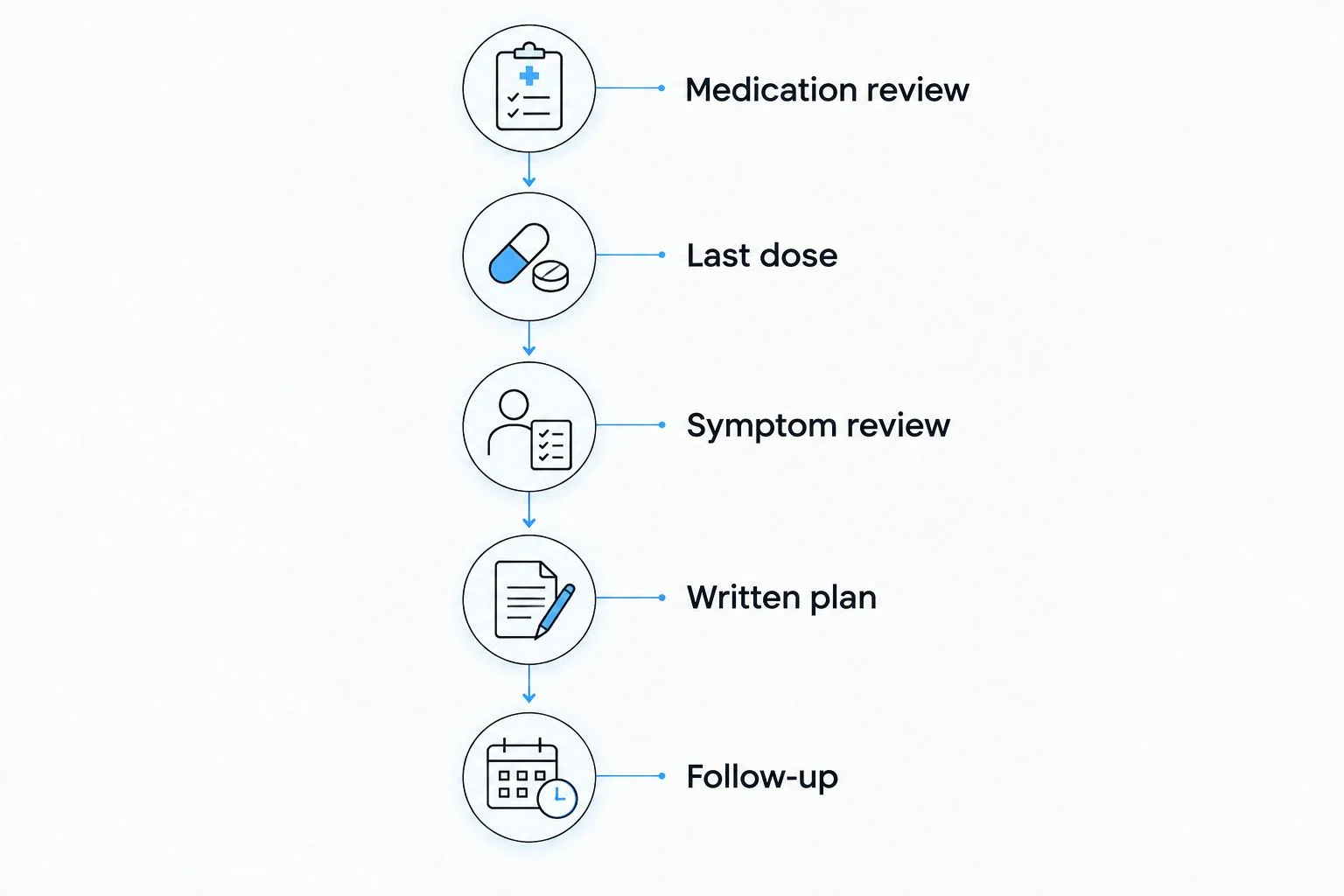
A prescriber-directed switching checklist
- Medication review: Share every current prescription, over-the-counter medication, and supplement, including insulin or other diabetes treatments.
- Last dose: Record the exact medication, formulation, amount, date, and time of your most recent dose.
- Symptom review: Report nausea, vomiting, abdominal pain, constipation, diarrhea, poor intake, or low-blood-sugar symptoms.
- Written plan: Ask for the new medication's starting instructions and confirmation of what to do with the previous prescription.
- Follow-up: Confirm who to contact about side effects, missed doses, or uncertainty about the next injection.
The goal is a clear handoff. Before starting the new prescription, you should be able to identify which medication you are taking, when you are taking it, and which clinician is directing the change.
If you use VevaRX for GLP-1 weight-loss care, tell the prescribing clinician about treatment received elsewhere as well. A prescription from another provider still belongs in your medication history, even if you plan to discontinue it.
What if you already took both medications?
Contact your prescribing clinician or Poison Control promptly for individualized advice. Do not wait for symptoms before asking what to do, and do not take another semaglutide or tirzepatide dose until a clinician has clarified the plan.
In the United States, Poison Control is available at 1-800-222-1222. Have the medication packaging, dose information, and administration times ready so the specialist can assess the exposure.
Describe what happened plainly: which products you took, how much you took, and when. Include insulin, sulfonylureas, alcohol use, or other relevant medications and substances rather than assuming they are unrelated.
Do not induce vomiting or try to counteract the injections with another medication. Follow the instructions from the clinician or poison specialist, including any guidance about monitoring, fluids, or emergency assessment.
When do you need emergency help?
Call 911 for trouble breathing, swelling of the face or throat, collapse, a seizure, or inability to wake the person. These symptoms require emergency assessment rather than a routine portal message.
Seek urgent medical evaluation for severe or persistent abdominal pain, repeated vomiting, or inability to keep fluids down. Severe abdominal pain that extends to the back is also a reason for prompt assessment.
If you use insulin or a sulfonylurea, follow your existing low-blood-sugar action plan and get medical advice about monitoring. Confusion, fainting, or a seizure requires emergency care; do not give food or drink to someone who cannot swallow safely.
Can you take them on different days of the same week?
Taking semaglutide and tirzepatide on different days does not make them separate treatments. Both remain in the body beyond the day of administration, so separating injection days does not remove the overlap.
An intentional clinician-directed transition is different from an ongoing schedule that alternates both medications. If your instructions appear to require both, confirm whether the prescriber means a switch before taking the next dose.
Does compounded medication change the answer?
No—compounding does not turn semaglutide and tirzepatide into unrelated medications. The active ingredients still have overlapping GLP-1 activity, and compounded drugs are not FDA-approved products.
A compounded vial also requires careful identification of its concentration and administration instructions. Volume markings or syringe units are not a universal medication dose, so do not transfer instructions from one vial to another.
For a 2026 medication review, bring the dispensing label or a clear photograph of it. Your clinician or pharmacist needs to identify the actual preparation rather than infer the dose from the syringe alone.
What should you ask if weight loss has stalled?
A plateau is a reason to review treatment, not to add another GLP-1 medication. Bring your weight trend, dosing history, missed doses, side effects, and changes in appetite or food intake to the conversation.
Ask whether the current medication remains appropriate, whether the treatment goals need adjustment, and whether a supervised change makes sense. If side effects are limiting eating, drinking, or daily activities, say that directly rather than focusing only on the scale.
The next move is a treatment review—not a second injection. Keep the discussion centered on a plan you can follow safely and consistently, including what happens if the medication is ineffective or poorly tolerated.
FAQ
Can you take semaglutide and tirzepatide together for faster weight loss?
No—semaglutide and tirzepatide should not be combined as a self-directed weight-loss regimen. FDA prescribing information advises against combining these overlapping treatments, and an added weight-loss benefit is not established.
Can I take semaglutide and tirzepatide on different days?
Different injection days do not remove the overlap between semaglutide and tirzepatide. Both remain in the body after administration, so ask your prescriber for a clear switching plan instead.
How long should I wait before switching from semaglutide to tirzepatide?
Your prescriber must set the switching interval; there is no universal waiting period for every patient. The decision depends on the formulation, last dose, current symptoms, and planned treatment.
What should I do if I accidentally took semaglutide and tirzepatide?
Contact your prescriber or US Poison Control at 1-800-222-1222 promptly. Call 911 for trouble breathing, collapse, a seizure, or inability to wake, and get advice before taking another dose.
Is tirzepatide the same as semaglutide?
No—tirzepatide activates GIP and GLP-1 receptors, while semaglutide activates GLP-1 receptors. They are different medications, but their overlapping GLP-1 activity is a reason not to combine them yourself.
Can I alternate semaglutide and tirzepatide every week?
Do not alternate semaglutide and tirzepatide without an explicit clinician-directed plan. An ongoing alternating regimen is not the same as replacing one medication with another.
Is it safe to combine compounded semaglutide and compounded tirzepatide?
Compounding does not make combining semaglutide and tirzepatide appropriate. The active ingredients still overlap, and the clinician or pharmacist must also verify each preparation's concentration and dosing instructions.
One last thing
Your refill list can contradict your treatment plan. When a clinician switches your medication, ask whether the previous prescription and any automatic refill need to be discontinued so the old treatment does not remain part of your routine.
Keep an updated medication list and share it with every prescriber. A clear record of what you stopped is just as useful as a record of what you started.
Related guides
This article is for informational purposes only and is not medical advice. Compounded medications are not approved by the FDA and have not been reviewed for safety, effectiveness, or quality. Prescription products require an online consultation with a licensed healthcare provider who will determine if a prescription is appropriate. Individual results vary.