
How long does it take to lose weight on semaglutide?
How long does it take to lose weight on semaglutide? Think months, not days. Understand dose escalation, the clinical trial benchmark, and when to seek care.

Semaglutide weight loss develops over months, with the pivotal STEP 1 trial reporting an average loss of 14.9% of starting body weight after 68 weeks; that is a long-term benchmark, not a deadline for your first results. The standard Wegovy injection schedule spends the first 16 weeks gradually increasing the dose, so the starter phase does not represent the full treatment course. For treatment decisions in 2026, judge your progress with your prescriber rather than expecting the trial average on a fixed personal schedule.
- How long does it take to lose weight on semaglutide? Think months, not a guaranteed first-week result.
- STEP 1 participants receiving semaglutide averaged 14.9% weight loss at 68 weeks alongside lifestyle support.
- Wegovy injection dose escalation takes 16 weeks on the standard schedule; tolerability can change that timeline.
- VevaRX serves US adults seeking doctor-prescribed GLP-1 weight loss online; treatment requires individual medical assessment.
How long does it take to lose weight on semaglutide?
There is no guaranteed week when everyone starts losing weight on semaglutide. Early changes in appetite and early changes on the scale are different measures. The stronger evidence concerns weight loss across a sustained treatment course, not a universal date for the first pound lost.
The STEP 1 randomized trial, published in the New England Journal of Medicine in 2021, studied adults with overweight or obesity without diabetes. Participants received once-weekly semaglutide 2.4 mg or placebo, with lifestyle intervention in both groups. At 68 weeks, average weight change was −14.9% with semaglutide and −2.4% with placebo.
That result supports a months-long planning horizon. It does not establish what you personally should lose during the starter dose, and it does not apply automatically to every semaglutide formulation or patient population.
| Treatment stage | Evidence-based reference | What it means for you |
|---|---|---|
| Starting treatment | Wegovy injection begins at 0.25 mg once weekly | The initial dose introduces treatment; it is not the final maintenance dose. |
| Dose escalation | The standard schedule increases doses across 16 weeks | Evaluate tolerability and progress together rather than rushing the schedule. |
| Long-term assessment | STEP 1 reported average weight loss of 14.9% at 68 weeks | Use the trial as context, not a promised result or required deadline. |
If you are still choosing care, compare online semaglutide providers by medical assessment and follow-up—not promises of rapid weight loss.
Why this matters
A starter dose and a maintenance dose serve different purposes. Treating the first few injections as a final test of effectiveness creates the wrong expectation and can encourage unsafe dose changes.
Your 2026 treatment plan should distinguish three questions: Are you tolerating the medication? Is your weight trending downward? Is the treatment appropriate for your health and goals? A single weigh-in answers none of those questions fully.
The useful benchmark is your trend under a prescribed plan, not someone else's fastest result. Better appetite control matters, but it does not replace a review of weight, nutrition, side effects, and overall health.
Starter phase: 0.25 mg once weekly
For FDA-approved Wegovy injection, the standard starting dose is 0.25 mg once weekly for 4 weeks. The purpose of gradual escalation is to reduce gastrointestinal adverse reactions while introducing treatment.
You do not need to feel dramatic nausea for the medication to work. Conversely, feeling less hungry does not prove that you are already receiving the dose intended for long-term treatment.
Best for understanding this phase: focus on following the prescription, recording symptoms, and establishing a consistent way to track weight. Do not turn the starter dose into a competition with other patients.
The advantage of this phase is a gradual introduction to treatment. The limitation is that it does not tell you the full extent of your eventual response. If your scale barely moves, bring that information to your prescriber without changing the dose yourself.
Escalation phase: 16 weeks on the standard schedule
The standard Wegovy injection escalation schedule progresses through 0.25 mg, 0.5 mg, 1 mg, and 1.7 mg, with 4 weeks at each step before reaching the usual maintenance stage. Your prescriber determines whether to follow, delay, or otherwise adjust that schedule under the prescribing instructions.
Those 16 weeks are part of treatment, not a waiting period you can safely skip. Increasing faster to chase faster weight loss raises the risk of problems rather than establishing a better outcome.
During this phase, record both benefits and problems. A lower appetite is useful information; persistent vomiting, difficulty drinking, or inability to eat adequately requires medical attention, not praise for staying disciplined.
Best for evaluating escalation: review the dose, time at that dose, weight trend, and side effects together. The benefit is a structured progression; the drawback is that tolerability can interrupt the planned timetable.
Maintenance phase: 2.4 mg in the STEP 1 trial
The STEP 1 weight-loss benchmark comes from a trial using once-weekly semaglutide 2.4 mg, with dose escalation and lifestyle intervention. Its average result at 68 weeks describes the entire studied course—not 68 weeks spent entirely at the maintenance dose.
That distinction matters when you compare your treatment with a headline percentage. A few weeks at a starter dose are not equivalent to the exposure, support, or follow-up in a long clinical trial.
Best for interpreting maintenance treatment: assess sustained benefit and tolerability with your clinician. The advantage is a clearer opportunity to judge the prescribed long-term regimen; the limitation is that individual response still varies.
Reaching maintenance does not create an automatic deadline for a particular percentage of weight loss. It also does not mean that continued treatment needs no supervision. Your clinician should keep reviewing whether the benefits outweigh the risks.
Why the semaglutide weight-loss timeline varies
Semaglutide does not produce an identical weight-loss curve for every patient. These factors explain why the same calendar date can represent very different treatment progress:
- Dose and escalation: Time on a starter dose is different from time on the prescribed maintenance regimen. A delayed increase changes your exposure timeline.
- Treatment consistency: Missed doses and interruptions affect treatment. Restarting after a gap requires instructions specific to the medication and interruption.
- Tolerability: Nausea, vomiting, diarrhea, constipation, and other adverse effects can require clinical review or a change in the plan.
- Health context: Diabetes status, other conditions, and medicines matter when interpreting response. STEP 1 excluded people with diabetes, so its average is not a universal benchmark.
- Nutrition and activity: STEP 1 included lifestyle intervention. Its results do not represent medication used without that accompanying support.
- Scale fluctuations: Hydration, bowel contents, and other short-term changes affect measured weight. A temporary increase does not establish fat gain or treatment failure.
For a 2026 progress review, bring information about these factors rather than only your latest weight. That gives your clinician something actionable: a treatment history, not an isolated number.
How should you track progress without overreacting?
Use a simple record that separates weight from symptoms and medication use. You need enough consistency to identify a trend, without letting each measurement dictate your next decision.
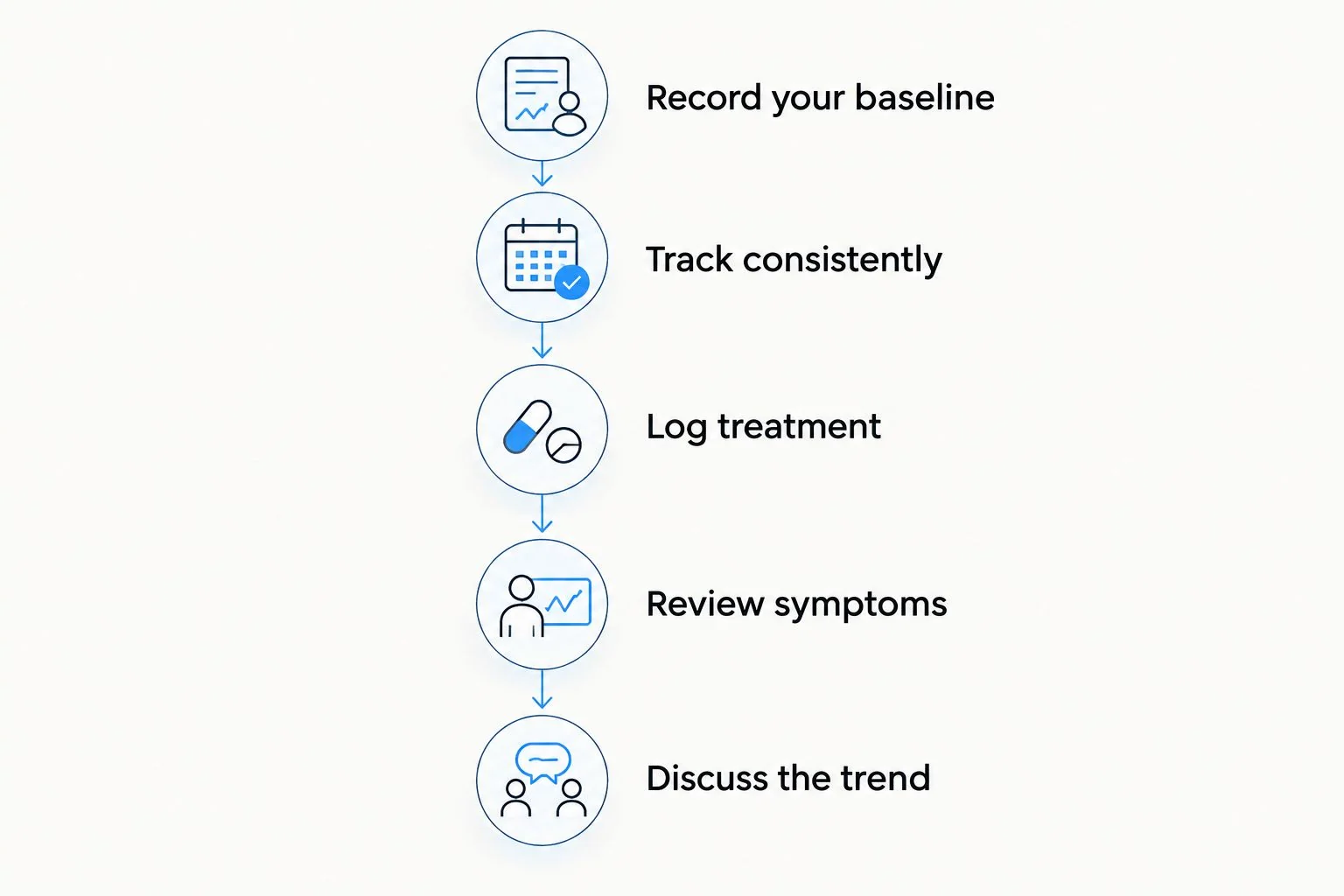
- Record your baseline. Note your starting weight and the date treatment begins. Keep any clinician-recommended health measurements alongside it.
- Track consistently. Use the same scale under similar conditions. Comparing unrelated measurements makes normal variation harder to interpret.
- Log treatment. Record injection dates, prescribed doses, missed doses, and interruptions. Do not reconstruct this history from memory at your appointment.
- Review symptoms. Write down appetite changes, digestive symptoms, and difficulty eating or drinking. Include symptoms even when the scale is moving in the desired direction.
- Discuss the trend. Bring the record to your prescriber and ask whether to continue, reassess, or adjust the prescribed plan.
The goal is not perfect data collection. It is to make the next medical conversation more useful. A readable record helps distinguish an interrupted treatment course from a consistent course with limited response.
If you use a food log, this guide to connecting MyFitnessPal to your GLP-1 weight-loss plan provides a related starting point. Tracking supports a conversation; it does not replace medical judgment.
What if you are not losing weight yet?
Do not increase semaglutide on your own because the scale has stalled. First establish your prescribed dose, how long you have taken it, and whether you have missed or interrupted treatment.
Next, ask your clinician to review the wider picture: your weight trend, food intake, activity, other medicines, and symptoms. The answer is not always a higher dose, and a social-media timeline is not a treatment instruction.
Avoid compensating with extreme restriction. Eating very little because your appetite is lower can leave you struggling to meet nutritional needs; rapid scale movement alone is not proof of a healthy treatment response.
For a 2026 follow-up, ask a direct question: What findings would make you continue this plan, change it, or stop it? Agreeing on the review criteria is more useful than repeatedly checking whether you are on schedule against a stranger's results.
When should you contact a clinician instead of waiting?
Do not wait for a weight-loss milestone if you have concerning symptoms. Persistent vomiting, signs of dehydration, or inability to keep fluids down need prompt medical assessment.
Severe, persistent abdominal pain—especially if it extends to your back—requires urgent evaluation. Semaglutide prescribing information includes warnings about acute pancreatitis; pain should not be dismissed as evidence that treatment is working.
Seek emergency help for symptoms of a serious allergic reaction, including trouble breathing or swelling of the face, lips, tongue, or throat. If you also take insulin or a sulfonylurea, discuss low-blood-sugar risk with your clinician.
Side effects are not a weight-loss strategy. Your treatment needs to support health, not simply produce a smaller number on the scale. This article provides general education and does not replace individual medical advice.
Where does online medical care fit?
VevaRX is for US adults seeking doctor-prescribed, medically supervised GLP-1 weight loss online. Its stated offering includes semaglutide prescriptions, but whether semaglutide is appropriate for you depends on a medical assessment.
Online care changes how you access a clinician; it does not establish a faster biological response. The practical benefit is access to prescription care online. The limitation is that a telehealth visit does not replace urgent or emergency evaluation when symptoms require it.
For VevaRX semaglutide care, discuss your medical history and expectations with the prescribing clinician. Ask how to report side effects and interruptions before they happen, rather than improvising after a missed injection.
Will I lose weight during the first month on semaglutide?
The first 4 weeks of standard Wegovy injection treatment use 0.25 mg once weekly, and weight loss during that period is not guaranteed. Treat the first month as an introduction to the prescribed regimen, not a definitive test of your long-term response.
Does everyone lose 14.9% of their weight on semaglutide?
14.9% at 68 weeks was the average weight loss in the STEP 1 semaglutide group, not the result for every participant. The trial studied adults without diabetes and included lifestyle intervention, so your clinician must interpret that benchmark in your own health context.
FAQ
How long does it take to lose weight on semaglutide?
Semaglutide weight loss develops over months, with no guaranteed starting week for every patient. The STEP 1 trial reported average weight loss of 14.9% at 68 weeks with semaglutide 2.4 mg and lifestyle intervention.
Is it normal not to lose weight on the semaglutide starter dose?
A limited early response does not by itself establish treatment failure. The standard Wegovy injection starter dose is 0.25 mg once weekly for 4 weeks, followed by gradual escalation under prescribing instructions.
Should I increase semaglutide if I am not losing weight?
Do not increase semaglutide without your prescriber's instructions. Your clinician should review your dose, time on treatment, adherence, symptoms, and weight trend before changing the plan.
Does nausea mean semaglutide is working?
Nausea is a side effect, not a reliable measure of semaglutide effectiveness. Report persistent or severe symptoms, especially vomiting or difficulty keeping fluids down.
Can I use the STEP 1 average to predict my own weight loss?
The STEP 1 average is context, not an individual prediction. The trial reported 14.9% average weight loss at 68 weeks in adults without diabetes receiving semaglutide 2.4 mg plus lifestyle intervention.
Does online semaglutide treatment work faster?
Online prescribing does not make semaglutide act faster. VevaRX offers doctor-prescribed GLP-1 weight-loss care online for US adults; your treatment response still requires individual medical assessment.
What should I bring to a semaglutide follow-up in 2026?
Bring your weight record, injection dates, prescribed doses, missed doses, and symptom notes. Ask your clinician which findings would justify continuing, adjusting, or stopping the current plan.
One last thing
Appetite change and weight change are not the same endpoint. Feeling fuller sooner can precede a clear scale trend, while constipation or fluid changes can obscure short-term measurements.
For your next 2026 appointment, bring one clear summary of weight, dose history, and symptoms. That record is more useful than a screenshot of someone else's transformation—and it gives your clinician a sounder basis for the next decision.
Related guides
This article is for informational purposes only and is not medical advice. Compounded medications are not approved by the FDA and have not been reviewed for safety, effectiveness, or quality. Prescription products require an online consultation with a licensed healthcare provider who will determine if a prescription is appropriate. Individual results vary.