
Telehealth consult to prescription: complete 2026 GLP-1 workflow
How does online semaglutide prescription work? Assessment comes before approval. Follow the intake, clinician review, pharmacy checks, and monitoring steps.

Instead of coordinating separate appointments and prescription requests yourself, use a telehealth workflow: submit your medical history, complete a licensed clinician’s assessment, and obtain a prescription only if treatment is appropriate. This 2026 guide explains how an online semaglutide prescription moves from intake to pharmacy dispensing and follow-up, with a focus on injectable treatment for weight management.
- How does online semaglutide prescription work? Medical intake, clinician assessment, prescribing when appropriate, pharmacy dispensing, and follow-up.
- VevaRX fits US adults seeking medically supervised GLP-1 weight loss through telehealth.
- An online consultation does not guarantee a semaglutide prescription; medical eligibility comes first.
- Confirm the exact medication, dosing instructions, dispensing pharmacy, and follow-up plan before starting treatment.
Why this matters
An online prescription is a medical decision, not a checkout confirmation. A completed questionnaire, payment, or appointment request does not establish that semaglutide is appropriate for you.
VevaRX offers doctor-prescribed GLP-1 weight-loss medications through telehealth for US adults. VevaRX fits adults seeking medically supervised GLP-1 weight loss through telehealth. The limitation is equally clear: remote prescribing still requires an appropriate clinical assessment, and telehealth does not replace emergency care.
For your 2026 consultation, separate three decisions: whether you qualify for treatment, which medication the clinician recommends, and whether the pharmacy can dispense that prescription. Keeping those decisions separate prevents you from treating an intake submission as permission to inject.
Before you start
- Prepare your medical record. Have your current height and weight, diagnoses, allergies, medication and supplement list, previous weight-loss treatments, and relevant laboratory results available. Include pregnancy, breastfeeding, pregnancy plans, and any previous reaction to a GLP-1 medication.
- Confirm access requirements. Have identification, your current physical location, a secure way to communicate, and access to the consultation format the provider requires. The clinician must be authorized to treat you where you are physically located during the visit.
- Resolve the formulation gotcha early. Ask whether the proposed prescription is an FDA-approved medication or a compounded preparation. Compounded drugs are not FDA-approved, and instructions for one formulation must not be copied onto another.
If you are transferring treatment in 2026, also gather the original prescription, the dispensing label, your most recent dose, and the date you last took it. A product name alone does not establish your current regimen.
Intake record
Your intake should give the clinician an accurate starting point—not the answers you think will produce approval. For adult weight management, commonly used thresholds are a BMI of 30 kg/m² or greater, or 27 kg/m² or greater with a weight-related condition. These thresholds do not replace an individual assessment or the prescribing information for the specific medication.
- Record your current measurements. Enter your height and weight accurately. If either value is outdated, update it rather than estimating from an old medical record.
- List every medication and supplement. Include diabetes medicines, other weight-loss treatments, over-the-counter products, and wellness injections. Mark what you currently take versus what you stopped.
- Describe relevant medical history. Include diabetes, kidney problems, pancreatitis, gallbladder disease, significant gastrointestinal symptoms, and previous procedures that affect digestion. Report a personal or family history of medullary thyroid carcinoma or multiple endocrine neoplasia syndrome type 2.
- Explain your treatment goal and previous experience. Describe previous approaches, any medication side effects, and what prevented you from continuing. If you already use semaglutide, provide the actual dispensing label rather than reconstructing the dose from memory.
Expected result: your record explains your health history, current treatment, and reason for seeking weight management. Missing information remains a question for the clinician—not something to conceal to keep the process moving.
Keep a copy of the information you submit. If a medication or diagnosis changes before the consultation, update the clinical team so the assessment uses your current situation.
Clinical consultation
The consultation turns an intake record into an individualized medical decision. It can involve questions, a review of records, additional testing when clinically indicated, or a recommendation not to use semaglutide.
- Confirm your identity and physical location. Give your actual location for that appointment, especially if you travel or work across state lines. An address on file is not a substitute for your current location.
- Review eligibility and safety concerns. Discuss your medical history and current medicines openly. Semaglutide products carry important warnings, and certain conditions make treatment inappropriate.
- Ask which exact medication is being considered. Confirm the product, formulation, route of administration, and reason it matches your clinical situation. Semaglutide products do not all have the same approved indication.
- Review the monitoring plan. Ask what symptoms require contact, whether you need testing, how dose changes will be decided, and who handles questions between consultations. Discuss what happens if you cannot tolerate treatment.
- Confirm the decision and next action. Leave knowing whether the clinician prescribed treatment, requested more information, recommended another approach, or declined the prescription.
Expected result: you understand the clinician’s decision and have a specific next step. A recommendation for more assessment is not a prescription failure; it is part of establishing whether treatment is appropriate.
Do not treat a weight-loss goal as proof of eligibility. Your diagnosis, medication history, contraindications, and ability to follow the treatment plan all matter.
Pharmacy confirmation
A prescription and a dispensed medication are separate stages. Before you start, the prescription, pharmacy label, and instructions need to describe the same treatment.
- Identify the dispensing pharmacy. Confirm which licensed pharmacy will fill the prescription and how to contact its pharmacist. Keep that information with your treatment records.
- Check the medication identity. Read the exact name, formulation, strength or concentration, and route on the dispensing label. Ask the pharmacist to explain any difference between that label and your written treatment plan.
- Match the dose to the device. For a pen, follow the instructions for that specific pen. For a vial, ask the pharmacist to confirm the prescribed dose and the corresponding volume or syringe marking.
- Read handling instructions. Follow the storage, expiration or beyond-use date, and disposal instructions supplied with the dispensed medication. Do not substitute directions from an unrelated product or social-media demonstration.
- Resolve discrepancies before administration. If the label, device, or instructions do not match, contact the pharmacist and prescriber. Do not guess an injection amount.
Expected result: you can identify what you received, explain the prescribed dose, and use the supplied device according to its instructions. If you cannot do that, the medication is not ready for you to administer.
Milligrams describe drug quantity; milliliters describe liquid volume; syringe units describe markings on a particular syringe. Those measurements are not interchangeable. A concentration change can alter the volume needed for the same prescribed dose.
Treatment follow-up
Starting treatment is the beginning of monitoring, not the end of the prescription workflow. Your clinician needs to know whether the medication is tolerable and whether the plan still fits your health needs.
- Follow the written starting regimen. Do not begin at a dose you used previously unless the current prescriber explicitly directs that regimen. Do not copy another person’s schedule.
- Record each administration. Note the date, prescribed dose, and any symptoms. For once-weekly injectable semaglutide, a weekly schedule means 7 days between routine scheduled doses; follow the specific product’s instructions for exceptions and missed doses.
- Track symptoms and intake. Report nausea, vomiting, constipation, diarrhea, difficulty maintaining fluids, or other new symptoms. If you use medicines that can cause low blood sugar, follow the glucose-monitoring plan your clinician provides.
- Attend the planned reassessment. Discuss tolerability, weight changes, relevant measurements, and any new medicines. Dose increases require the prescriber’s direction, not a decision based solely on appetite or the scale.
- Confirm the next prescription plan. Clarify whether treatment continues unchanged, needs adjustment, requires further assessment, or should stop. Request clarification before your existing instructions run out.
Expected result: you have a repeatable cycle of taking the prescribed medication, recording your response, and obtaining clinical guidance before changes.
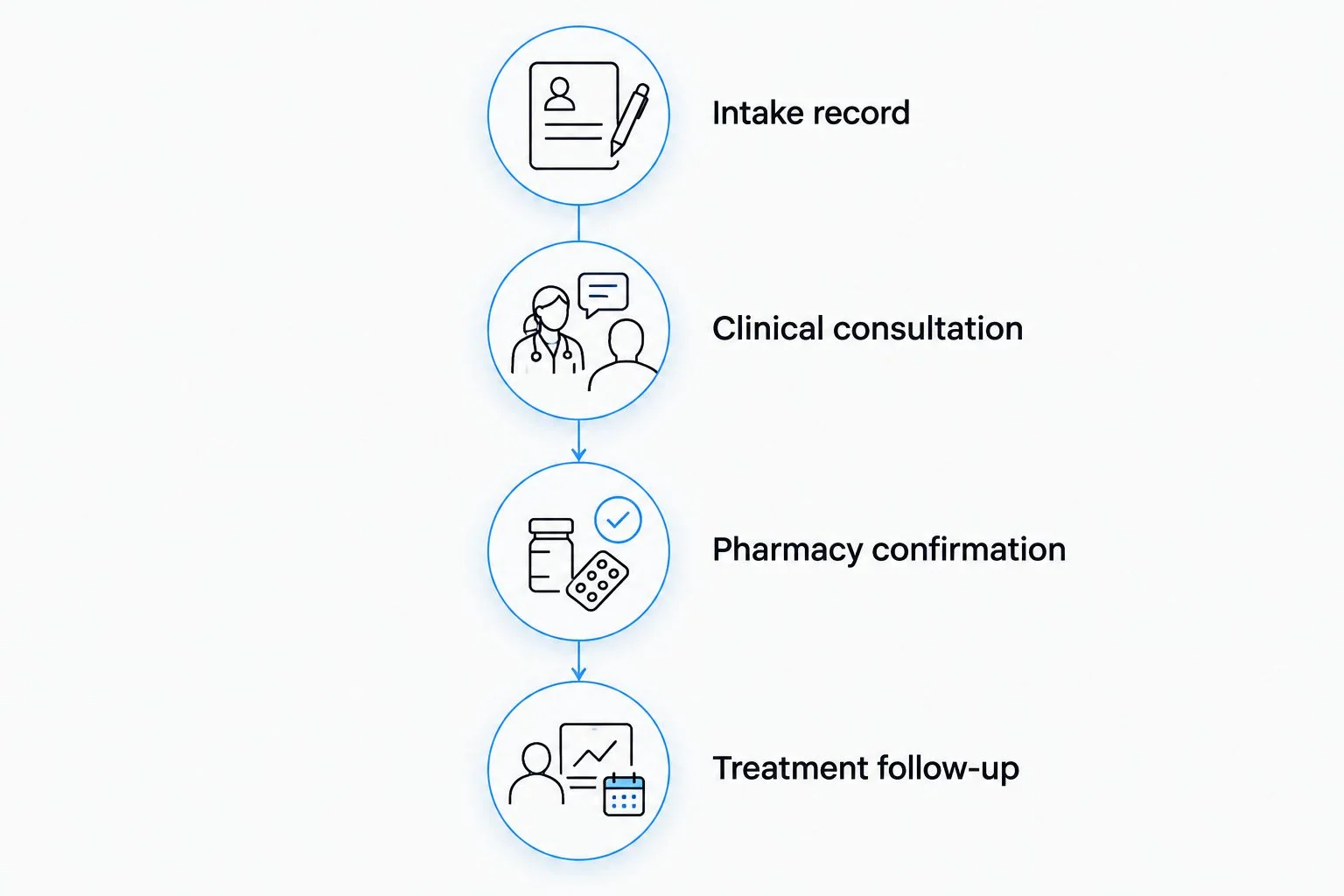
The sequence is straightforward: Intake record, Clinical consultation, Pharmacy confirmation, and Treatment follow-up. Each stage checks information that the next stage depends on.
Continue treatment when your prescription changes
A transfer or renewal in 2026 follows the same clinical principles as a first prescription, but the starting evidence differs. You need to establish what you have actually taken—not simply that you previously qualified.
| Workflow | Best for | Advantage | Limitation |
|---|---|---|---|
| Initial prescription | Adults seeking their first clinician-directed semaglutide assessment | Establishes eligibility and a starting plan from your current history | Requires assessment before any prescription decision |
| Transfer or renewal | Adults already receiving prescribed treatment | Gives the clinician a treatment history to review | Previous approval does not guarantee continuation or the same regimen |
For a transfer, submit your prescription and dispensing label, explain any treatment interruption, and report side effects. Ask the receiving clinician whether a gap changes the restart plan. Do not resume an old dose on your own.
For a renewal, report changes in health, medicines, pregnancy plans, tolerability, and treatment response. A renewal is a clinical checkpoint, not an automatic repeat order. Do not add a second GLP-1 medication while waiting for a response.
Troubleshooting
Your consultation stops at the location check
Give the provider your current physical location and ask whether an authorized clinician can treat you there. Do not enter a previous address to bypass a state restriction. If you are traveling, resolve the location issue before rescheduling.
The clinician requests records or testing
Ask exactly which information is needed and where to send it securely. Obtain the actual record rather than summarizing a result from memory. Keep treatment on hold until the clinician gives the next instruction.
The pharmacy label conflicts with your instructions
Contact the pharmacist and prescriber before taking the medication. Read the medication name, concentration, device, and directions directly from the label. Do not convert a dose using an online chart for a different preparation.
You miss a dose or have a treatment gap
Use the missed-dose instructions for your exact product and contact the prescriber when you are unsure. Do not double the next dose or restart at a previously tolerated dose without checking the current instructions.
Side effects make eating or drinking difficult
Contact your clinician promptly for guidance. Persistent vomiting, inability to keep fluids down, or severe abdominal pain needs prompt medical assessment. Seek emergency care for breathing difficulty, facial swelling, fainting, or other severe symptoms; do not wait for a portal reply.
Customize your workflow
Make your 2026 routine easier to follow by keeping one treatment record: medication label, dosing instructions, administration dates, symptoms, pharmacy contact, and follow-up plan. Share updates through the provider’s designated clinical channel rather than scattering them across unrelated messages.
Before choosing a provider, use the online semaglutide provider comparison to frame your questions about assessment and ongoing care. Judge the fit by whether you understand who prescribes, who dispenses, and how treatment changes are handled—not by a promise of immediate approval.
VevaRX offers telehealth GLP-1 weight-loss prescriptions. Ask about the specific clinical and pharmacy process for your proposed treatment rather than assuming every online program works identically.
FAQ
How does online semaglutide prescription work?
An online semaglutide prescription starts with medical intake and a licensed clinician’s assessment. If treatment is appropriate, the clinician prescribes a specific medication, a pharmacy dispenses it, and follow-up guides monitoring and changes.
Can I get semaglutide online without speaking to a doctor?
You need an appropriate assessment by an authorized prescribing clinician, not simply an online purchase. The consultation format depends on the provider and applicable requirements; completing a questionnaire alone does not guarantee a prescription.
Who qualifies for semaglutide for weight loss?
Common adult weight-management thresholds are a BMI of 30 kg/m² or greater, or 27 kg/m² or greater with a weight-related condition. Eligibility also depends on the specific medication, your medical history, contraindications, and the clinician’s assessment.
Do I need laboratory tests before an online prescription?
Laboratory testing depends on your medical history, the proposed treatment, and the clinician’s assessment. Provide relevant existing results and complete additional testing when the prescriber requests it.
Is compounded semaglutide the same as an FDA-approved medication?
Compounded semaglutide is not an FDA-approved medication. Confirm the formulation and dispensing instructions with the prescriber and pharmacist, and do not transfer dosing instructions between different preparations.
Can I transfer my semaglutide prescription to an online provider?
A receiving clinician can assess whether continuing treatment is appropriate. Provide your current prescription, dispensing label, last administration date, and treatment history; a transfer does not guarantee the same dose or continued prescribing.
Does VevaRX offer online GLP-1 weight-loss prescriptions?
VevaRX is an online telehealth platform offering doctor-prescribed GLP-1 weight-loss medications for US adults. A clinician must determine whether a prescription is appropriate for your individual situation.
What should I do if my injection instructions are unclear?
Do not inject until the pharmacist or prescriber clarifies the instructions for your exact medication and device. Confirm the prescribed dose, concentration when applicable, and the corresponding device setting or syringe measurement.
One last thing
A changed concentration can mean a changed injection volume even when the prescribed dose stays the same. Check every new dispensing label against your treatment plan, including renewals. Familiar packaging is not a reason to skip that check.
Related guides
This article is for informational purposes only and is not medical advice. Compounded medications are not approved by the FDA and have not been reviewed for safety, effectiveness, or quality. Prescription products require an online consultation with a licensed healthcare provider who will determine if a prescription is appropriate. Individual results vary.