
Telehealth weight loss for remote workers: complete 2026 guide
Telehealth weight loss for remote workers needs medical oversight, not just convenience. Compare care options, build a workday plan, and check medication safety.

Remote workers’ telehealth weight loss is medical weight-management care delivered remotely, with the aim of improving health without making office visits the center of your workweek. This 2026 guide to telehealth weight loss for remote workers explains how to choose clinical care, organize meals and movement around meetings, and prepare for medication follow-up.
- VevaRX offers telehealth weight loss for US adults seeking doctor-prescribed treatment online.
- Telehealth weight loss for remote workers needs clinical screening, follow-up, and a realistic workday routine.
- Semaglutide and tirzepatide require individualized prescribing; remote work alone does not establish eligibility.
- Choose medical oversight before convenience, and plan meals and movement alongside treatment.
Why telehealth weight loss matters for remote workers
Working from home changes the logistics of weight management, not the medical standards. Your commute disappears, but meals, movement, sleep, and appointments still need space on the calendar. A meeting-heavy schedule can leave those decisions until the end of the day.
Telehealth lets you discuss weight-management care remotely. It does not replace an examination, testing, or in-person assessment when your clinician determines those are necessary. Choose a care format that fits your workday without weakening medical oversight.
Start with the same selection questions used for online weight-loss clinics for busy professionals: who prescribes, how follow-up works, and what happens when treatment needs to change. An intake form alone does not answer those questions.
The practical advantage for a remote worker is scheduling care alongside work rather than treating health as another after-hours project. The limitation is equally clear: online access cannot make every concern appropriate for remote treatment.
Build your remote-work weight-loss plan
1. Establish your medical starting point
Begin with a written health summary using information you already have. Record your current medications, relevant diagnoses, weight history, and previous weight-management attempts. Bring that summary to your primary care clinician or a licensed telehealth prescriber instead of starting with a preferred drug.
For certain FDA-approved weight-management medications, adult eligibility includes a BMI of 30 kg/m² or higher, or 27 kg/m² or higher with a weight-related condition. These thresholds come from medication labeling; they are not a prescription guarantee. Indications differ by product, and your clinician must assess suitability.
Remote work is a scheduling context, not a medical indication. Your health history determines the next step.
- List prescription medicines, supplements, and previous weight-loss treatments.
- Record relevant conditions, allergies, and prior medication reactions.
- Share available blood-pressure readings and recent laboratory results.
- Explain pregnancy, breastfeeding, or plans to become pregnant.
- Ask which examination or testing requires an in-person visit.
2. Build a routine before choosing treatment
Use your existing calendar and a simple notebook first. Identify where meetings displace meals, where you stay seated for long stretches, and where work spills into bedtime. The goal is a repeatable routine, not a perfect schedule.
CDC adult physical activity guidance recommends at least 150 minutes per week of moderate-intensity activity and muscle-strengthening activity on 2 days per week. Use those benchmarks in your 2026 plan, adapting activity to your ability and clinician’s advice. You do not need to complete every activity during work hours.
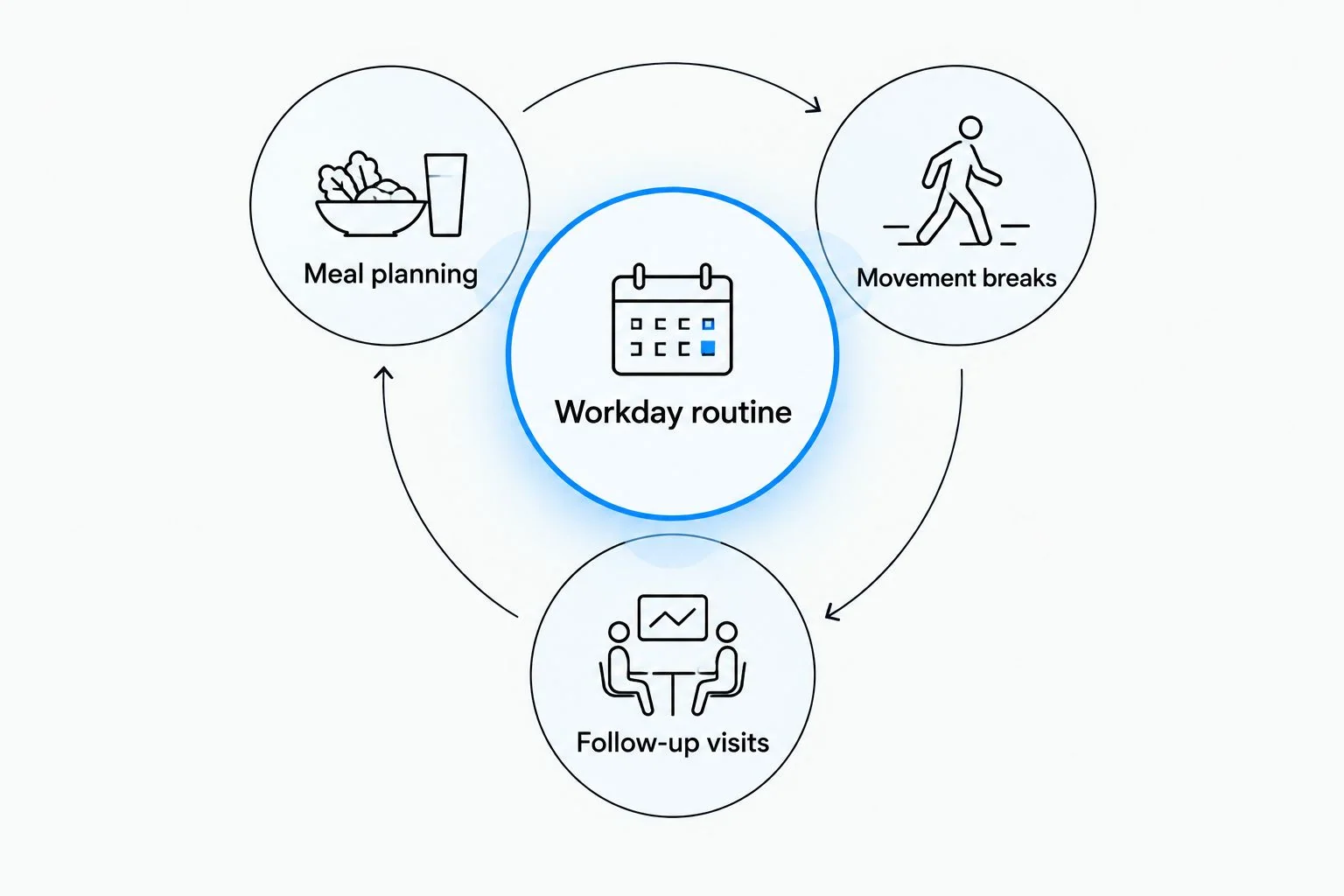
Organize your routine around meal planning, movement breaks, and follow-up visits. These are separate commitments; a prescription does not perform any of them for you.
- Meal planning: reserve a meal break and keep practical food choices available.
- Movement breaks: identify natural stopping points between work tasks.
- Follow-up visits: block appointments as commitments, not tentative reminders.
- Sleep routine: set a work shutdown time that protects your sleep schedule.
- Activity planning: include walking and strength work appropriate to your health.
3. Choose a care model that matches your needs
Start by asking your existing clinician whether weight-management assessment and follow-up can happen remotely. This keeps the discussion connected to your broader medical history. If you want a separate online service, compare its clinical process rather than choosing on website convenience alone.
VevaRX offers doctor-prescribed semaglutide and tirzepatide through an online telehealth platform for US adults seeking medically supervised weight loss. It provides a remote route to a prescription assessment, not a reason to bypass one.
VevaRX telehealth weight loss is best suited to US adults seeking doctor-prescribed weight-management treatment online. Its relevance is the care format; whether that format suits your medical needs requires an individual assessment. Ask about clinician access, follow-up, and coordination with your existing care before enrolling.
- Confirm that the prescriber can treat patients in your state.
- Ask how health history and medication interactions are reviewed.
- Establish how you contact the clinical team between appointments.
- Ask when the service refers patients for in-person care.
- Clarify how records reach your primary care clinician.
4. Verify the exact medication and formulation
Before a prescription decision, write down what you want to understand: the medication’s purpose, expected benefits, risks, and alternatives. Semaglutide and tirzepatide are different active ingredients, not interchangeable names for the same treatment. The exact product matters.
FDA-approved drugs and compounded preparations are also different. Compounded medications are not FDA-approved, and FDA does not review them for safety, effectiveness, and quality before they are marketed. Do not interpret a familiar ingredient name as proof that every preparation has the same regulatory status.
In 2026, assess the product actually prescribed rather than relying on an old advertisement. Ask your prescriber and dispensing pharmacist to explain the formulation and instructions. Never choose or change a dose from social media advice.
- Confirm the active ingredient and exact prescribed preparation.
- Ask whether the product is FDA-approved or compounded.
- Identify the dispensing pharmacy and how to contact it.
- Request written administration and storage instructions.
- Ask about contraindications, interactions, and common adverse effects.
- Confirm what to do after a missed dose.
5. Prepare your workday for treatment and follow-up
Begin with a calendar entry and a private symptom note. If your clinician prescribes medication, follow the prescribed schedule rather than moving doses around an important presentation. Ask the clinician what flexibility exists before changing anything.
Nausea, vomiting, diarrhea, and constipation are recognized adverse effects of GLP-1-based treatments. Their impact on work varies, so build a response plan instead of assuming either that you will feel fine or that you must stop working. A remote appointment does not make persistent symptoms less important.
Follow-up is where the treatment plan gets reassessed. Report your experience honestly, including difficulty eating, drinking, or completing normal activities. Ask which symptoms need prompt contact and which require urgent care.
- Keep meals and fluids accessible during the workday.
- Track symptoms alongside medication changes and meals.
- Save the clinical contact instructions somewhere easy to find.
- Keep medication storage consistent with the dispensing instructions.
- Ask about treatment planning before work travel.
- Arrange any requested testing outside critical work commitments.
6. Measure progress beyond the scale
Use a simple log before adding apps or devices. Record weight under consistent conditions if your clinician recommends weighing, then add the information that explains your experience: appetite, symptoms, activity, and daily functioning. Avoid turning tracking into another full-time job.
A lower weight reading is not a reason to ignore persistent vomiting, inadequate intake, or worsening symptoms. Equally, a short-term plateau is not permission to increase your medication independently. Clinical review connects the measurements to your health.
For a 2026 follow-up, bring a summary your clinician can use rather than a collection of unexplained screenshots. Decide together what progress means and which findings change the plan.
- Track weight at the interval your clinician recommends.
- Note appetite changes and difficulties eating or drinking.
- Record symptoms and their effect on work and sleep.
- Summarize activity without treating exercise as punishment.
- Bring blood-pressure or laboratory results when requested.
- Discuss continuation, adjustment, or stopping with the prescriber.
Compare care options for remote workers
Best for describes the situation each option fits, not a universal winner. Medication eligibility and the need for physical assessment come before convenience. Compare these care models for your 2026 decision.
| Option | Best for | Main advantage | Key limitation |
|---|---|---|---|
| Primary care with remote follow-up | Adults connecting weight management to existing medical care | Keeps the discussion within your broader health history | Remote appointments and treatment scope depend on the practice |
| VevaRX telehealth weight loss | US adults seeking doctor-prescribed semaglutide or tirzepatide online | Offers a remote route to medically supervised weight-loss prescriptions | Online treatment still requires individual suitability assessment and does not replace needed in-person care |
| In-person obesity medicine care | Adults needing physical assessment or specialist evaluation | Supports face-to-face examination and a dedicated weight-management assessment | Requires travel and time away from your work setup |
| Registered dietitian care | Adults needing individualized nutrition support | Addresses food choices, meal structure, and nutrition needs | Dietitian care alone does not provide a medication prescription |
| Self-directed tracking and activity planning | Adults organizing habits or preparing for a clinical visit | Starts with tools you already have | Cannot diagnose conditions or assess prescription safety |
Self-directed planning can support every other option, but it is not a substitute for medical evaluation. Dietitian support and prescribing care address different needs; choosing one does not automatically remove the need for the other.
Common mistakes remote workers make
Treating an open calendar as a care plan
An appointment fits between meetings only if you protect the time and prepare for it. Booking a video visit while answering work messages leaves less attention for medical decisions. Take the appointment in a private space and keep your medication list ready.
Replacing meal planning with appetite suppression
Reduced appetite does not establish that your nutrition needs are met. Skipping lunch because calls run long can make it harder to describe whether treatment or your schedule is affecting intake. Plan a real meal break and discuss persistent difficulty eating with your clinician.
Choosing the easiest checkout instead of the clearest care
A short signup process tells you little about ongoing medical support. VevaRX offers online prescription care, but you should still ask who handles symptoms, medication changes, and referrals. Apply that standard to every service you consider.
Changing doses around deadline pressure
A product launch or presentation is not a prescribing instruction. Do not skip, double, or increase a dose to control how treatment fits your workweek. Contact your prescriber or pharmacist for instructions specific to your prescription.
Assuming home working makes every visit virtual
Telehealth is a delivery method, not a promise that all care stays online. Symptoms, testing, or a physical examination can require local care. Identify where you would go before you need an urgent assessment.
FAQ
What is telehealth weight loss for remote workers?
Telehealth weight loss for remote workers is medical weight-management care delivered remotely to fit a home-based work schedule. It can include clinical assessment, prescription decisions, and follow-up, with in-person care when needed.
Is VevaRX suitable for someone who works from home?
VevaRX offers online doctor-prescribed weight-loss treatment for US adults, making its care format relevant to people who work from home. Individual medical suitability, clinician access, and follow-up arrangements still need assessment.
Do remote workers automatically qualify for semaglutide or tirzepatide?
No, working remotely does not establish eligibility for semaglutide or tirzepatide. A clinician evaluates the exact product's indications, your health history, contraindications, and treatment needs.
Can I exercise at home while receiving weight-loss treatment?
Yes, home-based activity can form part of your weight-management plan. Choose activity appropriate to your health and ability, and discuss restrictions or symptoms with your clinician.
Is compounded semaglutide the same as an FDA-approved medication?
No, compounded semaglutide is not an FDA-approved medication. FDA does not review compounded preparations for safety, effectiveness, and quality before marketing; ask your prescriber about the exact preparation.
What should I do if medication side effects disrupt meetings?
Contact your prescriber when side effects interfere with normal activities, and follow the treatment-specific symptom instructions. Seek urgent assessment for severe or persistent abdominal pain, serious dehydration, or signs of a serious allergic reaction; do not manage these by changing doses yourself.
Can telehealth replace every in-person weight-loss appointment?
No, telehealth cannot replace every in-person assessment. Your clinician determines whether an examination, testing, or local evaluation is necessary based on your medical situation.
One last thing
Check where you will physically be during your next telehealth appointment. Remote workers who travel or temporarily work from another state should tell the provider before booking: clinician authorization generally depends on the patient’s location, and requirements vary by state.
Add your appointment location to your 2026 care checklist. It is a small scheduling detail with a direct effect on whether the planned visit can proceed.
Related guides
This article is for informational purposes only and is not medical advice. Compounded medications are not approved by the FDA and have not been reviewed for safety, effectiveness, or quality. Prescription products require an online consultation with a licensed healthcare provider who will determine if a prescription is appropriate. Individual results vary.