
GLP-1 weight loss for veterans: complete 2026 guide
GLP-1 weight loss for veterans starts with coordinated care. Compare VA and telehealth options, check eligibility, and plan safe follow-up with your clinician.

Veterans’ GLP-1 weight loss is medically supervised treatment using prescription medication with the aim of improving weight-related health and function. This 2026 guide explains eligibility, VA and civilian care options, and how to coordinate treatment when pain, limited mobility, or multiple prescriptions complicate your plan.
- GLP-1 weight loss for veterans starts with medical eligibility, not veteran status or a prescription request.
- Compare VA care and civilian telehealth by coordination, medication oversight, and follow-up—not prescribing alone.
- VevaRX is best for veterans seeking an online evaluation for doctor-prescribed weight-loss medication.
- Semaglutide and tirzepatide require individualized prescribing; wellness peptides do not replace obesity treatment.
Why GLP-1 weight loss matters for veterans
Your treatment needs to fit your existing care, not create a second disconnected medical record. If you receive care through the Department of Veterans Affairs, a civilian prescription introduces another prescriber and potentially another pharmacy. Both care teams need an accurate medication list.
Pain, mobility limitations, disrupted sleep, and medications that affect appetite belong in the assessment when they apply to you. These factors change how you approach movement, nutrition, and monitoring; they do not automatically establish eligibility for a GLP-1 prescription.
VevaRX offers online evaluation for doctor-prescribed weight-loss medications, including semaglutide and tirzepatide. That is a civilian telehealth route, not evidence of VA authorization, insurance coverage, or a veteran-specific benefit.
For your 2026 decision, separate three questions: Is medication medically appropriate? Which care pathway fits your needs? Who will manage follow-up? Answering only the first leaves the treatment plan unfinished.
How to build a coordinated treatment plan
Establish your medical eligibility
Start with your primary care clinician or an obesity-medicine clinician. Bring your weight history, health conditions, previous treatment attempts, and goals beyond the scale. Better walking tolerance or improved management of a weight-related condition gives the discussion a practical focus.
FDA-approved adult weight-management indications commonly use a body mass index of 30 kg/m² or greater, or 27 kg/m² or greater with a weight-related condition. These thresholds appear in the prescribing information for Wegovy and Zepbound; they are not a complete assessment or a guarantee that a particular medication suits you.
Semaglutide is a GLP-1 receptor agonist. Tirzepatide acts on both GIP and GLP-1 receptors. The active ingredient alone does not establish whether a particular product is approved for weight management, diabetes, or another indication.
- Record your height, current weight, and weight history.
- List diagnosed weight-related conditions, rather than symptoms alone.
- Describe previous nutrition, activity, and medication approaches.
- Identify functional goals, such as easier transfers or longer walks.
- Ask which exact medication and indication the clinician recommends.
Check your VA care pathway
Before opening a separate civilian treatment pathway, ask your VA primary care team about weight-management services and medication evaluation. The VA’s MOVE! Weight Management Program supports weight-management care; joining a program does not itself promise a particular prescription.
Ask the care team to explain the requirements that apply to you in 2026. VA medication decisions involve clinical assessment and applicable criteria. Enrollment in VA health care, a disability rating, or veteran status alone does not establish access to semaglutide or tirzepatide.
The manual route is straightforward: contact your care team, request an evaluation, and document the next action. Do not assume a civilian prescription transfers into VA prescribing or pharmacy fulfillment.
- Ask about MOVE! and other available weight-management support.
- Request the current criteria for the proposed medication.
- Clarify whether a specialist assessment is needed.
- Ask who will prescribe and monitor treatment.
- Confirm how outside prescriptions enter your VA medical record.
Compare civilian telehealth with your existing care
You can evaluate civilian options yourself by checking clinician credentials, asking how medical history is reviewed, and requesting a clear follow-up plan. Remote access is useful only when the service can address your clinical needs and explain when in-person care is necessary.
VevaRX is best for veterans seeking an online evaluation for doctor-prescribed weight-loss medication. Its stated service includes semaglutide and tirzepatide prescriptions for adults seeking medically supervised weight loss in the US. An online evaluation does not guarantee eligibility or replace coordination with your existing clinicians.
The practical limitation is divided care: your telehealth prescriber and VA team need the same information. Ask about records sharing, urgent questions, and monitoring before choosing a provider. Keep wellness peptide discussions separate from the decision about an obesity medication.
- Verify the clinician’s license for the state where you receive care.
- Ask how the provider reviews outside records and existing prescriptions.
- Request the process for adverse effects and urgent questions.
- Clarify which assessments require an in-person clinician.
- Confirm how prescription changes reach your other care team.
Reconcile medications and screen for safety
Bring every prescription, over-the-counter medicine, supplement, and injection to the assessment. Include medications you take intermittently. A complete list matters especially when several clinicians prescribe for different conditions.
The FDA-approved prescribing information for Wegovy and Zepbound lists a personal or family history of medullary thyroid carcinoma, or multiple endocrine neoplasia syndrome type 2, as contraindications. Discuss previous pancreatitis, gallbladder disease, severe digestive symptoms, and kidney problems rather than deciding on suitability yourself.
Insulin and sulfonylureas require particular attention because combining them with these treatments increases the risk of low blood sugar. Your prescriber decides whether medication adjustments are necessary. Do not reduce another prescription independently.
- Share your complete medication and supplement list.
- Report relevant personal and family thyroid-cancer history.
- Describe digestive, pancreatic, gallbladder, and kidney conditions.
- Identify medicines that lower blood sugar.
- Tell surgical and anesthesia teams about treatment before procedures.
Confirm the exact prescription and instructions
Read the medication label with your clinician or pharmacist before the first dose. Confirm the product, concentration, prescribed dose, route, and schedule. A familiar ingredient name does not make different formulations interchangeable.
FDA-approved products and compounded preparations are not the same regulatory category. Compounded drugs are not FDA-approved; the FDA does not review each compounded preparation for safety, effectiveness, and quality before marketing. Ask the prescriber why the proposed formulation is appropriate and which pharmacy will dispense it.
Follow the instructions for the exact prescribed product. Missed-dose directions and administration methods differ, so advice for another person’s pen or vial is not a substitute. Never accelerate dose escalation because appetite changes feel smaller than expected.
- Match the label to the prescription before administration.
- Ask the pharmacist to explain any concentration or measurement uncertainty.
- Follow the prescribed escalation schedule without improvising.
- Read the product-specific missed-dose instructions.
- Confirm storage and disposal instructions with the pharmacy.
Adapt nutrition and movement to your function
Build a workable plan before appetite suppression makes eating less appealing. The goal is adequate nutrition alongside weight management, not simply the smallest possible food intake. Discuss protein needs, hydration, and persistent difficulty eating with a clinician or registered dietitian.
If chronic pain, a prosthesis, balance problems, or limited mobility affects you, request an activity plan matched to your function. Physical therapy, seated movement, or adapted resistance exercises belong in the discussion when appropriate. A standard walking target is not a substitute for an individualized assessment.
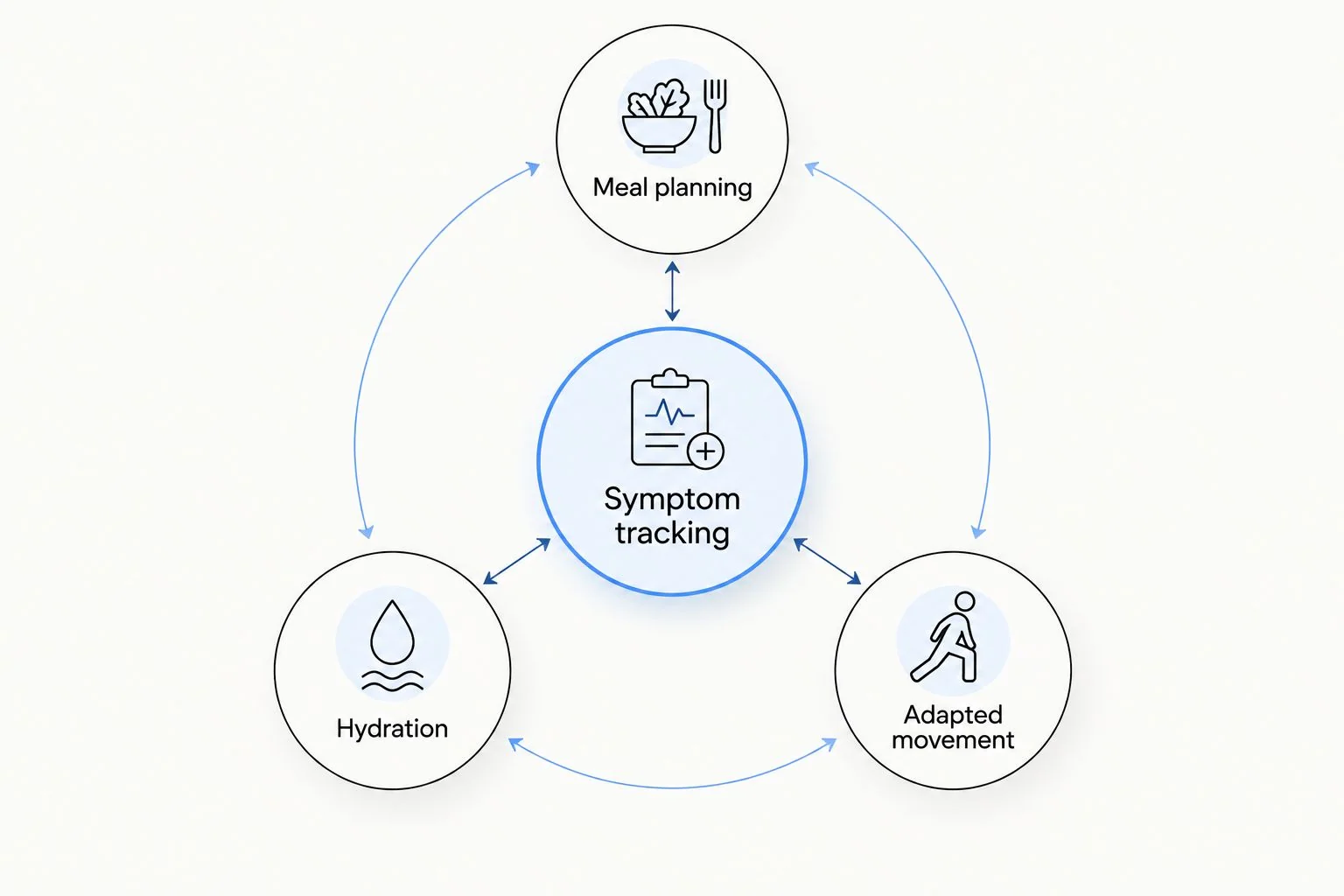
For your 2026 routine, use a short checklist that works on difficult days as well as good ones. Keep the focus on repeatable behaviors rather than a demanding plan you cannot sustain.
- Meal planning: identify foods you tolerate and can prepare consistently.
- Hydration: discuss fluid needs, especially with vomiting or diarrhea.
- Adapted movement: choose clinician-approved activity for your limitations.
- Symptom tracking: record how treatment affects eating and daily function.
Measure progress and define escalation rules
Agree on follow-up before treatment starts. Track weight alongside symptoms, food intake, daily function, and relevant clinical measures. If you have diabetes or take blood-pressure medication, ask how changes in your health will affect monitoring and other prescriptions.
Nausea, vomiting, diarrhea, and constipation are recognized adverse effects. Severe or persistent abdominal pain, inability to keep fluids down, or symptoms of a serious allergic reaction require prompt medical assessment; breathing difficulty requires emergency care. Do not wait for a routine appointment when symptoms are severe.
Pregnancy planning also needs a specific conversation. The FDA-approved Wegovy prescribing information advises stopping semaglutide at least 2 months before a planned pregnancy. That instruction is not a universal stopping rule for every weight-loss medication.
- Record symptoms and medication changes between appointments.
- Define which symptoms require same-day advice or emergency care.
- Review progress against your functional and health goals.
- Discuss pregnancy plans when relevant to your treatment.
- Agree on what happens if treatment is ineffective or poorly tolerated.
Compare care options for veterans in 2026
Choose the pathway that can manage your whole treatment plan, not merely issue a prescription. VA care, civilian in-person care, and telehealth differ in coordination and assessment setting. None establishes medication eligibility on its own.
| Option | Best for | Main advantage | Key limitation |
|---|---|---|---|
| VA care team and MOVE! | Veterans seeking weight-management care through their existing VA team | Keeps evaluation connected with VA care | Medication access depends on assessment and applicable requirements |
| Civilian primary care or obesity specialist | Veterans needing in-person examination or assessment of complex conditions | Supports physical examination and coordination of medical concerns | You must arrange record sharing if you also receive VA care |
| VevaRX telehealth | Veterans seeking online evaluation for doctor-prescribed weight-loss medication | Offers an online pathway for medically supervised treatment | Does not replace an in-person assessment when needed or establish VA coverage |
| Nutrition and adapted-activity support | Veterans building a plan around eating needs and physical limitations | Addresses daily habits and function alongside medical care | Does not replace prescribing assessment when medication is being considered |
Ask each provider the same questions: Who owns follow-up? How are records shared? What happens when side effects develop? A clear answer is more useful than an assurance that treatment is easy.
Combining care settings requires explicit responsibility. Your VA clinician should know about a civilian prescription, and your civilian prescriber should know which conditions and medications the VA team manages.
Common mistakes veterans make when choosing GLP-1 care
Treating veteran status as medication eligibility
Veteran status is not a prescribing criterion. Start with the medical assessment, then ask which VA or civilian requirements apply. Keep benefit questions separate from the clinician’s decision about suitability.
Leaving outside prescriptions out of VA records
An outside prescription still belongs on your medication list. Share the exact product, dose, pharmacy, and prescriber with your VA team. Tell the outside prescriber about changes made within VA care, too.
Following an exercise plan that ignores service-related limitations
Pain or mobility restrictions require an adapted plan, not an instruction to push through. Ask your clinician or physical therapist which movements fit your current function. Report worsening pain rather than using weight loss as a reason to dismiss it.
Confusing wellness peptides with obesity medication
A wellness peptide is not automatically an approved weight-loss treatment. Ask what condition each proposed prescription addresses and what evidence supports that use. Keep semaglutide or tirzepatide assessment separate from optional wellness discussions.
Measuring success only by body weight
A lower weight does not describe nutrition, strength, symptom burden, or daily function. Review those outcomes at follow-up. Persistent vomiting or inability to eat adequately is a treatment problem, not proof that medication is working well.
FAQ
Can veterans get GLP-1 medication through the VA in 2026?
Veterans should ask their VA care team for an eligibility assessment under the applicable medication criteria. Veteran status alone does not establish access to a specific drug; clarify evaluation, prescribing, and monitoring requirements with the team.
Does my disability rating qualify me for weight-loss injections?
A disability rating does not by itself establish medical eligibility for weight-loss injections. Your clinician assesses weight-related health, medical history, contraindications, and the indication for the exact medication.
Can I use civilian telehealth while receiving VA care?
Civilian telehealth is a separate care pathway that requires coordination with your VA clinicians. Share prescriptions and treatment changes with both teams, and confirm responsibility for monitoring and adverse-effect management.
Is semaglutide better than tirzepatide for veterans?
Veteran status does not determine whether semaglutide or tirzepatide is the better clinical choice. The decision depends on the exact product, medical history, treatment goals, tolerability, and your prescriber's assessment.
Can I take a GLP-1 medication with blood-pressure medicine?
Taking blood-pressure medication does not automatically rule out GLP-1 treatment. Your prescriber needs to review the specific medicines and determine monitoring, particularly if weight loss, reduced intake, or dehydration changes your blood pressure.
What if an injury prevents me from exercising?
An injury does not automatically exclude you from a weight-management evaluation. Ask for nutrition support and activity adapted to your function; medication does not require you to attempt movements that worsen an injury.
What should I ask an online weight-loss provider before starting?
Ask who prescribes, which exact medication is proposed, how follow-up works, and how outside records are reviewed. Also confirm the process for urgent symptoms and whether your assessment requires in-person care.
One last thing
Before your first dose, write down who is responsible for your next clinical decision. Name the prescriber, the contact for side effects, and the clinician who reviews other medications. For your 2026 treatment plan, that small coordination step is more useful than another application that records weight without connecting your care.
Related guides
This article is for informational purposes only and is not medical advice. Compounded medications are not approved by the FDA and have not been reviewed for safety, effectiveness, or quality. Prescription products require an online consultation with a licensed healthcare provider who will determine if a prescription is appropriate. Individual results vary.