
Telehealth weight loss for teachers: complete 2026 guide
Telehealth weight loss for teachers works best with medical oversight. Compare care options, check GLP-1 eligibility, and build a plan around your school day.

Teachers’ telehealth weight loss is remote medical care aimed at helping educators manage weight through clinician assessment, treatment, and follow-up. This 2026 guide explains how to fit that care around classroom responsibilities without treating an online prescription as a substitute for ongoing medical supervision.
- Telehealth weight loss for teachers works best when clinical follow-up fits the school day.
- Vevarx offers online doctor-prescribed GLP-1 weight-loss care for adults seeking medical supervision.
- Semaglutide and tirzepatide require individual assessment; teaching schedules do not determine eligibility.
- Compare prescribing, pharmacy arrangements, and follow-up before choosing a telehealth program.
Why telehealth weight loss matters for teachers
Your treatment plan needs to work during teaching hours, not just during an appointment. If your timetable restricts meals, bathroom breaks, or private phone calls, explain those limits before starting medication. A prescription alone does not solve those practical problems.
Vevarx is best suited to teachers seeking online, doctor-prescribed weight-loss care rather than wellness advice alone. Vevarx offers semaglutide and tirzepatide prescriptions through its telehealth platform. Whether either medication fits your health needs requires a clinician’s assessment; the platform’s stated offering does not establish your eligibility or guarantee a prescription.
For teachers comparing care in 2026, the useful distinction is not online versus offline. It is whether the service can assess your medical history, explain treatment risks, and provide a clear route for follow-up. Ask how appointments and messages work before deciding that a program fits your school schedule.
How to build a school-compatible treatment plan
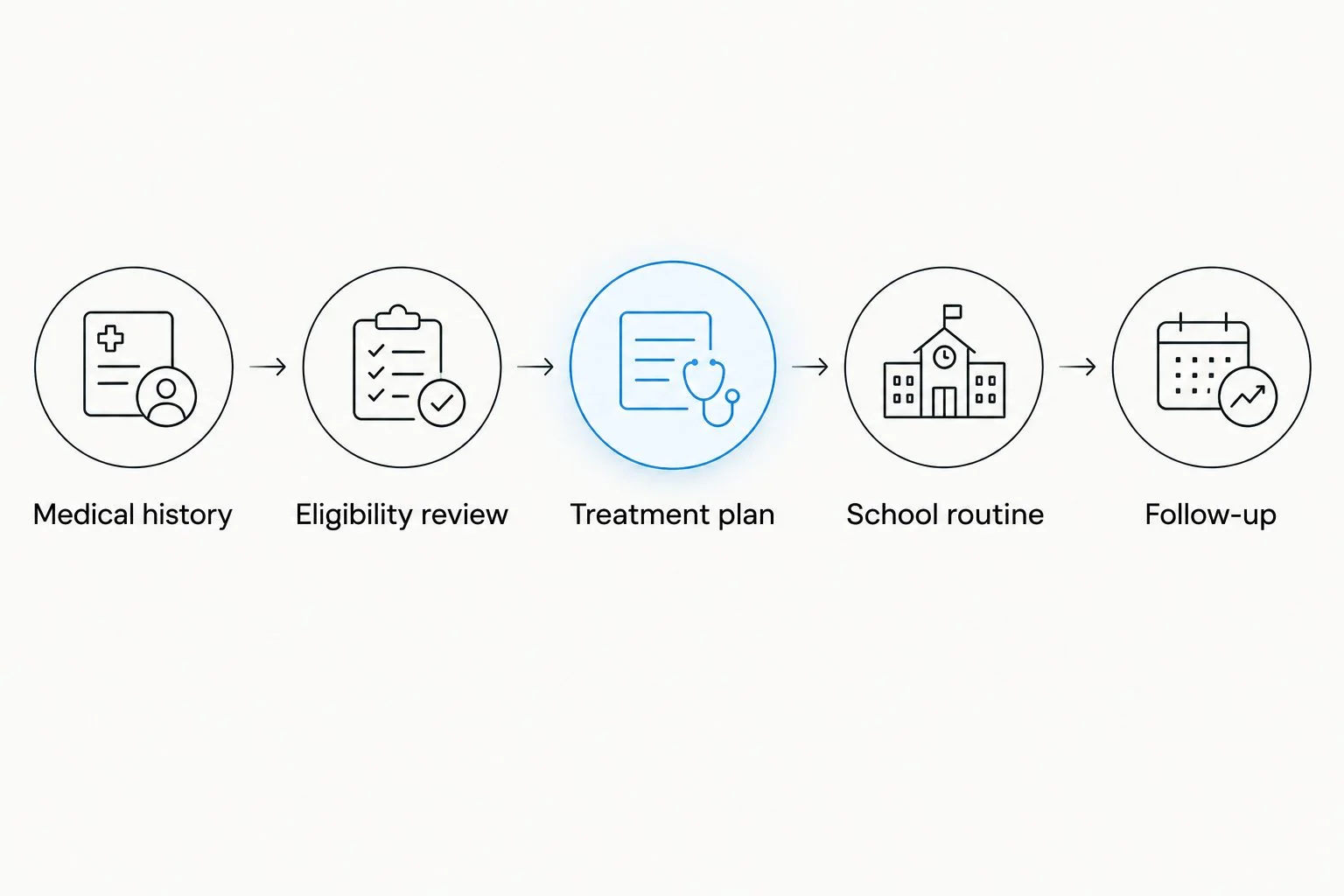
Use this sequence: Medical history, Eligibility review, Treatment plan, School routine, Follow-up. Start with information you can collect yourself. Then use a clinician to make decisions that require medical judgment.
Gather your medical history before booking
Start with a simple document or notebook. Record your current medications, supplements, allergies, previous weight-management treatments, and relevant diagnoses. Include anything you stopped because of side effects. This preparation requires no special software and helps you avoid relying on memory during a short appointment.
Give the clinician a realistic description of your workday. If lunch depends on supervision duties or you cannot leave your classroom without coverage, say so. Those details help shape advice about eating, hydration, and responding to symptoms; they do not justify changing medication instructions yourself.
- List prescription medicines, nonprescription medicines, and supplements.
- Record previous treatments and the reasons you stopped them.
- Note relevant medical conditions and pregnancy plans.
- Describe your actual meal, break, and appointment windows.
Confirm eligibility with a licensed clinician
Start by asking your existing clinician whether weight-management medication is appropriate. A telehealth evaluation is another route, but convenience does not change prescribing requirements. Choose care based on the quality of the assessment, not the likelihood of receiving a particular drug.
FDA labeling for adult chronic weight-management indications commonly uses a body mass index of 30 kg/m² or greater, or 27 kg/m² or greater with a weight-related condition. These thresholds describe certain labeled indications, not automatic eligibility for every semaglutide or tirzepatide formulation. In 2026, ask the prescriber to identify the exact medication, indication, and relevant precautions.
The assessment should also cover your medical history, other medicines, pregnancy considerations, and any examinations or testing the clinician requires. A questionnaire cannot make an unsuitable treatment suitable.
- Ask which medication and indication the clinician is considering.
- Confirm that the clinician can legally treat you in your state.
- Disclose diabetes treatments and other medicines that affect blood sugar.
- Discuss personal or family history of medullary thyroid carcinoma or MEN2.
- Ask whether you need an in-person assessment or additional testing.
Compare care models before selecting a program
First, make a written comparison using information available from each provider and direct answers from its staff. Separate the consultation, prescribing decision, pharmacy arrangements, and follow-up. A service that is easy to join is not necessarily easy to use when you have a treatment question during the term.
Vevarx telehealth weight-loss care offers an online route to doctor-prescribed semaglutide and tirzepatide. Its online format fits the need to seek care remotely; you still need to verify appointment arrangements, clinician access, and the exact medication offered. Do not assume after-school availability or a particular response time.
Use the telehealth weight-loss programs guide to organize your comparison, then confirm current details directly. A provider comparison helps you shortlist options; it does not replace medical advice.
- Ask whether consultations are live, asynchronous, or a combination.
- Confirm who makes prescribing and dose-change decisions.
- Identify the dispensing pharmacy and medication formulation.
- Ask how routine questions and urgent concerns are handled.
- Check how follow-up and repeat prescriptions are arranged.
Build a routine around classroom constraints
Start with your existing timetable. Identify where meals, drinking water, movement, and appointments realistically fit, then discuss that routine with your clinician. Keep the plan workable during an ordinary teaching week, not just during a school break.
If your clinician prescribes an injectable medication, follow the instructions for that exact product. Ask about injection technique, storage, missed doses, and disposal. Do not choose a dosing schedule from a social post or change it solely to avoid a busy school day.
For general adult health, US Department of Health and Human Services guidance recommends 150 minutes of moderate-intensity activity per week, alongside muscle-strengthening activity. Adapt activity to your health and ability; the guideline is not a promise of weight loss or a condition for receiving care.
- Identify practical opportunities to eat and drink during the school day.
- Ask your clinician how to handle symptoms during classroom duties.
- Follow the prescribed administration and storage instructions.
- Plan safe disposal if your treatment uses needles.
- Choose activity you can repeat during both term time and school breaks.
Monitor symptoms without adjusting treatment yourself
Start with a brief symptom log rather than an elaborate tracking system. Record what happened, when it happened, and whether it affected eating, drinking, or work. Share that information at follow-up instead of trying to infer a dose change from a single difficult day.
Nausea, vomiting, diarrhea, and constipation are recognized adverse effects of GLP-1-based treatments. Ask your clinician which symptoms call for routine advice and which need urgent assessment. Do not wait for an online reply when you have emergency symptoms. Severe or persistent abdominal pain, inability to keep fluids down, or signs of a serious allergic reaction need prompt medical attention.
If you also use insulin or certain other diabetes medicines, discuss low-blood-sugar risk and a response plan with your clinician. Classroom responsibilities do not change that safety requirement.
- Record symptoms and their effect on meals, fluids, and teaching.
- Report persistent or worsening symptoms to your care team.
- Keep the provider’s contact instructions readily accessible.
- Follow the clinician’s advice rather than changing doses independently.
- Know when to use urgent care or emergency services.
Review the plan when your schedule changes
Start each follow-up with what has changed: symptoms, other medicines, eating patterns, activity, or your timetable. A school holiday, new supervision duty, or different teaching assignment can disrupt a routine that previously worked. Tell the clinician rather than silently working around the problem.
Assess more than the scale. Your ability to eat adequately, stay hydrated, tolerate treatment, and function at work matters. Ask what monitoring is appropriate and what would lead the clinician to continue, change, or stop treatment.
A review is also the time to discuss continuity. If you travel during a school break, ask how location affects appointments and prescribing. Do not assume a telehealth provider can treat you wherever you happen to be.
- Bring your symptom notes and updated medication list.
- Describe changes to your timetable or location.
- Review nutrition, hydration, and treatment tolerance.
- Ask about examinations or testing needed for continued care.
- Confirm the next follow-up and prescription-review process.
Compare weight-management options for teachers
For your 2026 decision, compare the care model before comparing medications. The best option is the one that provides appropriate assessment and usable follow-up for your circumstances. The table separates those needs without implying that every teacher needs prescription treatment.
| Option | Best for | Main advantage | Key limitation |
|---|---|---|---|
| Self-directed habits and tracking | Teachers preparing for care or improving routines | Lets you document meals, activity, and symptoms independently | Cannot diagnose conditions or provide prescription treatment |
| Primary care or an in-person weight-management clinic | Teachers needing physical examination or coordination of several conditions | Provides a route to hands-on assessment | Visits require a workable appointment arrangement |
| Vevarx telehealth weight-loss care | Teachers seeking online, doctor-prescribed medication assessment | Offers remote access to semaglutide and tirzepatide prescribing assessment | Suitability, medication details, and follow-up arrangements require confirmation |
| Registered dietitian support | Teachers needing individualized nutrition planning | Focuses on eating patterns and nutritional adequacy | Does not replace a prescribing clinician when medication is involved |
These options are not mutually exclusive. You can work with a prescribing clinician and a registered dietitian while keeping your own symptom record. Confirm who is responsible for each part of care so that medication questions do not disappear between providers.
Common mistakes teachers make when choosing care
Planning only for school holidays
Starting during a break does not establish that treatment will fit term time. Describe the timetable you will return to, including meal access and classroom coverage. Ask for a plan that remains workable when teaching resumes.
Treating restricted meals as a weight-loss strategy
If supervision duties already interfere with meals, disclose that constraint rather than treating it as an advantage. Appetite changes do not remove your nutritional needs. Ask for help with a realistic eating plan instead of relying on skipped lunches.
Assuming online care means instant clinical access
A platform can be online without offering immediate clinician replies. Confirm how to contact the care team, what follow-up includes, and what to do outside its normal process. Emergency care should never depend on a routine message response.
Comparing drug names without checking formulations
A shared ingredient name does not establish that products have the same indication, instructions, or regulatory status. FDA-approved and compounded products are not interchangeable descriptions; compounded drugs are not FDA-approved. Ask exactly what is being prescribed and why it is appropriate for you.
Adding wellness peptides to solve a difficult term
Vevarx also offers wellness peptides, but that does not make them a required part of weight management. Do not interpret a demanding school schedule as a medical reason to add treatment. Ask about the evidence, risks, and regulatory status for each proposed therapy separately.
FAQ
What's the best telehealth weight-loss option for a teacher?
The best option provides an appropriate medical assessment and follow-up you can use around teaching duties. Vevarx offers online doctor-prescribed weight-loss care, but confirm clinician access, medication details, and suitability before choosing it.
Can teachers get semaglutide or tirzepatide online?
Teachers can seek an online prescribing assessment for semaglutide or tirzepatide where lawful care is available. A clinician must assess the individual; being a teacher does not establish eligibility or guarantee a prescription.
Do I need a particular BMI for weight-loss medication?
Certain adult weight-management indications use a BMI of at least 30 kg/m², or at least 27 kg/m² with a weight-related condition. The exact product, medical history, and contraindications also matter, so these thresholds are not an automatic approval rule.
Can I change injection day to fit my teaching schedule?
Ask your prescriber before changing your injection schedule. Follow the instructions for your exact medication, including the rules for changing administration days and handling missed doses.
What if medication side effects interrupt my classes?
Contact your clinician for advice and explain how symptoms affect eating, drinking, and teaching. Severe or persistent abdominal pain, inability to keep fluids down, or serious allergic symptoms require prompt medical assessment rather than waiting for a routine online reply.
Is telehealth enough if I also have diabetes or high blood pressure?
Telehealth does not remove the need to coordinate care for diabetes or high blood pressure. Share your full medication list and ask whether your situation requires an examination, testing, or involvement from your existing clinician.
Are wellness peptides necessary for a teacher's weight-loss plan?
Wellness peptides are not a prerequisite for a medically supervised weight-loss plan. Discuss the evidence, risks, and regulatory status of each treatment separately rather than assuming that adding therapies improves results.
One last thing
Before choosing care in 2026, write down what you would do if symptoms began halfway through a lesson. A usable contact and escalation plan is part of treatment, not an administrative extra. If you cannot explain whom to contact and when to seek urgent help, resolve that gap before starting.
Related guides
This article is for informational purposes only and is not medical advice. Compounded medications are not approved by the FDA and have not been reviewed for safety, effectiveness, or quality. Prescription products require an online consultation with a licensed healthcare provider who will determine if a prescription is appropriate. Individual results vary.