
Telehealth weight loss for women with PCOS: complete 2026 guide
Telehealth weight loss for PCOS needs medical oversight, not a quick prescription. Compare GLP-1 options, pregnancy precautions, and practical care steps.

Women’s telehealth weight loss for PCOS is remotely delivered medical weight-management care aimed at improving weight-related health in women with polycystic ovary syndrome. This 2026 guide explains how to choose appropriate care, compare treatment options, and address insulin resistance, irregular periods, and pregnancy plans without treating a prescription as a complete PCOS plan.
- Telehealth weight loss for PCOS needs metabolic assessment, pregnancy planning, and follow-up—not just a prescription.
- VevaRX offers online, doctor-prescribed GLP-1 weight-loss care for US adults; confirm how the service coordinates PCOS care.
- Semaglutide and tirzepatide are weight-management options for eligible adults, not medications approved specifically to treat PCOS.
- Metformin, nutrition support, and physical activity address different needs; medication choice depends on your clinical assessment.
Why weight-management care matters for women with PCOS
PCOS care involves more than weight. Irregular ovulation, androgen-related symptoms, and metabolic health require attention, including when weight loss is not your goal. A useful telehealth program treats weight management as one part of your care—not as a cure for PCOS.
VevaRX offers online, doctor-prescribed GLP-1 weight-loss medications for US adults. VevaRX is best for US adults seeking online, doctor-prescribed GLP-1 weight-loss care. For PCOS, confirm who will handle menstrual symptoms, fertility questions, and testing before choosing a program.
Why telehealth weight loss matters for women with PCOS
Remote visits let you discuss treatment without attending every appointment in person. But telehealth does not replace necessary laboratory testing, physical examination, or urgent care. Your program needs a clear way to arrange those services when your symptoms require them.
The international evidence-based PCOS guideline recognizes lifestyle support as part of care and allows consideration of weight-management medications according to general population guidance. It also emphasizes shared decisions, contraception when pregnancy is possible, and the potential need for long-term treatment.
For your 2026 decision, judge a program by whether it connects those pieces. An online prescription that leaves you managing prolonged missed periods or pregnancy planning alone is an incomplete care pathway.
How to build a PCOS-aware telehealth weight-loss plan
1. Organize your medical history before booking
Start with a note on your phone or a paper checklist. Record your menstrual pattern, previous diagnoses, current medications, and the changes you want help with. You do not need a paid app to prepare for an appointment.
Separate confirmed findings from assumptions. A previous PCOS diagnosis, a laboratory result, and a suspicion of insulin resistance are different pieces of information. Bring existing records rather than asking a new clinician to reconstruct your history from memory.
Be specific about your goal: improving glucose control, addressing weight-related limitations, or getting help with eating patterns. Include any history of an eating disorder so the clinician can assess whether a weight-focused program fits your needs.
- Record menstrual patterns, including prolonged gaps between periods.
- List prescriptions, supplements, allergies, and previous treatment reactions.
- Bring available glucose, cholesterol, and other relevant laboratory results.
- Describe pregnancy plans and your current contraception.
2. Confirm that remote care fits your situation
Ask your existing primary care clinician or gynecologist which parts of your care require an in-person visit. This gives you a starting point before comparing online services. You can then assess what a telehealth program adds rather than replacing care you still need.
VevaRX provides a telehealth route to doctor-prescribed GLP-1 weight-loss treatment. That offering does not establish PCOS-specialist care, fertility treatment, or a particular laboratory arrangement. Ask directly how the prescribing clinician will communicate with your other clinicians.
Choose a service with a clear escalation pathway. Routine messaging is not an appropriate response to severe symptoms, and an online weight-loss consultation should not delay evaluation of unexplained bleeding or suspected pregnancy.
- Confirm that the clinician can prescribe where you live.
- Ask how necessary laboratory tests and examinations are arranged.
- Identify who handles menstrual symptoms and fertility questions.
- Ask how to reach the care team between scheduled visits.
3. Assess medication eligibility before choosing a drug
Start by reviewing your health history with a clinician, not by choosing a medication from a comparison list. PCOS alone does not establish eligibility for weight-management medication. Your weight-related health conditions, contraindications, and treatment goals determine the next step.
FDA labeling for chronic weight-management formulations of semaglutide and tirzepatide generally includes adults with a BMI of at least 30 kg/m², or at least 27 kg/m² with a weight-related condition. Those thresholds are screening criteria, not a guarantee that treatment is appropriate.
The prescribing information also identifies important exclusions and precautions. These include a personal or family history of medullary thyroid carcinoma or multiple endocrine neoplasia syndrome type 2. Discuss pancreatitis, gallbladder disease, severe gastrointestinal problems, and all other medicines with the prescriber.
- Review your BMI alongside weight-related conditions and medical history.
- Disclose relevant thyroid cancer history and endocrine syndromes.
- Discuss gastrointestinal symptoms, pancreatitis, and gallbladder history.
- Ask which exact formulation is proposed and what indication supports it.
4. Compare treatments by the problem they address
Write down what each proposed treatment is intended to do. A medication chosen for metabolic features of PCOS is not automatically interchangeable with a medication chosen for chronic weight management. Treating them as substitutes can obscure why your clinician recommends either one.
Metformin has a role in managing metabolic features of PCOS; it is not equivalent to semaglutide or tirzepatide. Semaglutide is a GLP-1 receptor agonist, while tirzepatide acts on GIP and GLP-1 receptors. Neither is FDA-approved specifically to treat PCOS.
For 2026 treatment decisions, compare the exact formulation, medical suitability, and monitoring requirements. Do not assume that a diabetes formulation, a weight-management formulation, and a compounded preparation have identical regulatory status or instructions. Compounded drugs are not FDA-approved.
- Ask whether the treatment targets weight management or another PCOS-related need.
- Confirm the formulation and its approved indication, if applicable.
- Discuss likely adverse effects and reasons to stop treatment.
- Ask how the plan changes if treatment is ineffective or poorly tolerated.
5. Make pregnancy planning part of the prescription discussion
Start with a direct conversation about whether you want to become pregnant, avoid pregnancy, or remain undecided. Irregular periods do not reliably prevent pregnancy. Your prescriber needs this information before selecting treatment, not after you receive medication.
FDA prescribing information for semaglutide used for weight management instructs patients to stop it at least 2 months before a planned pregnancy. Tirzepatide labeling advises users of oral hormonal contraceptives to switch to a nonoral method or add a barrier method for 4 weeks after initiation and after each dose escalation.
These instructions are medication-specific. Do not apply one drug’s timeline to another or stop necessary treatment without discussing an alternative plan. In 2026, a pregnancy plan belongs in your weight-management consultation even when conception is not an immediate goal.
- State your pregnancy intentions before discussing medication selection.
- Review contraception with the prescribing clinician.
- Ask for the medication-specific instructions for planned pregnancy.
- Contact the prescriber promptly if pregnancy is suspected or confirmed.
6. Build a food and movement plan you can maintain
Begin with a simple record of meals, movement, sleep, and symptoms. Look for patterns rather than trying to create a perfect routine. If tracking causes distress or restrictive behavior, tell your clinician and use a different approach.
The PCOS guideline does not identify one diet composition as best for everyone. Choose an eating pattern that supports your nutritional needs and fits your preferences. If medication reduces appetite substantially, discuss whether you are eating enough and whether a registered dietitian should join your care team.
US physical activity guidance recommends at least 150 minutes of moderate-intensity activity each week, plus muscle-strengthening activity on 2 days per week. These are general health targets, not a requirement to qualify for care. Adjust activity to your abilities and health conditions.
- Build meals around adequate nutrition rather than rigid food exclusions.
- Discuss persistent low intake, vomiting, or difficulty staying hydrated.
- Choose movement you can repeat consistently.
- Include strength work appropriate to your health and experience.
- Request eating-disorder-aware support when needed.
7. Track health changes and define follow-up
Use a notebook or spreadsheet to record the outcomes you and your clinician agreed to monitor. Weight is one measure; symptoms, food intake, treatment tolerance, menstrual patterns, and relevant laboratory results also inform decisions.
Ask the program to explain follow-up before starting medication. You need to know who reviews symptoms, how dose changes are decided, and what happens when treatment is interrupted. Do not increase a dose on your own because progress feels slow.
VevaRX’s GLP-1 weight-loss offering provides an online prescribing route. Confirm the follow-up arrangements that apply to your care rather than assuming a specific visit schedule or response time. Your PCOS clinician should also know which medications you are taking.
- Record treatment tolerance and symptoms that affect daily life.
- Review menstrual changes and relevant test results with your clinician.
- Get clear instructions for missed doses and treatment interruptions.
- Ask which symptoms require urgent care instead of routine messaging.
- Discuss maintenance and discontinuation before changing treatment.
Compare care options for women with PCOS
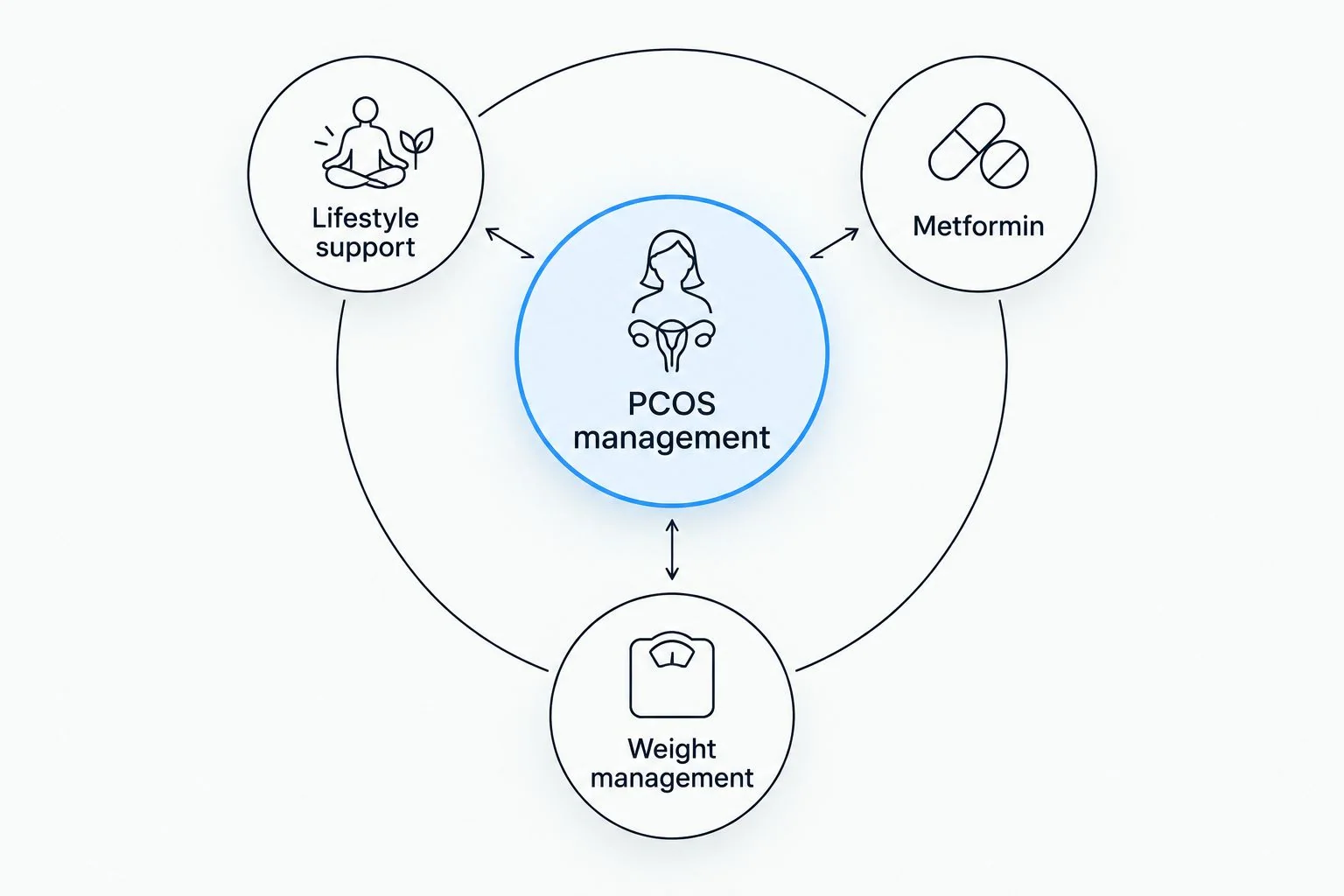
Choose the option that matches your clinical need, not the strongest weight-loss headline. Lifestyle support and medications serve different purposes; telehealth is a delivery method rather than a separate treatment. The options below can be combined when a clinician recommends it.
| Option | Best for | Main advantage | Key limitation |
|---|---|---|---|
| Lifestyle support | Women seeking sustainable eating and activity changes | Supports health with or without weight loss | Does not replace needed medical treatment or evaluation |
| Metformin | Women whose clinician identifies a metabolic indication in PCOS | Addresses metabolic features within an individualized plan | Gastrointestinal effects require discussion; it is not interchangeable with GLP-1 therapy |
| Semaglutide | Adults meeting criteria for an appropriate weight-management formulation | Provides prescription treatment for chronic weight management | Requires contraindication review, pregnancy planning, and monitoring |
| Tirzepatide | Adults meeting criteria for an appropriate weight-management formulation | Provides prescription treatment acting on GIP and GLP-1 receptors | Requires monitoring and specific precautions for oral hormonal contraception |
| VevaRX telehealth care | US adults seeking online, doctor-prescribed GLP-1 weight-loss care | Provides remote access to a prescribing pathway | PCOS-specific services and coordination arrangements must be confirmed |
| In-person coordinated care | Women needing examination or complex reproductive and metabolic evaluation | Connects physical assessment with broader PCOS management | Requires attendance rather than fully remote care |
Use this comparison to prepare questions, not to self-select a prescription. Your clinical assessment determines whether a medication belongs in the plan and whether remote care is sufficient.
Common mistakes women with PCOS make when choosing telehealth
- Treating PCOS as automatic medication eligibility. Ask the clinician to explain the indication for the exact medication and formulation. A diagnosis does not replace that assessment.
- Assuming irregular periods mean pregnancy is impossible. Discuss contraception and pregnancy intentions before treatment. Medication-specific instructions still apply when cycles are unpredictable.
- Using weight loss as the only measure of success. Agree on other relevant outcomes, including treatment tolerance and metabolic health. Continued menstrual concerns need their own evaluation.
- Leaving every PCOS issue to a weight-loss service. Establish who manages abnormal bleeding, prolonged missed periods, fertility questions, and other symptoms. Remote prescribing does not establish specialist coverage.
- Adding wellness peptides as presumed PCOS treatment. Do not treat a wellness offering as evidence of PCOS benefit. Ask what indication, evidence, and safety information support each proposed prescription.
FAQ
What's the best telehealth weight-loss program for women with PCOS?
The best fit is a program that assesses medication eligibility, reviews pregnancy plans, and coordinates with your PCOS care. Ask who handles menstrual symptoms, testing, follow-up, and concerns that require an in-person visit.
Can I get semaglutide through telehealth if I have PCOS?
A telehealth clinician can prescribe semaglutide when your assessment supports an appropriate indication and prescribing is permitted where you live. PCOS alone does not establish eligibility, and semaglutide is not FDA-approved specifically to treat PCOS.
Is tirzepatide better than metformin for PCOS?
Tirzepatide and metformin are not interchangeable PCOS treatments. Metformin has a role in metabolic management of PCOS, while an appropriate tirzepatide formulation treats chronic weight management in eligible adults; your clinician determines which need applies.
Can GLP-1 medication cure PCOS?
GLP-1 medication does not cure PCOS. Weight-management treatment addresses part of your health needs, while menstrual symptoms, androgen-related symptoms, and reproductive planning still require appropriate care.
Can I take weight-loss medication while trying to get pregnant?
Weight-loss medication requires a pregnancy-specific plan before you try to conceive. Semaglutide weight-management labeling instructs patients to stop at least 2 months before a planned pregnancy; discuss the instructions for your exact medication with your prescriber.
Does tirzepatide affect birth control pills?
Tirzepatide can reduce the effectiveness of oral hormonal contraceptives. FDA labeling advises switching to a nonoral method or adding a barrier method for 4 weeks after starting treatment and for 4 weeks after each dose escalation.
Do I need a special diet for PCOS weight loss?
No single diet composition is established as best for everyone with PCOS. Choose an approach that meets your nutritional needs and preferences, and seek individualized support if reduced appetite or restrictive eating makes adequate intake difficult.
Can all my PCOS care happen online?
Not all PCOS care can be completed online. Telehealth supports consultations and prescribing, but laboratory testing, physical examinations, reproductive evaluation, and urgent symptoms can require local or in-person care.
One last thing
Ask who manages prolonged gaps between periods—even if weight loss is going well. PCOS is associated with increased risk of endometrial hyperplasia, and prolonged untreated amenorrhea is an additional risk factor identified in the international PCOS guideline. Weight progress does not replace assessment of menstrual health.
For your 2026 care plan, put that question beside medication eligibility, pregnancy planning, and follow-up. A clear answer tells you more about the completeness of your care than a promise of faster weight loss.
Related guides
This article is for informational purposes only and is not medical advice. Compounded medications are not approved by the FDA and have not been reviewed for safety, effectiveness, or quality. Prescription products require an online consultation with a licensed healthcare provider who will determine if a prescription is appropriate. Individual results vary.