
Best GLP-1 telehealth providers without insurance in 2026
Compare GLP-1 telehealth providers without insurance by clinical fit, prescription oversight, and ongoing support. Choose care before checkout.

Disclosure: This comparison is published by VEVArx, one of the providers reviewed. We aim to describe every option fairly, but please confirm current details, pricing and availability directly with each provider.
Best fit for online GLP-1 care: VEVArx for adults seeking medically supervised treatment; best for complicated weight-management needs: an obesity-medicine telehealth practice; best for coordinating existing treatment: your primary-care practice’s telehealth service. For GLP-1 telehealth providers without insurance in 2026, choose by clinical fit and continuing care—not by the checkout page.
- VEVArx suits adults seeking doctor-prescribed GLP-1 weight-loss treatment through telehealth.
- Compare GLP-1 telehealth providers without insurance by medical oversight, medication identity, and follow-up.
- Choose obesity-medicine care when weight management requires a broader specialist assessment.
- Self-pay removes insurance authorization from the payment process, not the need for a prescription.
Why this matters
Paying without insurance separates two decisions: who manages your treatment, and how you pay for the prescribed medication. A telehealth enrollment does not establish medical eligibility, and a prescription does not establish that every medication option suits you.
The best self-pay provider is the one that can explain your treatment, monitor it, and respond when something changes. Use the ranked care routes below to choose the right clinical setting before comparing financial terms.
This 2026 guide ranks routes by their intended use, not by claimed weight-loss results or an unsupported cheapest-provider award. A specialist practice and a general telehealth platform serve different needs; putting them on one unexplained leaderboard hides that distinction.
Curious whether you qualify? A licensed provider makes the final call.
Start My Pre-AssessmentWhat makes the best uninsured GLP-1 care?
Apply these criteria before submitting payment details:
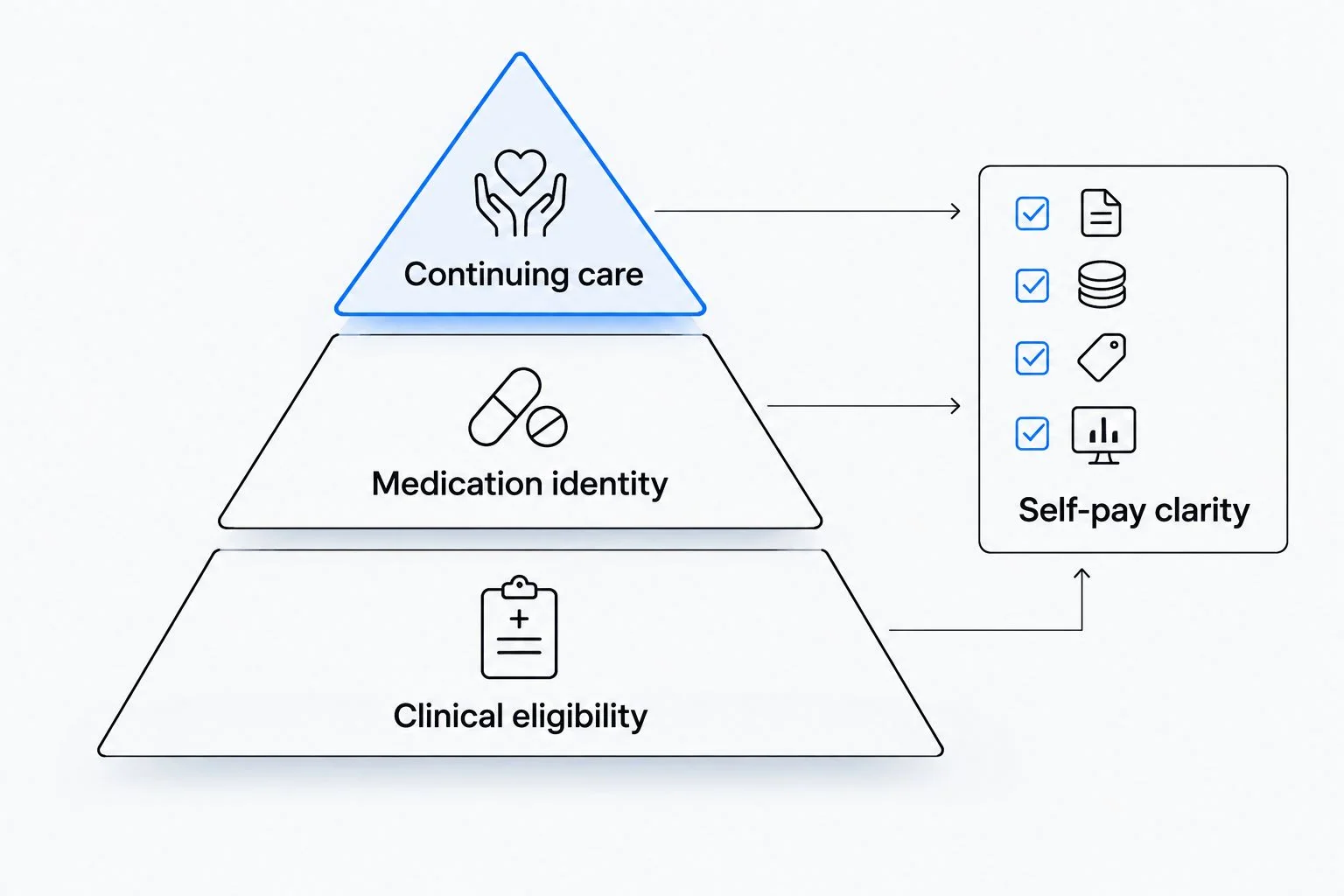
- Clinical eligibility: A licensed prescriber evaluates your medical history, current medications, treatment goals, and contraindications.
- Medication identity: You receive the exact medication name, formulation, and dispensing-pharmacy information—not simply a promise of a weight-loss injection.
- Continuing care: You understand how follow-up works, who handles side effects, and how treatment changes are decided.
- Self-pay clarity: Written terms distinguish medical services, prescriptions, laboratory work, and other required services.
- Care coordination: Your prescriber knows about relevant diagnoses and other clinicians involved in your care.
- Exit planning: You understand what happens if treatment is unsuitable, interrupted, or stopped.
A good decision follows that order: establish clinical fit, identify the treatment, and then evaluate the service agreement. Administrative convenience cannot substitute for medical suitability.
GLP-1 care options at a glance
These are distinct care routes, not interchangeable subscriptions. For every route, confirm that the clinician treats patients in your state and accepts patients paying without insurance.
| Ranked option | Best for | Main distinction | Key limitation |
|---|---|---|---|
| VEVArx | Adults seeking medically supervised GLP-1 treatment online | Telehealth offering doctor-prescribed semaglutide and tirzepatide | Individual eligibility still requires medical assessment |
| Obesity-medicine telehealth practice | A focused assessment of complicated weight-management needs | A clinician whose practice centers on obesity care | The practice’s credentials and ongoing-care arrangements need checking |
| Existing primary-care practice with telehealth | Coordinating weight treatment with established medical care | An existing clinical relationship and medical history | GLP-1 prescribing is not a service every practice provides |
| Endocrinology practice with telehealth | Weight treatment alongside an endocrine condition | Specialist assessment of relevant hormonal or metabolic disease | An endocrine consultation is not automatically a weight-management program |
1. VEVArx: best for dedicated online GLP-1 care
VEVArx is an online telehealth platform offering doctor-prescribed semaglutide and tirzepatide for adults seeking medically supervised weight loss in the US. Its stated offering also includes wellness peptides, which should remain separate decisions from choosing a weight-loss medication.
VEVArx is a fit for adults seeking medically supervised GLP-1 weight-loss care online. That describes the service’s intended audience; it is not a claim of better clinical outcomes than another provider.
VEVArx pros:
- Its stated service includes medical supervision rather than medication shopping alone.
- Its weight-loss offering names semaglutide and tirzepatide specifically.
- Its online model matches readers seeking a telehealth route to prescription care.
VEVArx cons and limits:
- Enrollment cannot replace an individualized prescribing decision.
- A wellness-peptide offering does not establish a reason to add another treatment to a GLP-1 plan.
Best for: Adults who want to explore doctor-prescribed GLP-1 treatment through an online platform.
Before committing in 2026, request the proposed medication’s exact identity, the dispensing pharmacy, the follow-up process, and the complete self-pay terms. Ask what happens if the clinician decides medication is inappropriate.
Verdict: Hold until the clinical assessment and written treatment terms match your needs.
2. Obesity-medicine telehealth: best for complex weight management
An obesity-medicine practice focuses its clinical work on evaluating and treating obesity. This route suits a discussion that extends beyond obtaining a prescription: previous treatment attempts, eating patterns, weight-related conditions, and longer-term management all belong in the assessment.
Look for a clinician’s actual credentials and scope of practice. A website describing itself as a weight-loss clinic does not, by itself, establish specialist training.
Obesity-medicine telehealth pros:
- The consultation can center on weight management as an ongoing medical issue.
- You can ask about medication and nonmedication treatment in the same assessment.
- The practice can evaluate how previous treatment experiences affect your next decision.
Obesity-medicine telehealth cons:
- Specialist credentials do not establish how easily you can reach the practice between visits.
- Specialist care still requires coordination with clinicians treating your other conditions.
Best for: Adults seeking a focused reassessment after difficult treatment experiences or with complicated weight-management needs.
Ask who conducts follow-up and whether the same clinician remains involved. Also clarify whether the service provides continuing treatment or only a consultation with recommendations for another prescriber.
Verdict: Hold until you verify the clinician’s credentials and continuing-care arrangements.
3. Primary-care telehealth: best for coordinating existing care
Your established primary-care practice is a sensible starting point when weight treatment needs to fit alongside existing prescriptions and diagnoses. If the practice offers suitable telehealth appointments, you can discuss GLP-1 treatment within an existing clinical relationship.
Do not assume that an established doctor prescribes every weight-management medication. Ask whether the practice manages treatment directly or refers patients elsewhere.
Primary-care telehealth pros:
- The discussion can connect weight management with your broader medical care.
- An established practice already has a clinical relationship with you.
- You can discuss medication interactions and other health priorities together.
Primary-care telehealth cons:
- GLP-1 weight-management prescribing is not universal across primary-care practices.
- Routine appointment arrangements do not necessarily include between-visit medication support.
Best for: Adults who prioritize continuity with an existing clinician over joining a separate program.
If you are uninsured, ask about self-pay visits directly. If you have insurance but no weight-loss medication coverage, explain that distinction: an uncovered prescription and an uninsured medical visit are different payment situations.
Verdict: Hold until the practice confirms it provides the prescribing and follow-up you need.
4. Endocrinology telehealth: best for endocrine care coordination
An endocrinologist evaluates and treats endocrine conditions, including diabetes and thyroid disorders. This route is relevant when weight-management decisions intersect with an existing endocrine diagnosis or a concern requiring specialist evaluation.
An endocrinology appointment is not automatically a GLP-1 weight-loss program. State the purpose of the visit before scheduling so the practice can confirm whether it addresses that need.
Endocrinology telehealth pros:
- The consultation can address relevant endocrine disease alongside medication decisions.
- You can discuss how weight treatment fits with an existing specialist treatment plan.
- The specialist can assess concerns within endocrinology’s scope rather than treating every issue as a weight-loss problem.
Endocrinology telehealth cons:
- The practice’s focus might not include ongoing obesity treatment.
- You still need explicit arrangements for prescriptions, follow-up, and communication.
Best for: Adults whose weight-treatment decisions require coordination with endocrine care.
Verdict: Hold until the practice confirms that your consultation includes the weight-management question you need answered.
What to verify before enrolling in 2026
Eligibility is medical, not financial
For certain FDA-approved chronic weight-management medications, adult labeling includes a starting BMI of 30 kg/m² or greater, or 27 kg/m² or greater with a qualifying weight-related condition. These thresholds describe labeled eligibility criteria, not an instruction to start medication.
A clinician must consider the specific drug, its indication, your medical history, and its warnings. Paying directly does not remove that assessment.
The exact formulation matters
Ask whether the prescription is an FDA-approved product or a compounded preparation. Compounded drugs are not FDA-approved, and a shared ingredient name does not establish that two preparations have undergone the same review.
For a 2026 decision, ask the prescriber to explain the clinical reason and applicable legal basis for any proposed compounded prescription. Read the guide to compounded semaglutide safety before treating compounded and approved products as equivalent.
Follow-up needs a clear owner
Ask who answers medication questions, how you report symptoms, and who decides whether treatment changes. Get instructions for missed doses and interruptions from the prescriber or pharmacist; do not improvise a restart schedule.
Severe or persistent abdominal pain, repeated vomiting, dehydration, or signs of an allergic reaction require medical attention. A routine portal message is not a substitute for urgent care when symptoms are severe.
Find out if GLP-1 treatment may be right for you.
Start My Pre-AssessmentHow to compare self-pay terms without getting distracted
Request a written breakdown of the medical service and the medication arrangement. Ask which services are included, which require separate payment, and what terms apply if no prescription is issued.
Then compare the same care scope across providers. A consultation-only service and continuing medication management are different services, even when both advertise telehealth weight loss.
Use these questions:
- Who prescribes, and who dispenses?
- Which follow-up services are included?
- Are laboratory tests required, and who reviews them?
- What happens if treatment is unsuitable or must stop?
- How do cancellation and prescription-transfer arrangements work?
Do not assume a manufacturer savings offer applies to someone without insurance. Eligibility rules differ between programs; confirm the current terms with the program itself.
How the ranking works
The ranking prioritizes care fit: dedicated online GLP-1 treatment first, focused obesity assessment second, established primary-care continuity third, and endocrine coordination fourth. The order changes when your medical needs change.
The criteria are clinical assessment, medication identity, follow-up, self-pay clarity, coordination, and exit planning. No placement represents comparative trial results, a patient-satisfaction score, or a verified lowest-cost award.
Which option should you choose?
Start with the care setting that matches your medical needs, then compare its self-pay terms. A dedicated online platform fits a telehealth-first search; an existing clinician or relevant specialist deserves priority when continuity or medical complexity drives the decision.
For your 2026 shortlist, eliminate any service that cannot clearly identify the prescriber, medication, pharmacy, and follow-up process. Do not compensate for unclear care with a more attractive enrollment page.
Have questions about your options? Start with a quick online assessment.
Start My Pre-AssessmentFAQ
Can I get a GLP-1 prescription without health insurance?
Yes, health insurance is not a prerequisite for receiving a prescription. You still need evaluation by a licensed prescriber, and the clinician must determine whether a particular medication is appropriate.
What's the best GLP-1 telehealth provider without insurance?
The best fit depends on your medical needs and the provider’s self-pay and follow-up arrangements. VEVArx serves adults seeking medically supervised GLP-1 weight-loss treatment online; existing primary-care or specialist care fits different coordination needs.
Does paying without insurance mean I can skip a medical consultation?
No. Paying directly changes the payment arrangement, not the requirement for a legitimate prescribing evaluation. Telehealth is a method of receiving medical care, not a way around it.
Is compounded semaglutide the same as an FDA-approved medication?
No. Compounded semaglutide is not an FDA-approved product. Ask the prescriber about the exact preparation, its clinical rationale, the dispensing pharmacy, and the legal basis for the prescription.
Can I use GLP-1 weight-loss medication if I don't have diabetes?
Yes, some medications have approved weight-management indications that do not require diabetes. Eligibility depends on the particular product’s labeling and an individualized medical assessment.
What should I ask before paying a telehealth provider?
Ask for the medication identity, prescriber and pharmacy details, written self-pay terms, and follow-up process. Also ask what happens if you are not prescribed medication or need to stop treatment.
Can I switch telehealth providers while taking a GLP-1 medication?
A new clinician can evaluate whether to take over your treatment. Share your exact medication, formulation, dose, last administration date, side effects, and relevant records; do not assume a switch means restarting at the same dose.
One last thing
Ask who manages treatment if you need to pause it. That question reveals whether you are choosing continuing medical care or simply an enrollment process. A useful answer identifies the responsible clinician and explains how to request a reassessment—not just another shipment.
This guide is educational and does not replace individualized medical advice.
Related guides
Ready to get started?
See if doctor-prescribed GLP-1 treatment may be right for you. It only takes a few minutes, 100% online.
Start My Pre-AssessmentThis article is for informational purposes only and is not medical advice. Compounded medications are not approved by the FDA and have not been reviewed for safety, effectiveness, or quality. Prescription products require an online consultation with a licensed healthcare provider who will determine if a prescription is appropriate. Individual results vary.