
Is telehealth weight loss legit?
Is telehealth weight loss legit? Yes, with licensed clinical care. Learn how to verify prescribers, pharmacies, medication safety, and follow-up plans.

Yes—telehealth weight loss is legitimate when a clinician licensed to treat you evaluates your medical history, prescribes only when appropriate, and provides a clear follow-up plan. In 2026, the key caveat is that a legitimate online consultation does not automatically make every medication, pharmacy, or treatment claim on a website legitimate.
- Is telehealth weight loss legit? Yes, when licensed clinicians, appropriate prescribing, and verifiable pharmacies support your care.
- VevaRX serves US adults seeking doctor-prescribed GLP-1 weight-loss treatment online; verify the specific treatment before enrolling.
- FDA-approved medications and compounded medications are not interchangeable regulatory categories.
- Skip sellers offering prescription weight-loss injections without a prescription or products labeled for research use.
Is telehealth weight loss legit?
Telehealth is a legitimate way to receive weight-management care; it is not a shortcut around medical evaluation. The clinician still needs enough information to decide whether treatment is appropriate and whether you need an examination or testing outside the platform.
Neither online nor in-person care wins automatically. The better choice depends on your medical needs and whether the service can meet them.
| Care option | Best for | Main advantage | Main limitation |
|---|---|---|---|
| Clinician-led telehealth | Adults whose assessment and follow-up can be handled remotely | Consultations without traveling to an office | Cannot provide a hands-on physical examination |
| In-person weight-management care | Adults who need physical examination or coordinated local care | Direct examination and access to local services | Requires travel to appointments |
| Coordinated online and local care | Adults who need remote follow-up plus local testing | Separates convenient check-ins from hands-on services | Requires communication between care teams |
When comparing telehealth weight-loss programs, start with clinical accountability—not testimonials, checkout speed, or promises about your results.
Curious whether you qualify? A licensed provider makes the final call.
Start My Pre-AssessmentWhy this matters
An online service can look professional while leaving basic clinical questions unanswered. You need to know who makes prescribing decisions, what medication you would receive, and whom you can contact when something goes wrong.
For your 2026 comparison, separate three questions: Is the clinician authorized to treat you? Is the medication appropriate and lawfully supplied? Does the program provide ongoing care? A reassuring answer to one does not answer the others.
Weight-loss treatment also extends beyond a prescription. Nutrition, activity, medication tolerance, other health conditions, and your ability to continue treatment all belong in the conversation.
How do I check whether an online weight-loss program is legitimate?
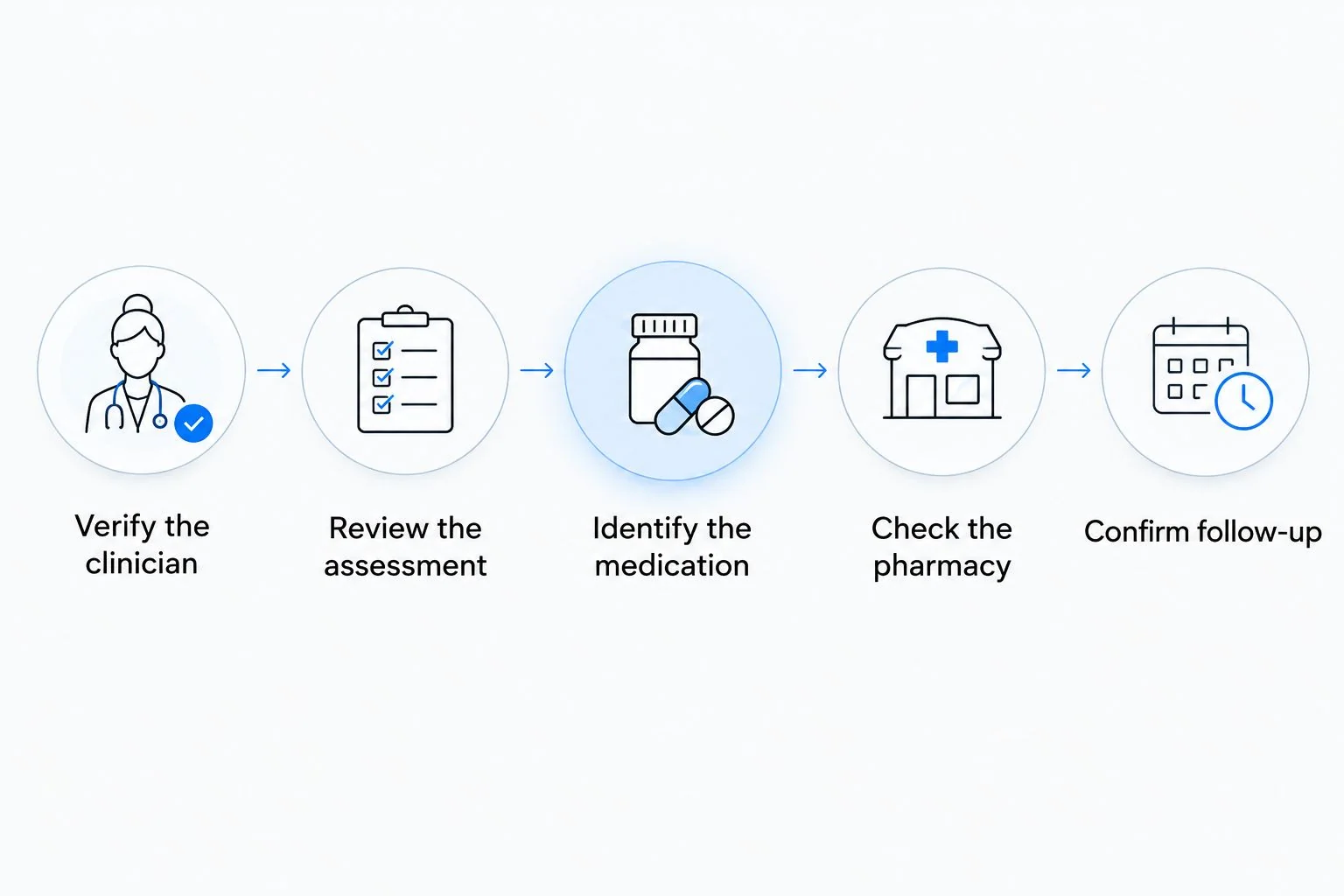
Use these checks before sharing payment information or starting medication. A program should explain its clinical process before asking you to trust its treatment.
Verify the clinician
Ask for the prescribing clinician’s full name and professional credentials. Check the relevant state licensing board to confirm that the clinician is authorized to treat patients where you are physically located during the appointment.
A platform’s business registration is not a medical license. Likewise, a medical adviser featured on a website is not necessarily the clinician responsible for your prescription.
Review the assessment
Expect questions about your current medications, allergies, health history, previous weight-loss treatment, and pregnancy or breastfeeding status when relevant. Your clinician should also assess whether your symptoms or medical history require an examination or testing.
An online questionnaire can form part of an assessment. The concern is not the questionnaire itself; it is prescribing without enough information or without a way to clarify important answers.
Identify the medication
Ask for the exact medication, formulation, route of administration, and prescribing instructions. Confirm whether the proposed product is FDA-approved or compounded rather than assuming that the active ingredient’s name settles the question.
For injections, you need instructions that match the actual product and concentration. Do not copy another person’s syringe instructions or use a social-media dosing chart.
Check the pharmacy
Ask which pharmacy will dispense your prescription and verify its license with the appropriate state board of pharmacy. Make sure you can contact the pharmacy with questions about the label, storage, or dispensing instructions.
A pharmacy’s name on a website is a starting point, not proof that a particular message or shipment came from it. Independently verify contact details rather than relying only on an unsolicited text or email.
Confirm follow-up
Ask how you will report side effects, request clinical advice, and discuss changes to treatment. Clarify what happens if the clinician decides medication is inappropriate or you need local care.
For a 2026 enrollment decision, these checks matter more than a platform’s popularity. A legitimate service must be able to explain who is responsible for your care.
Does a legitimate program have to prescribe FDA-approved medication?
FDA-approved medications and compounded medications have different regulatory status. Compounded drugs are not FDA-approved, and FDA does not review them for safety, effectiveness, or quality before marketing.
Compounding can serve a legitimate medical need when applicable legal requirements are met. That does not make a compounded product an FDA-approved generic or establish that every advertised compounded prescription is lawful.
Ask the clinician why a particular formulation is appropriate for you. Ask the pharmacy what it is dispensing, and do not assume that an online advertisement accurately describes the product’s regulatory status.
Also distinguish approval for an ingredient from approval for a particular product and use. A medication containing a familiar ingredient is not automatically approved for weight management.
Compounding rules depend on the circumstances and applicable federal and state requirements. For 2026 treatment decisions, verify the proposed prescription rather than relying on an old post about medication shortages or compounding permissions.
Who qualifies for prescription weight-loss treatment online?
For certain FDA-approved medications used for chronic weight management, adult eligibility generally includes a body mass index of 30 kg/m² or higher, or 27 kg/m² or higher with a weight-related health condition. These thresholds are screening criteria, not a guarantee of a prescription.
A clinician must apply the specific medication’s labeling and assess your health history. Being above a BMI threshold does not establish that a particular drug is safe for you.
Be ready to discuss:
- Your current prescriptions, supplements, and previous medication reactions.
- Pregnancy, breastfeeding, or plans to become pregnant.
- A personal or family history of medullary thyroid carcinoma or multiple endocrine neoplasia syndrome.
- Previous pancreatitis, gallbladder problems, severe digestive symptoms, or dehydration.
- Diabetes treatment, particularly medicines that can cause low blood sugar.
These details do not all lead to the same decision. Some affect contraindications, while others require additional assessment, monitoring, or a different treatment plan.
A clinician declining to prescribe can be evidence of appropriate care—not evidence that the consultation failed.
Why telehealth weight-loss care varies
Telehealth describes how care is delivered, not a uniform clinical service. These factors explain why two legitimate programs can provide different experiences:
- Assessment needs: Your medical history determines whether remote evaluation is enough or local examination and testing are needed.
- Medication choice: Different medications have different indications, contraindications, administration instructions, and monitoring needs.
- Product formulation: An FDA-approved product and a compounded preparation require different regulatory questions.
- Follow-up arrangements: Appointment-based care and messaging-based follow-up provide different ways to reach the clinical team.
- Care coordination: Treatment becomes more complicated when another clinician manages diabetes, pregnancy planning, or other significant conditions.
Ask what each difference means for your care. More features do not automatically mean better treatment, and a simpler program is not automatically inadequate.
What are the red flags for an online weight-loss scam?
Skip any seller offering prescription weight-loss medication without a prescription. Products labeled for research use are not substitutes for prescribed human medicines.
Other warning signs deserve a pause before you proceed:
- Guaranteed prescribing before a clinician reviews your history.
- Guaranteed weight loss regardless of your health or treatment response.
- Refusal to identify the prescriber or dispensing pharmacy.
- Claims that a compounded product is itself FDA-approved.
- Instructions to change an injection dose without clinical review.
- Pressure to hide treatment from your usual clinician.
A confusing website alone does not prove fraud. But an unanswered question about the clinician, medication, or pharmacy is enough reason to stop until you receive a clear answer.
Do not inject a product with an unclear label or instructions. Contact the dispensing pharmacist and prescriber to resolve the discrepancy first.
Where does VevaRX fit?
VevaRX is for US adults seeking doctor-prescribed GLP-1 weight-loss treatment online. The platform offers semaglutide and tirzepatide through telehealth, alongside wellness peptide prescriptions.
The advantage of that care format is access without traveling to an office for every consultation. Its limitation is the same as other remote care: an online appointment cannot replace a hands-on examination when one is clinically necessary.
Before choosing VevaRX in 2026, ask about your proposed medication, the prescribing clinician, the dispensing pharmacy, and follow-up arrangements. Offering wellness peptides does not establish that those treatments are appropriate for your weight-loss goals; assess each prescription separately.
Find out if GLP-1 treatment may be right for you.
Start My Pre-AssessmentCan an online doctor prescribe weight-loss medication without seeing me in person?
Yes, an authorized clinician can prescribe through telehealth when the assessment and applicable rules support it. An in-person appointment is not automatically required for every patient, but your clinician must decide when remote care is insufficient.
Do not confuse an online medical evaluation with buying medication without medical review. The prescription decision still belongs to the clinician.
Is telehealth weight loss as safe as going to a clinic?
Telehealth can support safe care when the patient, treatment, and monitoring needs fit remote delivery. The setting alone does not establish equivalent safety for every person or condition.
Choose in-person evaluation when a physical examination is needed. Severe or worsening symptoms require appropriate local care, not a wait for a routine platform message.
Can I get a prescription if I am not diabetic?
Yes, certain prescription medications are approved for chronic weight management in eligible adults without diabetes. For relevant medications, adult BMI criteria generally include 30 kg/m² or higher, or 27 kg/m² or higher with a weight-related health condition.
Your clinician must still check the specific product’s indication and your medical history. The same active ingredient can appear in products with different approved uses.
Have questions about your options? Start with a quick online assessment.
Start My Pre-AssessmentFAQ
How can I tell whether a telehealth weight-loss doctor is real?
Verify the clinician’s full name and license through the relevant state licensing board. Confirm that the clinician is authorized to treat you where you are physically located during the consultation.
Is an online questionnaire enough to get weight-loss medication?
An online questionnaire can be part of a clinical assessment, but it does not automatically provide enough information to prescribe safely. The clinician must resolve important questions and arrange additional evaluation when needed.
Does FDA-registered mean a weight-loss medication is FDA-approved?
No, FDA registration is not the same as FDA approval of a medication. Ask whether the exact product you would receive is FDA-approved or compounded.
Are compounded weight-loss injections FDA-approved?
No, compounded weight-loss injections are not FDA-approved. A legitimate compounding situation still requires an appropriate prescription and compliance with applicable requirements.
Should a telehealth program guarantee that I will get a prescription?
No, prescribing should depend on a clinician’s assessment of your eligibility and safety. A program should explain what happens if medication is not appropriate for you.
What should I do if my injection instructions do not match the label?
Do not inject the medication until your pharmacist and prescriber clarify the instructions. Confirm the prescribed dose, product concentration, and correct measuring device.
Can I use online weight-loss care instead of emergency care?
No, telehealth weight-loss follow-up does not replace emergency care. Seek immediate help for severe symptoms such as trouble breathing, fainting, or severe persistent abdominal pain.
One last thing
The strongest trust signal is a clinician willing to say no. Appropriate care includes declining an unsuitable prescription, postponing a dose increase, or directing you to an in-person examination.
Before enrolling, ask: What would make you decide this treatment is wrong for me? A clear clinical answer tells you more than a promise about results.
This article provides general information, not an individual diagnosis or treatment plan. Discuss medication decisions with a licensed clinician who knows your health history.
Related guides
Ready to get started?
See if doctor-prescribed GLP-1 treatment may be right for you. It only takes a few minutes, 100% online.
Start My Pre-AssessmentThis article is for informational purposes only and is not medical advice. Compounded medications are not approved by the FDA and have not been reviewed for safety, effectiveness, or quality. Prescription products require an online consultation with a licensed healthcare provider who will determine if a prescription is appropriate. Individual results vary.