
Best peptide programs backed by 503A compounding pharmacies in 2026
Compare the best compounding pharmacy backed peptide programs online. Prioritize verified pharmacies, clinical assessment, and clear prescription guidance.

Disclosure: This comparison is published by VEVArx, one of the providers reviewed. We aim to describe every option fairly, but please confirm current details, pricing and availability directly with each provider.
Best fit for adults comparing medically supervised weight loss with wellness peptide options: VEVArx, subject to pharmacy verification. Best for continuity: your existing clinician plus a licensed compounding pharmacy. Best for a focused evaluation: a condition-specific specialist. For 2026, these are care pathways to compare—not a certification that any named platform uses a qualifying 503A pharmacy.
- For the best compounding pharmacy backed peptide programs online, verify the dispensing pharmacy before choosing a platform.
- VEVArx fits adults comparing doctor-prescribed weight-loss medications with wellness peptide options; confirm pharmacy details before treatment.
- A 503A prescription does not make a compounded medication FDA-approved or prove that a peptide treats your condition.
- Choose clinical assessment, pharmacy transparency, and follow-up over a longer peptide menu.
Why this matters
An online platform, a prescribing clinician, and a dispensing pharmacy have different responsibilities. A polished enrollment page tells you little about who prepares your medication or whether that particular prescription meets compounding requirements.
Pharmacy verification comes before program selection. Section 503A describes a federal framework for qualifying pharmacy compounding; it is not an FDA endorsement of a telehealth service. Compounded medications are not FDA-approved, and FDA does not review them for safety, effectiveness, or quality before marketing.
For your 2026 decision, separate three questions: Is the proposed treatment appropriate? Is the pharmacy authorized to dispense to you? Does the specific compounded preparation meet applicable requirements? A reassuring answer to one does not answer the others.
Curious whether you qualify? A licensed provider makes the final call.
Start My Pre-AssessmentWhat makes the best pharmacy-backed peptide program?
Use these criteria before comparing program names. A strong candidate should give you answers specific to your prescription, not general statements about “trusted partners.”
- Identifiable pharmacy: Obtain the dispensing pharmacy’s legal name and verify its license through the relevant state board of pharmacy.
- Individual clinical assessment: Your prescriber should review your goals, medical history, medications, and contraindications before recommending treatment.
- A defensible treatment choice: Ask what evidence supports the proposed medication for your condition and why a compounded preparation is appropriate.
- Prescription-specific instructions: Require a clear concentration, prescribed dose, administration directions, storage instructions, and beyond-use date.
- Defined follow-up: Know whom to contact about adverse effects, dosing questions, treatment changes, and whether to continue.
- Clear limits: Reject claims that pharmacy licensing proves effectiveness, eliminates risk, or makes every peptide legally compoundable.
Do not treat a certificate of analysis as a substitute for these checks. Ingredient testing alone does not establish the sterility, suitability, or clinical benefit of your finished prescription.
Care pathways at a glance
The ranking below separates distinct needs. The alternative pathways describe arrangements to seek; they are not claims about specific competing businesses.
| Rank and option | Best for | Standout feature | Key limitation |
|---|---|---|---|
| 1. VEVArx | Adults comparing weight-loss care and wellness peptide options online | Offers doctor-prescribed GLP-1 medications and wellness options through telehealth | A platform description does not establish the dispensing pharmacy’s 503A status |
| 2. Existing clinician plus licensed compounding pharmacy | People prioritizing continuity with their current clinician | Keeps the treatment discussion with a clinician who already manages their care | Requires coordination; the clinician must determine whether prescribing is appropriate |
| 3. Condition-specific specialist pathway | People whose symptoms need a focused diagnostic assessment | Starts with the condition rather than a requested peptide | An evaluation does not guarantee a peptide prescription |
1. VEVArx: best for comparing weight-loss and peptide care
VEVArx is an online telehealth platform for US adults seeking medically supervised weight loss. Its stated offerings include doctor-prescribed semaglutide and tirzepatide, plus wellness options including sermorelin, glutathione, and NAD+.
That scope makes the platform relevant when you want to discuss weight management and other treatment interests. It does not establish that combining treatments is appropriate, that every option is a peptide, or that a particular dispensing pharmacy qualifies under section 503A.
VEVArx pros:
- Its stated focus includes medically supervised weight loss for adults.
- Its offerings include both semaglutide and tirzepatide.
- Its telehealth model fits people seeking an online clinical evaluation.
VEVArx cons:
- The platform’s stated scope does not verify a specific pharmacy relationship.
- A broader treatment menu does not establish benefit for your particular goal.
- Prescription eligibility and treatment suitability require individual clinical assessment.
Best for: Adults who want to discuss GLP-1 weight-loss treatment and wellness options through an online platform.
Before starting, request the dispensing pharmacy’s name and ask the prescriber to explain the proposed formulation. If compounding is recommended, ask why it is appropriate instead of an FDA-approved medication.
Verdict: Hold until the proposed treatment and dispensing pharmacy are verified.
2. Existing clinician: best for continuity of care
An existing clinician plus a licensed compounding pharmacy is a pathway to consider when continuity matters more than choosing a new online program. Your current clinician can evaluate the treatment request within the care they already provide.
Ask whether the clinician offers an appropriate remote appointment and whether they consider the requested treatment medically justified. Neither telehealth access nor a willingness to prescribe should be assumed.
Existing-clinician pathway pros:
- Keeps the discussion within an established clinical relationship.
- Lets you raise the treatment alongside your current diagnoses and medications.
- Allows pharmacy selection to remain a separate, explicit decision.
Existing-clinician pathway cons:
- Your clinician might not prescribe the requested treatment.
- Coordinating the prescriber and pharmacy becomes an additional task.
- This arrangement is not necessarily a single online program.
Best for: People who already have a treating clinician and want continuity before adding another prescriber.
Ask the clinician to identify the clinical goal before discussing a particular compound. “What condition are we treating?” is a better starting point than “Which peptide should I order?”
Verdict: Hold until your clinician confirms an appropriate treatment plan and pharmacy arrangement.
3. Specialist pathway: best for a condition-first evaluation
A condition-specific specialist pathway starts with a diagnostic question rather than a peptide menu. Consider this route when your main concern is an unexplained symptom or a condition that needs focused assessment.
For example, asking for a treatment marketed for “recovery” does not establish what is causing poor recovery. The specialist’s role is to assess the underlying problem and discuss supported treatments, which need not include a compounded medication.
Specialist pathway pros:
- Centers the evaluation on a defined clinical concern.
- Creates room to compare medication and nonmedication approaches.
- Separates diagnosis from the decision to request a particular peptide.
Specialist pathway cons:
- The evaluation might not support the treatment you initially wanted.
- A specialist does not necessarily offer remote prescribing.
- Any resulting compounded prescription still needs independent pharmacy checks.
Best for: People whose primary need is understanding a symptom or evaluating a specific condition.
Bring your medication list and describe what you want to improve in practical terms. A measurable clinical goal is more useful than a general request for “anti-aging” treatment.
Verdict: Hold peptide selection until the diagnostic assessment is complete.
What 503A does—and does not—tell you
Section 503A of the Federal Food, Drug, and Cosmetic Act addresses qualifying compounding by licensed pharmacists in state-licensed pharmacies or federal facilities, and by licensed physicians. Its conditions include requirements concerning patient-specific prescriptions, ingredients, and restrictions on making essentially copies of commercially available drugs.
“Compounded” does not mean “FDA-approved.” It also does not mean that any ingredient advertised online can lawfully be compounded for any purpose. A pharmacy’s license and a preparation’s compliance are related but separate checks.
For a 2026 review, consult FDA materials on human drug compounding and the relevant state pharmacy board’s license records. These sources address different questions: federal compounding requirements and the pharmacy’s licensing status.
If you are considering semaglutide, the compounded semaglutide safety guide provides additional context for the treatment discussion. Your prescriber and pharmacist still need to answer questions about your actual prescription.
Do not accept “503A-backed” as the final answer. Ask which pharmacy, which preparation, and why that preparation is appropriate for you.
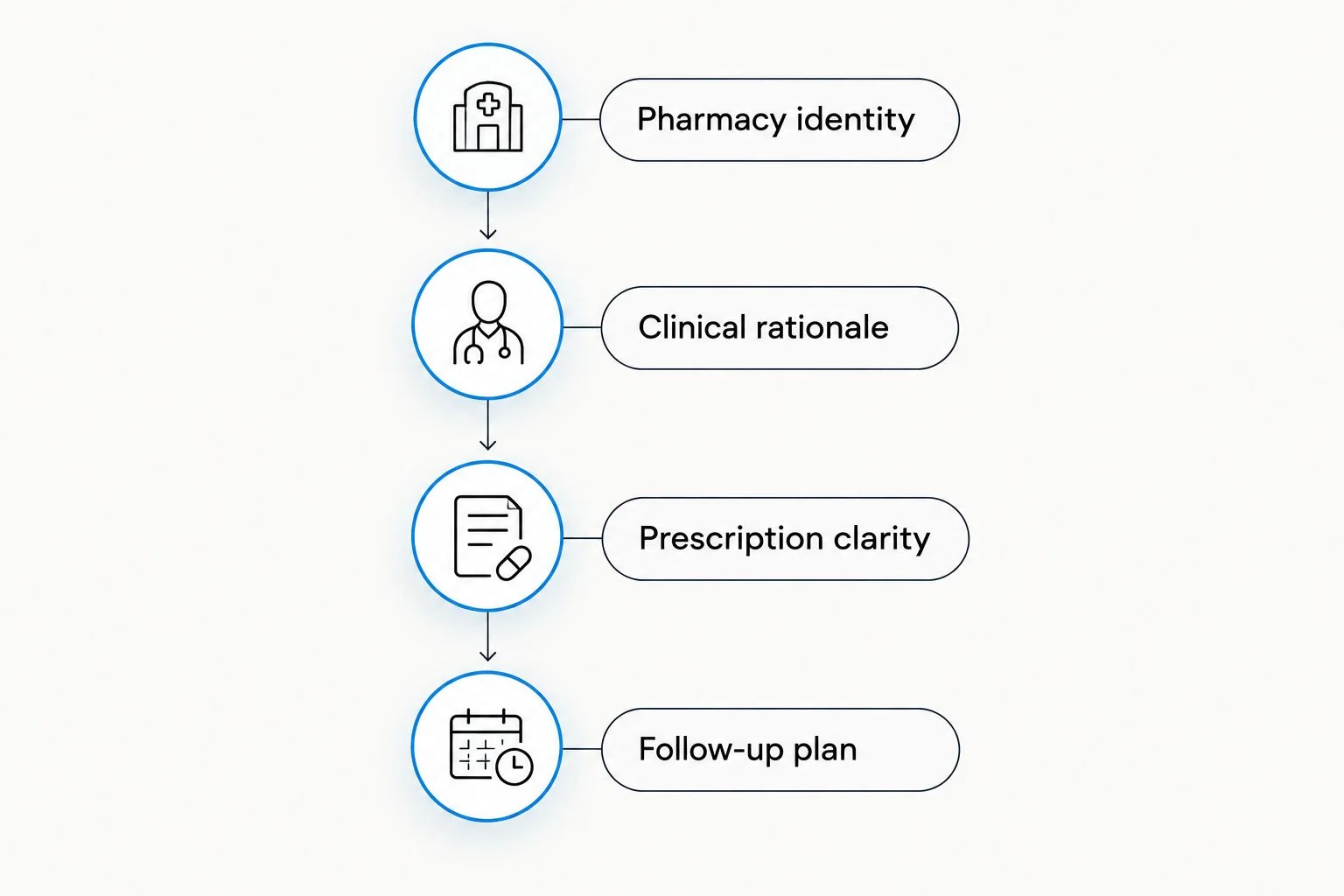
Verify the program before you commit
Use this sequence for any online program in 2026. Complete the pharmacy checks before treating a platform’s recommendation as sufficient reassurance.
Pharmacy identity
Request the pharmacy’s legal name and location. Check the relevant state board records, including whether the pharmacy has the authorization required to dispense into your state.
Keep 2 records accessible: the pharmacy information and your written prescription instructions. These serve different purposes; a platform receipt is not a substitute for either.
Clinical rationale
Ask these 3 questions: What condition are we treating? What evidence supports this medication? Why is this formulation appropriate?
A clinician should explain the recommendation in terms you understand. A promised outcome or a list of testimonials is not a clinical rationale.
Prescription clarity
Review the medication name, concentration, prescribed dose, administration instructions, storage directions, and beyond-use date. If an injectable instruction uses syringe units, ask the pharmacist to explain how those units relate to the prescribed dose and concentration.
Do not calculate a replacement dose from an online conversion chart. Resolve inconsistencies with the prescriber or dispensing pharmacist before use.
Follow-up plan
Identify the clinical contact for side effects and the pharmacy contact for dispensing questions. Ask how treatment response will be assessed and what would lead the clinician to stop or change treatment.
Find out if GLP-1 treatment may be right for you.
Start My Pre-AssessmentRed flags that outweigh a convenient enrollment process
A program’s tone can be reassuring while its claims remain unhelpful. In 2026, judge the answers you receive—not how confidently they are delivered.
- “FDA-approved compounded peptide”: Compounded drugs are not FDA-approved. Ask whether the statement refers to a separate approved product.
- No pharmacy name: Do not proceed without knowing who will dispense your medication.
- “Research use only” for personal treatment: Research products are not a substitute for a patient-specific prescription dispensed for human use.
- Guaranteed results: A pharmacy relationship does not establish that you will achieve a particular outcome.
- Unclear dosing instructions: A vial and a syringe do not constitute an adequate administration plan.
- A bundle before an assessment: Multiple recommended substances require individual clinical justification, not just a combined treatment label.
A useful rule is simple: do not inject a medication you cannot clearly identify and explain back to the pharmacist. If the label and instructions do not match your understanding, stop and ask.
How these pathways are ranked
This ranking prioritizes fit with the stated treatment goal, continuity of care, and the ability to verify the prescribing and dispensing arrangement. It does not rank clinical outcomes or certify pharmacy compliance.
The online platform fits a broad comparison of weight-loss and wellness options. The existing-clinician pathway prioritizes continuity, while the specialist pathway prioritizes diagnosis. Pharmacy identity, clinical rationale, prescription clarity, and follow-up remain mandatory checks whichever route you choose.
Which pathway should you choose?
Default to the clinician-led pathway that can explain both the treatment and the pharmacy arrangement. Start with your existing clinician if you already receive care for the condition you want to address.
Choose an online evaluation when that format meets your needs, but verify the proposed prescription before starting. Choose a specialist assessment when the underlying concern remains unexplained. Do not let the appeal of a particular peptide reverse that order.
Have questions about your options? Start with a quick online assessment.
Start My Pre-AssessmentFAQ
What's the best compounding pharmacy backed peptide program online?
The best choice is a clinician-led program that identifies its dispensing pharmacy and explains why the specific treatment is appropriate. VEVArx is a relevant option for adults comparing online weight-loss care with wellness options, but pharmacy verification remains necessary.
Does a 503A pharmacy mean my peptide is FDA-approved?
No, a compounded medication is not FDA-approved. Section 503A sets conditions for qualifying compounding; it does not establish that a particular preparation is safe or effective for your condition.
How do I verify an online program's compounding pharmacy?
Request the pharmacy's legal name and check the relevant state board of pharmacy records. Confirm the authorization required to dispense to your state, then ask the pharmacist about your specific prescription.
Is a 503A pharmacy better than a 503B outsourcing facility?
Neither designation alone proves that a preparation is the right treatment for you. They are different federal compounding frameworks, and your clinician and pharmacist should explain which applies to your prescription.
Are NAD+ and glutathione both peptides?
No. NAD+ is a coenzyme, while glutathione is a tripeptide. A wellness menu can group different substances together, so ask about each treatment separately.
Can I choose a peptide program without a clinical assessment?
Do not select prescription treatment without an appropriate clinical assessment. Your clinician needs to review your health history, current medications, and treatment goals before determining suitability.
What should I do if my injection instructions are confusing?
Do not inject until the prescriber or dispensing pharmacist resolves the confusion. Confirm the medication, concentration, prescribed dose, and administration instructions rather than using an online conversion chart.
One last thing
A broad “peptide” menu can include substances that are not peptides at all. That naming shortcut is a reason to slow down, not a reason to dismiss every treatment: ask for the exact substance, its purpose, and the evidence supporting its use.
Before starting in 2026, write down 1 treatment goal you can discuss at follow-up. A clear goal gives your clinician something to assess beyond whether you have continued taking the medication.
Related guides
Ready to get started?
See if doctor-prescribed GLP-1 treatment may be right for you. It only takes a few minutes, 100% online.
Start My Pre-AssessmentThis article is for informational purposes only and is not medical advice. Compounded medications are not approved by the FDA and have not been reviewed for safety, effectiveness, or quality. Prescription products require an online consultation with a licensed healthcare provider who will determine if a prescription is appropriate. Individual results vary.