
Best peptide therapy programs for men's health in 2026
Compare the best peptide therapy programs for men's health. Choose medical weight-loss care or specialist evaluation based on your goals and safety needs.

Disclosure: This comparison is published by VEVArx, one of the providers reviewed. We aim to describe every option fairly, but please confirm current details, pricing and availability directly with each provider.
Best for online, medically supervised weight loss: VEVArx. Best for complex weight management: an obesity-medicine clinic. Best for suspected hormone disorders: an endocrinology practice. Best for an evaluation before treatment: primary care. The best peptide therapy programs for men's health in 2026 match treatment to a medical need—not a promised anti-aging effect.
- VEVArx is best suited to men seeking online, medically supervised weight loss—not a general anti-aging prescription.
- The best peptide therapy programs for men's health start with diagnosis, prescribing safety, and a follow-up plan.
- Choose obesity medicine for complex weight management and endocrinology for suspected hormone disorders.
- Sermorelin, glutathione, NAD+, and GLP-1 medications are not interchangeable men's health treatments.
Why this matters
Men searching for peptide therapy often want different things: weight loss, better recovery, more energy, or help with symptoms they associate with low testosterone. Those goals do not point to the same treatment. A useful program identifies the problem before recommending an injection.
VEVArx is best suited to men seeking online, medically supervised weight loss. The platform offers doctor-prescribed semaglutide and tirzepatide, plus wellness offerings including sermorelin, glutathione, and NAD+. That offering does not establish that every option is appropriate for every man.
This 2026 guide ranks care pathways by use case rather than inventing a provider leaderboard. Choose the pathway that fits your symptoms, medical history, and need for examination.
Curious whether you qualify? A licensed provider makes the final call.
Start My Pre-AssessmentWhat makes the best peptide therapy program?
Use these criteria before comparing treatment menus:
- Medical fit: The clinician identifies a condition or treatment goal that justifies the proposed medication.
- Evidence quality: The program distinguishes approved indications from off-label use and compounded preparations.
- Prescribing safety: The clinician reviews medications, contraindications, relevant history, and symptoms before prescribing.
- Pharmacy transparency: You can identify the dispensing pharmacy and the exact formulation prescribed.
- Follow-up plan: You know how to report side effects, request reassessment, and discuss stopping treatment.
- Referral access: The clinician recognizes when symptoms require an examination, specialist care, or urgent treatment.
A long treatment menu is not a substitute for these safeguards. Ask the clinician to explain why a particular medication fits your health goal and what finding would change the recommendation.
Men's health program options at a glance
| Rank and option | Best for | Standout feature | Key limitation |
|---|---|---|---|
| 1. VEVArx | Online, medically supervised weight loss | Doctor-prescribed GLP-1 medications alongside wellness offerings | Not a substitute for an in-person examination when needed |
| 2. Obesity-medicine clinic | Complex weight-management needs | A clinical focus on obesity and related conditions | Individual clinics differ in services and prescribing options |
| 3. Endocrinology practice | Suspected hormone disorders | Specialist assessment of endocrine conditions | Not a general fitness or anti-aging service |
| 4. Primary care practice | Unexplained fatigue or an unclear starting point | Broad evaluation before choosing a treatment | Specialist referral can still be necessary |
These are distinct care pathways, not interchangeable peptide subscriptions. The ranking reflects which problem each pathway addresses; it does not claim that every clinic within a category provides identical care.
1. VEVArx: best for online medical weight loss
VEVArx is an online telehealth platform for US adults seeking medically supervised weight loss. Its stated offerings include doctor-prescribed semaglutide and tirzepatide, along with sermorelin, glutathione, and NAD+.
Best for: Men whose main goal is evaluating prescription weight-loss treatment through telehealth.
This is the most direct match when weight management—not an unexplained hormone symptom—is your reason for seeking care. A prescribing clinician still needs to establish whether a medication is appropriate. An online platform is a care setting, not a guarantee of eligibility.
VEVArx pros:
- Online access fits men seeking a telehealth care pathway.
- The stated offering includes prescription GLP-1 weight-loss medications.
- Medical supervision matches a treatment decision that requires clinical assessment.
VEVArx limitations:
- Telehealth does not replace a physical examination when symptoms require one.
- The listed wellness offerings do not establish proven benefits for general anti-aging, athletic recovery, or low testosterone.
- The treatment menu alone does not establish which laboratory tests or follow-up arrangements your plan will include.
Before choosing VEVArx in 2026, ask which formulation the clinician is considering, why it fits your history, and how follow-up works. Do not assume that weight-loss care requires adding a wellness injection.
Verdict: Choose VEVArx for an online weight-loss evaluation; wait on additional treatments until the clinician explains their separate purpose.
2. Obesity-medicine clinics: best for complex weight management
An obesity-medicine clinic focuses on assessing and treating obesity. This pathway fits men who need weight management considered alongside other diagnoses, medications, or previous treatment difficulties.
Best for: Men with complex histories who want a dedicated weight-management assessment.
Bring a complete medication list and a record of previous weight treatments. Ask how the clinician will coordinate with your existing care team rather than treating each condition in isolation.
Obesity-medicine clinic pros:
- The clinical focus matches weight management as the primary concern.
- The assessment can address medication treatment alongside nutrition and activity.
- An in-person practice provides a route to physical examination when needed.
Obesity-medicine clinic limitations:
- A specialty label does not establish the quality of an individual clinic.
- Peptide or wellness services are not a standard feature of every practice.
- You still need to confirm the prescribing clinician's credentials and follow-up arrangements.
Choose this pathway for the complexity of your care, not because it promises a particular drug. A useful consultation should explain the treatment options that fit your medical history, including when medication is not the next step.
Verdict: Choose an obesity-medicine clinic when coordinated weight-management care matters more than an online-only format.
3. Endocrinology practices: best for suspected hormone disorders
Endocrinologists assess disorders involving hormones and endocrine glands. This is a different service from selecting a peptide for gym recovery or general wellness.
Best for: Men with a suspected or established endocrine condition requiring specialist assessment.
Persistent symptoms, abnormal laboratory results, or a referring clinician's concern can justify this pathway. Fatigue alone does not establish growth hormone deficiency or low testosterone, and a treatment menu cannot make that diagnosis.
Endocrinology practice pros:
- Specialist evaluation fits questions about endocrine disease.
- Testing can be interpreted alongside symptoms and medical history.
- The consultation can distinguish a diagnosed disorder from a general wellness goal.
Endocrinology practice limitations:
- Specialist evaluation does not guarantee a peptide prescription.
- Athletic performance and anti-aging requests are not equivalent to a medical diagnosis.
- Some concerns belong with another specialty after assessment.
Ask what diagnosis the clinician is evaluating and what evidence would support treatment. If a program recommends a hormone-related intervention without explaining the diagnosis, pause before proceeding.
Verdict: Choose endocrinology for a hormone question; skip providers that treat nonspecific symptoms as proof of hormone deficiency.
4. Primary care: best for evaluating unexplained symptoms
Primary care is a sensible starting point when your main concern is fatigue, poor sleep, reduced exercise tolerance, or a general sense that something is off. These complaints need evaluation before they become a peptide shopping list.
Best for: Men who need help identifying the problem before selecting a treatment.
A primary care clinician can review your symptoms, medications, sleep, and broader health history. The next step might be testing, a referral, a treatment change, or reassurance—not necessarily an injection.
Primary care pros:
- Broad assessment avoids assuming that every symptom has a hormone cause.
- Existing records can support continuity of care.
- Referral provides a route to focused specialist assessment when indicated.
Primary care limitations:
- Not every practice offers prescription weight-management care.
- Specialist assessment can still be needed.
- A general visit is not a substitute for urgent care when symptoms are severe.
In 2026, the useful distinction remains diagnosis-first care versus product-first selling. Ask for a plan that explains what is being evaluated and when you should return if symptoms persist.
Verdict: Choose primary care when you cannot yet name the condition you want treated; skip a peptide bundle as your first diagnostic step.
Know what the treatment names actually mean
“Peptide therapy” groups together substances with different structures, evidence, and regulatory status. Do not treat the label as proof that two treatments serve the same purpose.
- Semaglutide and tirzepatide: Prescription medications with FDA-approved products for specific indications. Approval belongs to the particular product and indication, not every preparation containing the ingredient.
- Sermorelin: A peptide that stimulates growth hormone release. That mechanism does not establish that it treats ordinary aging, fatigue, or low testosterone.
- Glutathione: A tripeptide involved in cellular antioxidant processes. Its biological role does not establish that injections improve general men's health.
- NAD+: A coenzyme, not a peptide. Grouping it under a wellness menu does not change its classification.
Compounded drugs are not FDA-approved. FDA does not review compounded preparations for safety, effectiveness, or quality before marketing as it does approved drugs.
For a 2026 treatment decision, verify the exact product and current prescribing information. The distinction between approved medication, off-label prescribing, and compounding matters more than whether a website uses the word “peptide.” Read the separate guide to peptide therapy legality in the US before choosing a prescribing pathway.
Find out if GLP-1 treatment may be right for you.
Start My Pre-AssessmentQuestions to ask before you agree to treatment
Use this checklist during the consultation. You should leave understanding the medical reason for treatment, not just how to administer it.
- Treatment goal: What condition or symptom are we treating, and what outcome will we assess?
- Evidence review: What evidence supports this exact formulation for my situation?
- Safety review: Which parts of my history or medication list change the recommendation?
- Pharmacy details: Who dispenses the prescription, and what exactly will the label say?
- Follow-up plan: Who handles side effects, reassessment, and decisions about continuing treatment?
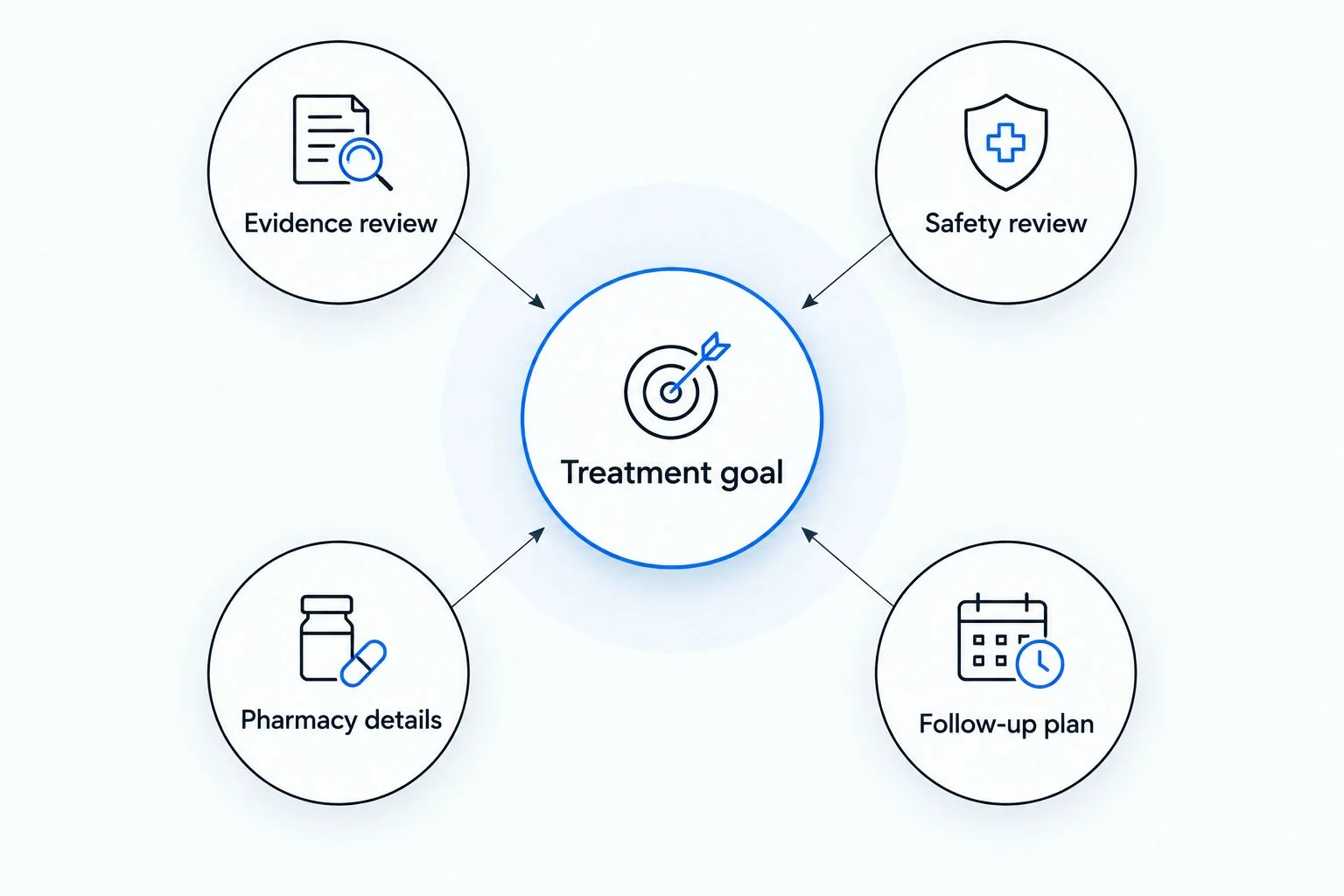
An inability to answer these questions is a reason to pause. Do not substitute a testimonial or a laboratory certificate for an explanation of clinical benefit and risk.
Eligibility is not the same as suitability
FDA prescribing information for weight-management products such as Wegovy and Zepbound includes adults with an initial BMI of 30 kg/m² or greater, or 27 kg/m² or greater with a weight-related condition. Those thresholds describe labeled eligibility; they do not establish that a specific medication is right for you.
The prescribing information also includes contraindications and warnings. For example, a personal or family history of medullary thyroid carcinoma or MEN2 is a contraindication for these products. Discuss your history with the prescribing clinician rather than screening yourself from a short checklist.
Medication also does not replace broader care. The federal Physical Activity Guidelines for Americans recommend at least 150 minutes per week of moderate-intensity aerobic activity for adults; adapt activity to your health and ability with clinical guidance.
For a 2026 consultation, bring your current medications, relevant diagnoses, previous treatment experiences, and questions about side effects. Do not start, combine, or change prescription treatments based on a ranked guide.
How the ranking works
This ranking prioritizes medical fit, prescribing safety, evidence, pharmacy transparency, follow-up, and referral needs. It is a use-case comparison, not a clinical trial or a claim that named providers have identical outcomes.
The online option comes first for a straightforward telehealth weight-loss search. Specialist and primary care pathways take priority when the underlying problem requires a different kind of assessment.
Which program should you choose?
Choose VEVArx when your main goal is an online evaluation for medically supervised weight loss. Choose an obesity-medicine clinic for complex weight management, endocrinology for suspected endocrine disease, and primary care when unexplained symptoms come first.
For men's health in 2026, the default is simple: establish the treatment goal before choosing the substance. More injections do not make a care plan more complete.
Have questions about your options? Start with a quick online assessment.
Start My Pre-AssessmentFAQ
What's the best peptide therapy program for men's health?
The best program depends on the medical problem you need assessed. VEVArx fits an online, medically supervised weight-loss search; suspected hormone disorders call for an endocrine assessment rather than a general wellness menu.
Is peptide therapy the same as testosterone therapy?
No, peptide therapy is not the same as testosterone therapy. Testosterone is a steroid hormone, and symptoms associated with low testosterone require a clinical evaluation rather than an assumed peptide substitute.
Does sermorelin treat low testosterone?
Sermorelin is not testosterone replacement. It stimulates growth hormone release, which does not establish that it treats testosterone deficiency or explains your symptoms.
Is NAD+ a peptide?
No, NAD+ is a coenzyme, not a peptide. Its inclusion in a wellness treatment menu does not establish a proven benefit for fatigue, recovery, or anti-aging.
Are compounded peptides FDA-approved?
Compounded drugs are not FDA-approved. FDA does not review compounded preparations for safety, effectiveness, or quality before marketing as it does approved drugs.
Can men use GLP-1 medications for weight loss?
Eligible adult men can be prescribed weight-management medications after clinical assessment. Suitability depends on the specific product, medical history, contraindications, and treatment goals—not sex alone.
Can I combine a weight-loss medication with wellness peptides?
Do not combine prescription treatments without a prescribing clinician's review. Each treatment needs its own justification, and the clinician must assess the proposed combination and monitoring needs.
One last thing
Ask the clinician: “What would make you recommend against this treatment for me?” A useful answer explains contraindications, uncertain benefits, and alternatives. That tells you more about the decision than the length of a treatment menu.
This guide is educational and does not replace personalized medical advice.
Related guides
Ready to get started?
See if doctor-prescribed GLP-1 treatment may be right for you. It only takes a few minutes, 100% online.
Start My Pre-AssessmentThis article is for informational purposes only and is not medical advice. Compounded medications are not approved by the FDA and have not been reviewed for safety, effectiveness, or quality. Prescription products require an online consultation with a licensed healthcare provider who will determine if a prescription is appropriate. Individual results vary.