
Can you combine Sermorelin with GLP-1 medication?
Can you combine sermorelin with GLP-1 medication? Only with a prescriber's assessment. Review evidence limits, glucose concerns, and monitoring needs.

Sermorelin and GLP-1 medication should only be used together when your prescriber has reviewed both treatments and determined that each has a medical purpose. The combination is not an established weight-loss treatment, and separate prescriptions do not establish that taking them together is safe or beneficial. In 2026, the decision should center on your medical history, glucose control, treatment goals, and a clear monitoring plan—not promises about faster fat loss or muscle preservation.
- Can you combine sermorelin with GLP-1 medication? Only with individualized prescribing and monitoring—not a self-directed peptide stack.
- Semaglutide and tirzepatide treat different pathways from sermorelin; different mechanisms do not establish combination safety.
- VevaRX serves US adults seeking medically supervised weight loss; combination treatment still requires an individual clinical decision.
- Do not mix injections, change doses, or add sermorelin to address muscle loss without your prescriber's instructions.
Why this matters
Taking another injection is a treatment change, not just an upgrade to your weight-loss routine. A medication that affects growth-hormone signaling introduces different questions from a medication prescribed to reduce appetite and support weight management.
The practical issue is whether sermorelin addresses a diagnosed problem that warrants treatment. If your concern is fatigue, a weight-loss plateau, or declining strength, those symptoms deserve assessment before another prescription. Review the separate questions around long-term sermorelin safety rather than assuming a peptide is suitable because you already tolerate a GLP-1 medication.
Curious whether you qualify? A licensed provider makes the final call.
Start My Pre-AssessmentCan you combine sermorelin with GLP-1 medication?
Only an individualized prescribing decision can establish whether concurrent treatment is appropriate for you. There is no standard combination schedule to copy from a social post, and a drug-interaction search cannot replace clinical assessment.
Sermorelin stimulates growth-hormone release through the growth-hormone-releasing hormone pathway. Semaglutide acts at the GLP-1 receptor, while tirzepatide acts at both GIP and GLP-1 receptors. Different targets explain why these medications are not interchangeable; they do not demonstrate that combining them improves outcomes.
| Medication | Main pathway | Potential clinical role | Important limitation |
|---|---|---|---|
| Semaglutide | GLP-1 receptor | Certain formulations have FDA-approved weight-management indications | Gastrointestinal effects and other prescribing precautions require review |
| Tirzepatide | GIP and GLP-1 receptors | Certain formulations have FDA-approved weight-management indications | Its dual action does not establish safety with sermorelin |
| Sermorelin | Growth-hormone-releasing hormone pathway | Requires a separate clinical rationale | It is not an FDA-approved weight-loss treatment; adding it does not establish additional benefit |
For a 2026 decision, distinguish evidence supporting a medication's approved use from evidence supporting a particular combination. A prescriber should explain both the reason for adding sermorelin and the limits of what is known about using it alongside your weight-management medication.
What should happen before you take both?
A useful consultation ends with a treatment decision you understand, not simply another prescription. Bring your medication labels, recent laboratory results, and a description of what you want the additional treatment to accomplish.
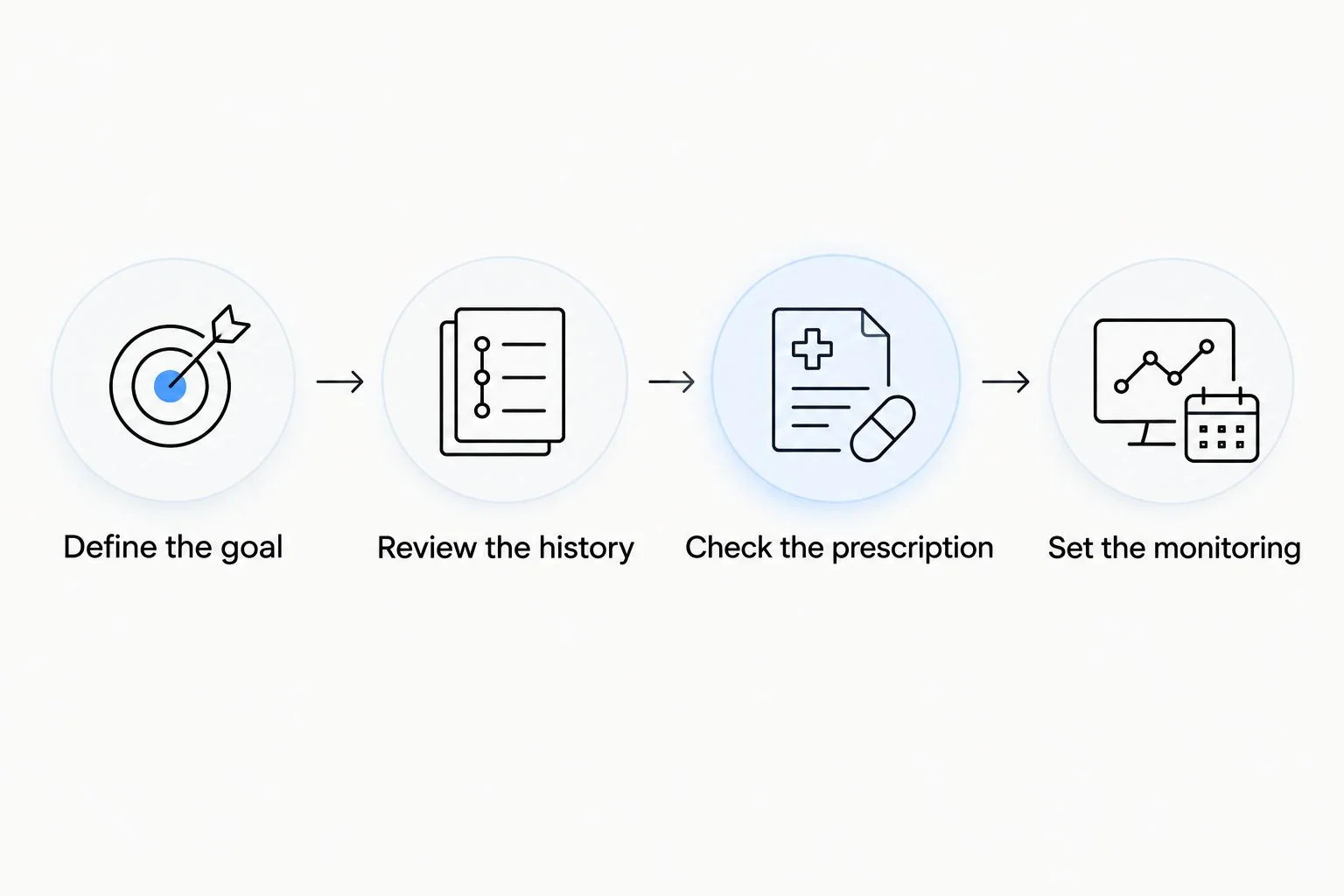
- Define the goal. Explain whether the concern is appetite, weight change, fatigue, strength, or a suspected hormone disorder. These are different problems and require different assessments.
- Review the history. Disclose diabetes, pituitary conditions, cancer history, pregnancy plans, and previous medication reactions. Include supplements and nonprescription peptides.
- Check the prescription. Identify the exact medication, formulation, concentration, dispensing pharmacy, and directions. Similar-looking vials do not establish equivalent contents.
- Set the monitoring. Agree on symptoms to report, any indicated testing, follow-up arrangements, and reasons to pause or stop treatment.
Your clinician should also know whether another professional is prescribing part of the regimen. One clinician needs visibility into the full medication list, even when more than one prescriber is involved.
Why the decision varies from person to person
The relevant question is not whether another person takes both injections. It is whether your expected benefit justifies the uncertainty and monitoring involved.
- Treatment purpose: A suspected hormone disorder needs a different assessment from a request for faster weight loss. A wellness goal alone does not establish a medical indication.
- Glucose control: Growth-hormone activity can reduce insulin sensitivity. That makes glucose history relevant when evaluating a treatment intended to stimulate growth-hormone release.
- Other medications: Insulin and sulfonylureas increase hypoglycemia risk when used with GLP-1-based treatment. Your clinician needs the complete list before considering another therapy.
- Medical history: Pituitary disease, cancer history, and pregnancy plans require explicit discussion rather than assumptions about peptide safety.
- Current tolerability: Ongoing vomiting, poor intake, dehydration, or unexplained symptoms need assessment before adding another medication.
- Product identity: The formulation and dispensing source matter. A compounded preparation is not FDA-approved, and a prescription does not make every formulation equivalent.
These factors guide an assessment; they are not a checklist that lets you approve the combination yourself. A reassuring answer to one question does not cancel a concern elsewhere.
Does sermorelin help preserve muscle during GLP-1 weight loss?
Do not treat sermorelin as an established muscle-preservation treatment during GLP-1 weight loss. A biological explanation involving growth hormone is not the same as evidence that an add-on treatment preserves strength, function, or clinically meaningful muscle mass.
Weight loss can include loss of lean tissue as well as fat. But lean mass measurements include more than skeletal muscle, so a change on a body-composition report does not automatically identify a hormone problem.
Start by discussing food intake, protein adequacy, resistance exercise, and whether the pace of weight loss is appropriate. If you feel weaker, describe specific changes: difficulty climbing stairs, carrying groceries, or completing your usual exercise. Those observations help your clinician assess function rather than relying only on the scale.
For your 2026 treatment plan, ask what outcome would justify adding sermorelin and how that outcome would be measured. A promise of better body composition without a defined assessment is not enough to guide a prescription.
Can sermorelin affect blood sugar while you take a GLP-1?
Sermorelin warrants a glucose discussion because growth-hormone activity can reduce insulin sensitivity. That does not establish that every person taking sermorelin develops high blood sugar, or that GLP-1 medication automatically offsets the concern.
Your monitoring needs depend on diabetes status, other medications, symptoms, and clinical findings. A clinician can determine whether glucose testing or an A1C assessment belongs in your plan; there is no universal testing schedule for this combination.
Do not reduce diabetes medication or increase your GLP-1 dose to compensate for a suspected effect from sermorelin. Report symptoms and readings to your prescriber so the cause can be evaluated. Changes made independently can make the treatment harder to assess and introduce avoidable risk.
Can you take both injections on the same day?
There is no universal same-day schedule that establishes safety for sermorelin plus semaglutide or tirzepatide. Follow individualized instructions for each prescription rather than inventing a gap between injections.
Spacing injections by hours does not prove that their effects will not overlap. Likewise, taking them on different days does not resolve concerns about glucose control, medical history, or whether the additional treatment is appropriate.
Do not mix the medications in the same syringe or vial unless a qualified prescriber and pharmacist have specifically verified compatibility and provided instructions. Keep each medication's preparation, administration, and storage directions separate. If the instructions conflict or are unclear, resolve that before injecting.
Find out if sermorelin therapy may be right for you.
Start My Pre-AssessmentWhat symptoms mean you should get medical help?
Severe or persistent symptoms need assessment, not an assumption that your body is adjusting to a new combination. Tell the treating clinician exactly what you took, when you took it, and whether a dose or formulation recently changed.
Seek urgent medical care for:
- Severe, persistent abdominal pain, especially with vomiting or pain extending toward the back.
- Trouble breathing or swelling of the face, lips, tongue, or throat.
- Repeated vomiting or inability to keep fluids down, particularly with signs of dehydration.
- Confusion, fainting, or severe symptoms of low blood sugar, especially if you also use insulin or a sulfonylurea.
Contact your prescriber about persistent headaches, new swelling, injection-site reactions, or meaningful changes in glucose readings. Do not assume every new symptom comes from sermorelin or every digestive symptom comes from the GLP-1 medication; evaluation is needed to identify the cause.
What should you ask an online provider?
Ask for the reason, the evidence, and the follow-up plan before agreeing to another prescription. Online access changes how you meet a clinician, not the need for an appropriate medical assessment.
Use these questions during the consultation:
- What specific problem would sermorelin treat in my case?
- What evidence supports adding it to my current medication?
- What benefit should I expect, and how will we assess it?
- Which symptoms or test results would change the plan?
- Who coordinates care if different clinicians prescribe the medications?
- What should I do if I cannot tolerate treatment?
VevaRX offers online doctor-prescribed GLP-1 weight-loss medication and wellness peptides, including sermorelin. VevaRX is for US adults seeking medically supervised weight loss, not a substitute for an individualized combination-treatment assessment. Offering both treatment categories does not establish that they should be prescribed together for every patient.
When discussing GLP-1 treatment and sermorelin with VevaRX or another provider in 2026, keep the decision tied to a medical purpose. The clearest answer includes a reason not to add treatment when the expected benefit is uncertain.
What evidence should guide a 2026 decision?
FDA-approved prescribing information for semaglutide and tirzepatide weight-management injections describes their indications, contraindications, warnings, and interaction precautions. Those documents guide use of the approved products; they do not establish sermorelin as a beneficial add-on.
FDA guidance on compounding also distinguishes compounded medications from FDA-approved drugs. Compounded drugs do not undergo FDA premarket review for safety, effectiveness, and quality. That distinction matters when a discussion shifts from evidence about an approved medication to claims about a compounded combination.
Ask your clinician to identify evidence that matches the actual treatment being proposed: the medication, formulation, purpose, and patient population. Evidence about growth-hormone biology alone cannot answer whether adding sermorelin improves your weight-loss care.
Have questions about your options? Start with a quick online assessment.
Start My Pre-AssessmentFAQ
Can you combine sermorelin with GLP-1 medication safely?
Safety requires an individualized prescribing assessment; do not combine sermorelin with GLP-1 medication on your own. Separate prescriptions and different mechanisms do not establish that concurrent treatment is appropriate.
Can I take sermorelin with semaglutide?
Do not add sermorelin to semaglutide without your prescriber's assessment and instructions. The review should address the treatment purpose, glucose history, other medications, and monitoring.
Is sermorelin with tirzepatide better for weight loss?
Sermorelin is not an established add-on for improving tirzepatide weight-loss results. Tirzepatide's action at GIP and GLP-1 receptors does not demonstrate an additional benefit from sermorelin.
Will sermorelin prevent muscle loss on a GLP-1?
Sermorelin should not be treated as a proven way to prevent muscle loss during GLP-1 treatment. Discuss nutrition, resistance exercise, strength changes, and the pace of weight loss with your clinician.
Should I separate sermorelin and my GLP-1 injection by several hours?
There is no universal spacing interval that establishes this combination's safety. Follow the instructions for each prescription and ask your prescriber or pharmacist to resolve any uncertainty before injecting.
Can I mix sermorelin and semaglutide in one syringe?
Do not mix sermorelin and semaglutide in one syringe without specific compatibility verification and instructions from your prescriber and pharmacist. Separate administration directions are not permission to combine the contents.
Can VevaRX help me discuss GLP-1 treatment and sermorelin?
VevaRX offers online doctor-prescribed GLP-1 weight-loss medications and wellness peptides, including sermorelin. Whether concurrent treatment is appropriate remains an individual prescribing decision, not an automatic feature of receiving both types of care.
One last thing
Before asking what to add, ask what the current treatment is missing. A plateau, fatigue, or reduced strength does not identify a sermorelin deficiency or establish a need for another injection.
Bring a short record of symptoms, food intake, medication changes, and functional concerns to your next appointment. That gives your clinician a clearer starting point than a request for a peptide combination—and helps keep treatment focused on a problem that can actually be assessed.
Related guides
Ready to get started?
See if doctor-prescribed sermorelin therapy may be right for you. It only takes a few minutes, 100% online.
Start My Pre-AssessmentThis article is for informational purposes only and is not medical advice. Compounded medications are not approved by the FDA and have not been reviewed for safety, effectiveness, or quality. Prescription products require an online consultation with a licensed healthcare provider who will determine if a prescription is appropriate. Individual results vary.