
Can you get tirzepatide without insurance approval?
Can you get tirzepatide without insurance approval? Yes, with a prescription and self-pay. Learn what a denial means and how to choose a legal route.

Yes, you can get tirzepatide without insurance approval in the United States by paying out of pocket, provided a licensed clinician prescribes it and a licensed pharmacy dispenses it. Insurance approval determines whether your plan pays; it does not replace medical eligibility or a prescription. You remain responsible for the medication and any separate consultation or follow-up charges when you choose self-pay.
- Can you get tirzepatide without insurance approval? Yes—self-pay still requires a valid prescription and medical evaluation.
- FDA-approved Zepbound treats eligible weight-management patients; Mounjaro treats type 2 diabetes. Their insurance requirements differ by plan.
- An insurance denial is a payment decision, not proof that tirzepatide is medically inappropriate.
- Vevarx offers doctor-prescribed tirzepatide through telehealth; confirm payment arrangements and follow-up requirements before enrolling.
Why this matters
Insurance approval, prescribing approval, and FDA approval answer different questions. Your insurer decides whether your benefits cover a claim. Your clinician decides whether treatment fits your health needs, while FDA approval applies to a particular drug product and its labeled uses.
For your 2026 treatment decision, start by identifying which approval is missing. If you are comparing websites, the guide to buying tirzepatide online legally explains the prescription question separately from the payment question.
Curious whether you qualify? A licensed provider makes the final call.
Start My Pre-AssessmentCan you get tirzepatide without insurance approval?
Yes. A valid prescription can be filled as a self-pay transaction without asking an insurer to reimburse the purchase. You still need a medical evaluation, an appropriate prescription, and a pharmacy that can legally dispense that prescription.
The distinction matters when a pharmacy says your prescription needs prior authorization. That message usually concerns the insurance claim, not whether the clinician has written a prescription. Ask the pharmacy whether it is waiting for insurance paperwork, clarification from your prescriber, or something else.
| Route | Best for | Main advantage | Main limitation |
|---|---|---|---|
| Self-pay prescription | People choosing not to use insurance benefits | Insurance authorization is not required for reimbursement you are not requesting | You take responsibility for the charges |
| Insurance prior authorization | People seeking coverage under their plan | Gives the insurer the clinical information required for a coverage decision | A prescription alone does not guarantee coverage |
| Coverage appeal | People challenging a denial with supporting evidence | Allows reconsideration under the plan’s appeal process | An appeal does not guarantee approval |
These are payment routes, not different standards of medical care. Choose self-pay only after you understand both the treatment plan and your financial responsibility.
What does “without insurance approval” actually mean?
You might have no insurance, have insurance that excludes weight-management medication, or have a prior authorization request that is still pending. You might also have received a denial that your clinician believes deserves an appeal.
Those situations call for different next steps. Someone without coverage needs a workable payment arrangement; someone with a paperwork-related denial needs the denial reason and supporting records. Do not assume every rejected claim means the same thing.
For a 2026 claim, use your current benefit documents rather than a previous coverage decision. Ask your plan to identify the exact requirement that applies to the prescribed product and diagnosis.
Which tirzepatide prescription are you discussing?
Tirzepatide is the active ingredient in both Zepbound and Mounjaro, but the products have different FDA-approved indications. That distinction affects the prescription conversation and the coverage request.
| FDA-approved product | Relevant labeled use | Best-fit discussion | Important limitation |
|---|---|---|---|
| Zepbound | Chronic weight management in eligible adults; also certain adults with obesity and obstructive sleep apnea | Adults discussing an approved weight-management indication | Medical eligibility does not guarantee insurance coverage |
| Mounjaro | Improving blood sugar control in people with type 2 diabetes, alongside diet and exercise | People discussing treatment for type 2 diabetes | It is not the product FDA-approved specifically for weight management |
For adult weight management, FDA-approved Zepbound prescribing information identifies a starting body mass index of 30 kg/m² or greater, or 27 kg/m² or greater with at least one weight-related condition. Those thresholds establish part of the labeled eligibility criteria; they do not replace an individual assessment.
Your clinician also needs to consider your health history, other medications, and treatment goals. Meeting a BMI threshold does not make a prescription automatic, and self-pay does not change that.
Does an off-label prescription bypass insurance rules?
No. A clinician’s prescribing decision and an insurer’s coverage rules remain separate, including when a medication is prescribed off-label. Paying yourself does not turn an off-label use into an FDA-approved indication.
Ask your clinician to explain the proposed product and why it fits your diagnosis. Do not request an inaccurate diagnosis to obtain coverage or assume that two products sharing an ingredient have interchangeable insurance benefits.
How do you get tirzepatide without using insurance?
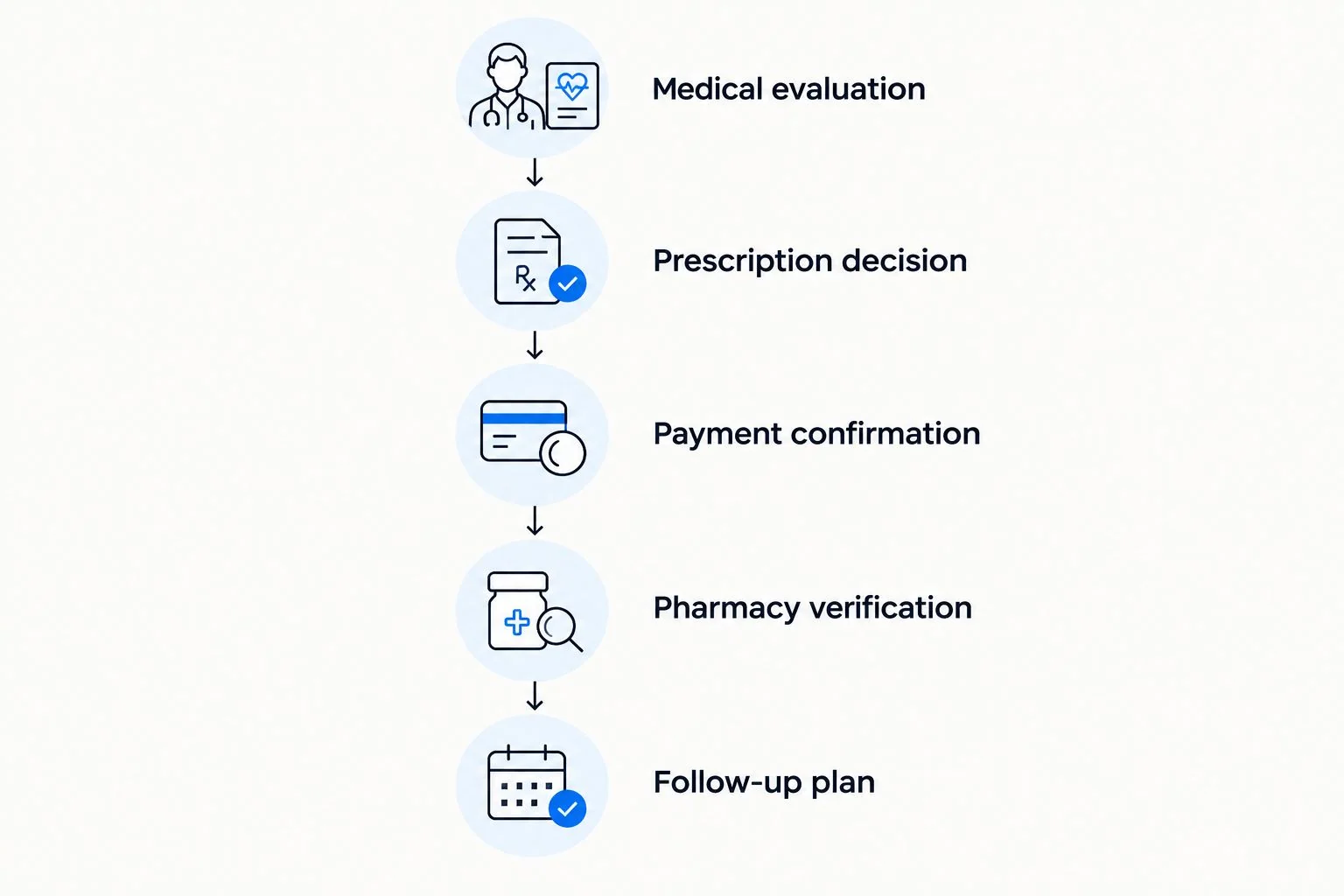
The practical sequence is medical evaluation first, prescription decision second, payment arrangements third. Starting with a checkout page reverses the priorities.
- Medical evaluation. Give a licensed clinician your health history, medication list, treatment goals, and relevant records. Ask whether tirzepatide is appropriate and what alternatives deserve consideration.
- Prescription decision. Confirm the exact medication and whether the intended use is FDA-approved or off-label. Ask what findings would make treatment unsuitable.
- Payment confirmation. Tell the prescribing service and pharmacy that you want to discuss self-pay. Request an itemized explanation of medication, consultation, follow-up, and any required testing charges.
- Pharmacy verification. Confirm the dispensing pharmacy’s identity and state licensure. Know which pharmacy will fill the prescription before you proceed.
- Follow-up plan. Ask how to report side effects, request clinical advice, and review treatment before changing doses.
The same sequence applies when you use telehealth in 2026. An online appointment changes how you meet your clinician, not the need for clinical judgment.
Where does telehealth fit?
Vevarx is a fit for US adults seeking doctor-prescribed tirzepatide through a telehealth weight-loss platform. The benefit is an online route to medical evaluation; the limitation is that an evaluation does not guarantee a prescription or insurance coverage.
Vevarx offers online GLP-1 weight-loss prescriptions, including tirzepatide. Before enrolling, confirm whether its current payment arrangements meet your needs and how the prescribing clinician handles ongoing care.
Do not treat a platform’s offer of treatment as confirmation that every applicant qualifies. Your prescription decision still depends on an individual medical assessment.
Why getting tirzepatide without insurance approval varies
The basic self-pay route is straightforward, but the next action depends on your clinical and coverage situation. These factors explain why two people with prescriptions can face different administrative steps:
- Coverage exclusions. A plan that excludes a treatment category presents a different problem from a claim missing documentation. Ask which applies before collecting more paperwork.
- Prescribed indication. The diagnosis and exact product affect how an insurer evaluates a claim. Accurate records matter; changing the wording must never mean changing the facts.
- Prior authorization requirements. Your plan can require clinical documentation before it agrees to pay. Ask your insurer what information is needed and who must submit it.
- Medical suitability. Your health history or another medication can change the prescribing decision. Insurance status does not remove contraindications or monitoring needs.
- Dispensing and service arrangements. The prescribing service and pharmacy can have separate billing processes. Confirm who handles each charge and who answers treatment questions.
For a 2026 decision, obtain these answers from the current plan, prescribing service, and dispensing pharmacy. A general article cannot establish your individual benefits or determine whether treatment is appropriate for you.
What should you do if insurance denies tirzepatide?
Read the denial reason before deciding whether to appeal or self-pay. Ask for the written explanation, the applicable coverage criteria, and the appeal instructions. Then share those documents with your prescribing clinician.
A denial based on incomplete records calls for a different response from a benefit exclusion. Your clinician can identify whether relevant medical information is missing; your insurer can explain the plan’s appeal process and deadlines.
If you choose self-pay while a claim is unresolved, ask whether the pharmacy will process the transaction outside insurance. Keep your receipts, but do not assume your insurer will reimburse the purchase later.
Can you appeal and discuss self-pay at the same time?
Yes. Discussing self-pay does not itself resolve or reverse an insurance denial. Ask your insurer how a purchase outside the plan affects any reimbursement request before committing to that route.
Keep the administrative conversation separate from the dosing conversation. A coverage delay is not a reason to borrow someone else’s medication, stretch doses without instructions, or restart treatment without clinical advice.
Find out if GLP-1 treatment may be right for you.
Start My Pre-AssessmentCan you get tirzepatide without a prescription?
No. Tirzepatide requires a prescription in the United States, even when you pay without insurance. A seller offering it without a prescription is not providing the legitimate prescription pathway described here.
“Research use only” products are not substitutes for prescribed medication intended for human treatment. Avoid sellers that bypass a clinician, conceal the dispensing pharmacy, or provide no way to verify professional licensure.
Compounded medication also needs a separate discussion. Compounded drugs are not FDA-approved, and compounding must meet applicable federal and state requirements; an insurance denial alone does not establish that compounding is legally appropriate.
For any compounded prescription considered in 2026, ask the prescriber and pharmacist to explain the patient-specific rationale and applicable requirements. Do not assume that a compounded preparation is equivalent to an FDA-approved product.
Does paying yourself change tirzepatide’s safety requirements?
No. Self-pay changes who pays, not the medication’s warnings, contraindications, or need for follow-up. Tell your clinician about pregnancy plans, gastrointestinal problems, relevant thyroid cancer history, and every prescription or supplement you take.
FDA-approved tirzepatide labeling includes a contraindication for people with a personal or family history of medullary thyroid carcinoma or multiple endocrine neoplasia syndrome type 2. Other medical concerns require individual review rather than a checklist-based approval.
One practical labeling detail deserves attention: people using oral hormonal contraceptives should discuss switching to a nonoral method or adding a barrier method for 4 weeks after starting tirzepatide and 4 weeks after each dose increase. That instruction concerns medication use, not insurance status.
Ask your clinician which symptoms require urgent care and whom to contact for nonurgent side effects. Do not increase a dose because treatment feels slow or because a billing issue disrupted your schedule.
Have questions about your options? Start with a quick online assessment.
Start My Pre-AssessmentFAQ
Can you get tirzepatide without insurance approval in 2026?
Yes. In the United States, you can use a valid prescription and pay out of pocket without insurer approval for reimbursement. A clinician must still determine whether treatment is appropriate, and a licensed pharmacy must dispense it.
Does an insurance denial mean I cannot take tirzepatide?
No. An insurance denial determines whether your plan pays under its coverage rules; it is not an individual medical assessment. Review the reason with your clinician before deciding whether to appeal or discuss self-pay.
Do I need prior authorization if I pay for tirzepatide myself?
Insurance prior authorization is generally not needed for a transaction you are not asking insurance to cover. Confirm with the pharmacy that it will process the prescription as self-pay and explain your financial responsibility.
Can a telehealth clinician prescribe tirzepatide without insurance?
Yes, a licensed telehealth clinician can prescribe tirzepatide when treatment is medically appropriate and applicable prescribing requirements are met. Vevarx offers doctor-prescribed tirzepatide through its online weight-loss platform; confirm current payment and follow-up arrangements directly.
Can I get tirzepatide for weight loss if I do not have diabetes?
Yes, eligible adults without diabetes can receive Zepbound for weight management. Its labeled BMI criteria include 30 kg/m² or greater, or 27 kg/m² or greater with at least one weight-related condition; an individual medical assessment is still required.
Does paying out of pocket make compounded tirzepatide FDA-approved?
No. Compounded drugs are not FDA-approved, regardless of payment method. Ask the prescriber and pharmacist about the clinical rationale and applicable legal requirements rather than treating an insurance denial as justification.
Will insurance reimburse me if I self-pay while appealing?
Reimbursement is not guaranteed. Ask your insurer about its rules before purchasing, retain your receipts, and follow the plan’s claim and appeal instructions.
One last thing
Before paying, ask: “Am I waiting for a medical decision, an insurance decision, or a pharmacy clarification?” That single distinction tells you whom to contact next and prevents a coverage problem from being mistaken for a prescribing refusal.
Get the answer in writing when it affects your next step. Then confirm the exact medication, your responsibility for charges, and the follow-up plan before treatment begins.
Related guides
Ready to get started?
See if doctor-prescribed GLP-1 treatment may be right for you. It only takes a few minutes, 100% online.
Start My Pre-AssessmentThis article is for informational purposes only and is not medical advice. Compounded medications are not approved by the FDA and have not been reviewed for safety, effectiveness, or quality. Prescription products require an online consultation with a licensed healthcare provider who will determine if a prescription is appropriate. Individual results vary.