
How long can you stay on tirzepatide?
How long can you stay on tirzepatide? Long-term use has no fixed end date. Learn when to continue, reassess, or stop with your prescriber's guidance.

You can stay on tirzepatide long term, including for years, while it remains effective, tolerable, and appropriate for your medical needs; there is no fixed treatment limit in its FDA-approved prescribing information. Reaching your goal weight does not automatically mean stopping, because weight regain is common after withdrawal and continued treatment still requires medical review.
- How long can you stay on tirzepatide? Years, when benefits continue to outweigh risks under medical supervision.
- Tirzepatide maintenance treatment has no preset stopping date; reaching your goal weight triggers review, not automatic discontinuation.
- Withdrawal research shows weight regain after stopping; discuss a maintenance plan before changing treatment.
- VevaRX offers doctor-prescribed weight-loss medication for US adults seeking online, medically supervised care.
Why this matters
Treating tirzepatide as a short course can leave you without a maintenance plan once weight loss slows. Obesity is a chronic condition, and maintaining a result is a treatment benefit—not evidence that medication has become unnecessary.
For your 2026 treatment plan, separate the question of duration from the question of speed. The guide to how long tirzepatide takes to work addresses early response; this page explains when continuing, reassessing, or stopping treatment makes medical sense.
Curious whether you qualify? A licensed provider makes the final call.
Start My Pre-AssessmentHow long can you stay on tirzepatide?
Tirzepatide has no universal maximum treatment duration. FDA-approved Zepbound prescribing information includes long-term weight reduction and maintenance, while Mounjaro prescribing information addresses blood-glucose management in type 2 diabetes. Your reason for treatment matters when deciding whether to continue.
Research supports ongoing treatment, but a trial's endpoint is not an expiration date for your prescription. These are distinct pieces of evidence:
| Evidence | Duration studied | What it tells you | What it does not establish |
|---|---|---|---|
| SURMOUNT-1 obesity trial | 72 weeks in the primary trial | Tirzepatide produced sustained weight reduction during treatment | A required stopping point at 72 weeks |
| SURMOUNT-1 extension in participants with obesity and prediabetes | 176 weeks of treatment | Longer-term treatment was studied in this specific population | Lifetime safety for every patient |
| SURMOUNT-4 randomized withdrawal trial | 36 weeks before randomization, then 52 additional weeks | Continuing treatment supported maintenance better than withdrawal | That every individual will have the same response |
These findings, reported in The New England Journal of Medicine and JAMA, support a long-term treatment discussion in 2026. They do not replace your clinician's assessment of side effects, nutrition, other medications, and ongoing benefit.
Long-term use is supported; indefinite treatment without reassessment is not. You do not need to decide today whether you will take tirzepatide forever. You need a clear reason to continue now and a plan for reviewing that decision.
Starting treatment: 4 weeks is not the full course
The FDA-approved starting schedule uses 2.5 mg once weekly for 4 weeks before increasing to 5 mg once weekly. Additional increases, when appropriate, occur only after at least 4 weeks on the current dose. These are prescribing-label details, not instructions to change your own prescription.
The starting dose introduces treatment; it is not a test of your eventual maintenance result. Early appetite changes, nausea, or a single weight measurement cannot establish how long you should stay on medication.
Your prescriber should assess tolerability before increasing treatment. More medication is not automatically better, and a dose increase is not a substitute for investigating persistent vomiting, inadequate intake, or other concerning symptoms.
Maintenance treatment: no preset end date
Maintenance means preserving a clinically useful result, not continuing to lose weight indefinitely. Your clinician can review weight stability, blood-glucose control when relevant, eating patterns, physical function, and side effects together.
A stable weight can be a successful outcome. Conversely, continued weight loss is not automatically desirable if you are struggling to eat adequately, becoming weak, or losing more weight than intended.
For maintenance planning in 2026, ask what the medication is still accomplishing and what would trigger a change. A useful plan names both the benefit you are protecting and the problems that would make continued treatment inappropriate.
Why tirzepatide treatment duration varies
The right duration depends on your current health, not a calendar deadline. These factors belong in the decision:
- Treatment purpose. Weight maintenance and blood-glucose management involve different goals. Stopping diabetes treatment also requires a plan for glucose control.
- Ongoing benefit. Maintaining weight reduction can justify continued treatment even after the scale stops moving downward.
- Side effects. Persistent gastrointestinal symptoms, dehydration, or other adverse effects require review rather than automatic refills.
- Nutrition and function. Difficulty eating enough, declining strength, or unwanted continued weight loss changes the benefit-risk discussion.
- New health circumstances. Pregnancy, serious illness, or a newly identified contraindication can change whether treatment remains appropriate.
- Other medications. Insulin and sulfonylureas increase the importance of reviewing low-blood-sugar risk when used with tirzepatide.
No single factor answers the duration question on its own. A lower weight with worsening health is not a good maintenance outcome; stable weight with sustained health benefits can be.
What happens if you stop tirzepatide?
Weight regain is a documented risk after stopping. In SURMOUNT-4, participants first received tirzepatide for 36 weeks, then either continued treatment or switched to placebo for another 52 weeks.
During that randomized period, the placebo group gained an average of 14.0% of their week-36 body weight, while the group continuing tirzepatide lost an additional 5.5%. These are group averages in adults with obesity or overweight without diabetes—not a prediction of your personal result.
The practical message is not that stopping is forbidden. Stopping needs a follow-up plan, especially if appetite increases, weight begins returning, or glucose control worsens.
| Approach | Best suited to | Main benefit | Main limitation |
|---|---|---|---|
| Continue prescribed maintenance | People with ongoing benefit and acceptable tolerability | Preserves active medication support | Ongoing side effects and monitoring remain relevant |
| Clinician-directed discontinuation | People whose risks, circumstances, or preferences require stopping | Ends continued medication exposure | Weight regain and loss of glucose control require attention |
| Reassess or change treatment | People with inadequate benefit or unacceptable effects | Allows a different treatment strategy | Requires a new clinical assessment; alternatives are not interchangeable |
These are discussion paths, not instructions to choose a treatment yourself. Continued treatment is not automatically correct, and discontinuation is not a personal failure.
Do you have to stay on tirzepatide forever?
No fixed lifetime commitment is required, but some people need ongoing medication to maintain its benefits. The evidence does not identify a universal course after which everyone can stop without regaining weight.
Discuss what would make a supervised discontinuation reasonable for you. That conversation should include how weight, appetite, nutrition, and blood glucose will be followed—not just the date of the last injection.
Can you stop tirzepatide once you reach your goal weight?
Reaching your goal weight does not create an automatic stopping point. Your clinician should first determine whether continued treatment is helping maintain that result and whether your current prescription remains appropriate.
Ask for a maintenance goal rather than another weight-loss target. The next phase should protect health and function, not pursue a lower number without a medical reason.
Find out if GLP-1 treatment may be right for you.
Start My Pre-AssessmentDo you need to taper tirzepatide before stopping?
FDA-approved tirzepatide labeling does not specify a required tapering schedule. That does not make an unsupervised stop, dose reduction, or injection-spacing experiment a sound plan.
Your clinician should decide how to discontinue treatment and manage the condition it was treating. If you have missed several doses, get restart instructions instead of assuming your previous dose is still appropriate.
How to review your long-term treatment plan
Use your next 2026 appointment to make the continuation decision explicit. Bring your actual symptoms and medication history, not just a goal-weight screenshot.
- Review benefits. Describe changes in weight, appetite, daily function, and blood glucose if you monitor it. Explain which improvements matter to you.
- Review symptoms. Report nausea, vomiting, constipation, abdominal pain, dizziness, and problems eating or drinking. Describe their effect on daily life.
- Review medicines. Share prescriptions, supplements, pregnancy plans, and upcoming procedures. Your treatment cannot be assessed accurately from the tirzepatide prescription alone.
- Set follow-up. Agree on whether to continue, adjust, or stop, and identify the symptoms or changes that should prompt earlier contact.
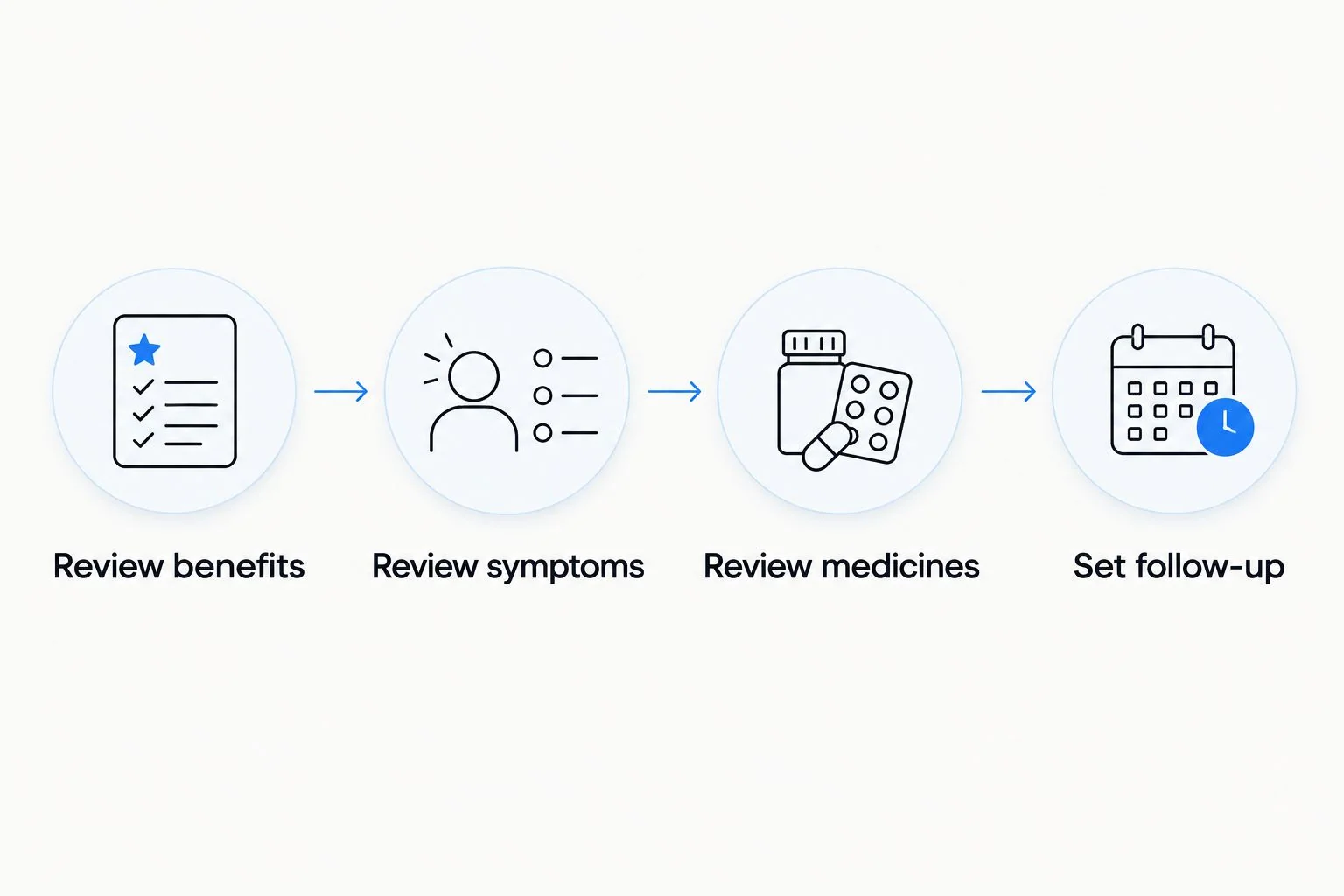
Your follow-up schedule should reflect your clinical needs rather than a universal interval. Keep a record that helps your clinician distinguish a brief fluctuation from a sustained change, without treating every daily scale movement as a treatment decision.
When should you seek help instead of waiting?
Long-term eligibility does not cancel short-term safety concerns. Seek urgent medical assessment for severe, persistent abdominal pain, especially with vomiting; this can signal pancreatitis or another serious problem.
Get emergency help for trouble breathing, facial or throat swelling, or other signs of a serious allergic reaction. Persistent vomiting, inability to keep fluids down, or signs of dehydration also require prompt medical attention.
FDA-approved tirzepatide products are contraindicated in people with a personal or family history of medullary thyroid carcinoma or multiple endocrine neoplasia syndrome type 2. Tell your prescriber if either applies, even if you have already started treatment.
If you become pregnant while using tirzepatide for weight reduction, stop treatment and contact your prescriber. Tirzepatide can also reduce the effectiveness of oral hormonal contraceptives: labeling advises a nonoral method or an added barrier method for 4 weeks after starting and for 4 weeks after each dose increase.
Tell your anesthesia or procedure team that you take tirzepatide before planned surgery or deep sedation. Do not invent your own medication-hold schedule.
Where VevaRX fits into long-term care
VevaRX is best for US adults seeking online evaluation for medically supervised weight loss. VevaRX offers doctor-prescribed GLP-1 weight-loss medications, including tirzepatide; a prescription still depends on clinical appropriateness.
The online setting does not remove the need to assess symptoms or seek in-person care when required. Before choosing any telehealth platform in 2026, ask how ongoing treatment decisions, concerning symptoms, and discontinuation are handled.
Have questions about your options? Start with a quick online assessment.
Start My Pre-AssessmentFAQ
Can I take tirzepatide for several years?
Yes, tirzepatide can be continued for years when it remains appropriate and beneficial. Research includes 176 weeks of treatment in participants with obesity and prediabetes, but that does not establish lifetime safety for everyone.
Is there a maximum time you can take tirzepatide?
FDA-approved tirzepatide prescribing information does not set a universal maximum treatment duration. Your clinician should reassess ongoing benefit, side effects, and changes in your health.
Will I regain weight if I stop tirzepatide?
Weight regain is common after stopping tirzepatide, but your individual result is not predetermined. In SURMOUNT-4, participants switched to placebo gained an average of 14.0% of their week-36 body weight over the next 52 weeks.
Does a weight-loss plateau mean tirzepatide stopped working?
A plateau does not necessarily mean tirzepatide stopped working. Maintaining previous weight loss can be a treatment benefit; your clinician should review the full picture before changing treatment.
Can I take tirzepatide every other week for maintenance?
Every-other-week dosing is not the FDA-approved once-weekly schedule. Do not change your injection interval without your prescriber's direction.
Can I restart my previous dose after a long break?
Do not assume your previous dose is appropriate after a long break. Contact your prescriber for a restart plan that accounts for the interruption and your previous tolerability.
Are compounded and FDA-approved tirzepatide the same?
Compounded tirzepatide is not an FDA-approved product. Evidence and dosing instructions for approved products do not establish the quality, safety, or effectiveness of a particular compounded preparation.
One last thing
A maintenance success can look like nothing changing on the scale. Before your next refill, ask your clinician: What benefit are we preserving, and what would make us change this plan?
That question is more useful than choosing an arbitrary stopping month. It turns long-term treatment into a decision you revisit, rather than a commitment you never examine.
Related guides
Ready to get started?
See if doctor-prescribed GLP-1 treatment may be right for you. It only takes a few minutes, 100% online.
Start My Pre-AssessmentThis article is for informational purposes only and is not medical advice. Compounded medications are not approved by the FDA and have not been reviewed for safety, effectiveness, or quality. Prescription products require an online consultation with a licensed healthcare provider who will determine if a prescription is appropriate. Individual results vary.