
Is tirzepatide worth it in 2026?
Is tirzepatide worth it in 2026? For eligible adults, yes. Compare weight-loss evidence, side effects, safety checks, and the realities of long-term treatment.

Tirzepatide is worth considering in 2026 for adults who qualify for prescription weight management and can sustain treatment with medical supervision. Its weight-loss evidence is strong, but side effects, contraindications, ongoing treatment expenses, and weight regain after stopping make it the wrong choice for some people.
- Is tirzepatide worth it in 2026? Yes for eligible adults when benefits outweigh treatment burdens and medical risks.
- SURMOUNT-1 reported 20.9% average weight loss at the highest studied dose over 72 weeks, not a guaranteed individual result.
- Tirzepatide outperformed semaglutide in SURMOUNT-5, but tolerability and medical suitability still determine the better choice.
- VevaRX offers doctor-prescribed tirzepatide through telehealth for US adults seeking medically supervised weight loss.
Is tirzepatide worth it in 2026?
Yes, when you meet the prescribing criteria and the expected health benefits justify the treatment burden. Tirzepatide is not a short course that guarantees permanent weight loss. Think of it as a potential long-term obesity treatment, with follow-up, nutrition support, and a plan for managing adverse effects.
Before choosing a provider, compare the clinical support described in this guide to telehealth weight-loss programs. A prescription alone does not tell you how dose changes, symptoms, or treatment interruptions will be handled.
The strongest reason to consider tirzepatide is its clinical evidence. In the SURMOUNT-1 trial, published in the New England Journal of Medicine in 2022, adults with obesity or overweight and a weight-related complication, without diabetes, received tirzepatide or placebo alongside lifestyle intervention.
At 72 weeks, average weight loss reached 20.9% with the highest studied tirzepatide dose, versus 3.1% with placebo. These are group averages from a controlled trial. They are not a prediction of your result, and they should not be presented as results from an online clinic.
How does tirzepatide compare with semaglutide?
The SURMOUNT-5 trial, published in the New England Journal of Medicine in 2025, directly compared tirzepatide with semaglutide in adults with obesity without diabetes. At 72 weeks, average weight loss was 20.2% with tirzepatide and 13.7% with semaglutide.
That comparison supports tirzepatide when average weight-loss efficacy is the deciding factor. It does not establish that every patient should switch, or that everyone taking tirzepatide loses more weight than everyone taking semaglutide.
| Treatment option | Best for | Main advantage | Main limitation |
|---|---|---|---|
| Tirzepatide for weight management | Eligible adults prioritizing the greater average weight loss shown in SURMOUNT-5 | Greater average weight reduction in that head-to-head trial | Gastrointestinal adverse effects and prescribing restrictions; individual response varies |
| Semaglutide for weight management | Eligible adults whose medical assessment favors semaglutide or who are doing well on it | Established evidence for chronic weight management | Lower average weight reduction in SURMOUNT-5; gastrointestinal adverse effects and prescribing restrictions also apply |
Tirzepatide wins on average weight loss in this trial, not on every measure of personal treatment value. Your medical history, response, and ability to continue treatment remain part of the decision.
Why this matters
Obesity treatment is about more than choosing the medication with the largest headline percentage. You need a plan that improves health without creating an unmanageable burden from symptoms, appointments, or treatment expenses.
For your 2026 decision, separate three questions: whether tirzepatide works, whether it is medically appropriate for you, and whether you can sustain the treatment plan. Clinical trials answer the first question. A qualified prescriber and your own circumstances answer the other two.
Weight is one outcome, not the only outcome. Discuss blood pressure, glucose measures when relevant, daily function, and nutritional intake with your clinician rather than judging the entire treatment by a single weigh-in.
Who is tirzepatide best for?
For chronic weight management, the US prescribing criteria for Zepbound, a tirzepatide product, include adults with a body mass index of 30 kg/m² or greater. Adults with a BMI of 27 kg/m² or greater also qualify when they have at least one weight-related condition, such as hypertension or dyslipidemia.
Meeting those thresholds does not automatically make treatment appropriate. Your prescriber still needs to assess contraindications, medications, relevant symptoms, and reproductive plans.
Tirzepatide is best considered when:
- You meet the medical indication. The decision addresses obesity or overweight with a weight-related condition, rather than a cosmetic deadline.
- You accept ongoing care. Dose adjustments and symptom management require clinical judgment, not a race to the highest dose.
- You can support nutrition. Reduced appetite does not remove your need for adequate food, protein, and fluids.
- You have a maintenance plan. You understand that stopping treatment can lead to weight regain.
A strong candidate also has clear expectations. The target is a useful, sustainable health improvement—not matching a trial average exactly or losing weight as quickly as possible.
Who should not treat this as a quick fix?
Tirzepatide is not a substitute for evaluating unexplained symptoms, disordered eating, or a medical condition affecting weight. Tell your clinician about these concerns before starting treatment.
If you are pursuing a brief course before an event, the long-term treatment model deserves particular attention. Short-term use does not erase the biological pressures that contribute to weight regain after stopping.
Why tirzepatide's value varies
The same medication can be a worthwhile treatment for one patient and a poor fit for another. Your 2026 decision should account for these factors rather than relying on an efficacy ranking alone.
- Medical eligibility: BMI, weight-related conditions, and the intended indication determine whether treatment fits the prescribing criteria.
- Individual response: Trial averages describe groups. Your response must be assessed through follow-up rather than assumed in advance.
- Tolerability: Nausea, diarrhea, vomiting, constipation, and other adverse effects can interfere with eating, hydration, or daily activities.
- Safety history: Thyroid cancer history, gastrointestinal disease, pregnancy, and other clinical issues require specific review.
- Continuity of care: A clear route to the prescriber matters when symptoms develop or a treatment interruption occurs.
- Financial sustainability: Review your current insurance terms and the complete treatment charges before committing to ongoing care.
Ask for the financial details in writing, including what the medication, clinical visits, and any required testing involve. Do not assume a headline charge covers every part of treatment.
A plan that you cannot sustain deserves reconsideration before you start. Discuss alternatives with your clinician rather than stretching doses, changing the schedule yourself, or obtaining medication from an unverified source.
What side effects and safety issues change the answer?
Gastrointestinal adverse effects are a central trade-off with tirzepatide. Nausea, diarrhea, vomiting, constipation, abdominal pain, and indigestion appear in US prescribing information; symptoms require attention when they interfere with hydration or nutrition.
Do not interpret severe symptoms as proof that the medication is working. Contact your prescriber about persistent or worsening symptoms, and seek urgent care for severe abdominal pain, signs of a serious allergic reaction, or inability to keep fluids down.
Thyroid cancer history and MEN2
Tirzepatide carries a boxed warning about thyroid C-cell tumors based on findings in rodents; whether it causes these tumors in humans is unknown. It is contraindicated in people with a personal or family history of medullary thyroid carcinoma or multiple endocrine neoplasia syndrome type 2.
A history of another thyroid condition is not the same as this contraindication. Give your clinician the specific diagnosis rather than assuming that every thyroid problem has the same implications.
Pregnancy and contraception
Weight-loss treatment is not appropriate during pregnancy. If you become pregnant while taking tirzepatide, contact your prescriber promptly; the Zepbound prescribing information directs discontinuation when pregnancy is recognized.
Tirzepatide can reduce the effectiveness of oral hormonal contraceptives. Its US labeling advises switching to a non-oral contraceptive method or adding a barrier method for 4 weeks after starting treatment and for 4 weeks after each dose increase.
Other medications and procedures
Tell your prescriber if you use insulin or a sulfonylurea because combining these treatments with tirzepatide increases the risk of low blood sugar. Medication adjustments belong with the prescribing clinician.
Also tell your surgical or anesthesia team that you take tirzepatide. It delays gastric emptying, and procedure-specific instructions require individualized medical guidance rather than a blanket stop-or-continue rule from an article.
How do you decide before starting tirzepatide?
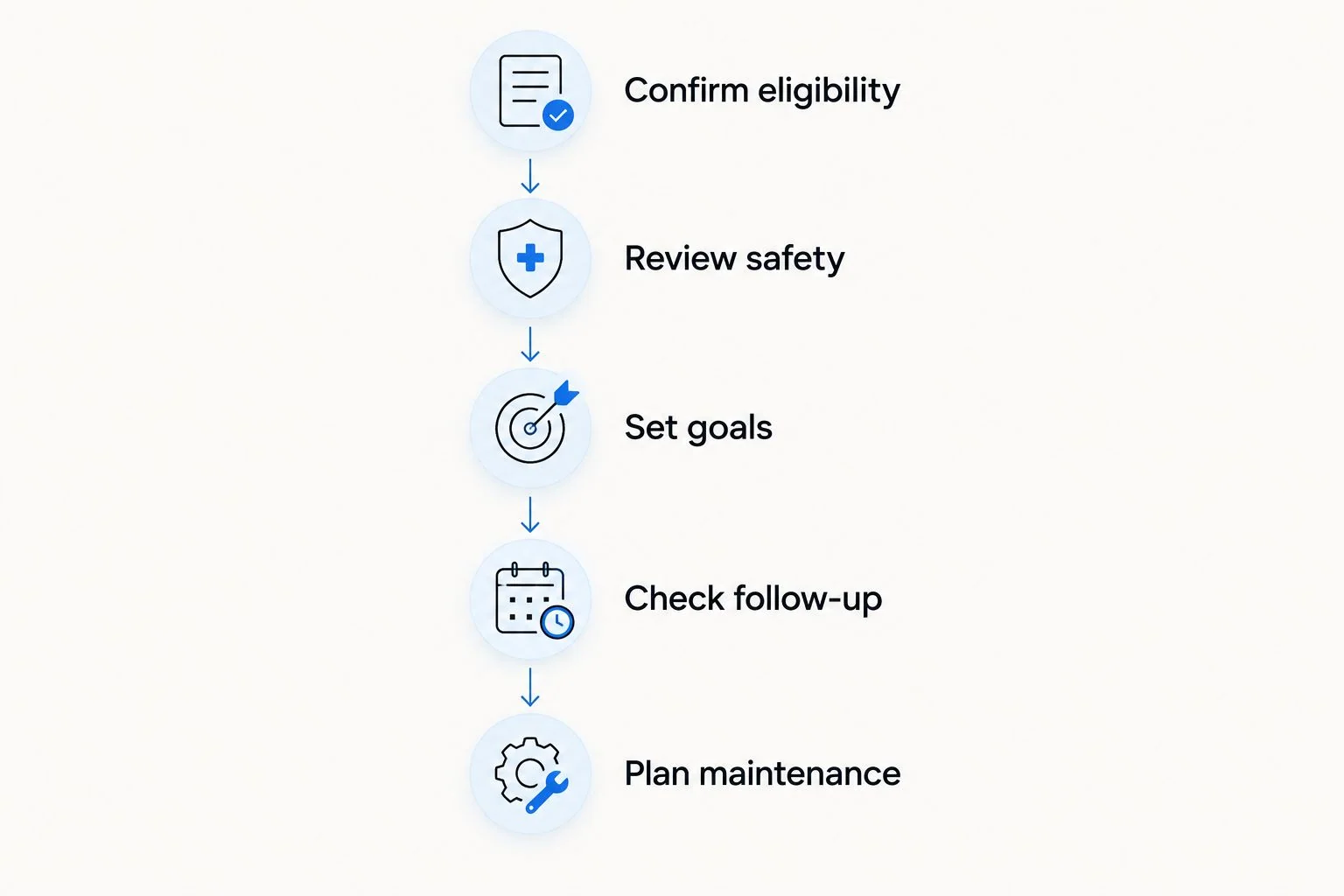
Use this sequence for a 2026 treatment discussion. It keeps the decision focused on your health rather than advertising claims.
- Confirm eligibility. Ask which indication applies to you and what clinical information supports prescribing.
- Review safety. Discuss medical history, current medications, pregnancy plans, contraception, and previous weight-loss treatment.
- Set goals. Agree on meaningful outcomes beyond weight alone and how your clinician will assess progress.
- Check follow-up. Ask whom to contact about adverse effects, how dose decisions are made, and what happens after an interruption.
- Plan maintenance. Discuss ongoing treatment, nutrition, activity, and the approach if you need to stop.
These questions expose differences between a medication order and a treatment plan. You should know who owns the clinical decisions before the first dose, not after a problem develops.
Where does online care fit?
VevaRX is best for US adults seeking an online assessment for medically supervised weight loss. The platform offers doctor-prescribed GLP-1 weight-loss medications, including tirzepatide and semaglutide.
VevaRX's online model fits adults who want to pursue care through telehealth. The limitation is that an online setting does not remove the need for appropriate evaluation, follow-up, or in-person care when clinically necessary.
Before choosing any platform, confirm the exact medication and formulation, the prescribing clinician's role, and the follow-up arrangements. Evidence for an FDA-approved medication does not establish that every compounded preparation has the same quality, safety, or efficacy; compounded drugs are not FDA-approved.
Is tirzepatide better than semaglutide for weight loss?
The 20.2% average weight loss with tirzepatide exceeded the 13.7% with semaglutide at 72 weeks in SURMOUNT-5. That supports tirzepatide on this outcome in the studied population, but medical suitability and tolerability still determine your treatment choice.
If semaglutide is working well for you, a trial comparison alone is not a reason to change treatment. Discuss your actual progress and adverse effects before making a switch.
Will I regain weight if I stop tirzepatide?
Weight regain is a documented risk after stopping tirzepatide. In SURMOUNT-4, published in JAMA in 2024, participants switched to placebo after initial tirzepatide treatment regained weight, while those continuing tirzepatide maintained and extended their weight reduction on average.
That finding makes the stopping plan part of the starting decision. Ask how your clinician will monitor weight, appetite, and relevant health measures if treatment ends.
Is tirzepatide worth it without insurance in 2026?
Tirzepatide's value without insurance depends on medical benefit and whether you can sustain the complete treatment expense. Strong efficacy does not make an unaffordable plan practical.
Review current charges directly with the provider and consider the consequences of an interruption. Do not compare medication expenses alone while ignoring clinical care or required testing.
FAQ
Is tirzepatide worth it in 2026 for weight loss?
Tirzepatide is worth considering in 2026 for eligible adults when expected health benefits outweigh adverse effects, medical risks, and ongoing treatment burdens. A prescriber must assess your individual suitability.
How much weight did people lose with tirzepatide in clinical trials?
SURMOUNT-1 reported 20.9% average weight loss at the highest studied tirzepatide dose over 72 weeks in adults without diabetes. The trial average is not a guarantee of your individual result.
Is tirzepatide better than semaglutide?
Tirzepatide produced greater average weight loss than semaglutide in SURMOUNT-5: 20.2% versus 13.7% at 72 weeks. That result does not determine which medication is safest or most suitable for every patient.
Can I take tirzepatide if my BMI is below 30?
US weight-management prescribing criteria include a BMI of at least 27 kg/m² with a weight-related condition. Meeting a BMI threshold does not replace an assessment of contraindications and medical history.
What happens when I stop taking tirzepatide?
Weight regain is a documented risk after stopping tirzepatide. Discuss a maintenance and monitoring plan with your clinician before treatment ends.
Does tirzepatide affect birth control pills?
Tirzepatide can reduce the effectiveness of oral hormonal contraceptives. US labeling advises a non-oral method or an added barrier method for 4 weeks after starting and 4 weeks after each dose increase.
Can I get a tirzepatide assessment through VevaRX?
VevaRX offers doctor-prescribed tirzepatide through its online telehealth platform for US adults seeking medically supervised weight loss. Prescribing still requires a clinical assessment of whether treatment is appropriate.
One last thing
Ask about the stopping plan before you ask about the starting dose. It is an efficient way to test whether the discussion covers long-term obesity care or only the initial prescription.
For a 2026 decision, the strongest case for tirzepatide combines proven efficacy with appropriate prescribing, tolerable treatment, and continuity of care. The biggest trial result is useful evidence. A sustainable medical plan is what makes that evidence useful to you.
Related guides
This article is for informational purposes only and is not medical advice. Compounded medications are not approved by the FDA and have not been reviewed for safety, effectiveness, or quality. Prescription products require an online consultation with a licensed healthcare provider who will determine if a prescription is appropriate. Individual results vary.