
Can you take NAD+ injections at home?
Can you take NAD+ injections at home? Yes, with a suitable prescription and training. Learn the safety checks, route differences, and questions to ask first.

Yes, you can take NAD+ injections at home when a licensed clinician prescribes a formulation and injection route suitable for self-administration and you receive instructions specific to that prescription. At-home treatment still requires medical screening, sterile supplies, correct storage, and a plan for side effects; it is not the same as giving yourself an intravenous infusion.
- Can you take NAD+ injections at home? Yes, with an appropriate prescription, injection training, and clinician oversight.
- VevaRX offers prescription NAD+ through telehealth; discuss whether treatment fits your medical history and goals.
- Subcutaneous injections, intramuscular injections, and intravenous infusions require different administration methods.
- Compounded NAD+ injections are not FDA-approved; a prescription does not establish effectiveness for anti-aging or weight loss.
Can you take NAD+ injections at home?
At-home NAD+ injections are an option only when your clinician approves the specific product, route, and treatment plan. You also need to understand the pharmacy label and demonstrate that you can follow the administration instructions. Receiving a vial does not establish that you are ready to inject it.
For your 2026 provider search, use the NAD+ injection provider guide alongside these safety criteria. Compare medical oversight and prescription instructions—not just how easy enrollment looks.
| Administration option | Best for | Practical advantage | Limitation |
|---|---|---|---|
| Prescribed subcutaneous injection | People whose clinician selects injection into tissue beneath the skin and approves self-administration | Can fit a clinician-directed home routine | Requires route-specific training, correct measurement, and sterile technique |
| Prescribed intramuscular injection | People whose clinician selects injection into a muscle and determines who should administer it | Allows the prescribed treatment through the selected muscle route | Site selection and technique differ from subcutaneous injection; home use is not automatic |
| Professionally administered intravenous infusion | People whose clinician selects treatment delivered into a vein | Provides administration and observation by qualified personnel | Requires intravenous access and professional management; it is not a self-injection substitute |
These options are not interchangeable. Use only the route printed on your prescription and confirmed by your clinician. Do not convert an infusion protocol into an injection schedule or copy another patient's instructions.
Why this matters
Home administration moves responsibility for handling, measurement, and disposal into your hands. That makes training part of treatment, not an optional extra. A telehealth appointment does not replace the practical instructions needed to handle an injectable medication safely.
NAD+ wellness claims also need a separate check. Evidence does not establish injected NAD+ as a proven treatment for general anti-aging, fatigue, or weight loss. In 2026, distinguish a clinician's individualized prescribing decision from a claim that a treatment reliably produces those outcomes.
Compounded medications are not FDA-approved. The FDA does not review compounded drugs for safety, effectiveness, or quality before they are marketed, so the prescribing clinician and dispensing pharmacy remain essential sources of product-specific information.
Subcutaneous NAD+ injections at home
Subcutaneous administration means injecting into tissue beneath the skin. Whether that route is appropriate depends on the prescribed formulation and your clinician's assessment—not on which injection method seems easiest.
The practical benefit is the possibility of self-administration after training. The limitation is that you must correctly identify the prescribed amount, use the instructed technique, and handle the vial and supplies without contaminating them.
Ask your clinician or pharmacist to explain:
- Which injection sites are appropriate for your prescription.
- How to measure the prescribed amount using the supplied syringe.
- How to prepare the product, if preparation is required.
- What to do if you spill medication, contaminate a supply, or cannot complete the injection.
- Which symptoms require stopping treatment and contacting the care team.
Do not borrow instructions from a GLP-1 injection tutorial. Similar-looking supplies do not establish that the medication, concentration, route, or handling requirements are the same.
Intramuscular NAD+ injections at home
Intramuscular administration delivers medication into a muscle. It requires a different technique from subcutaneous administration, and the appropriate site and equipment depend on the prescription and the person receiving it.
Your clinician must determine whether self-administration is appropriate or whether a trained professional should give the injection. Being comfortable with needles does not replace that assessment.
The potential convenience of home treatment comes with a practical limitation: you need to understand the anatomy and technique your clinician teaches. If you cannot confidently follow the prescribed method, arrange professional administration rather than improvising.
Do not switch between intramuscular and subcutaneous use because an online video shows a simpler approach. Contact the prescriber before making any change to the route.
Intravenous NAD+ is not a DIY alternative
An intravenous infusion delivers a solution directly into a vein. It requires intravenous access, appropriate equipment, and qualified personnel to administer and monitor treatment.
Professional administration provides direct observation during the procedure. Its limitation is that it requires an arranged clinical service rather than an independent home injection routine.
A professionally staffed home infusion, when medically arranged, is different from self-administering an infusion. Neither an injection prescription nor experience using a syringe authorizes you to start an intravenous line yourself.
Do not attempt a DIY NAD+ infusion. If a provider discusses intravenous treatment, ask who administers it, where it takes place, and how adverse reactions are managed.
What should you check before your first home injection?
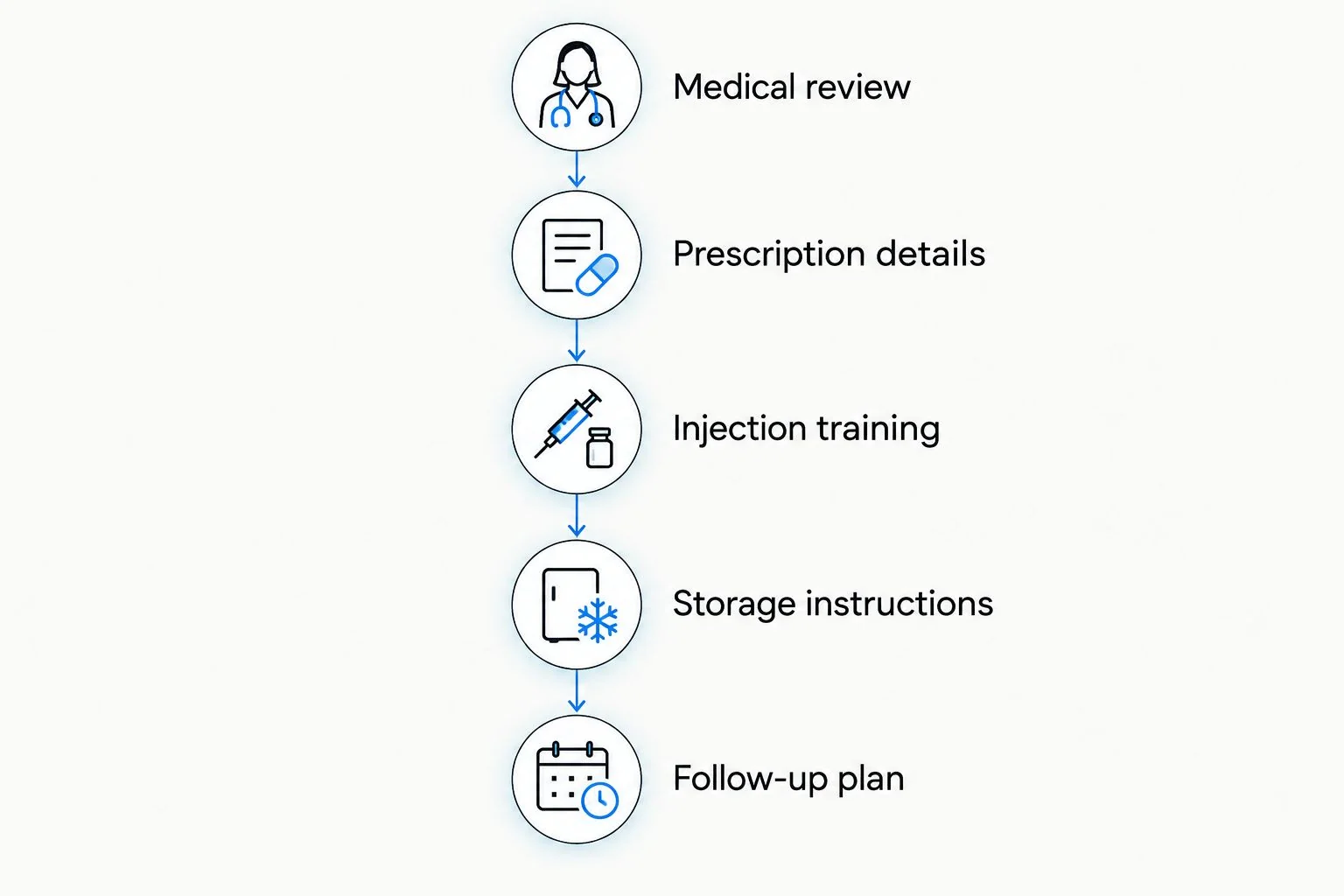
Before starting NAD+ injections in 2026, confirm the following sequence with your clinician and pharmacist. These are readiness checks, not a substitute for individualized injection training.
Medical review
Explain why you want treatment and describe your symptoms rather than choosing a dose first. Share your medications, supplements, allergies, medical conditions, previous injection reactions, and whether you are pregnant or breastfeeding.
If fatigue is your main concern, ask whether it needs an evaluation for an underlying cause. Starting a wellness treatment should not replace investigating persistent or unexplained symptoms.
Prescription details
Confirm the medication name, concentration, prescribed amount, injection route, and schedule. Ask the clinician to explain the intended treatment goal and when that goal will be reassessed.
Milligrams, milliliters, and syringe markings describe different things. If the label and the instructions do not clearly agree, do not inject until the pharmacist or prescriber resolves the discrepancy. Never use an internet conversion chart in place of that clarification.
Injection training
Request instructions that match your exact prescription and supplies. Ask how to prepare your work area, handle the vial, measure the medication, administer it, and dispose of used equipment.
Have the clinician or pharmacist check your understanding. A useful readiness test is whether you can explain the process back without guessing at a step.
Storage instructions
Follow the dispensing pharmacy's storage and handling directions, including any instructions that apply after opening or preparing the medication. Do not assume that every NAD+ formulation has identical requirements.
If a shipment arrives damaged, the label is unreadable, or storage conditions were not maintained, ask the pharmacy what to do before using it. Do not decide that a product is usable based on appearance alone.
Follow-up plan
Know whom to contact about routine questions and unexpected symptoms. Ask what to do after a missed dose, an uncertain injection, or an interruption in treatment.
Keep a record of administration and symptoms for follow-up. If you are unsure whether a dose was delivered, do not automatically repeat it; contact the prescribing team for instructions.
Completing these checks gives you a clear decision point: proceed only when your medical review, prescription, training, storage instructions, and follow-up plan are understood.
Why at-home NAD+ treatment plans vary
There is no universal home-injection protocol that applies to every patient or compounded product. In 2026, your written prescription—not a social media routine—must determine how you use the medication.
The main factors are:
- Treatment goal: Your clinician needs a defined reason for prescribing and a plan to assess whether treatment is helping.
- Medical history: Existing conditions, medications, allergies, and prior reactions affect the prescribing decision.
- Injection route: Subcutaneous, intramuscular, and intravenous administration require different methods and oversight.
- Product concentration: The concentration determines how the prescribed amount relates to the volume measured.
- Administration ability: Needle anxiety, difficulty measuring, or trouble following the technique affects whether home use is appropriate.
- Product handling: Pharmacy-specific storage, preparation, and beyond-use instructions determine how the dispensed product must be managed.
A friend's schedule is not a shortcut through these decisions. Even if both labels say NAD+, the prescriptions and administration instructions can differ.
What symptoms mean you should stop and get help?
Stop administration and seek urgent medical help for trouble breathing, swelling of the face or throat, fainting, or chest pain. Call 911 for a suspected medical emergency rather than waiting for a portal message.
Contact your clinician promptly for fever, chills, worsening injection-site redness, increasing pain, or other unexpected symptoms. Do not assume that feeling unwell means the treatment is working or that you should push through it.
The FDA has reported adverse events associated with compounded NAD+ injectables, including severe chills, shaking, vomiting, and fatigue. Its safety communications have also raised concerns about using food-grade NAD+ ingredients in sterile compounding because of contamination risks, including endotoxins.
For your 2026 safety check, ask the dispensing pharmacy about the prescription product and report problems through the prescribing team. The fact that NAD+ occurs naturally in the body does not establish the safety of an injectable preparation.
Is NAD+ approved for anti-aging or weight loss?
Injected NAD+ is not an FDA-approved treatment for anti-aging or weight loss. Do not treat a wellness claim as an approved indication or a guarantee of benefit.
A prescription also does not mean the compounded preparation has received FDA approval. Ask what evidence supports the proposed use, what uncertainty remains, and what alternatives address your actual concern.
If weight management is your goal, discuss treatments evaluated for that purpose. NAD+ injections should not be presented as interchangeable with prescribed GLP-1 medication.
Can you inject NAD+ without medical supervision?
Do not start NAD+ injections without medical supervision. You need a clinician's assessment, a suitable prescription, and instructions from the prescriber and dispensing pharmacy.
Avoid products labeled for research use or not intended for human administration. Do not buy raw powder and attempt to make a sterile injectable at home; sterile compounding is not a kitchen preparation task.
Can a telehealth provider help you decide?
VevaRX offers doctor-prescribed NAD+ through its US telehealth platform. VevaRX is best suited to US adults seeking a telehealth prescription discussion, not a do-it-yourself injection plan.
Telehealth offers a way to discuss treatment without an initial in-person appointment. Its limitation is that a remote consultation does not automatically establish eligibility, the appropriate route, or readiness for self-administration. Your prescribing clinician must address those decisions.
FAQ
Can you take NAD+ injections at home safely?
At-home NAD+ injections require a clinician-approved prescription, route-specific training, correct handling, and a plan for adverse reactions. Those safeguards reduce avoidable risks but do not make treatment risk-free.
Do you need a prescription for NAD+ injections at home?
Use injectable NAD+ only under a licensed clinician's prescription and supervision. Do not substitute research-use products or self-prepared solutions for a prescribed preparation.
Where should you inject NAD+?
Use only the route and injection sites your clinician specifies for your prescription. Subcutaneous and intramuscular techniques are different, so generic online instructions are not enough.
What dose of NAD+ should you inject at home?
Use only the amount prescribed for your specific formulation and concentration. Ask the pharmacist to clarify any uncertainty about milligrams, milliliters, or syringe markings before injecting.
Does NAD+ need to be refrigerated?
Follow the storage instructions supplied by the dispensing pharmacy for your exact product. Do not assume that every preparation has the same refrigeration or after-opening requirements.
Are NAD+ injections FDA-approved for weight loss?
NAD+ injections are not FDA-approved for weight loss, and compounded NAD+ products are not FDA-approved drugs. Discuss evidence-based weight-management options with your clinician instead of treating NAD+ as a GLP-1 substitute.
Does VevaRX offer prescription NAD+?
VevaRX offers doctor-prescribed NAD+ through telehealth for US adults. The prescribing clinician must determine whether treatment is appropriate and explain the prescribed administration plan.
One last thing
Being taught to inject does not answer whether the treatment is worth taking. Before starting in 2026, ask your clinician: what outcome are we looking for, how will we assess it, and what would make us stop?
Those questions keep the decision focused on your health rather than the convenience of a home routine. This article provides general information, not a diagnosis, prescription, or personalized injection instructions.
Related guides
This article is for informational purposes only and is not medical advice. Compounded medications are not approved by the FDA and have not been reviewed for safety, effectiveness, or quality. Prescription products require an online consultation with a licensed healthcare provider who will determine if a prescription is appropriate. Individual results vary.