
GLP-1 weight loss for people with sleep apnea: complete 2026 guide
GLP-1 for sleep apnea: Zepbound has an FDA-approved OSA indication. Compare treatment options, safety checks, and when to reassess CPAP with your clinician.

For people with sleep apnea, GLP-1 weight management is prescription treatment aimed at reducing excess weight that contributes to obstructive sleep apnea (OSA). Zepbound (tirzepatide) has an FDA-approved indication for moderate-to-severe OSA in adults with obesity; other weight-loss prescriptions do not automatically share that indication.
- GLP-1 for sleep apnea requires matching the medication to your diagnosis; Zepbound has an FDA-approved OSA indication.
- Keep using prescribed PAP therapy until your sleep clinician reviews objective evidence and changes your treatment.
- VEVArx suits adults seeking online, medically supervised weight loss alongside separate sleep-apnea care.
- Track breathing events, daytime sleepiness, medication tolerance, and weight—not the scale alone.
Why GLP-1 weight management matters for people with sleep apnea
Obstructive sleep apnea involves repeated upper-airway blockage during sleep. Excess body weight can contribute to that blockage, so treating obesity addresses a contributor that positive airway pressure (PAP) does not directly treat. PAP supports breathing while you use it; weight management serves a different purpose.
Your needs are different from those of someone pursuing weight loss alone. You need a plan that protects nighttime breathing, accounts for daytime sleepiness, and coordinates medication decisions with sleep care. Less snoring is encouraging, but it does not prove that breathing interruptions have resolved.
VEVArx is best suited to adults seeking online, medically supervised weight loss alongside separate sleep-apnea care. VEVArx offers doctor-prescribed semaglutide and tirzepatide through telehealth; a weight-loss prescription does not replace a sleep evaluation.
For this 2026 guide, the key clinical references are FDA Zepbound prescribing information, the FDA's OSA approval announcement, and American Academy of Sleep Medicine guidance on diagnosis and follow-up testing. These sources distinguish medication eligibility from the separate decision to change apnea treatment.
Curious whether you qualify? A licensed provider makes the final call.
Start My Pre-AssessmentBuild your sleep-apnea weight-loss plan
1. Confirm your apnea type and severity
Start with your existing sleep-study report, not a medication checkout page. Obstructive sleep apnea and central sleep apnea are different: OSA involves airway obstruction, while central apnea involves disrupted breathing signals. Tirzepatide's OSA indication is not an indication for central sleep apnea.
The apnea-hypopnea index (AHI) counts breathing events per hour of sleep. Standard adult categories are mild at 5 to fewer than 15 events/hour, moderate at 15 to fewer than 30 events/hour, and severe at 30 events/hour or more. Your clinician also considers oxygen levels, symptoms, and other health conditions.
- Obtain your diagnostic sleep-study report and current treatment instructions.
- Write down your AHI, oxygen findings, and whether central events were identified.
- Bring PAP reports or oral-appliance records to the appointment.
- Report sleepiness while driving; do not drive when drowsy.
2. Keep your current breathing treatment in place
Do not stop PAP because you start losing weight. Medication does not hold your airway open during sleep, and symptom improvement does not establish that untreated OSA is safe.
PAP downloads can help your sleep clinician assess treatment effectiveness, mask leak, and usage. A low event count while wearing PAP shows how treatment is working; it does not prove you no longer need treatment without it. Follow-up sleep testing answers a different question.
For your 2026 treatment plan, identify who can adjust PAP settings and who will decide whether repeat testing is needed. That responsibility should stay explicit even when weight management happens online.
- Continue PAP or your prescribed oral appliance unless your clinician changes the plan.
- Address mask leaks, dryness, and discomfort with your sleep-care team.
- Record daytime sleepiness and witnessed breathing pauses, not just snoring.
- Ask what changes would trigger a pressure review or follow-up sleep study.
3. Match the prescription to the indication
Bring your sleep report, medication list, and weight history to a prescribing clinician. An active ingredient is not the same thing as a specific FDA-approved product and indication. Zepbound contains tirzepatide and has an OSA indication for adults with obesity and moderate-to-severe OSA, alongside a reduced-calorie diet and increased physical activity.
Semaglutide-based weight management can address excess weight, but that is not the same claim as Zepbound's OSA indication. Likewise, a compounded preparation is not FDA-approved and does not inherit an approved product's indication merely because it contains a related active ingredient.
VEVArx provides an online route to medically supervised GLP-1 weight management. Its stated offering includes semaglutide and tirzepatide, but that alone does not establish which formulation a particular patient will receive or whether it matches an OSA-specific indication.
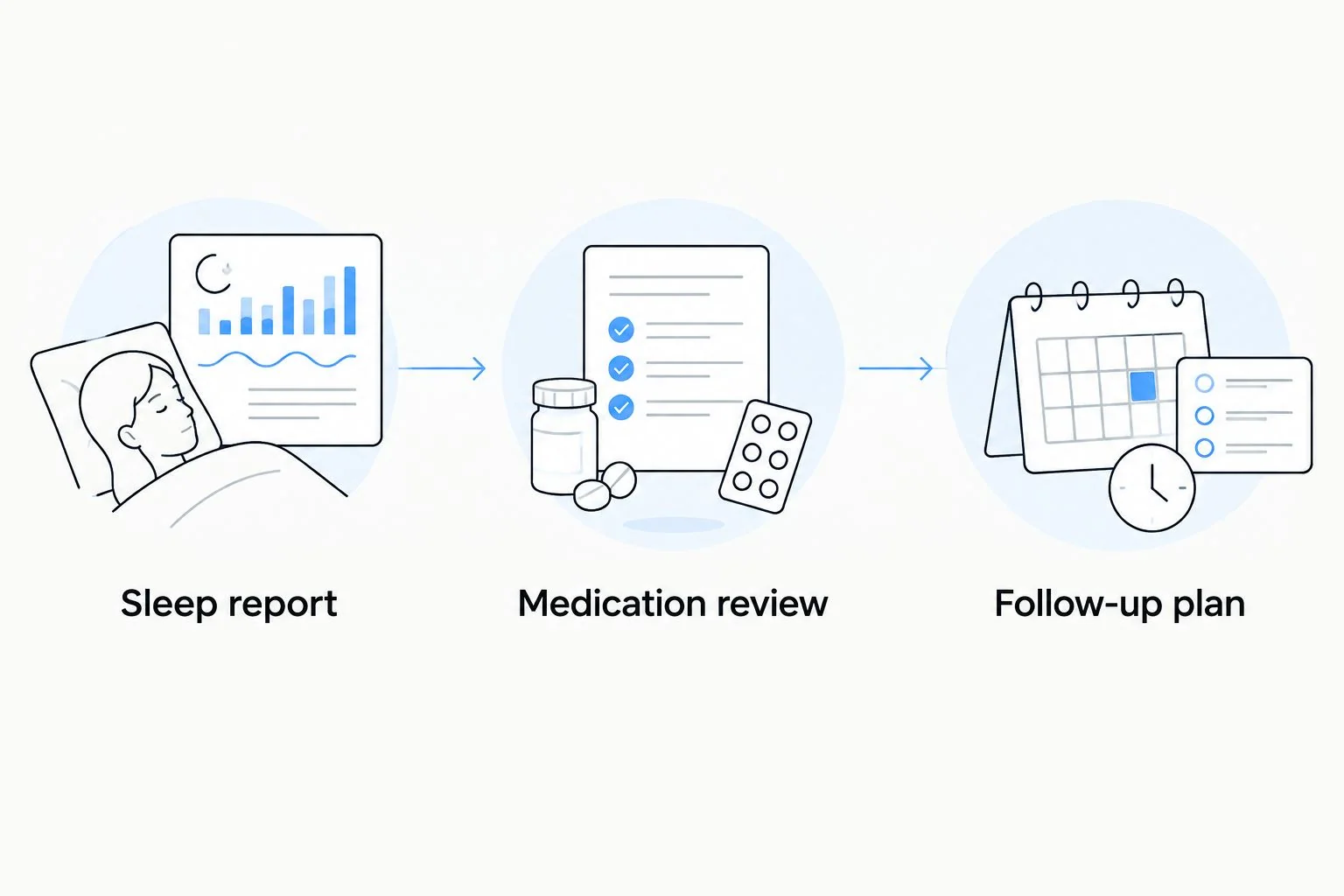
- Sleep report: Share the diagnosis and severity before choosing medication.
- Medication review: Confirm the exact product, active ingredient, and prescribing purpose.
- Follow-up plan: Identify who handles side effects and sleep-care coordination.
- Ask whether the prescription is FDA-approved or compounded.
A coordinated review connects the sleep diagnosis, prescription choice, and follow-up responsibilities. Keep those three pieces together rather than treating online prescribing as a separate project.
4. Screen for medication risks before starting
Your sleep-apnea diagnosis does not override medication safety requirements. FDA prescribing information for tirzepatide and semaglutide includes important contraindications and warnings, including personal or family history of medullary thyroid carcinoma and multiple endocrine neoplasia syndrome type 2.
Tell your prescriber about pancreatitis, gallbladder problems, severe digestive symptoms, kidney problems, diabetes treatment, and pregnancy plans. These details require individualized review, not an automatic yes or no from a general guide. Do not combine semaglutide and tirzepatide on your own.
Tirzepatide also has specific guidance for people using oral hormonal contraception: its prescribing information advises switching to a non-oral method or adding a barrier method for 4 weeks after starting and for 4 weeks after each dose increase. Discuss this before treatment begins.
- Bring a complete prescription, supplement, and nonprescription medication list.
- Discuss insulin or sulfonylurea use because hypoglycemia risk needs review.
- Tell surgical and anesthesia teams about GLP-1 treatment before procedures.
- Seek prompt medical assessment for severe, persistent abdominal pain or repeated vomiting.
5. Build eating and movement habits around tolerance
Start with a written food, fluid, activity, and symptom log. Smaller meals and stopping when comfortably full are practical responses to early fullness; forcing large meals can worsen discomfort. Persistent vomiting or an inability to keep fluids down needs medical attention, not another diet adjustment.
Your goal is not simply to eat less. Maintain adequate nutrition while losing weight, and ask your clinician or a registered dietitian how to meet protein needs and preserve muscle. Resistance exercise supports muscle maintenance, but your starting routine should reflect your health and physical limitations.
Sleepiness adds a practical constraint: choose activity you can perform safely and avoid driving to exercise when drowsy. A repeatable routine beats a demanding plan that leaves you exhausted.
- Record meals, fluids, digestive symptoms, and activity in a notebook or app.
- Ask for individualized nutrition advice if appetite suppression limits eating.
- Add tolerable strength and aerobic activity with clinical guidance.
- Keep a consistent sleep opportunity while continuing prescribed apnea treatment.
6. Measure breathing outcomes separately from weight
Use two tracks: weight-management progress and sleep-apnea control. For your 2026 follow-up visits, bring weight trends, medication tolerance, PAP data, and notes about daytime function. A smaller waistline and fewer breathing events are related goals, not interchangeable measurements.
The FDA's OSA approval announcement describes two randomized, placebo-controlled studies lasting 52 weeks in adults with obesity and moderate-to-severe OSA. One study included participants using PAP; the other included participants unable or unwilling to use PAP. Those studies support the approved indication, not a promise that every patient can stop PAP.
American Academy of Sleep Medicine guidance supports considering follow-up sleep testing after clinically significant weight change. Your sleep clinician determines timing and test type; you should not set your own stopping threshold from a scale reading.
- Review weight change and medication tolerance with your prescriber.
- Review PAP effectiveness and persistent symptoms with your sleep clinician.
- Ask whether weight change warrants repeat diagnostic testing.
- Change PAP settings or stop treatment only under clinical direction.
Compare treatment options for sleep apnea and excess weight
The right comparison in 2026 is not medication versus PAP as mutually exclusive choices. Each option addresses a different treatment need, and some patients need more than one. The table separates each option's strength from its limitation.
| Option | Best for | Main benefit | Key limitation |
|---|---|---|---|
| PAP therapy | People prescribed direct nighttime breathing support | Keeps the airway open during use | Requires ongoing use and equipment management; does not directly treat obesity |
| Zepbound (tirzepatide) | Eligible adults with obesity and moderate-to-severe OSA | Has an FDA-approved OSA indication alongside diet and physical activity | Requires prescribing assessment and monitoring; does not automatically replace PAP |
| Semaglutide-based weight management | Eligible adults treating excess weight | Addresses weight as a contributor to OSA | A weight-management indication is not an OSA-specific indication |
| Custom oral appliance | Selected patients after sleep and dental assessment | Provides a non-PAP way to address airway obstruction | Not suitable for everyone; effectiveness needs follow-up assessment |
| Nutrition and physical activity support | People building sustainable weight-management habits | Supports nutrition, fitness, and weight management | Does not establish control of nighttime breathing interruptions |
Choose treatment by the problem it addresses, not by which option sounds easiest. PAP provides breathing support during use; obesity treatment targets excess weight; follow-up testing evaluates whether untreated apnea has changed.
Common mistakes people with sleep apnea make
Treating less snoring as proof of recovery
Snoring is not an AHI measurement. A quieter bedroom does not confirm normal oxygen levels or the absence of breathing interruptions. Keep treatment in place until your clinician evaluates objective evidence.
Assuming every tirzepatide prescription carries the OSA indication
Product identity matters. The FDA-approved indication belongs to Zepbound under its prescribing conditions, not automatically to every preparation described as tirzepatide. Ask exactly what is being prescribed.
Letting weight-loss care and sleep care operate separately
A prescriber needs to know about daytime sleepiness and current apnea treatment; a sleep clinician needs to know about weight change and medication use. Share updates with both rather than assuming records transfer automatically.
Chasing dose increases despite poor tolerance
More medication is not a substitute for reassessment. Persistent digestive symptoms, dehydration, or difficulty eating need a prescriber review. Do not accelerate dosing to reach a weight target or qualify for a PAP change.
Find out if GLP-1 treatment may be right for you.
Start My Pre-AssessmentFAQ
What's the best GLP-1 for sleep apnea?
Zepbound, which contains tirzepatide, has an FDA-approved indication for moderate-to-severe obstructive sleep apnea in adults with obesity. Whether it is appropriate for you depends on your diagnosis, medical history, and prescribing assessment.
Can I stop CPAP when I start tirzepatide?
No—starting tirzepatide is not a reason to stop prescribed CPAP. Continue treatment until your sleep clinician reviews your progress and determines whether testing or treatment changes are appropriate.
Does semaglutide treat sleep apnea the same way as Zepbound?
Semaglutide-based weight management is not the same as Zepbound's FDA-approved OSA indication. Losing excess weight can help address a contributor to obstructive sleep apnea, but your breathing outcomes still need separate assessment.
Can people without diabetes use GLP-1 treatment for sleep apnea?
Diabetes is not required for Zepbound's OSA indication. That indication applies to adults with obesity and moderate-to-severe obstructive sleep apnea, subject to the medication's prescribing requirements.
How long does tirzepatide take to improve sleep apnea?
There is no guaranteed personal timeline for improvement. The studies supporting the FDA's OSA approval lasted 52 weeks; your clinician should assess symptoms, treatment data, and whether repeat sleep testing is needed.
Does GLP-1 medication treat central sleep apnea?
Zepbound's sleep-apnea indication is for obstructive sleep apnea, not central sleep apnea. Central events require evaluation because their mechanism and treatment differ from airway obstruction.
Can VEVArx replace my sleep specialist?
VEVArx's stated service is online medically supervised weight management, not a replacement for sleep-specialist care. Keep responsibility for sleep testing, PAP adjustments, and apnea reassessment with an appropriate sleep-care clinician.
One last thing
A good PAP report can mean treatment is working—not that apnea is gone. Before your next 2026 follow-up, ask your sleep clinician: What evidence would justify changing my breathing treatment? That question keeps a successful weight-loss plan from becoming an unsafe self-directed PAP withdrawal.
This guide provides general education, not a diagnosis or individualized treatment instructions.
Related guides
Ready to get started?
See if doctor-prescribed GLP-1 treatment may be right for you. It only takes a few minutes, 100% online.
Start My Pre-AssessmentThis article is for informational purposes only and is not medical advice. Compounded medications are not approved by the FDA and have not been reviewed for safety, effectiveness, or quality. Prescription products require an online consultation with a licensed healthcare provider who will determine if a prescription is appropriate. Individual results vary.