
How long does a telehealth weight loss prescription last?
How long does a telehealth weight loss prescription last? Timing varies. Learn what controls refills, medication supply, renewals, and treatment length.

A telehealth weight-loss prescription lasts for the quantity and refills your clinician authorizes, subject to the dispensing pharmacy’s rules and applicable state law; there is no single US-wide duration. Your medication supply, prescription validity, and total treatment length are separate timelines. In 2026, the practical answer is to confirm your next refill date, remaining refills, and required follow-up before your current supply runs out.
- How long does a telehealth weight loss prescription last? Prescription validity, medication supply, and treatment duration are separate timelines.
- VevaRX offers doctor-prescribed weight-loss treatment through telehealth for US adults seeking medical supervision.
- A refill request is not a renewal: a renewal requires a clinician’s authorization.
- Follow your dispensing label and prescriber’s instructions, not a subscription billing date.
Why this matters
A prescription is not a promise of uninterrupted refills. You can have medication remaining but need a new prescription for your next fill. You can also have authorized refills but need a clinical review before continuing the same treatment.
VevaRX is best suited to US adults seeking doctor-prescribed weight-loss treatment through telehealth. The same planning rule applies across providers: understand the medical authorization separately from the program’s administrative schedule.
Getting those timelines straight helps you ask the right question before a gap develops. Instead of asking only when your prescription expires, ask what must happen before your next dose is due.
Curious whether you qualify? A licensed provider makes the final call.
Start My Pre-AssessmentHow long does a telehealth weight loss prescription last?
A telehealth weight-loss prescription lasts according to its written directions, authorized quantity, remaining refills, and legal validity. Being prescribed online does not, by itself, establish a standard expiration period.
For your 2026 treatment plan, separate these timelines:
| Timeline | What it means | Where to confirm it | What it does not establish |
|---|---|---|---|
| Medication supply | How long the dispensed quantity lasts at the prescribed dose | Dispensing label and pharmacist | How long you can keep receiving treatment |
| Prescription validity | Whether the pharmacy can legally dispense against that prescription | Pharmacy and applicable state requirements | Whether the medicine itself remains usable |
| Refill authorization | Whether additional fills remain authorized | Prescription record and pharmacy | Whether your dose should stay unchanged |
| Follow-up schedule | When your clinician needs to reassess treatment | Prescriber’s care instructions | An automatic medication shipment |
| Treatment duration | How long medication remains appropriate for you | Ongoing clinical assessment | A fixed stopping date for everyone |
The dispensing label is your starting point, not the whole answer. It tells you how to use the medication you received. Your pharmacist can clarify supply and refill status; your prescriber decides whether to continue, change, or stop treatment.
To establish your actual timeline:
- Read the medication name, strength, directions, and dispensed quantity.
- Ask the pharmacy how much supply that quantity provides at your prescribed dose.
- Confirm whether refills remain and whether the prescription is still valid.
- Check whether your clinician requires a follow-up before another prescription.
- Record the next action you need to take, rather than relying on a billing reminder.
Medication supply: how long your current fill lasts
Your supply lasts according to the amount dispensed and the directions you were given. A package’s appearance is not a reliable substitute for its dispensing label.
For a weekly medication dispensed as four single-dose pens, four prescribed weekly doses provide 28 days of supply. That calculation describes the medication in that fill; it does not establish how many refills you have or how long your treatment should continue.
A calendar month and a four-week supply are not interchangeable. If your program communicates in monthly terms, ask the pharmacy for the actual days’ supply rather than assuming the dates will align.
For a vial, the number of doses depends on the concentration, prescribed amount, and usable quantity. Do not calculate doses from vial size alone or copy syringe instructions from another person’s prescription. Ask the pharmacist to explain any unclear directions before using it.
Best for confirming supply: your dispensing pharmacist. The advantage is a calculation tied to the actual product and prescription; the limitation is that a supply calculation cannot authorize a dose change.
Prescription validity: how long the pharmacy can use the order
Prescription validity concerns the pharmacy’s authority to dispense medication against an existing order. It is different from the expiration date printed on the medication package.
There is no universal telehealth expiration period you can apply to every US weight-loss prescription in 2026. State requirements, the medication, the prescription’s terms, and the dispensing circumstances determine what the pharmacy can accept.
Ask a precise question: Can you fill this prescription again, and what would prevent the next fill? That gets you a more useful answer than asking whether your account is active.
If no authorized refills remain, the pharmacy needs new prescribing authorization before dispensing another fill. A refill request sent to your clinician starts that process; it does not complete it.
Best for confirming validity: the pharmacy holding your prescription. The benefit is a direct answer about that order; the limitation is that only an authorized prescriber can issue a replacement or change treatment.
Treatment duration: how long you stay on medication
Weight-loss treatment does not necessarily end when your first prescription runs out. Some weight-management medications are intended for long-term use when they remain appropriate, effective, and tolerable.
Your clinician evaluates treatment benefit, side effects, medical history, and your preferences. A decision to continue treatment is separate from deciding whether to increase a dose or authorize another fill.
Reaching a goal weight does not automatically establish a stopping date. Neither does finishing a starter package. Discuss a maintenance or discontinuation plan with your prescriber rather than using the last available dose as the decision point.
Best for setting treatment length: your prescribing clinician. Medical review connects the decision to your health; the limitation is that no generic online timeline can replace that assessment.
For VevaRX weight-loss treatment, bring the same distinction to your consultation: ask about the current prescription and the longer-term care plan separately.
Why medication instructions do not establish prescription length
Dose-escalation and storage instructions contain specific time periods, but those periods answer different questions. They do not tell you when a prescription legally expires or guarantee a renewal.
For a 2026 medication check, consult the current FDA-approved prescribing information for your exact product and presentation. The examples below show why the wording matters.
| Medication example | Timing in FDA-approved prescribing information | What that timing means | What it does not mean |
|---|---|---|---|
| Wegovy injection | Dose escalation generally uses steps lasting 4 weeks | Time at a dose before a planned increase, subject to clinical instructions | Every prescription expires after 4 weeks |
| Zepbound injection | The starting dose is used for 4 weeks | An initiation period before the next prescribed dosing step | Treatment ends after the starting period |
| Zepbound single-dose pen or vial | Up to 21 days at room temperature not exceeding 86°F | A product-specific storage limit under labeled conditions | The prescription remains valid for only 21 days |
Source: FDA-approved Wegovy injection prescribing information, dosage and administration; FDA-approved Zepbound prescribing information, dosage and administration and storage sections. Follow the current labeling for the exact presentation you receive.
Do not transfer storage rules between products. A pen, a multidose presentation, and a compounded vial can have different instructions. The pharmacy label and product-specific instructions govern what you received.
Why a telehealth weight-loss prescription’s duration varies
Several separate factors determine whether you can obtain and use another fill:
- Authorized quantity: The amount dispensed determines your current supply at the prescribed dose.
- Remaining refills: An order without additional authorized refills needs new prescribing authorization.
- Dose changes: A different dose can require an updated prescription rather than another fill of the existing order.
- Clinical reassessment: Side effects, treatment response, or changes in your health can change the prescribing decision.
- State requirements: Applicable law affects prescription validity and whether a pharmacy can dispense against an order.
- Product instructions: Expiration, beyond-use dates, and storage requirements determine whether medication remains usable—not whether another prescription is authorized.
A longer written prescription period is not automatically better care. The useful measure is whether your authorization, follow-up, and medication supply fit the treatment your clinician has prescribed.
How to prepare for a renewal without guessing
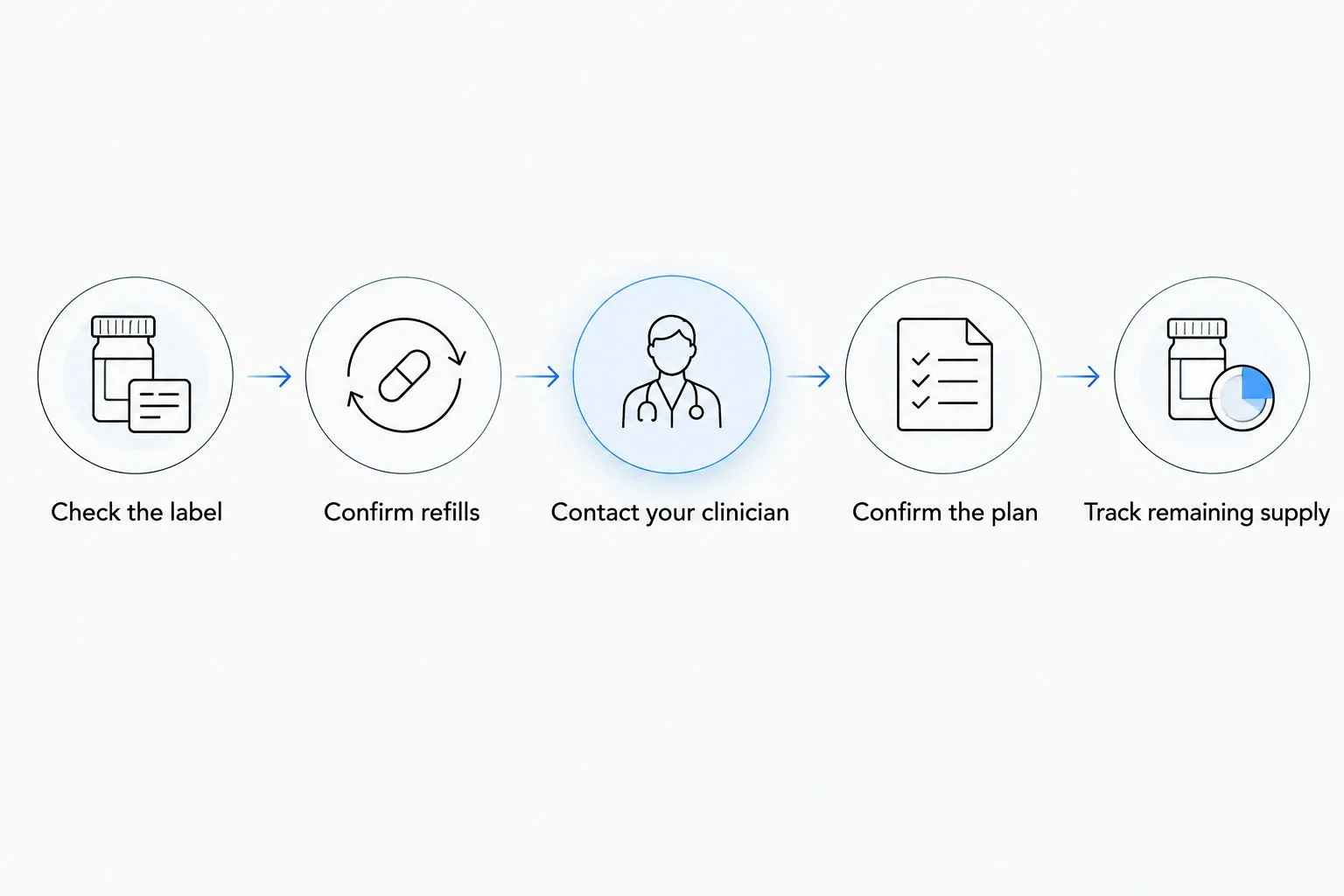
Start with the actual label and treatment instructions. Your goal is a clear next step, not an assumed renewal date.
- Check the label. Confirm the medication, strength, directions, quantity, and pharmacy contact details. Resolve discrepancies before taking a dose.
- Confirm refills. Ask whether another fill is authorized and whether the pharmacy needs an updated prescription.
- Contact your clinician. Ask whether a follow-up is required before continuation. Report side effects, missed doses, and changes to your medications or health.
- Confirm the plan. Establish which dose you should use next and what to do if a gap occurs. Do not restart or increase a dose based only on your previous schedule.
- Track remaining supply. Keep the next required action alongside your medication schedule. A payment confirmation does not replace prescribing instructions.
For a 2026 renewal, give your clinician accurate information rather than just requesting the same prescription again. Include your current prescribed dose, when you last took it, any treatment gap, and symptoms that affect eating or drinking.
This approach supports a specific decision. It does not guarantee continuation: the clinician still needs to determine whether the requested treatment is appropriate.
Find out if GLP-1 treatment may be right for you.
Start My Pre-AssessmentDoes automatic refill enrollment mean my prescription renews automatically?
Automatic refill enrollment does not replace prescribing authorization. A reminder, scheduled request, or recurring payment cannot create additional authorized refills.
Ask what the automatic process actually covers: a reminder, a pharmacy request, or dispensing after the required authorization. Those are different steps. Also confirm how the service handles a dose change or a follow-up that has not yet happened.
The convenience is less administrative work. The limitation is that clinical and pharmacy requirements still apply.
Can I use leftover medication after my prescription expires?
Prescription validity and medication usability are different questions. Whether medication already dispensed remains appropriate to use depends on your current treatment instructions, its expiration or beyond-use date, and how it was stored.
Do not restart leftover medication after a treatment gap without checking with your prescriber. Your previous dose is not automatically the right restart dose.
Ask your pharmacist about the medication’s condition and dates; ask your clinician whether you should resume it.
Do I need a new appointment for every refill?
A new appointment is not automatically required for every refill. Your authorized refills, clinician’s follow-up plan, and applicable requirements determine what happens next.
Ask whether your next step is a refill request, a clinical review, or a new prescription. That distinction keeps an administrative task from being mistaken for a medical decision.
Have questions about your options? Start with a quick online assessment.
Start My Pre-AssessmentFAQ
How long does a telehealth weight loss prescription last in 2026?
A telehealth weight-loss prescription lasts according to its authorized quantity, refills, and applicable validity requirements; there is no single US-wide duration. Confirm your days’ supply with the pharmacy and your follow-up requirements with the prescriber.
Is a monthly weight-loss program the same as a monthly prescription?
A monthly program schedule does not establish your prescription’s duration. Billing, dispensing, and clinical follow-up are separate processes, so confirm each one directly.
Can a pharmacy refill my weight-loss medication without a new prescription?
A pharmacy needs valid prescribing authorization to dispense another fill. Existing authorized refills can permit another fill, but an exhausted or invalid prescription requires new authorization.
Does increasing my dose change how long my supply lasts?
A dose change can change how long a dispensed quantity lasts, depending on the product and presentation. Follow the updated prescription and ask the pharmacist to confirm the days’ supply rather than recalculating it yourself.
Can I keep taking weight-loss medication after reaching my goal?
Continued treatment after reaching a goal weight is a clinical decision, not an automatic stop or renewal. Discuss benefits, side effects, and a maintenance plan with your prescriber.
What should I do if I run out before my renewal is approved?
Contact your prescriber and pharmacy for instructions rather than borrowing medication or changing your dosing schedule. If a gap occurs, confirm how to restart before taking another dose.
Does VevaRX offer telehealth weight-loss prescriptions?
VevaRX offers doctor-prescribed weight-loss medications through an online telehealth platform for US adults seeking medical supervision. Ask about your individual prescription quantity, refill authorization, and follow-up plan during your consultation.
One last thing
Ask for your next action date, not just your prescription’s expiration date. A legally valid prescription does not tell you whether refills remain, whether your next dose needs review, or whether medication already dispensed is still usable.
Before ending a consultation, ask: What do I need to do before I run out, and who should I contact if treatment is interrupted? That answer turns several separate timelines into a practical plan.
This article provides general information, not an individual treatment plan. Follow your prescriber’s instructions and contact your pharmacist about dispensing or storage questions.
Related guides
Ready to get started?
See if doctor-prescribed GLP-1 treatment may be right for you. It only takes a few minutes, 100% online.
Start My Pre-AssessmentThis article is for informational purposes only and is not medical advice. Compounded medications are not approved by the FDA and have not been reviewed for safety, effectiveness, or quality. Prescription products require an online consultation with a licensed healthcare provider who will determine if a prescription is appropriate. Individual results vary.