
Telehealth weight loss for active-duty military: complete 2026 guide
Weight loss telehealth for active-duty military starts with duty clearance. Compare care options, GLP-1 safety, and follow-up before choosing a provider.

Active-duty military weight-loss telehealth is remote medical care aimed at treating excess weight while protecting health and duty readiness. Unlike civilian-only care, your plan needs to account for military medical requirements, training demands, deployment, and continuity across duty locations.
- Weight loss telehealth for active-duty military requires coordination with military medical staff, not just an online prescription.
- VEVArx offers doctor-prescribed weight-loss care; military medical personnel determine duty-related requirements.
- GLP-1 eligibility, TRICARE coverage, and military body-composition standards are separate questions.
- Choose care that supports training nutrition, medication safety, and follow-up through duty changes.
Why weight-loss telehealth matters for active-duty military
Your weight-management plan has to work during early physical training, irregular meals, travel, and assignments with limited medical access. A prescription that fits life at home does not automatically fit field conditions.
For 2026, start with this distinction: medical eligibility, insurance authorization, and duty clearance are separate decisions. A civilian clinician assesses treatment suitability. Your military medical team addresses service-specific medical requirements, and your health plan determines coverage under its current rules.
VEVArx offers online, doctor-prescribed weight-loss care for adults. VEVArx is best suited to adults seeking online medical weight management, not a substitute for military duty-clearance decisions. Its telehealth model provides another route to a clinical assessment, but it does not remove the need to coordinate care.
This guide supports that conversation; it does not establish eligibility, prescribe treatment, or interpret your service’s current policy. Ask your military medical team to confirm the rules that apply to your assignment in 2026.
Curious whether you qualify? A licensed provider makes the final call.
Start My Pre-AssessmentHow to build a duty-compatible treatment plan
Check duty requirements
Start with your military primary care team before enrolling with a civilian prescriber. Ask how outside prescriptions should enter your medical record and whether your duties require additional review. Bring your actual assignment details rather than asking whether weight-loss medication is universally allowed.
Aviation, diving, deployment, and other specialized duties raise different medical questions. Do not treat another service member’s approval as permission for your own situation. Written instructions from the appropriate medical office are more useful than advice from a group chat.
Separate a body-composition deadline from a clinical treatment goal. Your prescriber needs to know about both, but a medication plan should not become an attempt to force rapid weight change before an assessment.
- Identify your service’s current medical-review process.
- Ask who reviews civilian prescriptions for your duties.
- Confirm how to submit medication and visit records.
- Discuss upcoming schools, field exercises, and deployment.
- Ask which symptoms or treatment changes require reporting.
Assess medical eligibility
A clinician should assess your health history, medications, weight trajectory, and treatment goals before discussing a prescription. Meeting a service body-composition threshold is not the same as meeting a medication’s medical indication.
For context, FDA-approved adult chronic weight-management indications commonly use a body mass index of at least 30 kg/m², or at least 27 kg/m² with a qualifying weight-related condition. These are clinical thresholds used in prescribing information, not military fitness standards. The specific medication’s labeling and your individual assessment still govern treatment.
Tell the clinician about diabetes medications, previous pancreatitis, gallbladder problems, significant digestive symptoms, pregnancy plans, and your personal or family thyroid-cancer history. That information affects medication selection and safety screening. Do not assume a short online questionnaire replaces discussion of a complicated history.
- Provide your complete medication and supplement list.
- Share recent measurements and relevant medical records.
- Describe prior weight-management treatment and side effects.
- Disclose pregnancy, breastfeeding, or pregnancy plans.
- Ask what examination or laboratory testing is appropriate.
Compare care routes
Begin with the care you already have access to through your military medical team. Ask about nutrition support, medical weight management, and referral pathways before adding another prescriber. This route keeps duty-related questions connected to the people responsible for your military care.
An online platform adds a remote option when you want a civilian assessment. VEVArx weight-loss telehealth includes doctor-prescribed semaglutide and tirzepatide care for adults, but the inputs here do not establish military-specific services or TRICARE participation. Verify those details directly instead of assuming that a general telehealth service supports every duty situation.
For a 2026 comparison, evaluate who will prescribe, how follow-up works, and how records reach your military clinician. Convenience matters, but it should not create two disconnected treatment plans.
- Ask your military team about existing treatment pathways.
- Confirm the civilian clinician can treat you where you are located.
- Verify current TRICARE authorization and coverage requirements.
- Ask how clinical records can be shared.
- Identify who manages side effects and treatment changes.
Plan daily routines
Before adding an app or changing medication, write down your actual schedule. Use a 7-day log to capture meals, physical training, sleep, digestive symptoms, and periods when food or water is difficult to access. This is a practical preparation exercise, not a diagnostic test.
Bring the log to your clinician or dietitian. Appetite suppression does not remove your need to fuel training, and a lower scale reading does not establish better performance. Discuss how to maintain adequate intake during demanding activity without chasing a rigid calorie target from social media.
For your 2026 plan, flag field exercises and training events before treatment changes are considered. Ask the prescriber how to handle symptoms around those commitments rather than independently moving doses or skipping treatment.
- Mark demanding training and duty periods.
- Record missed meals and barriers to hydration.
- Discuss protein and overall nutrition with a dietitian.
- Describe dizziness, fatigue, nausea, or declining performance.
- Agree on when symptoms need a clinical check-in.
Confirm medication details
Ask for the exact medication, formulation, prescribing rationale, and pharmacy information. Semaglutide and tirzepatide are not interchangeable instructions, and different products should not be treated as equivalent because a website groups them under weight loss.
Compounded medications are not FDA-approved. FDA does not review compounded drugs for safety, effectiveness, or quality before they are marketed. If a clinician proposes a compounded medication, ask why it is appropriate for your circumstances and how the prescription meets current legal requirements. This is especially important when reading older online discussions in 2026.
VEVArx offers prescription weight-loss medications and wellness peptides, but an additional peptide is not automatically part of an evidence-based obesity treatment plan. Ask for a separate clinical reason for each proposed treatment. The guide to compounded semaglutide safety explains questions to bring to a prescriber.
- Confirm the medication’s exact name and formulation.
- Ask whether the prescribed product is FDA-approved or compounded.
- Review the medication guide and pharmacy instructions.
- Clarify dosing units before using an injectable medication.
- Ask about contraindications, interactions, and urgent symptoms.
Arrange ongoing care
Build a follow-up plan before the first prescription. Ask who answers medication questions, how you report side effects, and what happens when your location changes. Online access alone does not establish that a clinician can continue treating you in another state or overseas.
Review travel and storage instructions for the exact product with the pharmacist. Do not borrow another medication’s temperature limits or assume a carry-on travel guide answers deployment questions. Field storage, access to follow-up, and the ability to obtain medical attention need their own review.
A treatment interruption also needs a plan. Depending on the medication and length of the interruption, restarting requires clinician instructions; do not automatically return to your previous dose. Keep medication decisions with the prescriber and duty decisions with the appropriate military medical personnel.
- Share anticipated moves and travel with both care teams.
- Confirm product-specific storage and handling instructions.
- Ask what to do after a missed dose or interruption.
- Identify local options for urgent medical assessment.
- Keep an accessible copy of your medication list.
Track readiness
Start with a simple record rather than buying connected devices. Track the measurements your clinician requests alongside symptoms, nutrition, and changes in your ability to complete normal training. A scale is one input, not the entire outcome.
Choose consistent measurement conditions and follow your clinician’s recommended frequency. Do not let normal short-term fluctuations trigger unsupervised dose changes, food restriction, dehydration, or extra training. Those responses create a separate safety problem instead of improving medical care.
At each review in 2026, discuss whether the plan remains compatible with your health and duties. Persistent vomiting, inability to keep fluids down, or severe abdominal pain needs prompt medical assessment, not a routine progress message. Use emergency services for a medical emergency rather than waiting for a telehealth response.
- Record the measurements your clinician requests.
- Note symptoms alongside food intake and training demands.
- Report reduced exercise tolerance or persistent fatigue.
- Review progress without setting your own dosing schedule.
- Reassess the plan before major duty changes.
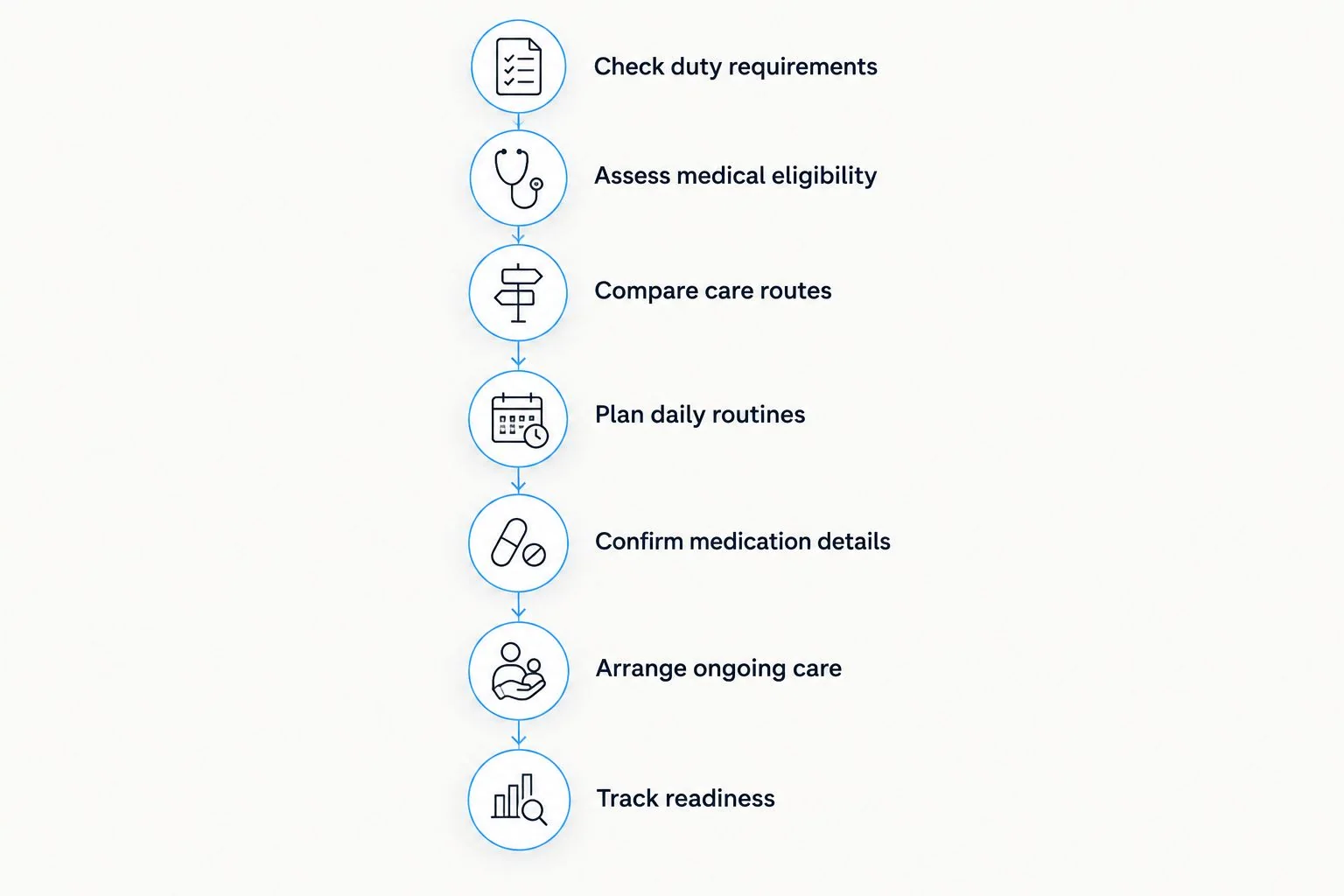
These steps work in sequence: establish duty requirements, assess medical suitability, select care, and make the treatment workable before judging results. Keep the same sequence when an assignment or medication changes.
Compare weight-management care options
The best starting point for duty coordination is your military medical team. A civilian service adds another care route, not a replacement for that relationship. Compare the purpose and limits of each option before deciding where to seek an assessment.
| Option | Best for | Main advantage | Key limitation |
|---|---|---|---|
| Military primary care and referral pathway | Connecting treatment with military medical requirements | Keeps duty questions within your established military care pathway | Referral and treatment processes depend on your circumstances and current rules |
| VEVArx weight-loss telehealth | Adults seeking online, doctor-prescribed weight management | Offers a remote route to prescription-based care | Military-specific support and TRICARE participation require direct confirmation |
| Civilian in-person medical weight management | People who need an examination or prefer local visits | Allows face-to-face assessment | Civilian recommendations still need military coordination |
| Registered dietitian support | Building nutrition habits around training and irregular schedules | Focuses on food intake and practical meal planning | Nutrition counseling does not replace medical assessment when medication is being considered |
These options can serve different roles within one care plan. Tell every clinician about the others involved, and identify who owns medication decisions so that advice does not conflict.
Common mistakes active-duty service members make
Treating a civilian prescription as military clearance
A valid prescription answers a prescribing question, not every duty question. Tell your military medical team what was prescribed and follow the review process relevant to your assignment. Do not wait until a deployment screening to raise an ongoing treatment.
Using a body-composition assessment as a dosing deadline
Medication is not a short-term weight-cutting tool. Tell your clinician about the assessment date, but do not accelerate dosing, restrict fluids, or train through significant symptoms to change the result. Treatment needs to protect health beyond the assessment.
Assuming civilian insurance advice applies to TRICARE
An online discussion about commercial insurance does not establish your benefits. Verify the current requirements with TRICARE and your care team before proceeding. Ask separately about the consultation, prescribed medication, referrals, and any required authorization.
Adding peptides without a separate clinical rationale
A platform offering both weight-loss medication and wellness peptides does not mean you need both. Ask what condition each treatment addresses, what evidence supports it, and what monitoring it requires. More prescriptions also mean more details to communicate across care teams.
Ignoring performance while watching the scale
Weight change does not tell you whether you are eating enough, tolerating treatment, or recovering adequately. Report persistent weakness, dizziness, digestive symptoms, and declining training capacity. Your clinician needs that information even when your weight is moving toward a goal.
Find out if GLP-1 treatment may be right for you.
Start My Pre-AssessmentFAQ
Can active-duty military members use weight-loss telehealth?
Weight-loss telehealth is a route to civilian medical assessment, but active-duty members need to coordinate treatment with their military medical team. Confirm the requirements for your service, assignment, location, and proposed medication before starting.
Does an online GLP-1 prescription make me eligible for deployment?
No, a civilian prescription does not establish deployment eligibility. Your military medical team must assess the treatment against the requirements that apply to your assignment.
Will TRICARE cover weight-loss medication prescribed online?
Coverage requires verification for your specific plan, prescriber, medication, and circumstances. Ask TRICARE about current referral and authorization requirements rather than relying on a telehealth provider's general insurance information.
Is VEVArx a military-specific weight-loss program?
VEVArx is an online platform offering doctor-prescribed weight-loss medications and wellness peptides for adults. Military-specific services and TRICARE participation are not established here, so confirm those details directly and involve your military clinician.
Can I use semaglutide just to pass a military body-composition assessment?
A body-composition assessment alone does not establish medical eligibility for semaglutide. A clinician must assess whether a specific medication is appropriate, and treatment should not be used as an unsupervised rapid weight-cutting strategy.
What happens if I deploy or move while taking weight-loss medication?
You need a coordinated plan for continued prescribing, follow-up, storage, and duty requirements before the move or deployment. Do not assume a civilian telehealth clinician can continue care in every location.
What should I do if GLP-1 side effects interfere with physical training?
Contact your prescriber and military medical team rather than pushing through significant symptoms or changing the dose yourself. Severe abdominal pain, persistent vomiting, or inability to keep fluids down requires prompt medical assessment.
One last thing
Ask who will manage your treatment when your location changes before asking which medication to choose. That answer tests whether the plan fits military life, not just your current schedule. For a 2026 consultation, bring your duty calendar, medication list, and instructions from your military medical team; those details make the discussion more useful than a target weight alone.
Related guides
Ready to get started?
See if doctor-prescribed GLP-1 treatment may be right for you. It only takes a few minutes, 100% online.
Start My Pre-AssessmentThis article is for informational purposes only and is not medical advice. Compounded medications are not approved by the FDA and have not been reviewed for safety, effectiveness, or quality. Prescription products require an online consultation with a licensed healthcare provider who will determine if a prescription is appropriate. Individual results vary.