
Telehealth weight loss for flight crews: complete 2026 guide
Weight loss telehealth for flight crews starts with duty clearance. Compare care options, plan GLP-1 travel, and prepare safer follow-up in 2026.

Flight crews’ weight loss telehealth is remote medical care aimed at supporting weight management without overlooking safety-sensitive duties. For pilots and flight attendants, treatment planning must account for medical certification, irregular meals, changing time zones, and medication side effects—not just appointment convenience.
- Weight loss telehealth for flight crews starts with duty requirements, not a prescription.
- VEVArx offers online GLP-1 weight-loss care for adults; prescribing does not establish fitness to fly.
- Pilots should consult an Aviation Medical Examiner before starting or changing medication.
- Plan GLP-1 storage, symptom reporting, and follow-up around your actual roster.
VEVArx offers doctor-prescribed GLP-1 weight-loss medications through telehealth for adults in the US. VEVArx is best for adults seeking online medical weight-loss evaluation, not aviation medical clearance. Treat those as separate decisions throughout this 2026 guide.
This guide supports appointment preparation; it does not establish your eligibility for medication or permission to perform flight duties.
Why weight loss telehealth matters for flight crews
Flight crews need a treatment plan that works during reserve duty, early departures, overnight trips, and disrupted meal breaks. A plan built around predictable office hours leaves practical questions unanswered: what happens when nausea starts before a report time, or when a connection strands medication away from suitable storage?
Telehealth lets you discuss treatment remotely, but remote care does not remove location-based prescribing requirements. Your clinician needs to know where you will physically be during appointments, especially when your roster crosses state or national borders.
Pilots also face an additional decision-maker: the aviation medical certification process. A medication prescribed appropriately for weight management is not automatically acceptable for flight duties. Flight attendants need to check applicable employer policies and occupational-health requirements rather than assume pilot certification rules apply to them.
For flight crews, the right plan protects both health and duty readiness. In 2026, start with your role, certification obligations, and medical history before comparing providers or requesting a particular medication.
Curious whether you qualify? A licensed provider makes the final call.
Start My Pre-AssessmentHow to build a flight-compatible treatment plan
1. Confirm your duty and medical requirements
Start with the manual route: write down your role, certification status, employer requirements, and existing medical conditions. Pilots should discuss the proposed medication and its intended use with an Aviation Medical Examiner, or AME, before starting treatment. Your prescribing clinician also needs that context.
The FAA’s Guide for Aviation Medical Examiners is the relevant US reference for pilot medical certification. For a 2026 decision, ask your AME to apply current guidance to the exact drug, indication, dose changes, and medical history. Do not use another pilot’s experience as clearance.
Keep prescribing and occupational decisions distinct. Your prescriber assesses whether treatment is medically appropriate; the aviation medical process addresses certification. Neither a telehealth approval nor an employer conversation replaces the other.
- Identify whether you hold an FAA medical certificate and which requirements apply.
- Ask your AME about treatment initiation, dose changes, and return-to-duty documentation.
- Check your employer’s medication-reporting and fitness-for-duty process.
- Record who must review changes before you perform safety-sensitive duties.
2. Document your roster before choosing treatment
Use a phone note or paper diary to record a representative 7-day period. Include report times, sleep opportunities, meals, hydration access, symptoms, and exercise. This is a planning exercise, not a diagnostic test or a requirement to qualify for care.
A useful diary shows the difference between home days and duty days. Recording only your days off hides the constraints your clinician needs to understand. Include reserve periods and layovers if they fall within the week; otherwise, describe them separately.
Use a 24-hour clock and identify the time zone. A note that says you ate late or felt unwell overnight is less useful than a clear sequence showing the relationship between meals, medication, and duty.
Bring the roster you actually work—not the routine you hope to follow. That gives your clinician a practical basis for discussing treatment and monitoring.
- Mark duty periods and realistic opportunities to eat and drink.
- Note existing nausea, constipation, reflux, dizziness, or fatigue before treatment.
- List prescription medicines, supplements, and relevant medical conditions.
- Identify appointments you can attend from an appropriate physical location.
3. Choose clinical care before choosing a medication
Start by comparing how each care option handles assessment, follow-up, and problems between appointments. A local primary-care clinician offers an existing medical relationship when you have one. Telehealth offers remote consultations, but you still need a clear process for examinations, tests, or urgent concerns that require in-person care.
VEVArx offers weight loss telehealth with doctor-prescribed semaglutide and tirzepatide for adults seeking medically supervised treatment. Confirm whether the service can meet your clinical and scheduling needs rather than assume it includes aviation-specific documentation or coordination.
Ask about the exact medication and formulation under consideration. Semaglutide and tirzepatide are different medicines, and suitability depends on your history and treatment goals. If a compounded preparation is proposed, remember that compounded drugs are not FDA-approved; discuss the reason for prescribing it and the dispensing pharmacy.
Do not select treatment because a colleague tolerates it. Your assessment must cover your health history and work demands.
- Ask who evaluates eligibility and manages ongoing treatment.
- Confirm how to report symptoms and request a clinical review.
- Ask what requires local testing or an in-person examination.
- Request the medication name, formulation, and pharmacy information in writing.
4. Plan medication changes around duty restrictions
Start with a shared calendar showing your roster, appointments, and any restrictions established by your clinicians or employer. Do not assume a weekend or short layover provides enough observation time after starting medication or changing a dose.
GLP-1-based medicines can cause gastrointestinal symptoms, including nausea, vomiting, diarrhea, and constipation. Vomiting or diarrhea can contribute to dehydration. Even without an aviation-specific prohibition, symptoms that interfere with alertness, hydration, or normal function require attention before safety-sensitive work.
Your prescriber should explain what to do after a missed dose, persistent symptoms, or interrupted treatment. Follow instructions for your exact prescription; do not move doses, double doses, or restart at a previous dose based on an online schedule.
For your 2026 plan, write down the decision process before a problem occurs. That prevents a last-minute choice between reporting for duty and seeking clinical advice.
- Record any required observation or restriction period provided by your AME.
- Ask your prescriber how missed doses and treatment interruptions are handled.
- Agree on which symptoms require stopping work and contacting a clinician.
- Keep urgent-care instructions accessible when you are away from home.
5. Prepare storage and travel instructions
Start with the pharmacy label, manufacturer instructions when applicable, and a written question list for your pharmacist. Storage requirements differ by product, presentation, and whether it has been opened. There is no single temperature or time limit that applies to every semaglutide or tirzepatide prescription.
Build a plan for the whole trip: commuting, airport screening, aircraft time, ground transport, and hotel storage. Avoid assuming that a hotel refrigerator maintains an appropriate temperature or that a cooling pack cannot freeze medication. Ask your pharmacist how to prevent temperature extremes and assess an excursion.
For a practical packing checklist, review flying with semaglutide pens in your carry-on. Then confirm current security and destination requirements for your actual medication and supplies; US screening procedures do not establish another country’s entry rules.
Travel preparation also includes disposal. Used needles belong in an appropriate sharps container, not loose in a bag or aircraft waste bin.
- Carry medication identification and the relevant dispensing information.
- Confirm storage instructions for the exact product you receive.
- Ask what to do after freezing, overheating, or an uncertain storage period.
- Check destination rules and arrange safe sharps disposal before departure.
6. Measure tolerance as well as weight
Start with a simple log of weight trends, symptoms, meals, hydration, sleep, and missed doses. Weight alone does not tell your clinician whether treatment fits your working life. Record how you feel during duty periods rather than only at home.
Ask your clinician which measurements matter for your circumstances and how often to collect them. Avoid judging progress from an isolated weigh-in after a long trip. The useful question is whether the overall treatment plan remains effective, tolerable, and compatible with safe work.
Prepare a 1-page summary before follow-up: current prescription, symptom pattern, interruptions, upcoming roster changes, and questions. Keep medical details secure, and share occupational documentation through the channels your employer or AME specifies.
Do not wait for a routine appointment when symptoms are severe. Persistent severe abdominal pain, repeated vomiting, inability to keep fluids down, fainting, or signs of a serious allergic reaction need prompt medical assessment; severe or rapidly worsening symptoms warrant emergency care.
- Track symptoms alongside duty periods and medication changes.
- Report difficulty eating or drinking enough rather than pushing through it.
- Review new medicines and supplements with your prescriber.
- Revisit the plan when routes, duties, or medical circumstances change.
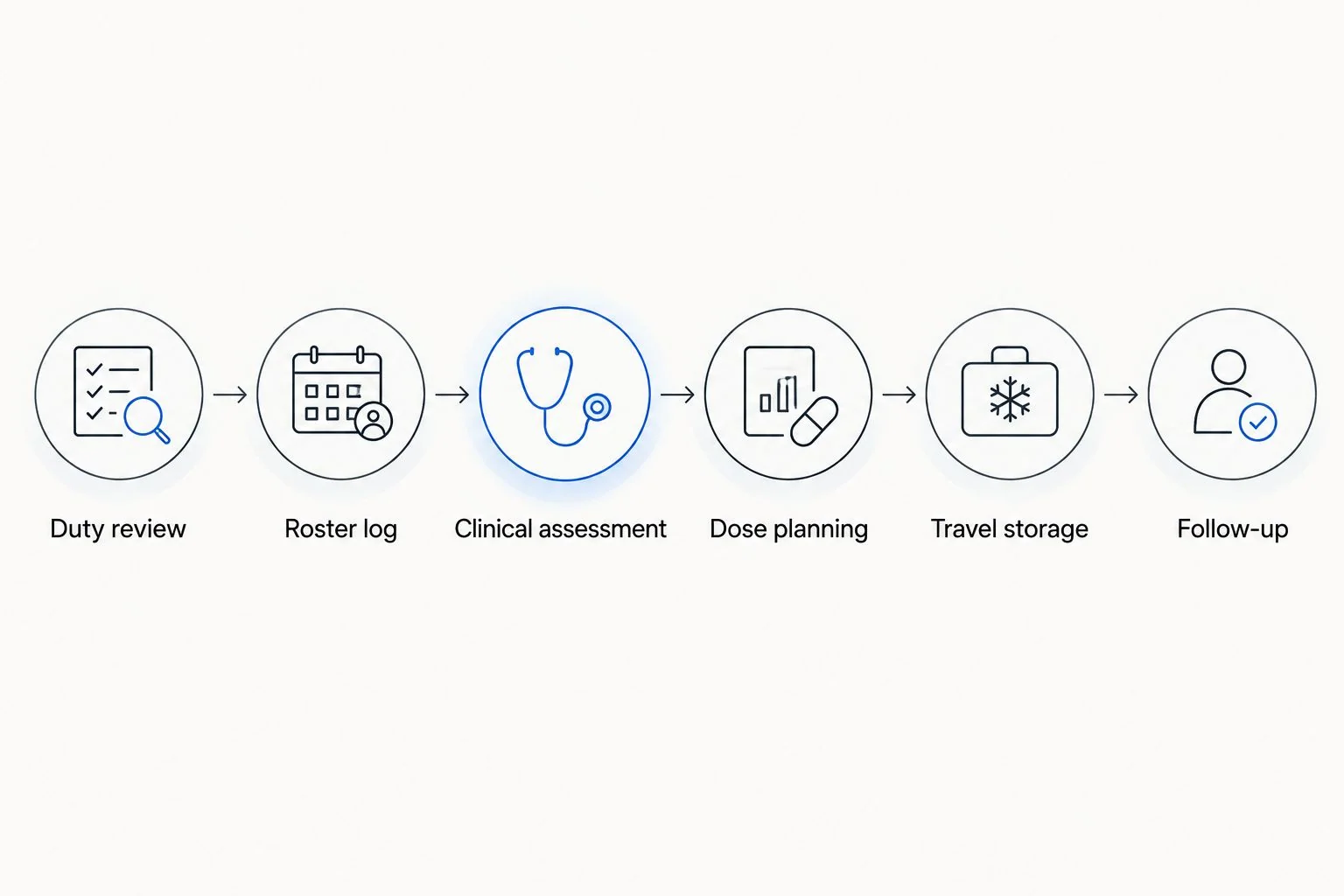
The process has six connected parts: Duty review, Roster log, Clinical assessment, Dose planning, Travel storage, and Follow-up. Complete the duty review before treating remote prescribing as the next step.
Compare care options for flight crews
No single care setting covers every need. Use this comparison to separate weight-management treatment from aviation and occupational review. In 2026, choose based on the responsibilities each option can actually fulfill—not an assumption that remote prescribing includes duty clearance.
| Option | Best for | Main advantage | Key limitation |
|---|---|---|---|
| VEVArx weight loss telehealth | Adults seeking online prescription weight-loss evaluation | Remote access to medically supervised GLP-1 care | Does not establish aviation medical clearance; confirm service details directly |
| Local primary-care clinician | Adults who need weight management coordinated with general medical care | Can assess broader health needs and arrange local evaluation | Appointment arrangements must fit your roster; aviation review remains separate |
| Obesity-medicine specialist | Adults needing specialist assessment of weight-management treatment | Focused evaluation of treatment choices and medical complexity | Does not replace required aviation or employer review |
| Aviation Medical Examiner | Pilots needing assessment against FAA medical requirements | Addresses the certification implications of medical conditions and treatment | Is not a substitute for ongoing weight-management care |
| Registered dietitian | Crew members seeking practical nutrition support | Helps adapt eating plans to duty schedules and personal needs | Does not replace a prescribing clinician or medical clearance |
Coordinate complementary roles instead of expecting one provider to do everything. A prescribing clinician, dietitian, and AME address different questions; adding appointments without assigning responsibilities creates confusion rather than continuity.
Common mistakes flight crews make
Treating a prescription as permission to fly
A legitimate prescription establishes a treatment decision, not fitness for duty. Pilots need the applicable aviation medical review; flight attendants need the relevant employer and occupational-health process. Keep written instructions accessible rather than relying on a casual conversation.
Starting treatment immediately before a demanding trip
A gap in your roster is not proof that you have met observation requirements or established tolerance. Confirm the timing with the appropriate clinicians before starting or increasing medication. Do not create your own clearance interval.
Applying another product’s storage rules
A colleague’s pen and your prescription can have different handling instructions. Use the directions for your exact medication, including what changes after opening. Ask the pharmacist about uncertain storage rather than deciding from appearance alone.
Solving appetite suppression by skipping food all day
Reduced appetite is not a reason to ignore nutrition or hydration during duty. Discuss difficulty eating, persistent nausea, and low intake with your clinician. Build realistic meal opportunities into the plan rather than relying on hunger as your only reminder.
Find out if GLP-1 treatment may be right for you.
Start My Pre-AssessmentFAQ
Can pilots use weight loss telehealth for flight crews?
Pilots can seek weight-management evaluation through telehealth, but a prescription does not establish fitness to fly. Consult an Aviation Medical Examiner about the exact medication, indication, and applicable FAA requirements before starting or changing treatment.
Is semaglutide or tirzepatide better for flight attendants?
Neither medication is automatically better because you are a flight attendant. A prescribing clinician must assess your medical history, treatment goals, potential adverse effects, and ability to follow the treatment plan around duty.
Does an online prescription mean I can work my next flight?
No, an online prescription does not clear you for flight duties. Follow the applicable aviation medical, employer, and occupational-health requirements, and do not perform safety-sensitive work when symptoms impair your function.
Can I attend a telehealth appointment during an international layover?
Do not assume your provider can conduct an appointment while you are abroad. Tell the provider your physical location and confirm whether care is permitted there before scheduling.
What should I do if I miss a GLP-1 dose while traveling?
Follow the missed-dose instructions for your exact prescription and contact your prescriber or pharmacist when the next step is unclear. Do not double a dose or improvise a restart schedule.
Can compounded semaglutide be treated like an FDA-approved product?
No, compounded semaglutide is not FDA-approved. Ask your prescriber why it is being proposed, identify the dispensing pharmacy, and obtain instructions for the exact formulation.
What symptoms mean I should get medical help instead of reporting for duty?
Severe abdominal pain, repeated vomiting, inability to keep fluids down, fainting, or signs of a serious allergic reaction require prompt medical assessment. Seek emergency care for severe or rapidly worsening symptoms and follow your employer’s fitness-for-duty process.
One last thing
Your most useful travel document might be a clear medication plan, not a packing checklist. Before your next treatment change in 2026, write down who handles prescribing questions, who addresses duty clearance, and what you should do when either person is unavailable.
If those responsibilities are unclear, resolve them before departure. A remote appointment helps only when you know how to act on the advice while away from home.
Related guides
Ready to get started?
See if doctor-prescribed GLP-1 treatment may be right for you. It only takes a few minutes, 100% online.
Start My Pre-AssessmentThis article is for informational purposes only and is not medical advice. Compounded medications are not approved by the FDA and have not been reviewed for safety, effectiveness, or quality. Prescription products require an online consultation with a licensed healthcare provider who will determine if a prescription is appropriate. Individual results vary.