
Can you fly with semaglutide pens in your carry-on?
Can you fly with semaglutide pens in your carry-on? Yes. Learn TSA screening rules, pen storage limits, cooling tips, and international travel checks.
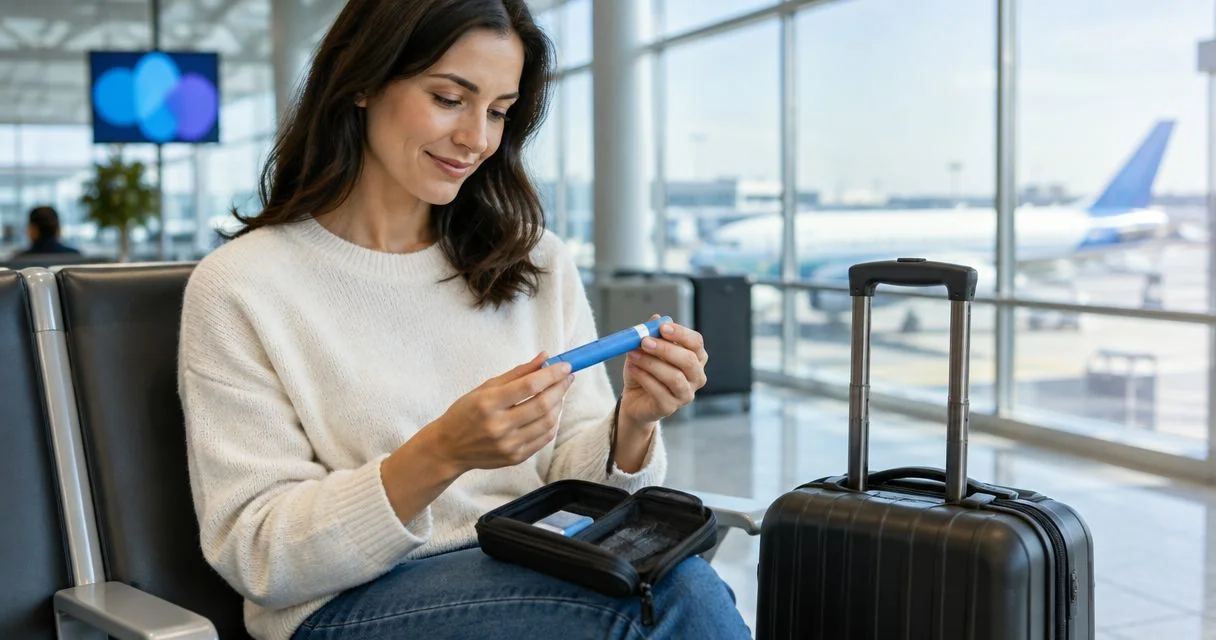
Yes, you can fly with semaglutide pens in your carry-on through U.S. Transportation Security Administration checkpoints, including the injection supplies needed for your treatment. Security permission does not replace the pen’s storage instructions or your destination’s medication-import rules. Keep the medication with you, tell the screening officer about medically necessary liquids and cooling supplies, and follow the instructions for your exact product.
- Can you fly with semaglutide pens in your carry-on? Yes, through U.S. TSA checkpoints, subject to screening.
- Keep semaglutide within its labeled temperature limits; never freeze it or place it directly against frozen packs.
- Ozempic and Wegovy have different unrefrigerated storage limits. Follow your exact product’s instructions.
- Vevarx offers online GLP-1 prescribing for adults seeking medically supervised weight loss, not airport or customs clearance.
Can you fly with semaglutide pens in your carry-on?
Yes. TSA allows injectable medication and associated supplies in carry-on baggage. Medically necessary liquids are permitted in reasonable quantities above the usual 3.4-ounce limit, but you must declare them for inspection. Unused syringes are allowed when accompanied by injectable medication; tell the officer you have them.
Pack the medication, its label, and your supplies together so you can present them without unpacking your entire bag. If you need a refresher before leaving, review how to inject semaglutide at home and follow the instructions supplied with your prescription.
For your 2026 trip, use this sequence:
- Identify your product. Check the medication name, presentation, and whether the pen has been used.
- Read storage instructions. Confirm temperature limits, permitted unrefrigerated time, and protection from light.
- Pack accessible supplies. Keep the medication, necessary needles, and cooling materials together in your personal bag.
- Declare medical items. Tell the screening officer about medically necessary liquids, needles, and cooling supplies before inspection.
- Check destination rules. Verify medication-import requirements for international travel, including relevant transit stops.
TSA’s “Medications (Liquid),” “Unused Syringes,” and “Gel Ice Packs” guidance covers U.S. checkpoint screening. It does not establish foreign entry requirements or determine whether a temperature-exposed pen remains usable.
Curious whether you qualify? A licensed provider makes the final call.
Start My Pre-AssessmentWhy this matters
Getting a pen through security and keeping it suitable for use are separate jobs. A medication can pass screening yet still be damaged by freezing, excessive heat, or storage beyond its labeled limit.
Carry-on storage gives you access to the medication during delays and avoids separating it from you if checked luggage goes missing. The limitation: a carry-on bag is not temperature-controlled, so it still needs a storage plan.
Plan the entire door-to-door journey, not just the flight. Include the drive to the airport, security queues, connections, ground transportation, and storage after arrival.
Ozempic pens: 56 days after first use
According to the U.S. Ozempic prescribing information, unused pens belong in a refrigerator at 36°F–46°F. After first use, an Ozempic pen can be stored for 56 days either refrigerated or at room temperature between 59°F and 86°F.
Keep the pen cap on when it is not in use, protect it from excessive heat and sunlight, and remove the needle after each injection. Do not freeze Ozempic or use a pen that has been frozen.
For travel, the benefit is straightforward: an in-use pen has a labeled room-temperature storage option. The limitation is equally important: that allowance does not apply outside the permitted temperature range, and refrigeration does not restart the 56-day clock.
Record the first-use date before packing. A pen that still contains medication is not automatically within its permitted use period.
Wegovy injection pens: up to 28 days before cap removal
The U.S. prescribing information for Wegovy injection pens specifies refrigerated storage at 36°F–46°F. Before removing the pen cap, the pen can be kept in its original carton at 46°F–86°F for up to 28 days.
Protect Wegovy from light, and do not freeze it. Keep the cap in place until you are ready to inject, following the product instructions.
The travel benefit is a defined unrefrigerated storage allowance. The limitation: Wegovy’s instructions are not interchangeable with Ozempic’s, even though both contain semaglutide.
Use the instructions supplied with your exact presentation for your 2026 packing plan. Do not apply another country’s pen instructions, another formulation’s label, or advice for an older package to the medication in your bag.
| Medication reference | Refrigerated storage | Labeled unrefrigerated allowance | Main travel limitation |
|---|---|---|---|
| Ozempic injection pen | 36°F–46°F before first use | After first use: 56 days at 59°F–86°F, or refrigerated | First-use date and temperature limits both matter |
| Wegovy injection pen | 36°F–46°F | Before cap removal: up to 28 days at 46°F–86°F in the original carton | Keep the cap on and protect the pen from light |
| Compounded semaglutide | Follow the dispensing pharmacy’s label | Follow the dispensing pharmacy’s instructions | Do not substitute Ozempic or Wegovy storage allowances |
These are storage comparisons, not medication recommendations. The prescribing clinician determines which treatment is appropriate; the product label determines how you store it.
Why semaglutide travel requirements vary
A useful 2026 checklist separates screening, storage, and border requirements. These factors change what you need to prepare:
- Exact formulation: A branded pen’s storage instructions do not establish the storage limits for a compounded preparation.
- First-use status: Ozempic’s 56-day storage period applies after first use, while unopened pens have different instructions.
- Temperature exposure: Time within a permitted range is different from exposure to excessive heat or freezing.
- Cooling supplies: TSA screens medically necessary ice packs and gel packs separately when needed, including packs that are not fully frozen.
- Destination and transit: Foreign authorities set their own medication-import requirements; TSA permission does not override them.
- Bag handling: A carry-on that gets gate-checked stops being accessible, so keep medication in a removable personal pouch.
Best for medication access: a personal item that stays with you. Its advantage is control during the journey; its limitation is that you must still protect the contents from temperature extremes and crushing.
How should you pack semaglutide for airport security?
Start with an identifiable prescription package and a pouch you can remove easily. TSA does not require prescription bottles for medication, but labeling helps explain what you are carrying, and other jurisdictions can have different requirements.
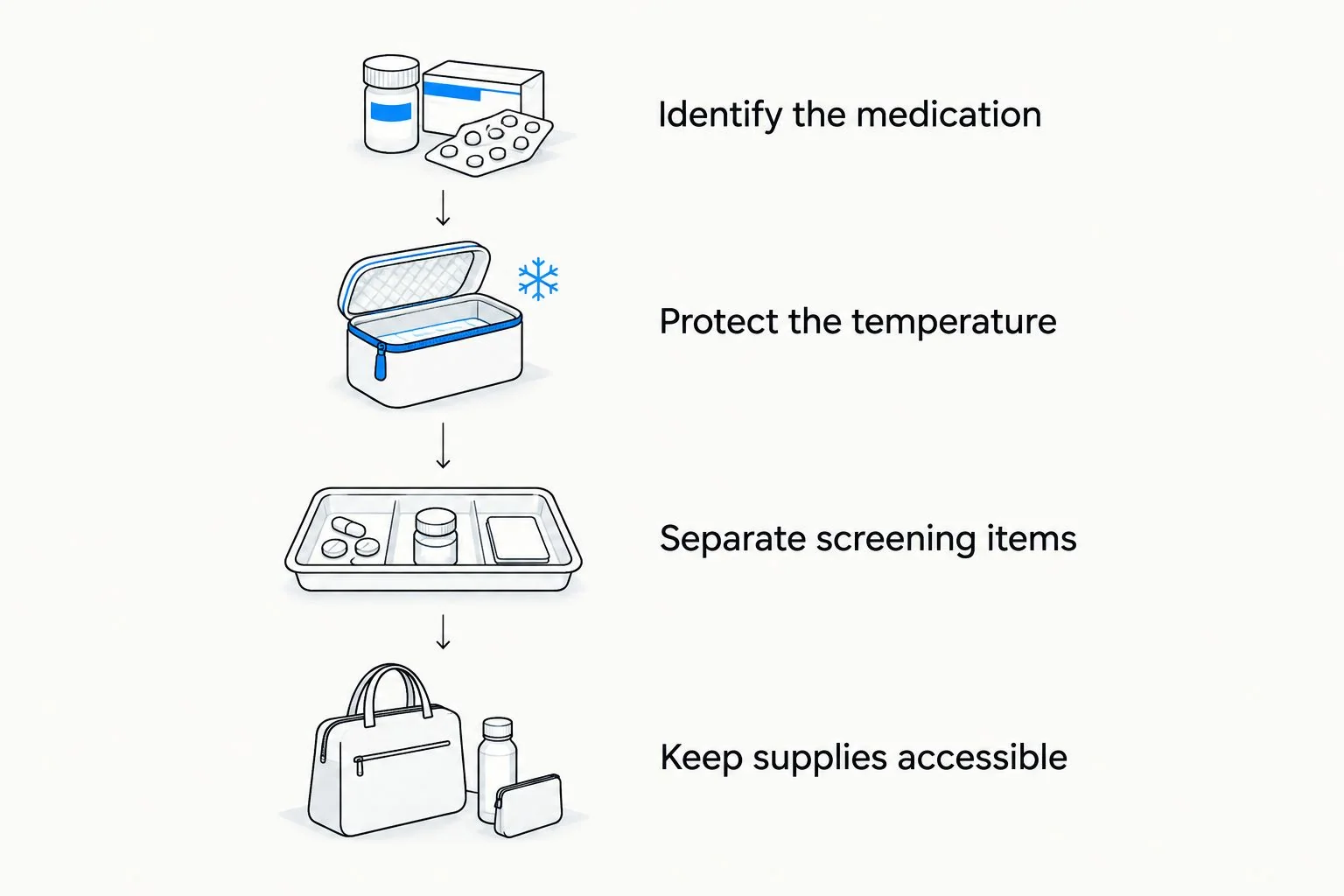
Identify the medication
Keep the dispensing label with the medication. For international travel, check whether the destination requires an original package, prescription copy, clinician letter, translated documentation, or advance permission.
Do not describe a medication as something else to avoid questions. Give the screening officer a clear, accurate explanation of the injectable medication and related supplies.
Protect the temperature
Use cooling materials when your product’s instructions and journey conditions require them. Prevent direct contact between the pen and a frozen pack; medication that needs refrigeration must not be frozen.
An insulated pouch slows temperature change but does not prove that the contents stayed within range. Ask your pharmacist how to pack your exact medication for the expected journey, especially if airport transfers or delays extend the time away from refrigeration.
Separate screening items
Tell the officer about medically necessary liquids and associated cooling supplies at the start of screening. TSA allows medically necessary cooling packs even when they are partially melted or slushy, subject to inspection.
If you do not want medication screened by X-ray, request inspection before screening begins. TSA determines the inspection process and can require additional screening.
Keep supplies accessible
Keep unused needles with the injectable medication and protect them from accidental exposure. Carry an appropriate sharps container if you expect to inject during the trip; used needles must not go loose into your bag or the aircraft trash.
If staff ask you to gate-check your bag, remove the medication pouch first. Keep it with you rather than relying on access to the bag during the flight.
Do I need a doctor’s note to fly with semaglutide?
TSA does not generally require a doctor’s note for prescribed injectable medication. International entry rules are separate, and a destination can require documentation that a U.S. checkpoint does not.
Check official customs, embassy, or health-authority instructions before departure. Your airline’s baggage advice does not replace the destination’s medication-import rules.
Find out if GLP-1 treatment may be right for you.
Start My Pre-AssessmentCan I put semaglutide in checked luggage instead?
Keep semaglutide in your carry-on rather than checked luggage. Carrying it yourself reduces separation risk and lets you respond if your travel plans change.
Checked luggage is less suitable because you cannot access it during the flight, and it can be delayed or lost. Neither a checked suitcase nor a cabin bag guarantees that a medication’s temperature limits will be maintained.
What if my semaglutide gets warm during the flight?
A warm pen is not automatically unusable; the answer depends on the exact product, temperature, and duration of exposure. Compare those details with the supplied storage instructions, and ask a pharmacist if the exposure exceeded them or is uncertain.
Do not use a pen that has been frozen. Do not assume that returning an overheated pen to the refrigerator restores its suitability for use.
Before departure, confirm your treatment plan
Vevarx is best suited to adults seeking online, medically supervised GLP-1 weight-loss care. Vevarx offers doctor-prescribed semaglutide and other listed treatments; travel clearance and product-specific storage decisions remain separate questions.
If you receive care through Vevarx, discuss travel-related treatment questions with your prescribing clinician and ask the dispensing pharmacist about the exact medication supplied. An online prescription does not remove checkpoint screening, foreign import requirements, or the need to follow the dispensing instructions.
Before your 2026 departure, confirm your scheduled injection day, supplies, and whom to contact about a missed dose. Do not double a dose or change your schedule just to simplify packing. Missed-dose instructions differ by product, so follow your prescription instructions rather than a generic travel tip.
Have questions about your options? Start with a quick online assessment.
Start My Pre-AssessmentFAQ
Can you fly with semaglutide pens in your carry-on in 2026?
Yes, TSA permits injectable medication and associated supplies in carry-on baggage through U.S. checkpoints, subject to screening. Keep the medication within its storage limits and check separate international entry requirements.
Does semaglutide have to go in my liquids bag?
Medically necessary liquids do not have to fit the standard TSA liquids bag. Declare them for inspection, especially when carrying quantities above the usual 3.4-ounce limit.
Can I bring ice packs for semaglutide through TSA?
Yes, TSA permits medically necessary cooling packs, including partially melted or slushy packs, subject to screening. Tell the officer about them and prevent frozen packs from directly contacting the medication.
Can I bring semaglutide needles on a plane?
Yes, TSA allows unused syringes when accompanied by injectable medication. Declare them for inspection and use an appropriate sharps container for used needles.
How long can an Ozempic pen stay unrefrigerated after first use?
An Ozempic pen can be stored for 56 days after first use at 59°F–86°F or in the refrigerator, according to its U.S. prescribing information. Do not freeze it, and discard it after the permitted use period even if medication remains.
How long can a Wegovy injection pen stay outside the refrigerator?
A Wegovy injection pen can stay at 46°F–86°F for up to 28 days before cap removal, in its original carton, according to its U.S. prescribing information. Protect it from light and do not freeze it.
Can I take compounded semaglutide abroad?
Whether you can take compounded semaglutide abroad depends on the destination’s medication-import rules and your specific prescription. Follow the dispensing pharmacy’s storage instructions rather than borrowing a branded pen’s temperature allowance.
One last thing
The easiest travel mistake is refrigerating a medication that should not be frozen without checking the refrigerator. Keep your pen away from freezer compartments and cooling elements, and confirm that any refrigerator you use maintains the labeled range.
Before leaving home, save the product instructions and your pharmacy’s contact details somewhere accessible offline. A storage question is easier to resolve when you can identify the exact medication and describe what happened.
Related guides
Ready to get started?
See if doctor-prescribed GLP-1 treatment may be right for you. It only takes a few minutes, 100% online.
Start My Pre-AssessmentThis article is for informational purposes only and is not medical advice. Compounded medications are not approved by the FDA and have not been reviewed for safety, effectiveness, or quality. Prescription products require an online consultation with a licensed healthcare provider who will determine if a prescription is appropriate. Individual results vary.