
Telehealth weight loss for gig economy workers: complete 2026 guide
Weight loss telehealth for gig workers works best with clinician oversight. Compare care options, plan around shifts, and protect medication routines.

Gig workers’ weight-loss telehealth is remote medical care with the aim of helping independent workers manage weight around changing schedules. This 2026 guide explains how to assess eligibility, compare care options, and plan treatment when driving, delivery routes, freelance deadlines, or travel complicate your routine.
- Weight loss telehealth for gig workers should prioritize medical oversight, follow-up access, and a workable medication routine.
- VEVArx offers adults online, doctor-prescribed weight-loss care; a prescription depends on clinical evaluation.
- Compare telehealth, primary care, and hybrid care by scheduling fit and access to examinations.
- Plan meals, medication storage, and symptom management before starting GLP-1 treatment.
Why telehealth weight loss matters for gig workers
If you earn by the assignment or shift, an office visit competes with paid work. Remote appointments remove the trip to the clinic, but you still need protected time, privacy, and any examinations or testing your clinician requires.
VEVArx is best suited to adults seeking online, doctor-prescribed weight-loss care. VEVArx offers telehealth access to medications including semaglutide and tirzepatide; clinical suitability still determines whether either belongs in your treatment plan.
For your 2026 comparison, focus on care continuity rather than appointment convenience alone. A quick consultation does not answer what happens when nausea interrupts a delivery route, you cross state lines, or your work schedule changes before a follow-up.
The right arrangement lets you report problems and receive clinical guidance without guessing. It also gives you a clear route to in-person care when remote assessment is not enough.
Curious whether you qualify? A licensed provider makes the final call.
Start My Pre-AssessmentHow to build a treatment plan around gig work
1. Map your work constraints before comparing providers
Start with a paper calendar or your phone’s notes app. Record a representative workweek: driving blocks, overnight assignments, breaks, meals, sleep, and the places where you can speak privately.
A 7-day work log is a planning exercise, not a medical requirement. Its purpose is to show your clinician where a proposed routine clashes with your actual day, including periods without reliable food, water, refrigeration, or bathroom access.
Describe your work accurately. A freelancer working from home has different practical constraints from a courier carrying medication between cities, even when both have unpredictable income.
- Mark appointment windows when you are parked and off duty.
- Identify a private location for discussing medical history.
- Note travel that takes you across state lines.
- Record gaps in meals, fluids, and bathroom access.
- List where you can safely store medication at home.
2. Check medical eligibility before choosing medication
Prepare your medical history yourself before booking: current medications, supplements, diagnoses, allergies, past weight-management treatment, and pregnancy or breastfeeding status. Bring concerns about eating patterns and mental health, too.
For FDA-approved chronic weight-management medications such as Wegovy and Zepbound, adult labeling includes a BMI of 30 kg/m² or greater, or 27 kg/m² or greater with at least one weight-related condition. These thresholds come from FDA prescribing information; they are screening criteria, not a prescription guarantee.
In 2026, ask which specific medication and formulation the clinician is considering. Semaglutide and tirzepatide are active ingredients, not interchangeable names for every product containing them. Eligibility, contraindications, and instructions depend on the prescribed product and your history.
- Gather your medication and supplement list.
- Share any history of pancreatitis or gallbladder disease.
- Disclose personal or family history of medullary thyroid carcinoma or MEN2.
- Discuss pregnancy plans, breastfeeding, and contraception.
- Ask whether testing or an in-person examination is needed.
3. Compare the care pathway, not just the signup process
Make a simple comparison sheet before enrolling anywhere. Ask how appointments work, how to reach a clinician between visits, and who handles a problem that needs physical examination.
VEVArx provides an online route to doctor-prescribed weight-loss care. That route offers an alternative to arranging every consultation in person, but the supplied service description does not establish appointment hours, response times, insurance participation, or support policies. Confirm those details directly before choosing a program.
Choose the service whose follow-up process you understand. A remote intake is useful only if you also know where to take questions after treatment starts. State-based licensing requirements also matter when your work involves travel.
- Ask whether visits use video, phone, or written messaging.
- Confirm care eligibility in the state where you will attend.
- Request the process for reporting side effects.
- Clarify who orders and reviews any required testing.
- Ask how records reach your usual healthcare professional.
4. Build a medication routine that survives schedule changes
Use a phone reminder and written medication log before adding a specialized tracking tool. Record the medication name, prescribed dose, administration date, and symptoms; follow the prescription rather than an app’s suggested schedule.
For your 2026 plan, distinguish a weekly prescription schedule from your weekly work schedule. Do not move doses, increase doses, or restart after an interruption simply because a quieter shift looks convenient. Ask the prescriber for product-specific instructions.
Storage also needs a real plan. Review the medication label and the guidance in how to store semaglutide after opening, then confirm the instructions for your exact formulation with the dispensing pharmacist. A delivery vehicle is not a controlled storage environment.
- Set reminders that match the prescribed schedule.
- Keep medication in its labeled packaging.
- Record the pharmacist’s storage instructions.
- Ask what to do after a missed dose or treatment gap.
- Keep medication and injection supplies secured from children.
The routine should connect your work calendar to clinical instructions, not replace those instructions. Use this sequence when you discuss treatment logistics with your clinician.
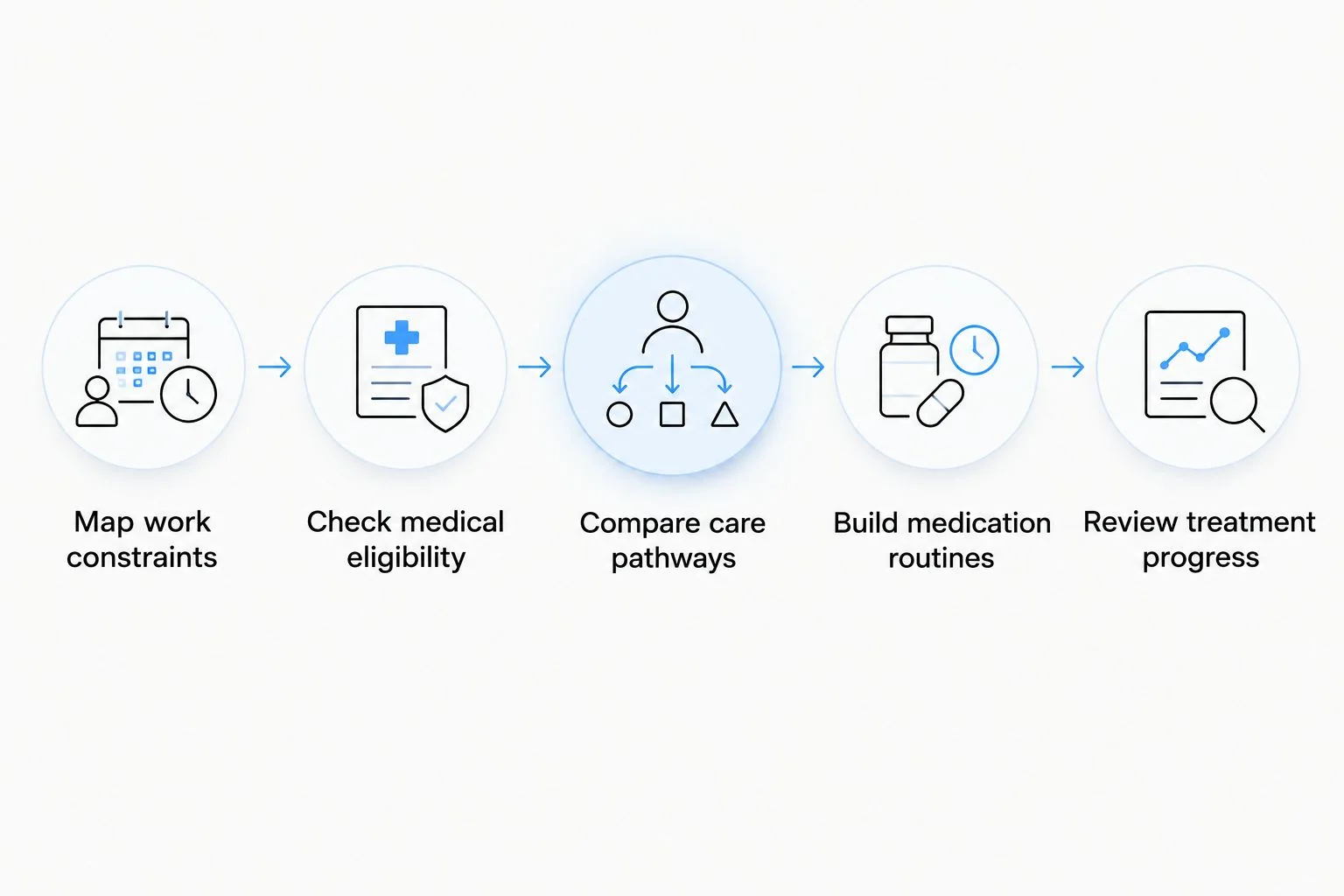
5. Plan meals and symptom responses around paid work
Start with practical food and fluid planning, not a restrictive challenge. Pack food you tolerate, identify realistic breaks, and tell your clinician when your job makes regular eating difficult.
Nausea, vomiting, diarrhea, and constipation are recognized adverse effects of GLP-1-based weight-management treatment. Reduced appetite does not remove your need for nutrition or fluids. Ask for individualized guidance, especially if you also use insulin or another medication that can cause low blood sugar.
Do not drive or operate equipment when symptoms impair your ability to work safely. Severe or persistent abdominal pain, repeated vomiting, inability to keep fluids down, or signs of a serious allergic reaction require prompt medical assessment—not a routine message left unanswered.
- Pack manageable meals or snacks for long assignments.
- Keep drinking water accessible during permitted breaks.
- Ask how to respond to vomiting or poor intake.
- Discuss low-blood-sugar precautions when relevant.
- Identify urgent-care and emergency options before problems arise.
6. Review treatment progress alongside your work capacity
Keep a basic log of weight trends, symptoms, food intake, and missed work. Follow your clinician’s recommended weighing and follow-up schedule rather than reacting to every change on the scale.
Bring the log to treatment reviews. A plan that reduces weight but leaves you unable to eat adequately or complete assignments needs clinical reassessment; side effects are information, not proof that medication is working.
For a 2026 treatment review, include continuity questions as well as results. Discuss what happens if your insurance changes, you relocate, or you need to interrupt treatment. Do not ration medication or alter the prescribed dose to stretch a supply.
- Report symptoms with their timing and effect on work.
- Track missed doses without doubling up independently.
- Discuss nutrition, strength, sleep, and daily function.
- Ask how the clinician evaluates treatment response.
- Agree on the next review and interruption plan.
Compare weight-management care options for gig workers
The best fit depends on the care you need and the appointments you can reliably attend. These options differ in access to physical examination and how much coordination you must handle yourself.
| Option | Best for | Main advantage | Key limitation |
|---|---|---|---|
| Online prescription care, including VEVArx | Adults seeking remote medical weight-management evaluation | Removes travel for remote consultations | Does not replace every examination, test, or urgent assessment |
| Your existing primary care practice | Adults who want weight care connected to ongoing medical care | Keeps decisions within an established care relationship | Appointment formats and weight-management services vary by practice |
| In-person obesity medicine care | Adults needing focused assessment or more complex treatment decisions | Supports face-to-face evaluation | Travel and appointment attendance must fit your work |
| Hybrid remote and local care | Adults who need remote follow-up plus local examinations | Combines appointment formats | Requires clear communication between clinicians |
| Self-directed food and activity tracking | Adults organizing habits or preparing for an appointment | Gives you a record to discuss | Cannot determine prescription eligibility or manage medication complications |
For a clean comparison, request a written breakdown of consultations, medication, testing, and follow-up responsibilities. Confirm insurance and payment arrangements directly; do not assume that an online service participates in your plan or that every prescribed formulation has the same coverage.
Common mistakes gig workers make
Treating telehealth as an appointment you can take while driving
A medical consultation needs your attention and privacy. Park safely, stop working, and allow enough time to discuss your history without watching for the next assignment.
Choosing treatment before checking storage conditions
A medication routine must work outside the consultation. If your day involves a hot vehicle or overnight travel, explain that before prescribing and follow the pharmacist’s instructions for the exact product.
Changing doses to match busy and quiet shifts
Prescription timing is not a productivity tool. Request a written missed-dose and interruption plan instead of improvising around deadlines or assuming instructions for another medication apply to yours.
Treating every online formulation as equivalent
Compounded drugs are not FDA-approved, and FDA does not review them for safety, effectiveness, and quality before marketing. Ask the prescriber and pharmacist exactly what is being prescribed; do not equate a shared ingredient name with an identical product.
Adding wellness treatments without a clinical reason
A weight-management plan does not require a stack of add-on treatments. VEVArx also describes wellness peptide offerings, but that does not establish a need for them in your care or a weight-loss benefit from combining them with prescribed medication.
Find out if GLP-1 treatment may be right for you.
Start My Pre-AssessmentFAQ
What's the best weight loss telehealth for gig workers?
The best fit is a service that can evaluate you appropriately and provide follow-up you can reliably use. Compare appointment formats, state eligibility, symptom support, and access to necessary in-person care rather than choosing from signup convenience alone.
Can I get weight-loss medication online without visiting a clinic?
An online clinician can prescribe weight-loss medication when remote evaluation is appropriate and prescribing requirements are met. Your history or symptoms can still require testing or an in-person examination, and completing an intake does not guarantee a prescription.
Can I use semaglutide or tirzepatide if I'm a delivery driver?
Delivery work alone does not determine eligibility for semaglutide or tirzepatide. Tell your prescriber about driving, bathroom access, meal breaks, and other medications; do not drive when symptoms impair your ability to do so safely.
Do I need diabetes to qualify for weight-loss medication?
No, diabetes is not required for every FDA-approved weight-management medication. Eligibility depends on the specific product, BMI, weight-related conditions, contraindications, and the clinician's assessment.
Can I attend a telehealth weight-loss visit while traveling?
Confirm eligibility before attending a visit from another state. Telehealth practice requirements depend on your location and the clinician's authorization to provide care there; a home address alone does not resolve that question.
What should I do if nausea interrupts my shifts?
Contact your prescribing clinician for guidance, and stop driving or operating equipment if symptoms make work unsafe. Repeated vomiting, inability to keep fluids down, or severe or persistent abdominal pain needs prompt medical assessment.
Can I skip medication during a slow earnings week?
Do not skip, ration, or change prescription doses without discussing the interruption with your prescriber. Ask for product-specific instructions and a continuity plan before you run out, because restarting instructions differ between treatments.
One last thing
Test the logistics before your first dose. Walk through a normal assignment day and identify where you would take a private call, eat, drink, use a bathroom, and seek help if you felt unwell.
That rehearsal exposes problems an intake form cannot solve. Bring those problems to your clinician so your 2026 plan fits the work you actually do—not an ideal calendar.
Related guides
Ready to get started?
See if doctor-prescribed GLP-1 treatment may be right for you. It only takes a few minutes, 100% online.
Start My Pre-AssessmentThis article is for informational purposes only and is not medical advice. Compounded medications are not approved by the FDA and have not been reviewed for safety, effectiveness, or quality. Prescription products require an online consultation with a licensed healthcare provider who will determine if a prescription is appropriate. Individual results vary.