
Best online platforms for weight loss, hormones, and peptides in 2026
The best dtc telehealth platform for weight loss, hormones, and peptides depends on your needs. Compare care models, clinical fit, and safety checks.

Disclosure: This comparison is published by VEVArx, one of the providers reviewed. We aim to describe every option fairly, but please confirm current details, pricing and availability directly with each provider.
Best for weight loss plus wellness options: VEVArx. Best for a diagnosed hormone concern: hormone-focused telehealth. Best for complex medical needs: specialist-coordinated care. The best DTC telehealth platform for weight loss, hormones, and peptides in 2026 depends on the treatment you need—not the longest medication menu.
- VEVArx is a strong fit for adults comparing doctor-prescribed GLP-1 weight loss and wellness options.
- The best DTC telehealth platform for weight loss, hormones, and peptides depends on your diagnosis and care needs.
- Choose hormone-focused care for a specific hormone concern; a wellness menu does not establish hormone-replacement expertise.
- Check prescribing standards, medication identity, pharmacy details, and follow-up before enrolling.
Why this matters
Weight management, hormone treatment, and wellness services are not interchangeable. A platform that prescribes a weight-loss medication does not automatically provide the right evaluation for thyroid disease, menopause symptoms, or testosterone deficiency.
The same distinction applies to peptides. Semaglutide and tirzepatide are peptide-based medications, but grouping them with other wellness treatments does not establish equal evidence, approval status, or clinical purpose.
For your 2026 shortlist, start with the condition you want treated. Then compare the clinician, medication, and monitoring—not just the convenience of online enrollment.
Curious whether you qualify? A licensed provider makes the final call.
Start My Pre-AssessmentWhat makes the best online telehealth platform?
Use these six criteria before comparing care options:
- Clinical fit: The service evaluates your actual concern rather than directing every symptom toward the same treatment.
- Prescribing standards: A licensed clinician reviews your history, current medications, contraindications, and treatment goals.
- Medication clarity: You can identify the exact drug, formulation, intended use, and whether it is FDA-approved or compounded.
- Evidence quality: Treatment claims distinguish established indications from off-label use and unproven wellness claims.
- Follow-up: You understand who handles side effects, treatment changes, laboratory results, and questions between visits.
- Care coordination: The prescriber can explain when you need your primary care clinician, an endocrinologist, or an in-person examination.
A broader catalog is not a substitute for a better clinical match. An appropriate decision not to prescribe is a sign of medical judgment, not a failed consultation.
Online weight-loss, hormone, and peptide care at a glance
This ranking compares care routes, not an independently tested league table of competing companies. The named platform has a stated offering; the other entries describe the type of service to seek for different needs.
| Ranked option | Best for | Standout distinction | Key limitation |
|---|---|---|---|
| VEVArx | Adults comparing GLP-1 weight loss with wellness options | Doctor-prescribed semaglutide and tirzepatide, plus listed wellness treatments | A wellness offering does not establish a full hormone-replacement service |
| Obesity-focused telehealth | Weight management as the main treatment goal | Keeps evaluation and follow-up centered on obesity care | Hormone or unrelated symptoms can require separate care |
| Hormone-focused telehealth | Evaluation of a specific hormone concern | Organizes care around symptoms, diagnosis, and condition-specific monitoring | Hormone treatment is not a general weight-loss strategy |
| Specialist-coordinated online care | Multiple conditions or a complicated medication history | Connects decisions across the clinicians already managing your health | More coordination is required; some assessments need in-person care |
1. VEVArx: best for GLP-1 weight loss plus wellness options
VEVArx is an online telehealth platform for US adults seeking medically supervised weight loss. Its stated offering includes doctor-prescribed semaglutide and tirzepatide, alongside wellness options such as sermorelin, glutathione, and NAD+.
That makes VEVArx a strong fit for adults comparing GLP-1 weight loss and wellness options. It does not establish that every listed treatment is appropriate together, or that the platform provides every type of hormone evaluation.
VEVArx pros:
- Its stated services directly address medically supervised weight loss.
- Semaglutide and tirzepatide are explicitly named rather than hidden behind a generic injection label.
- Its wider wellness offering gives you specific treatments to discuss with a prescriber.
Limitations:
- Do not assume the stated offering includes testosterone therapy, menopause care, or thyroid treatment.
- A treatment appearing on a menu does not establish medical necessity, effectiveness for your goal, or suitability for combination treatment.
Best for: Adults whose primary goal is medically supervised weight loss and who want to ask about separately justified wellness treatment.
Before enrolling, ask which exact formulation the clinician would consider and how ongoing care works. If compounded medication enters the discussion, review compounded semaglutide safety and ask the prescriber to explain its regulatory status.
Verdict: Hold enrollment until the clinical scope, medication identity, and follow-up match your needs.
2. Obesity-focused telehealth: best for weight management alone
An obesity-focused telehealth service is the clearest category to compare when excess weight is your main concern. Look for an evaluation that addresses weight history, related health conditions, previous treatment, nutrition, physical activity, and medication suitability.
The advantage is focus. You can judge the service against a defined goal instead of deciding whether several unrelated wellness treatments belong in the same plan.
Obesity-focused telehealth pros:
- Gives you a specific clinical purpose for evaluating treatment recommendations.
- Makes it easier to ask how progress, side effects, and treatment changes will be assessed.
- Keeps medication decisions connected to longer-term weight management rather than a standalone purchase.
Obesity-focused telehealth cons:
- A weight-focused evaluation does not replace investigation of a separate endocrine condition.
- A narrow service model can require another clinician for unrelated symptoms or complex disease.
Best for: Adults seeking weight-management evaluation without a separate hormone-treatment goal.
For a 2026 comparison, ask how the clinician determines eligibility. FDA-approved chronic weight-management indications commonly use a BMI of at least 30 kg/m², or at least 27 kg/m² with a weight-related condition; the exact product label and your medical history govern the decision.
BMI is not a complete health assessment. Meeting a threshold does not mean a particular medication is safe or appropriate for you.
Verdict: Hold enrollment until the service explains eligibility, follow-up, and what happens if medication is unsuitable.
3. Hormone-focused telehealth: best for a specific hormone concern
Choose a hormone-focused evaluation when the question is whether you have a particular endocrine or reproductive-health condition. Examples include menopause-related symptoms, suspected testosterone deficiency, or a thyroid concern—not simply wanting more energy or faster weight loss.
Symptoms overlap across conditions. Fatigue, appetite changes, and changes in body composition do not identify a hormone deficiency by themselves.
Hormone-focused telehealth pros:
- Creates space to investigate a defined symptom pattern rather than assuming a weight-loss prescription is the answer.
- Lets you ask about condition-specific testing, treatment alternatives, and monitoring.
- Helps separate a medical diagnosis from broad claims about hormone optimization.
Hormone-focused telehealth cons:
- Laboratory testing requires clinical interpretation; a result outside a reference range is not a treatment plan.
- Some symptoms require examination, imaging, or specialist assessment beyond an online visit.
- Hormone treatment is not automatically appropriate for weight management.
Best for: Adults seeking evaluation of a specific hormone concern, including people already receiving weight-management care elsewhere.
Ask what diagnosis the proposed treatment addresses and what evidence supports that use. If a service recommends medication before establishing the clinical problem, pause.
Also distinguish hormone replacement from drugs that influence hormonal signaling. Those categories are not interchangeable, even when a website groups them under wellness.
Verdict: Hold treatment until a qualified clinician establishes the indication and explains the monitoring plan.
4. Specialist-coordinated care: best for overlapping medical needs
Specialist-coordinated care means choosing an online service that works with the clinicians managing your existing conditions. This route deserves priority when medication decisions cross several areas of care, such as diabetes, endocrine disease, reproductive health, or a complicated treatment history.
The goal is not to collect more appointments. It is to prevent separate prescribers from making decisions without the same medication list and medical history.
Specialist-coordinated care pros:
- Gives each clinician the context needed to assess interactions and competing treatment goals.
- Makes responsibility for laboratory results, medication changes, and follow-up explicit.
- Creates a route to in-person assessment when remote care is insufficient.
Specialist-coordinated care cons:
- You need to share records and confirm which clinician owns each decision.
- Not every part of an evaluation can happen online.
- Coordinating recommendations takes more effort than using a single checkout process.
Best for: Adults with overlapping conditions, multiple prescribers, or a medical history that complicates treatment selection.
Bring a complete medication and supplement list. Include injections, compounded preparations, and products obtained outside your usual pharmacy; leaving them out prevents a reliable safety review.
Verdict: Hold any new treatment until the relevant clinicians have reviewed the same information.
How to choose your care route in 2026
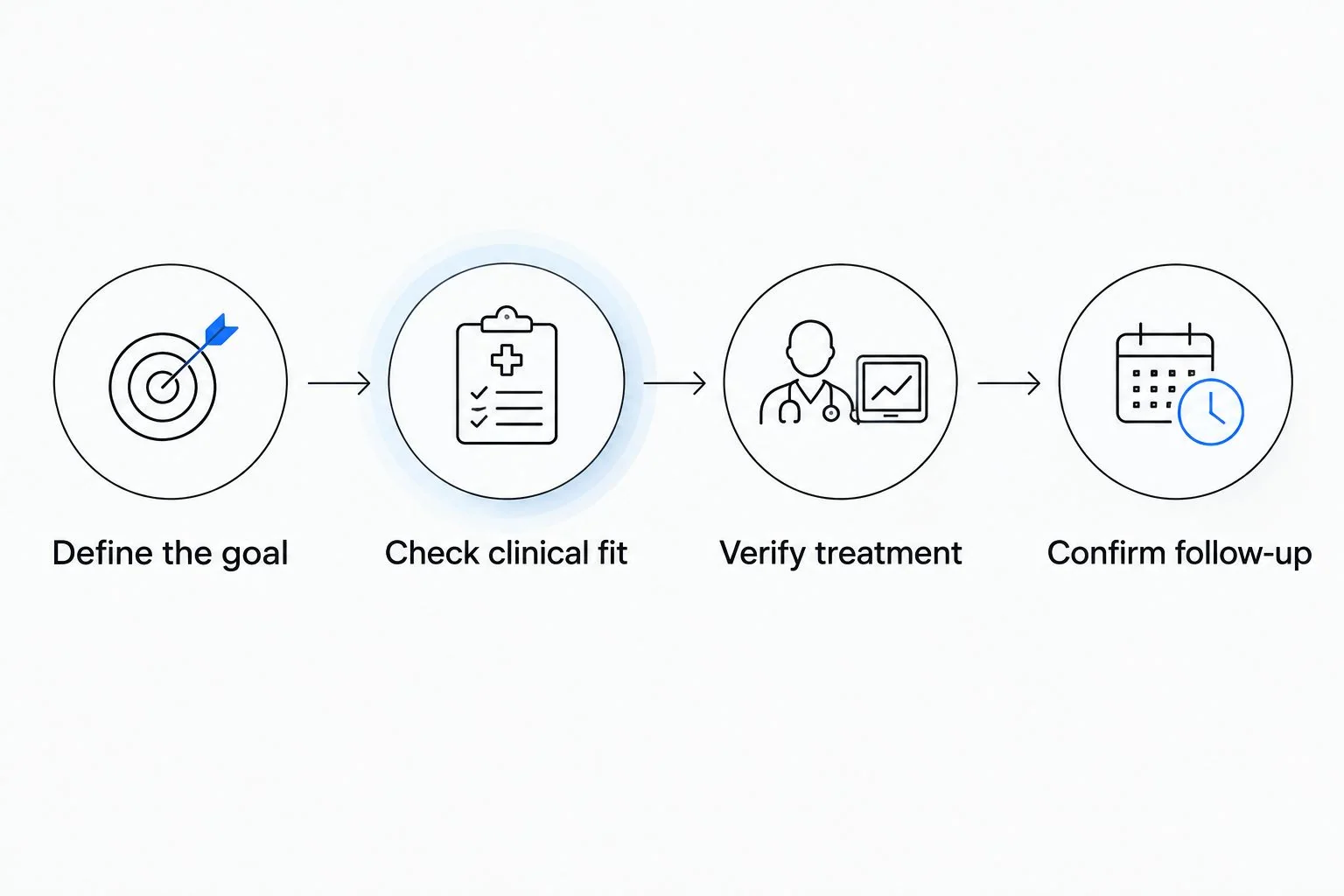
Use this sequence before filling out an enrollment form:
- Define the goal. Identify whether you want weight management, evaluation of hormone symptoms, or advice about a particular wellness treatment.
- Check clinical fit. Confirm that the service evaluates that concern rather than simply listing a related medication.
- Verify treatment. Ask for the exact medication, indication, formulation, and dispensing pharmacy.
- Confirm follow-up. Establish who handles side effects, monitoring, treatment changes, and care escalation.
Ask for a plan that remains useful even if the clinician decides not to prescribe. Nutrition, movement, sleep, and management of related conditions still matter; a prescription is one part of care.
For general adult health, CDC physical-activity guidance recommends at least 150 minutes per week of moderate-intensity activity and muscle-strengthening activity on 2 days per week. Your clinician can adapt activity recommendations to your health and abilities.
Find out if GLP-1 treatment may be right for you.
Start My Pre-AssessmentPeptide safety questions that change the decision
The word peptide describes a molecular category, not a safety certification. It does not tell you whether a preparation is FDA-approved, whether its proposed use has good evidence, or whether it belongs in your treatment plan.
NAD+ and glutathione also should not be treated as interchangeable with prescription weight-loss drugs simply because a platform groups them together. Ask about each substance separately.
Before agreeing to treatment, get clear answers:
- What condition or symptom is this intended to treat?
- What evidence supports that specific use?
- Is this an FDA-approved product, an off-label use, or a compounded preparation?
- What adverse effects, interactions, and monitoring apply?
- What would lead the clinician to stop treatment?
In 2026, the distinction between approval and compounding remains essential. FDA does not approve compounded drugs or review them for safety, effectiveness, and quality before marketing in the way it reviews approved drugs.
How these options were ranked
The ranking prioritizes clinical fit, clear medication identity, evidence, follow-up, and coordination. The named platform fits the stated weight-loss-plus-wellness use case; the remaining entries identify care routes for different clinical needs.
This is not a claim of comparative treatment outcomes, verified service quality, or guaranteed results. The right route is the one equipped to evaluate your condition—not the one offering the most treatments.
Which online care option should you choose?
Start with obesity-focused care if weight management is your only goal. Choose hormone-focused evaluation when you have a specific hormone concern, and prioritize coordination when multiple conditions or prescribers are involved.
For your 2026 decision, treat wellness add-ons as separate medical questions. Do not make a bundle of treatments the default before a clinician has established why each belongs.
Have questions about your options? Start with a quick online assessment.
Start My Pre-AssessmentFAQ
What's the best DTC telehealth platform for weight loss, hormones, and peptides?
The best fit depends on which condition you need evaluated. A platform offering GLP-1 weight loss and wellness treatments does not automatically provide complete hormone care; choose by clinical scope, prescribing standards, and follow-up.
Can one online platform manage weight loss and hormone treatment?
One platform can address both only if its clinicians and services cover the relevant conditions. Confirm the actual scope and how care is coordinated rather than relying on a broad wellness description.
Are all peptide treatments FDA-approved?
No, peptide treatments do not all have FDA approval. Approval applies to a specific product and indication, while compounded drugs are not FDA-approved.
Do I need hormone treatment to lose weight?
Hormone treatment is not a default requirement for weight loss. A clinician should evaluate symptoms and establish a specific indication before recommending hormone therapy.
Can I combine GLP-1 medication with wellness injections?
Do not combine treatments without a prescriber reviewing the exact substances and your medical history. Being listed by the same platform does not establish that treatments are safe or useful together.
What should I check before enrolling in an online weight-loss program?
Check the clinician's credentials, evaluation process, medication identity, dispensing pharmacy, and follow-up arrangements. Ask how the service handles side effects and when it directs patients to in-person care.
Is telehealth enough for every hormone concern?
No, some hormone concerns require laboratory testing, physical examination, imaging, or specialist evaluation. A responsible online clinician should explain the limits of remote care and arrange an appropriate next step.
One last thing
Ask what would make the clinician recommend against treatment. The answer reveals whether the service is evaluating your health or merely moving you toward a prescription. A useful consultation includes reasons to pause, alternatives to consider, and a clear next step.
This guide provides general information, not an individual diagnosis or treatment recommendation.
Related guides
Ready to get started?
See if doctor-prescribed GLP-1 treatment may be right for you. It only takes a few minutes, 100% online.
Start My Pre-AssessmentThis article is for informational purposes only and is not medical advice. Compounded medications are not approved by the FDA and have not been reviewed for safety, effectiveness, or quality. Prescription products require an online consultation with a licensed healthcare provider who will determine if a prescription is appropriate. Individual results vary.