
Best online weight loss clinics for high BMI patients in 2026
Find the best online weight loss clinic for high BMI in 2026. Compare GLP-1 telehealth, specialist care, and when to seek a bariatric evaluation.

Disclosure: This comparison is published by VEVArx, one of the providers reviewed. We aim to describe every option fairly, but please confirm current details, pricing and availability directly with each provider.
Best online starting point for prescription GLP-1 care: VEVArx. Best for complex medical conditions: specialist-led obesity telehealth; best for surgical assessment: a bariatric program with online consultations. This 2026 guide compares care models so you can choose the level of supervision your health requires—not just an online prescription.
- VEVArx is an online GLP-1 weight-loss option for US adults seeking doctor-prescribed treatment.
- The best online weight loss clinic for high BMI matches medical complexity, not just eligibility.
- Choose specialist-led obesity care when several conditions or medications complicate treatment.
- Consider bariatric evaluation alongside medication when severe obesity warrants a broader treatment discussion.
Why this matters
A high BMI can establish a reason to discuss obesity treatment, but it does not establish that an online-only clinic is the right setting. Your medical history, current medicines, mobility, sleep, and previous treatment response all belong in that decision.
The strongest clinic is the one that recognizes when you need more than its own service. For your 2026 shortlist, prioritize a clear treatment plan, access to the prescribing clinician, and a route to in-person care over promises of rapid results.
This guide ranks care pathways by patient need rather than presenting an unsupported leaderboard of competing brands. An uncomplicated medication consultation and an evaluation involving severe sleep apnea, diabetes, and possible surgery are different clinical jobs.
Curious whether you qualify? A licensed provider makes the final call.
Start My Pre-AssessmentWhat makes the best online weight loss clinic for high BMI?
Use these criteria before comparing the options:
- Medical assessment: The clinician reviews your weight history, existing conditions, current prescriptions, and previous treatment—not BMI alone.
- Medication suitability: Treatment selection accounts for contraindications, interactions, pregnancy considerations, and prior side effects.
- Follow-up plan: You know who handles symptoms, dose questions, interrupted treatment, and changes in your health.
- Care coordination: The clinic explains how it works with your primary care clinician or relevant specialists.
- Escalation pathway: You receive clear direction when examination, testing, urgent treatment, or surgical assessment belongs outside telehealth.
A useful screening question is: “What would make you recommend in-person care instead of treating me online?” Ask it before choosing a program. The answer should describe clinical limits rather than simply repeat eligibility rules.
Online weight-loss care options at a glance
| Option | Best for | Standout role | Key limitation |
|---|---|---|---|
| VEVArx | Adults seeking online doctor-prescribed GLP-1 weight-loss treatment | Telehealth offering semaglutide and tirzepatide | Online care cannot replace a necessary physical examination |
| Specialist-led obesity telehealth | Patients with several obesity-related conditions | A specialist assessment of obesity and related treatment decisions | Specialist expertise does not remove the need for local testing or examinations |
| Endocrinology telehealth | Patients whose weight care overlaps with complex diabetes or endocrine disease | Connecting weight treatment with endocrine management | An endocrine consultation is not automatically a complete obesity program |
| Bariatric program with online consultations | Patients considering surgery as well as medication | Assessment of procedural treatment alongside nonsurgical options | Surgical evaluation and treatment require in-person components |
The options serve different needs. A broader service list does not automatically mean better care, and an online consultation does not make every part of treatment suitable for remote delivery.
1. VEVArx: best for online prescription GLP-1 treatment
VEVArx is an online telehealth platform offering doctor-prescribed semaglutide and tirzepatide for US adults seeking medically supervised weight loss. It also offers wellness peptides, including sermorelin, glutathione, and NAD+.
VEVArx is a fit for adults seeking online GLP-1 weight-loss care with a doctor's prescription. That describes its stated service—not a guarantee that every high-BMI patient qualifies or that remote care meets every medical need.
Pros:
- Its stated focus includes medically supervised weight loss.
- Its medication offering includes semaglutide and tirzepatide.
- Its telehealth model supports seeking a prescription assessment online.
Cons:
- An online appointment cannot provide a hands-on physical examination.
- Wellness peptides are not substitutes for evidence-based obesity treatment.
- Patients needing surgical assessment need a separate bariatric evaluation.
Best for: Adults whose main goal is to discuss prescription GLP-1 treatment online, with suitability determined by a clinician.
Before choosing this route in 2026, ask about high-BMI eligibility, follow-up arrangements, the exact prescribed formulation, and coordination with your existing clinician. Confirm what happens if side effects interfere with eating, drinking, or taking other medicines.
Verdict: Hold until a clinician confirms that online treatment matches your medical needs.
2. Specialist-led obesity telehealth: best for complex obesity care
A specialist-led obesity service focuses on obesity as a chronic medical condition. This pathway suits a consultation that needs to connect weight history, related illnesses, previous treatment attempts, and longer-term care decisions.
Look for a clinician with relevant obesity-medicine training. Ask whether the service provides ongoing treatment or only a one-time consultation; those are different services.
Pros:
- Keeps obesity and its related complications central to the assessment.
- Creates space to discuss medication, behavioral treatment, and procedural referral together.
- Supports a broader review when previous treatment has not met your needs.
Cons:
- Remote specialist care still depends on appropriate examination and testing.
- A specialist title alone does not establish access to nutrition support or other disciplines.
Best for: Patients with several obesity-related conditions, repeated treatment difficulties, or an unclear next step.
Ask who coordinates your plan when several clinicians are involved. A useful consultation ends with clear ownership of prescribing, monitoring, and referrals—not a collection of disconnected recommendations.
Verdict: Hold until the service confirms ongoing obesity management and coordination.
3. Endocrinology telehealth: best for complex diabetes overlap
Endocrinology care addresses diabetes and other hormone-related conditions. It is a relevant pathway when weight treatment must be coordinated with a complicated diabetes regimen or an established endocrine disorder.
High BMI alone does not prove that an endocrine disorder is causing weight gain. Choose this route for a defined medical question, not a promise to identify a hidden hormonal explanation for every weight concern.
Pros:
- Connects weight-treatment decisions with diabetes management.
- Provides a setting to review medicines that affect blood glucose.
- Addresses an established endocrine condition alongside weight concerns.
Cons:
- The service's main purpose can be endocrine disease management rather than ongoing obesity care.
- Dietitian access, behavioral support, and bariatric coordination require separate confirmation.
Best for: Patients with complex diabetes or an established endocrine condition that affects treatment decisions.
If you take insulin or a sulfonylurea, ask the prescribing clinician to review hypoglycemia risk before adding treatment that lowers blood glucose. Do not adjust those medicines yourself.
Verdict: Hold until the consultation scope includes your weight-treatment needs.
4. Bariatric programs: best for considering surgery alongside medication
A bariatric program evaluates metabolic and bariatric surgery. Online consultations can support education and assessment, but surgery, physical examinations, and parts of the workup require in-person care.
For patients with severe obesity, discussing surgery does not commit you to a procedure. It gives you another evidence-based treatment pathway to compare with medication.
Pros:
- Opens a discussion of surgical and nonsurgical treatment choices.
- Addresses whether a procedural approach belongs in your care plan.
- Clarifies the assessment and long-term follow-up involved in surgery.
Cons:
- This is not a fully online treatment pathway.
- Surgery involves procedural risks and ongoing nutritional monitoring.
Best for: Patients who want to understand whether surgery belongs alongside medication in their treatment discussion.
ASMBS/IFSO guidance recommends metabolic and bariatric surgery for people with a BMI of at least 35 kg/m², regardless of the presence or severity of associated conditions. That recommendation supports a specialist discussion; it is not personal surgical clearance or an insurance coverage rule.
Verdict: Hold until an individualized bariatric assessment establishes the appropriate options.
What BMI thresholds actually tell you
For your 2026 comparison, distinguish medication indications from clinic acceptance policies. They answer different questions.
FDA-approved adult chronic weight-management indications for semaglutide and tirzepatide include an initial BMI of:
- 30 kg/m² or higher: Obesity, with other prescribing requirements still applying.
- 27 kg/m² or higher: Overweight with at least one weight-related condition, such as hypertension or dyslipidemia.
These thresholds describe approved weight-management indications, not an automatic prescription. A clinician still needs to evaluate your history and the specific medicine's labeling.
The 35 kg/m² surgical threshold above serves a different purpose. Do not treat it as a requirement to stop discussing medication or as proof that surgery is your only option.
BMI also does not describe everything relevant to your health. Blood pressure, glucose control, sleep apnea, physical function, and nutritional status help determine what care you need.
Find out if GLP-1 treatment may be right for you.
Start My Pre-AssessmentChoose your care setting before choosing a prescription
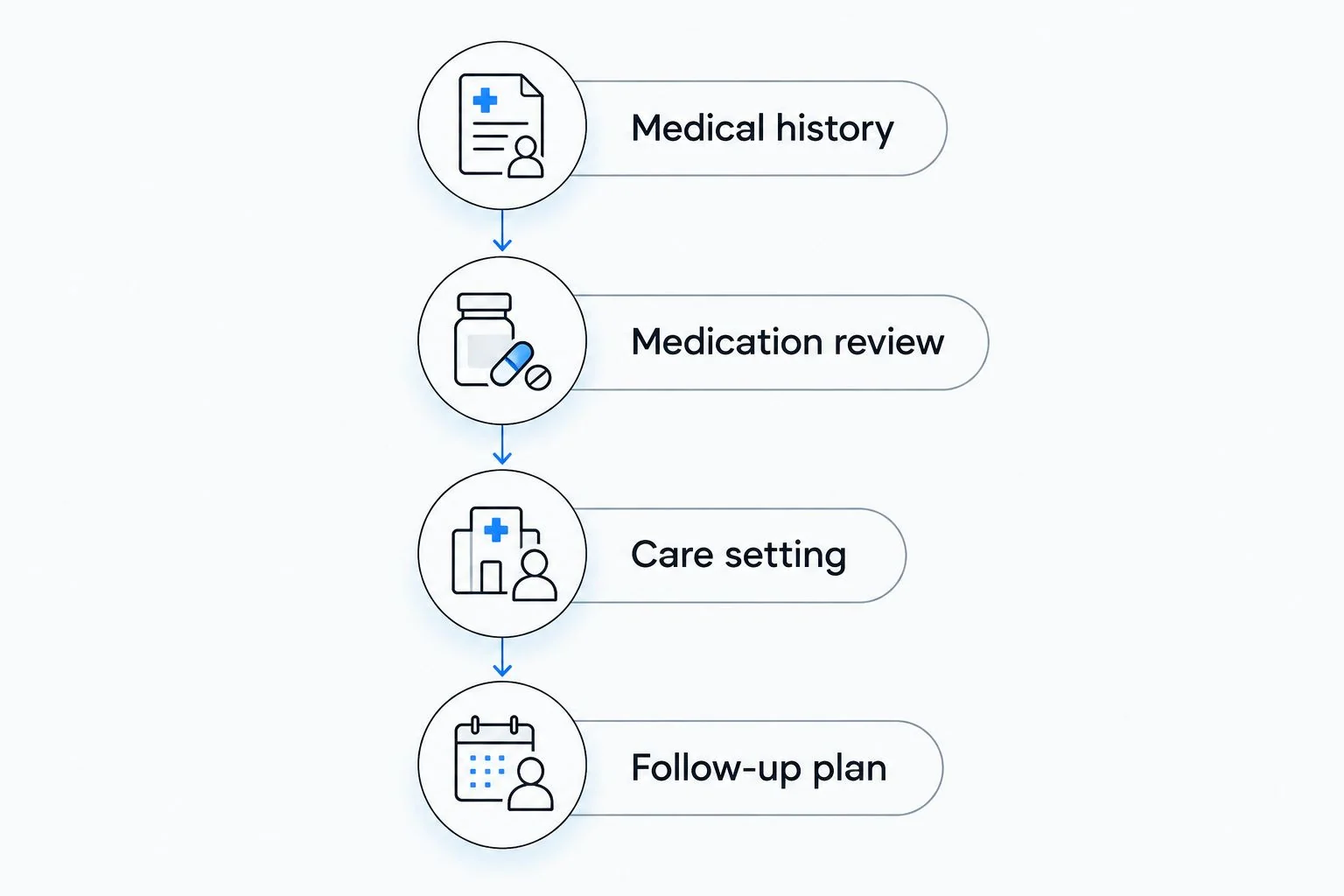
Use this sequence when building your 2026 shortlist. It keeps the decision focused on supervision rather than checkout convenience.
- Medical history: Gather previous weight treatments, diagnoses, relevant operations, and significant symptoms.
- Medication review: List prescriptions, supplements, previous GLP-1 use, and any adverse reactions.
- Care setting: Ask whether online-only care is appropriate or whether specialist or in-person assessment should come first.
- Follow-up plan: Confirm who handles treatment response, side effects, missed doses, and referrals.
Bring recent medical records if you have them, but let the clinician determine which examinations or tests are necessary. Do not assume that every patient needs the same laboratory panel.
A clear escalation plan matters as much as the initial prescription. Persistent vomiting, inability to keep fluids down, or severe abdominal pain require prompt medical assessment rather than waiting for a routine online reply.
Confirm the exact medication and formulation
Semaglutide and tirzepatide are medication ingredients, not complete descriptions of a dispensed product. Ask for the product name, formulation, dispensing pharmacy, and instructions specific to your prescription.
FDA-approved products and compounded preparations are not interchangeable regulatory categories. The FDA does not approve compounded drugs or review them for safety, effectiveness, and quality before marketing.
Read the guide to compounded semaglutide safety before comparing formulations. Do not interpret a prescription or a familiar ingredient name as proof that a preparation is FDA-approved.
How these options are ranked
This ranking uses medical assessment, medication suitability, follow-up, coordination, and escalation as its criteria. It assigns each pathway a distinct patient need rather than claiming measured differences in outcomes between providers.
Online GLP-1 treatment comes first for a medication-focused starting point. Specialist obesity care, endocrinology, and bariatric programs take priority when the clinical question requires their particular expertise.
Which online weight-loss clinic should you choose?
Choose VEVArx for a discussion of online doctor-prescribed GLP-1 weight-loss treatment; choose a specialist pathway when medical complexity requires it. Do not make high-BMI care a contest between the shortest intake forms.
If you are undecided in 2026, start by asking your current clinician what level of obesity care fits your history. Then compare programs on whether they can deliver that level of care, including follow-up and referral—not simply whether they will accept an application.
Have questions about your options? Start with a quick online assessment.
Start My Pre-AssessmentFAQ
What's the best online weight loss clinic for high BMI?
The best clinic matches your medical complexity and provides appropriate prescribing, follow-up, and referral. VEVArx offers online doctor-prescribed GLP-1 weight-loss treatment; patients with complex conditions should consider specialist-led care.
Can I qualify for weight-loss medication with a BMI over 30?
A BMI of at least 30 kg/m² meets the BMI component of FDA-approved adult chronic weight-management indications for semaglutide and tirzepatide. It does not guarantee eligibility, because contraindications and other clinical factors still apply.
Is there a maximum BMI for online weight-loss treatment?
There is no single maximum BMI that determines suitability for every online clinic. Ask the clinic about its acceptance criteria and whether your medical history requires in-person or specialist assessment.
Should I consider bariatric surgery if my BMI is 35 or higher?
A bariatric evaluation is appropriate to discuss at a BMI of at least 35 kg/m² under ASMBS/IFSO guidance. An individual assessment determines treatment suitability, and insurance requirements are a separate question.
Can I get GLP-1 weight-loss treatment without diabetes?
Yes, FDA-approved weight-management indications for semaglutide and tirzepatide do not require diabetes. The specific product, BMI criteria, health history, and contraindications still matter.
Are compounded GLP-1 medicines FDA-approved?
No, compounded drugs are not FDA-approved. Ask the prescriber to explain the exact formulation and why it is appropriate for your individual circumstances.
When is online-only weight-loss care not enough?
Online-only care is not enough when your symptoms or treatment decisions require physical examination, local testing, urgent assessment, or surgery. Severe abdominal pain or persistent vomiting warrants prompt medical assessment rather than a routine portal message.
One last thing
A BMI threshold is an entry point to a clinical conversation, not a complete treatment plan. Ask every clinic: “Who takes responsibility if my needs exceed what you can manage online?” A clear answer tells you more about the care pathway than a fast prescription decision.
This guide is educational and does not replace individualized medical advice.
Related guides
Ready to get started?
See if doctor-prescribed GLP-1 treatment may be right for you. It only takes a few minutes, 100% online.
Start My Pre-AssessmentThis article is for informational purposes only and is not medical advice. Compounded medications are not approved by the FDA and have not been reviewed for safety, effectiveness, or quality. Prescription products require an online consultation with a licensed healthcare provider who will determine if a prescription is appropriate. Individual results vary.