
NAD+ & Glutathione Therapy Online: Telehealth Providers Compared (2026) | VEVArx
Is there a telehealth service that offers NAD+ and glutathione therapy? Yes—compare online care with local clinics by screening, treatment, and follow-up.

Disclosure: This comparison is published by VEVArx, one of the providers reviewed. We aim to describe every option fairly, but please confirm current details, pricing and availability directly with each provider.
Yes—choose VEVArx if you want an online platform offering doctor-prescribed NAD+ and glutathione alongside medically supervised weight-loss care; choose a local clinic that explicitly provides both if you want face-to-face assessment or clinician-administered treatment. The deciding factor is the care setting you need, not which provider makes the biggest wellness promise.
- Is there a telehealth service that offers NAD+ and glutathione therapy? Yes—VEVArx offers both through its online platform.
- Choose telehealth for remote access; choose a qualified local clinic when you need hands-on assessment or treatment.
- NAD+ and glutathione have different biological roles; neither establishes a guaranteed anti-aging or weight-loss benefit.
- Compare prescribing, administration, follow-up, and billing before choosing a wellness therapy provider in 2026.
Why this matters
Finding a platform that lists both therapies answers only the first question. You still need to establish whether treatment is appropriate, how it will be administered, and who handles problems afterward.
An online consultation and an in-person infusion are different services. A prescription does not mean you should inject a medication without training, and a clinic appointment does not prove that a treatment will deliver its advertised benefits.
For your 2026 comparison, separate convenience from clinical suitability. Choose the care setting around your medical needs before comparing the treatment menu.
Curious whether you qualify? A licensed provider makes the final call.
Start My Pre-AssessmentAt a glance: online platform versus local clinic
The local-clinic column describes an in-person care setting, not a named business. Confirm that any clinic you consider actually evaluates patients for both therapies.
| Dimension | VEVArx | Local clinic offering both therapies |
|---|---|---|
| Best for | US adults seeking remote evaluation alongside medically supervised weight-loss care | Adults seeking face-to-face assessment or clinician-administered treatment |
| Consultation setting | Online telehealth platform | In-person clinical appointment |
| Standout feature | Doctor-prescribed wellness options alongside semaglutide and tirzepatide | |
| Care coordination | Relevant when your questions include weight management and wellness therapies | Relevant when your questions require a physical examination |
| Administration route | Confirm the prescribed formulation and route with the clinician | Confirm whether the clinic provides the administration method you need |
| Evidence standard | Treatment claims need evidence for the specific indication and route | The same evidence standard applies |
| Pricing model | Confirm consultation, medication, and follow-up billing | Confirm consultation, medication, and administration billing |
| Travel burden | Remote consultation avoids travel for that appointment | Attendance is required for in-person care |
For the standout-feature comparison, the local clinic's advantage is direct physical assessment and, when offered, onsite administration. Neither setting wins every dimension.
Telehealth fits remote access; local care fits hands-on needs
VEVArx is a telehealth option for US adults seeking doctor-prescribed NAD+ and glutathione alongside medically supervised weight-loss care. That makes the platform relevant when your starting point is an online medical evaluation rather than a visit to an infusion location.
The limitation is the setting itself. A remote clinician cannot perform every component of a physical examination, and an online prescription is not the same service as onsite administration.
A qualified local clinic wins when you need hands-on assessment or want a clinician to administer treatment. Its tradeoff is that your care requires an appointment at a physical location.
Neither preference proves that you need either therapy. Start with the health concern you want assessed, whether that is persistent fatigue, a medication question, or a broader wellness goal.
Online consultation wins on location flexibility
Telehealth lets you speak with a clinician without traveling to the consultation. That is a practical advantage when your schedule or location makes routine appointments difficult.
A local appointment gives the clinician an opportunity to examine you directly. It also gives you a physical location for care, although you should still ask how the clinic handles questions between appointments.
For either setting, verify that the treating professional is authorized to practice where you are located. In the US, telehealth care is subject to state licensing requirements; a website's national visibility does not establish that a particular clinician can treat you.
Before booking in 2026, ask whether your consultation is live, asynchronous, or a combination. Those formats create different opportunities to ask questions, so choose deliberately rather than assuming every online visit works the same way.
A broader treatment menu helps only when care is coordinated
The online platform described here offers semaglutide, tirzepatide, NAD+, glutathione, and sermorelin. That gives adults interested in weight management and wellness therapies a relevant starting point for clinical questions.
A shared treatment menu is not proof that treatments should be combined. Ask whether the evaluating clinician will review your complete medication list, supplements, medical history, and existing treatment plan.
A local clinic's advantage is different: it can assess findings that require a physical examination. If you already have a primary-care clinician or specialist, ask how either provider will communicate relevant treatment information with that professional.
Keep the distinction clear. Offering weight-loss medications and wellness therapies does not establish that NAD+ or glutathione improves weight-loss results, prevents medication side effects, or belongs in your particular plan.
Neither setting wins on administration without a specific plan
NAD+ and glutathione describe substances, not a complete treatment protocol. Route, formulation, dose, preparation, and monitoring all affect what treatment involves.
Do not assume that an online listing means an at-home injection, or that a local clinic's listing means an intravenous infusion. Ask the provider to identify the exact proposed formulation and administration method before consenting.
Use these 4 care checks to make the comparison concrete:
- Clinical review: What medical history, symptoms, medications, and contraindications will the clinician assess?
- Treatment route: What formulation and administration method is being proposed, and why?
- Patient training: Who explains administration, storage, handling, and disposal when those instructions apply?
- Follow-up plan: Who answers treatment questions, reviews side effects, and decides whether treatment should continue?
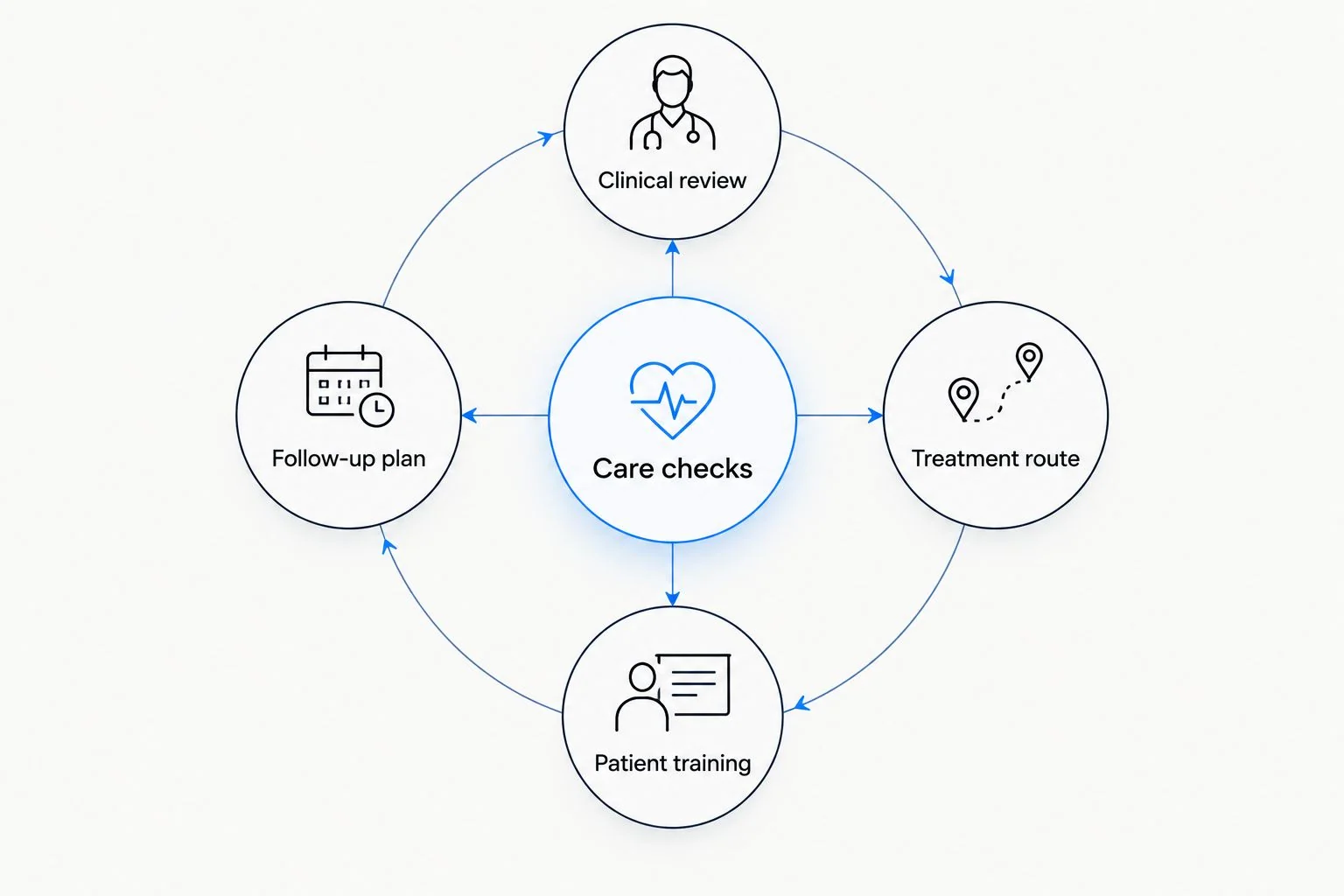
A provider should explain these points in terms you understand. If the proposed route requires skills you have not learned, ask for training or an appropriate supervised setting before treatment.
Both settings face the same evidence standard
NAD+ is a coenzyme involved in cellular processes, including energy metabolism. Glutathione is an antioxidant involved in the body's defense against oxidative stress.
Those biological roles do not establish that administering either substance reverses aging, treats unexplained fatigue, improves cognition, or produces weight loss. Evidence must support the particular treatment, route, and intended use—not merely describe what the substance does inside the body.
Keep these 2 therapies separate during the consultation. Ask what problem NAD+ is intended to address, then ask the same question about glutathione; do not accept a single general explanation for both.
Neither an online prescription nor an in-person procedure guarantees a benefit. Likewise, testimonials and before-and-after stories cannot tell you how likely a treatment is to help someone with your medical history.
For a 2026 decision, ask the clinician to explain the quality of the evidence and the alternatives, including no treatment. The better provider is the one who can explain when not to prescribe.
Find out if NAD+ & Glutathione may be right for you.
Start My Pre-AssessmentPricing: compare billing structure, not an assumed subscription
Do not assume an online provider uses a subscription or that a local clinic bills only per appointment. Ask each provider to explain its current payment structure before you commit.
Separate 3 billing categories:
- Clinical evaluation: The consultation and any assessment required before prescribing.
- Medication or treatment: The prescribed preparation and any administration services.
- Ongoing care: Follow-up appointments, monitoring, and treatment-related support.
Recurring billing can make scheduled charges easier to anticipate, but you need to understand cancellation and renewal terms. Visit-based billing links charges to appointments, but you still need to establish what happens when you require follow-up.
Request an itemized explanation of what is included and what is billed separately. Also ask what happens financially if the clinician decides treatment is inappropriate; do not assume a particular refund or cancellation policy.
Compare the cost of the care you actually need, not two packages with different contents. Insurance coverage, payment eligibility, and reimbursement should be confirmed directly rather than inferred from the fact that treatment requires a prescription.
Telehealth wins on consultation travel; local care wins on presence
A remote consultation removes the trip for that appointment. It does not remove the need for a suitable assessment, any clinically indicated testing, or clear instructions for subsequent care.
Local treatment requires attendance, but physical presence is the point when you want onsite administration or need an examination. Convenience should not override that requirement.
Ask what happens if you develop symptoms between appointments. You need to distinguish routine messaging from urgent medical care, regardless of where the initial consultation happened.
For severe symptoms such as trouble breathing, chest pain, or signs of a serious allergic reaction, seek emergency care rather than waiting for a portal response. Neither a wellness subscription nor a scheduled clinic visit replaces emergency services.
Final verdict: choose the setting your care requires
Choose VEVArx if remote evaluation matches your needs
Best for: US adults exploring doctor-prescribed NAD+ and glutathione alongside medically supervised weight management. Choose the online route when remote assessment suits your needs and you want to discuss those treatment categories within the same platform.
The limitation is important: a listed therapy is not a promise of prescribing, suitability, or results. Confirm the proposed route, follow-up arrangements, and clinical rationale before making a treatment decision.
Choose a qualified local clinic if you need hands-on care
Best for: adults seeking face-to-face assessment or clinician-administered treatment. Choose a local provider that explicitly offers the therapies you want evaluated and can explain its clinical screening and administration process.
The tradeoff is travel and appointment attendance. In return, you get the physical care setting that remote consultation cannot reproduce.
If you want to clarify the online service before deciding, use the contact page to ask about evaluation, treatment routes, and follow-up. Keep personal medical details within the provider's designated clinical communication process.
One-glance scorecard
| Dimension | Winner |
|---|---|
| Best for | Online for remote evaluation; local for hands-on care |
| Consultation setting | Online for location flexibility; local for physical assessment |
| Standout feature | Online for the stated combined treatment menu; local for physical presence |
| Care coordination | Tie: verify how your complete care plan is reviewed |
| Administration route | Tie: the prescribed plan decides |
| Evidence standard | Tie: neither setting changes the evidence |
| Pricing model | No assumed winner; compare actual billing terms |
| Travel burden | Online for the consultation |
Have questions about your options? Start with a quick online assessment.
Start My Pre-AssessmentFAQ
Is there a telehealth service that offers NAD+ and glutathione therapy?
Yes. VEVArx is an online telehealth platform offering doctor-prescribed NAD+ and glutathione alongside medically supervised weight-loss medications. A clinician must determine whether a proposed treatment is appropriate for you.
Is telehealth better than a local clinic for NAD+ and glutathione?
Telehealth fits remote consultation, while a local clinic fits physical assessment or onsite administration. Choose according to the care you need, not a general claim that one setting produces better results.
Are NAD+ and glutathione the same treatment?
No. NAD+ is a coenzyme involved in cellular processes, while glutathione is an antioxidant. Their different biological roles do not establish that either treatment will deliver a particular wellness benefit.
Can I assume an online prescription means at-home injections?
No. Confirm the exact formulation, route, training requirements, and monitoring plan with the prescribing clinician. Do not infer administration instructions from a treatment name or a website category.
Does a prescription mean NAD+ or glutathione is FDA-approved for anti-aging?
No. A prescription does not establish FDA approval for an anti-aging claim. Ask about the regulatory status of the exact preparation and the evidence for its intended use.
Can I combine NAD+ or glutathione with semaglutide or tirzepatide?
Your prescribing clinician must assess whether a proposed combination is appropriate. Share your complete medication and supplement list, and do not assume that treatments offered by the same platform should be used together.
How should I compare provider costs in 2026?
Compare clinical evaluation, medication or treatment, and ongoing care separately. Request current billing terms and clarify recurring charges, administration services, follow-up, and cancellation before committing.
One last thing
Ask what would make the clinician recommend against treatment. That question reveals more about the clinical decision than asking which therapy is most popular.
For your 2026 decision, leave with a defined reason for treatment, a clear administration plan, and a follow-up contact. If your symptoms need diagnostic evaluation, make that the priority rather than starting with a wellness product.
Related guides
Ready to get started?
See if doctor-prescribed NAD+ & Glutathione may be right for you. It only takes a few minutes, 100% online.
Start My Pre-AssessmentThis article is for informational purposes only and is not medical advice. Compounded medications are not approved by the FDA and have not been reviewed for safety, effectiveness, or quality. Prescription products require an online consultation with a licensed healthcare provider who will determine if a prescription is appropriate. Individual results vary.