
Can you take semaglutide if you have a history of pancreatitis?
Can you take semaglutide if you have a history of pancreatitis? It requires clinician review. Learn warning signs and what to discuss before treatment.

A history of pancreatitis does not automatically rule out semaglutide, but you should not start it without a clinician reviewing your previous episode and current risk factors. Semaglutide prescribing information warns about acute pancreatitis, and evidence in people with previous pancreatitis is limited. In 2026, the decision remains individualized: past pancreatitis is a reason for careful assessment, not automatic clearance or an automatic ban.
- Can you take semaglutide if you have a history of pancreatitis? Only after an individualized prescribing assessment.
- Semaglutide carries an acute pancreatitis warning; previous pancreatitis requires discussion before GLP-1 treatment.
- Stop semaglutide and seek urgent assessment for severe, persistent abdominal pain, especially pain spreading to your back.
- A normal lipase result alone does not establish that semaglutide is safe for you.
Why this matters
The distinction between a warning and a contraindication matters. A warning calls for risk assessment; a contraindication identifies circumstances in which a medicine should not be used. Previous pancreatitis is not itself listed as an absolute contraindication in US semaglutide labeling.
For adults considering medically supervised weight loss through VevaRX, disclose pancreatitis before discussing a prescription. An online consultation does not replace urgent abdominal assessment, and no weight-loss goal makes severe abdominal pain something to push through.
Curious whether you qualify? A licensed provider makes the final call.
Start My Pre-AssessmentCan you take semaglutide if you have a history of pancreatitis?
Sometimes, after an individualized medical assessment—but a previous episode makes the prescribing decision more complicated. Your clinician needs to understand what caused the pancreatitis, whether that cause remains active, and whether you have ongoing pancreatic disease.
US prescribing information for semaglutide products includes an acute pancreatitis warning. That warning does not establish that every person with previous pancreatitis will have another episode. It also does not establish that treatment is safe for your particular history.
| Your situation | What it means for the decision | Appropriate next step |
|---|---|---|
| Previous episode with a documented, treated cause | The resolved cause informs the assessment but does not eliminate uncertainty | Share hospital records and discuss benefits, risks, and alternatives |
| Repeated episodes or chronic pancreatitis | A recurring or ongoing pancreatic problem needs additional evaluation | Discuss gastroenterology input before starting treatment |
| Previous episode with no identified cause | The reason for the original pancreatitis remains unresolved | Ask whether further investigation is needed |
| Severe, persistent abdominal pain now | A prescribing discussion must not delay assessment for an acute illness | Seek urgent medical care |
| Pancreatitis suspected while taking semaglutide | The prescribing warning calls for stopping treatment and evaluation | Stop semaglutide and contact a clinician urgently |
This table supports a conversation, not self-clearance. A remote episode after a treated gallstone problem and repeated unexplained episodes are different clinical histories, even though both appear on an intake form as previous pancreatitis.
What does the pancreatitis warning actually mean?
Acute pancreatitis has been observed in people treated with GLP-1 receptor agonists, including semaglutide. The prescribing instructions tell clinicians to watch for symptoms and discontinue semaglutide when pancreatitis is suspected.
That is different from saying semaglutide causes every episode occurring during treatment. Gallstones, alcohol exposure, very high triglycerides, and other conditions can also cause pancreatitis. Establishing the cause requires clinical evaluation rather than a conclusion based only on timing.
For your 2026 treatment discussion, ask the prescriber to distinguish three questions:
- Eligibility: Do you meet the indication for the specific medication being considered?
- Suitability: Does your pancreatic history make another treatment more appropriate?
- Safety planning: What symptoms require stopping treatment and getting urgent care?
Answering the first question does not answer the other two. Meeting weight-management criteria is not proof that a particular drug is appropriate for your medical history.
Why the prescribing decision varies
A previous diagnosis is the starting point, not the whole assessment. These details help your clinician evaluate the decision:
- Original cause: Gallstones, alcohol, high triglycerides, medications, and unexplained pancreatitis require different follow-up discussions.
- Recurrence: Repeated episodes raise different concerns from an isolated event with a documented cause.
- Ongoing disease: Chronic pancreatitis, persistent symptoms, or pancreatic complications require attention beyond weight management.
- Remaining triggers: An untreated gallbladder problem or continued alcohol exposure remains relevant even if the original episode resolved.
- Expected benefit: Your clinician must weigh the intended treatment benefit against your individual history and suitable alternatives.
These factors do not produce a reliable home risk score. There is no universal symptom-free waiting period that automatically clears someone with previous pancreatitis to start semaglutide.
If alcohol contributed to your earlier episode, discuss it directly rather than treating it as a separate lifestyle question. The guide to alcohol while taking semaglutide provides related context, but your previous pancreatitis needs its own clinical assessment.
What should you bring to the prescribing appointment?
Bring the records that explain your pancreatitis, not just the diagnosis name. A discharge summary often provides more useful information than your memory of how severe the pain felt.
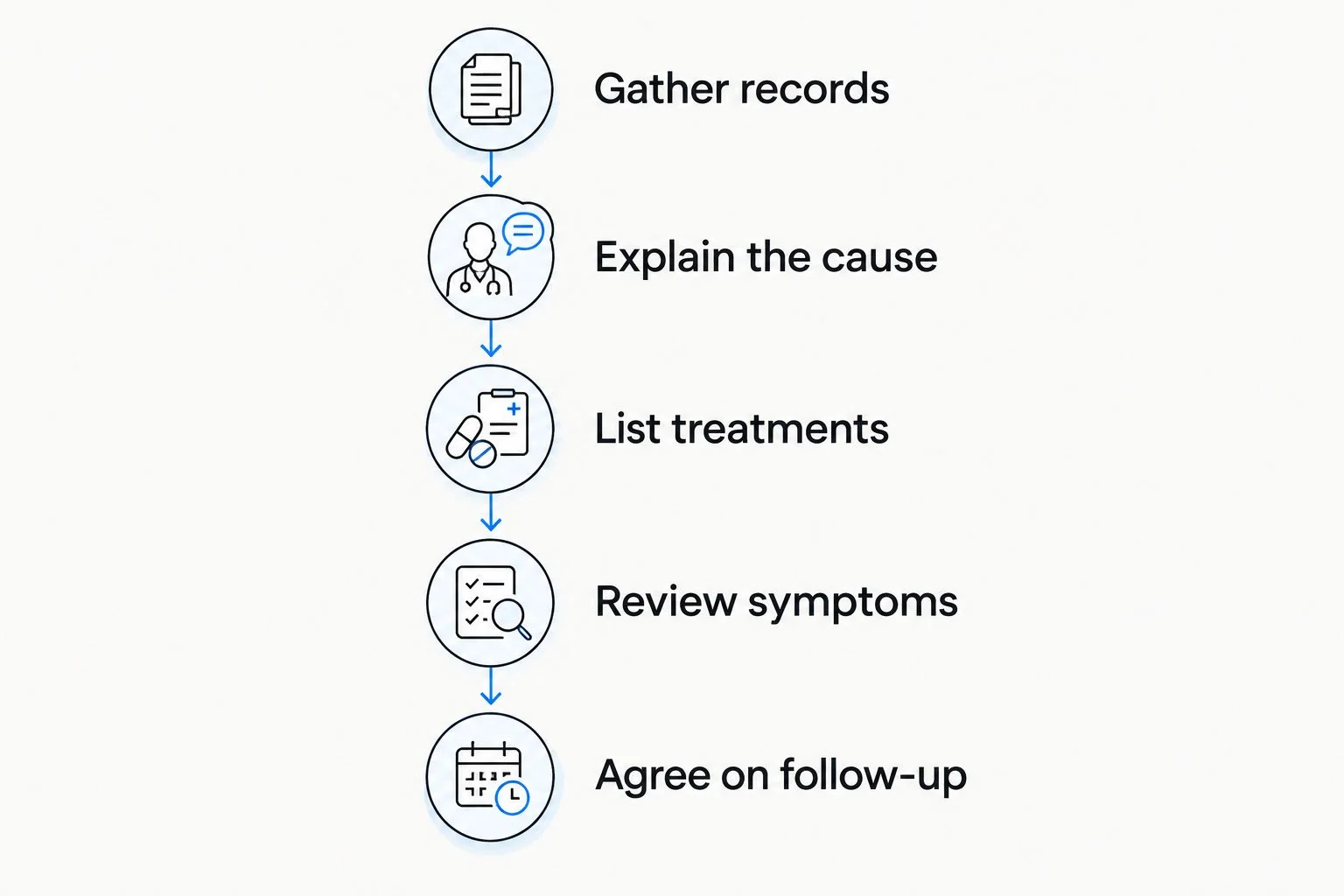
Use this sequence to prepare for a 2026 consultation:
- Gather records. Find the discharge summary, imaging reports, laboratory results, and any gastroenterology follow-up notes.
- Explain the cause. Tell the clinician what you were told caused the episode and whether that explanation was confirmed or remained uncertain.
- List treatments. Include gallbladder surgery, procedures, medication changes, and treatment for high triglycerides when relevant.
- Review symptoms. Describe ongoing abdominal pain, vomiting, difficulty eating, or other symptoms instead of assuming they are unrelated.
- Agree on follow-up. Ask who to contact for new symptoms and when you should seek in-person or emergency care instead.
The purpose is not to assemble paperwork for its own sake. Records help the prescriber distinguish a resolved trigger from an unresolved pancreatic problem.
A clinician might request additional information or specialist input before making a decision. Do not interpret a delayed prescription as a reason to seek a provider who asks fewer questions. The unresolved issue is your medical suitability, not the speed of the intake process.
What symptoms mean you should stop semaglutide?
Stop semaglutide and seek urgent medical assessment if you develop severe, persistent abdominal pain, especially pain that spreads to your back. Pancreatitis can occur with or without vomiting, so do not wait for vomiting before seeking help.
Nausea and other gastrointestinal effects occur with semaglutide, but that does not make severe or persistent pain routine. You cannot reliably distinguish pancreatitis from another serious abdominal condition through an online symptom checklist.
Tell the treating clinician:
- That you take semaglutide and have a history of pancreatitis.
- When you took your last dose and whether your dose recently changed.
- When the pain began, where it is, and whether it spreads.
- Whether you have vomiting, fever, jaundice, faintness, or difficulty keeping fluids down.
For severe symptoms, use emergency services or an emergency department rather than waiting for a routine telehealth reply. Do not take another dose to see whether your body adjusts.
Does a normal lipase test mean semaglutide is safe?
No. A normal lipase result does not predict that you will remain free of pancreatitis during treatment, and an isolated abnormal result does not establish the diagnosis by itself.
Acute pancreatitis is generally diagnosed when at least 2 of 3 diagnostic criteria are present: characteristic abdominal pain, pancreatic enzymes at least 3 times the upper limit of normal, or characteristic imaging findings. These criteria are part of clinical diagnosis, not a self-testing checklist.
If you develop symptoms, your clinician decides which blood tests and imaging are appropriate. Buying repeated enzyme tests without a clinical plan does not substitute for assessing new abdominal pain.
Find out if GLP-1 treatment may be right for you.
Start My Pre-AssessmentCan you restart semaglutide after pancreatitis?
Do not restart semaglutide on your own after suspected or confirmed pancreatitis. The clinician treating the episode must review the diagnosis, the likely cause, and the medication's prescribing instructions before deciding your next treatment.
Skipping an injection does not immediately remove semaglutide from your body. Injectable semaglutide has an elimination half-life of approximately 1 week; prescribing information for Ozempic describes its presence in circulation for about 5 weeks after the last dose.
That persistence is not a reason to stay home with worsening pain. It is a reason to tell the medical team exactly what you took and when, even if you have already stopped treatment.
Is a different weight-loss treatment automatically safer?
No. Switching treatments without reviewing the pancreatitis history does not resolve the underlying question. Another medicine can have its own warnings, contraindications, or monitoring requirements.
Ask the clinician to compare appropriate approaches based on your medical history and treatment goals. Lifestyle support, another medication, or specialist-led obesity treatment each requires an individualized discussion; none should be presented as universally safe after pancreatitis.
VevaRX is best suited to adults seeking clinician-prescribed telehealth weight-loss care, not emergency evaluation for suspected pancreatitis. Its online prescribing model does not establish that a particular person with pancreatic disease is eligible for semaglutide.
What evidence should guide your 2026 decision?
Use the US prescribing information for the exact semaglutide product under consideration. Ozempic and Wegovy prescribing information are primary references for their respective indications, contraindications, and pancreatitis warnings; the American College of Gastroenterology's acute pancreatitis guidance supports the diagnostic framework described above.
These sources answer different questions. Drug labeling explains product-specific precautions, while pancreatitis guidance explains how clinicians assess pancreatic inflammation. Neither source provides a personal recurrence probability from the fact that you once had pancreatitis.
When reviewing online claims, separate these statements carefully:
- A study finding no overall increase in pancreatitis does not establish safety for every person with previous pancreatitis.
- A warning does not mean every treated person will develop the condition.
- A previous successful prescription does not replace reassessment after new symptoms or another episode.
For a 2026 prescribing decision, the relevant endpoint is a documented clinical plan—not reassurance from a headline, forum post, or medication advertisement.
Have questions about your options? Start with a quick online assessment.
Start My Pre-AssessmentFAQ
Can I take semaglutide if I had pancreatitis years ago?
A remote history of pancreatitis does not automatically rule out semaglutide, but it still requires an individualized prescribing assessment. Your clinician should review the original cause, any recurrence, and ongoing symptoms before deciding.
Is previous pancreatitis an absolute contraindication to semaglutide?
Previous pancreatitis is not itself listed as an absolute contraindication in US semaglutide labeling. Semaglutide still carries an acute pancreatitis warning, and limited evidence in people with previous pancreatitis makes individual review necessary.
What if gallstones caused my previous pancreatitis?
A documented gallstone cause and its treatment are relevant to the prescribing decision, but they do not automatically establish that semaglutide is safe for you. Bring records of the episode, gallbladder treatment, and any later symptoms.
Should I stop semaglutide if my stomach hurts badly?
Stop semaglutide and seek urgent medical assessment for severe, persistent abdominal pain, especially pain spreading to your back. Pancreatitis can occur without vomiting, so do not wait for additional symptoms.
Can blood tests clear me to start semaglutide?
No blood test alone clears you to start semaglutide after pancreatitis. A clinician must interpret laboratory results alongside your history, symptoms, and any relevant imaging.
Can I restart semaglutide once pancreatitis pain goes away?
Do not restart semaglutide on your own when the pain improves. Your treating clinician must review whether pancreatitis occurred and determine the appropriate next treatment.
Can VevaRX tell me whether semaglutide is appropriate after pancreatitis?
VevaRX offers clinician-prescribed telehealth weight-loss care, but eligibility after pancreatitis requires an individual medical assessment. Disclose the diagnosis before treatment and seek urgent in-person care for symptoms suggesting an acute episode.
One last thing
Ask for a written symptom plan before your first dose. It should explain which symptoms require stopping treatment, whom to contact, and when not to wait for a response.
Whether you consult VevaRX or another prescriber, bring that plan to every medication review. The most useful reassurance is not a promise that pancreatitis cannot happen; it is a clear explanation of why treatment is appropriate for you and what to do if symptoms develop.
Related guides
Ready to get started?
See if doctor-prescribed GLP-1 treatment may be right for you. It only takes a few minutes, 100% online.
Start My Pre-AssessmentThis article is for informational purposes only and is not medical advice. Compounded medications are not approved by the FDA and have not been reviewed for safety, effectiveness, or quality. Prescription products require an online consultation with a licensed healthcare provider who will determine if a prescription is appropriate. Individual results vary.