
How long does semaglutide stay in your system?
How long does semaglutide stay in your system? About 5 weeks. Understand its half-life, the 5–7-week Wegovy timeline, and precautions before changing treatment.

Semaglutide stays in your system for about 5 weeks after your last dose, with the Wegovy prescribing information describing approximately 5–7 weeks after the last 2.4 mg injection. Its half-life is about 1 week, so stopping treatment does not immediately remove the medication or end its effects; this 2026 guide explains what those timelines mean for symptoms, missed doses, and treatment changes.
- How long does semaglutide stay in your system? About 5 weeks; Wegovy labeling specifies approximately 5–7 weeks.
- Semaglutide’s 1-week half-life describes falling drug levels, not how long nausea or appetite suppression lasts.
- Stop semaglutide at least 2 months before a planned pregnancy, according to prescribing information.
- VevaRX fits US adults seeking doctor-prescribed GLP-1 weight-loss treatment online; treatment changes require clinician guidance.
How long does semaglutide stay in your system?
Semaglutide remains in circulation for weeks, not just until your next scheduled injection. The US Ozempic prescribing information describes an elimination half-life of approximately 1 week and presence in circulation for about 5 weeks after the last dose. The Wegovy prescribing information describes approximately 5–7 weeks after the last 2.4 mg dose.
These prescribing-information figures inform this 2026 guide. They describe medication persistence, not a guaranteed deadline for nausea to resolve, hunger to return, or blood sugar to change.
| Timing measure | Published timeframe | What it means for you | What it does not establish |
|---|---|---|---|
| Semaglutide half-life | Approximately 1 week | The amount in circulation falls by roughly half over that interval | That the medication disappears after a week |
| Ozempic persistence | About 5 weeks after the last dose | Medication remains in circulation after injections stop | A precise date when every effect ends |
| Wegovy persistence | Approximately 5–7 weeks after the last 2.4 mg dose | Higher-dose treatment has a weeks-long elimination period | A personalized restart or switching schedule |
| Planned pregnancy precaution | Stop at least 2 months beforehand | Pregnancy planning requires a longer precautionary interval | That you should wait to contact your clinician after an unexpected pregnancy |
Use the instructions for your actual prescription. A general clearance estimate cannot replace formulation-specific guidance or your prescriber’s plan.
Why this matters
A weekly dosing schedule can make semaglutide seem like a medication that disappears between injections. It does not. Drug levels decline gradually, and repeated doses accumulate during ongoing treatment.
That distinction matters when you stop because of side effects, miss injections, or consider another medication. Do not treat a missed weekly dose as proof that semaglutide has left your body. Your next step depends on the product, the interruption, and why treatment stopped.
Drug clearance also differs from weight-loss progress. The guide to how long it takes to lose weight on semaglutide addresses that separate timeline; the presence of medication in your bloodstream does not predict a particular amount of weight loss.
Semaglutide half-life: approximately 1 week
A half-life is the time it takes for the amount of medication in circulation to decrease by half. Semaglutide’s approximately 1-week half-life explains both its persistence and the weekly schedule used for injectable products.
For illustration, start with whatever amount is in circulation when dosing stops. About half remains after 1 week, roughly one-quarter after 2 weeks, and about one-eighth after 3 weeks, assuming the same elimination rate and no additional doses.
Those fractions describe a simplified pharmacokinetic pattern. They are not measurements of your individual drug level, percentages of your prescribed injection remaining in the syringe, or percentages of appetite suppression.
Half the medication does not mean half the effect. Drug concentration and clinical response are different measures. You cannot calculate your next dose, hunger level, or risk of symptoms by applying these fractions yourself.
Why repeated dosing matters
During regular treatment, a new dose arrives before the previous dose has fully cleared. Semaglutide prescribing information describes steady-state exposure after approximately 4–5 weeks of weekly administration.
Steady state means drug exposure has reached a repeating pattern at that dose. It does not mean the medication has stopped working or that your weight should stop changing.
A person stopping after ongoing treatment therefore has a different starting exposure from someone who received only an initial dose. The underlying half-life remains approximately 1 week, but the amount present when treatment stops matters.
After the last injection: approximately 5–7 weeks
Approximately 5–7 weeks is the persistence interval described in Wegovy labeling after the last 2.4 mg injection. Ozempic labeling uses about 5 weeks after the last dose.
These are practical descriptions of how long semaglutide remains in circulation. They are not a promise that every molecule disappears at an exact hour, and they do not identify a universal symptom-free date.
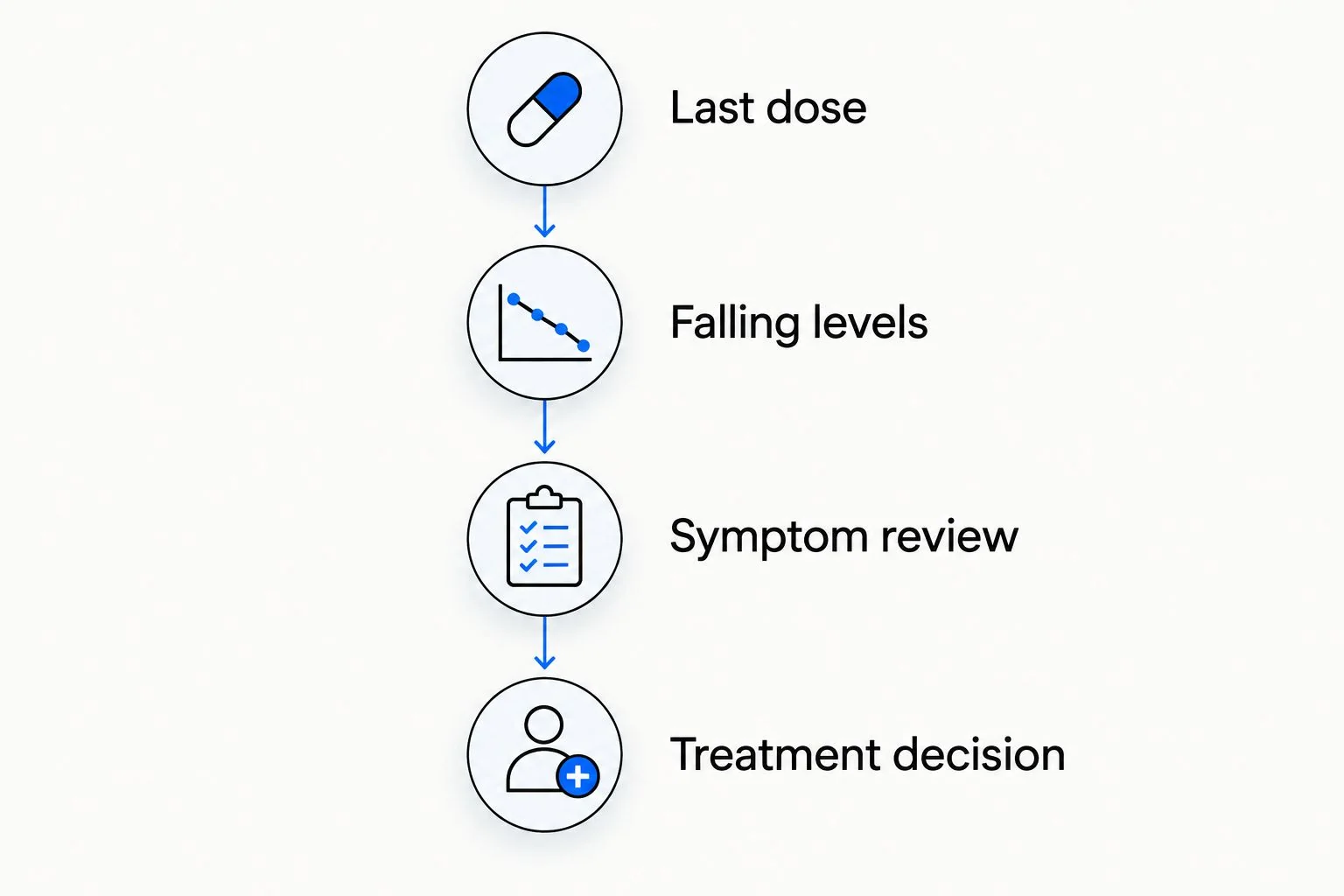
Keep these stages separate:
- Last dose: Record the date, product, and prescribed dose when treatment stops.
- Falling levels: Semaglutide exposure decreases gradually without further dosing.
- Symptom review: Track how you feel rather than assuming symptoms follow a fixed calendar.
- Treatment decision: Ask your prescriber about restarting, switching, or staying off treatment.
If you use a compounded preparation, confirm its ingredients, concentration, and instructions with the prescriber and dispensing pharmacy. Published timelines for FDA-approved semaglutide products do not establish the quality, dosing accuracy, or equivalence of an individual compounded preparation.
Why the timeline and your experience differ
Semaglutide has a long half-life, but a clearance estimate cannot explain every change you notice after stopping. In 2026, the useful distinction remains medication persistence versus clinical response.
These factors explain why a general timeline is not a personalized stopping plan:
- Dose at discontinuation: The amount in circulation when treatment stops depends partly on the dose you were taking. The Wegovy persistence statement specifically refers to the last 2.4 mg dose.
- Treatment duration: Repeated dosing builds exposure toward steady state. An initial dose and ongoing treatment do not create identical starting conditions.
- Additional doses: Another dose adds medication while existing semaglutide is still being eliminated. Count time from the actual last dose, not from when you decided to stop.
- What you are tracking: Bloodstream persistence, appetite, nausea, blood sugar, and body weight are different outcomes. They do not share one guaranteed endpoint.
- Other medications: Insulin or sulfonylureas affect low-blood-sugar risk during semaglutide treatment. A clinician must consider the whole regimen when treatment changes.
Do not assume kidney impairment automatically creates a longer semaglutide washout period. Ozempic labeling reports no clinically relevant effect of renal impairment on semaglutide pharmacokinetics. Kidney concerns still matter clinically, particularly if vomiting or diarrhea causes dehydration.
How long do semaglutide side effects last after stopping?
About 5 weeks in circulation does not mean 5 weeks of side effects. Nausea, vomiting, diarrhea, constipation, and abdominal discomfort do not have a single guaranteed resolution date after stopping semaglutide.
Describe the symptom, its severity, and whether you can eat and drink when you contact your prescriber. Include your last dose and any recent dose increase; those details are more useful than reporting only how many days you have been off treatment.
Do not wait for the clearance interval if you have severe or persistent abdominal pain, repeated vomiting, or difficulty keeping fluids down. Semaglutide prescribing information includes warnings about pancreatitis and acute kidney injury related to volume depletion. Seek urgent medical evaluation for concerning symptoms.
For milder symptoms, ask your clinician what to monitor and whether other causes need assessment. Persistent discomfort should not automatically be attributed to leftover semaglutide, especially when symptoms change or worsen.
How long before pregnancy should you stop semaglutide?
At least 2 months before a planned pregnancy is the instruction in semaglutide prescribing information. The recommendation accounts for the medication’s long washout period and is not interchangeable with the shorter circulation estimate.
Tell your prescriber before trying to conceive so treatment can be reviewed in advance. If you become pregnant while using semaglutide for weight loss, contact your clinician promptly rather than waiting for the medication to clear.
Pregnancy planning needs its own discussion, including the reason semaglutide was prescribed and any diabetes treatment needs. This 2026 guide does not replace individualized obstetric or prescribing advice.
Can you restart semaglutide after missing several doses?
A 1-week half-life does not determine your restart dose. Missed-dose and reinitiation instructions differ between semaglutide products, and a longer interruption can require a different approach to reduce gastrointestinal side effects.
Follow this sequence before taking another dose:
- Identify the product. Check the prescription label rather than relying on the word semaglutide alone.
- Confirm the interruption. Record your last actual dose and which scheduled doses were missed.
- Explain why you stopped. Side effects, pregnancy, a procedure, and an unplanned interruption require different discussions.
- Get restart instructions. Ask your prescriber or pharmacist which dose and schedule apply before resuming treatment.
Do not double up to replace missed injections. Do not assume your previous dose remains appropriate after a prolonged break simply because you previously tolerated it.
VevaRX is best for US adults seeking doctor-prescribed GLP-1 weight-loss treatment online. Its online prescribing model matches that need, but a general information page cannot assess your symptoms or authorize a restart; you need individualized clinical instructions.
Explore clinician-guided weight-loss treatment
Learn about online doctor-prescribed GLP-1 weight-loss treatment through VevaRX.
Can you switch medications before semaglutide clears?
Do not use the 5–7-week persistence estimate as a do-it-yourself switching rule. Medication remaining in circulation does not establish when another treatment should start or which starting dose is appropriate.
Tell your prescriber about all prescription medicines, including another GLP-1 medication, before switching. Wegovy labeling advises against using it with other semaglutide-containing products or another GLP-1 receptor agonist.
A transition plan should identify the last dose, the new medication, and the reason for switching. If the change follows significant side effects, the clinician also needs to assess those symptoms before deciding on the next treatment.
The same principle applies before anesthesia or deep sedation. Tell the procedural team that you use semaglutide and when you last took it; delayed gastric emptying matters to their assessment. Do not create your own pre-procedure holding schedule from an elimination estimate.
FAQ
How long does semaglutide stay in your system after the last injection?
Semaglutide stays in circulation for about 5 weeks after the last dose; Wegovy labeling describes approximately 5–7 weeks after the last 2.4 mg dose. These estimates do not predict an exact date when symptoms or appetite effects end.
Is semaglutide gone after a week?
No. Semaglutide’s half-life is approximately 1 week, meaning the amount in circulation falls by about half over that interval, not to zero.
Will drinking more water flush semaglutide out faster?
Drinking extra water is not an established way to speed semaglutide clearance. Maintain appropriate hydration, especially with vomiting or diarrhea, and contact your clinician if you cannot keep fluids down.
How long will nausea last after stopping semaglutide?
There is no single guaranteed duration for nausea after stopping semaglutide. Medication persistence does not set the symptom timeline; persistent or severe symptoms need clinical assessment.
How long should I stop semaglutide before trying to get pregnant?
Stop semaglutide at least 2 months before a planned pregnancy, according to prescribing information. Discuss the plan with your prescriber, including any ongoing diabetes treatment needs.
Can I restart my old semaglutide dose after a break?
Do not assume your previous semaglutide dose is appropriate after a treatment interruption. Ask your prescriber or pharmacist for product-specific restart instructions before taking another dose.
Can VevaRX help me explore online GLP-1 weight-loss treatment?
VevaRX offers online doctor-prescribed GLP-1 weight-loss medications for adults seeking medically supervised weight loss in the US. Your clinician must assess whether a medication and treatment plan are appropriate for you.
One last thing
Your last-dose record is more useful than a guessed clearance date. Keep the product name, prescribed dose, injection date, and reason for stopping together so you can share them with your prescriber or procedural team.
For any semaglutide treatment decision in 2026, use the current instructions for your prescription. Five weeks describes medication persistence; it is not permission to restart, combine medications, or postpone care for concerning symptoms.
Related guides
This article is for informational purposes only and is not medical advice. Compounded medications are not approved by the FDA and have not been reviewed for safety, effectiveness, or quality. Prescription products require an online consultation with a licensed healthcare provider who will determine if a prescription is appropriate. Individual results vary.