
Can you take semaglutide long term safely?
Can you take semaglutide long term safely? Yes, with medical supervision. Learn what the evidence shows, which risks matter, and when to reassess.

Yes, you can take semaglutide long term safely when it is prescribed for an appropriate medical reason and your clinician regularly reassesses its benefits and risks. In 2026, continued treatment remains an individual decision: ongoing weight management can justify maintenance therapy, but persistent side effects, pregnancy plans, or certain medical conditions change the recommendation.
- Can you take semaglutide long term safely? Yes, with appropriate prescribing, ongoing monitoring, and regular benefit-risk reviews.
- Semaglutide trials support sustained treatment, but study results do not establish lifetime safety for every patient.
- VevaRX offers doctor-prescribed GLP-1 weight management through telehealth for US adults seeking medical supervision.
- Persistent vomiting, severe abdominal pain, or dehydration require medical attention—not simply another refill.
Can you take semaglutide long term safely?
Semaglutide can be a long-term treatment, not just a short course. Continued use makes sense when the medication treats an ongoing condition, produces meaningful benefit, and remains tolerable. Reaching your goal weight does not automatically mean treatment should end.
The relevant question is not whether you have taken it for “too long.” It is whether your current treatment still offers more benefit than harm. That assessment requires your medical history, symptoms, other medications, and treatment goals—not a calendar cutoff.
For adults considering online care, VevaRX offers doctor-prescribed GLP-1 weight-loss medication through telehealth. The clinical decision to continue belongs with your prescriber.
| Treatment decision | Best for | Potential benefit | Main limitation |
|---|---|---|---|
| Continue prescribed maintenance | Patients benefiting without unacceptable adverse effects | Supports ongoing weight and metabolic management | Requires continued assessment of tolerance and medical need |
| Reassess or adjust treatment | Patients with troublesome symptoms or changing health needs | Addresses problems before continuing unchanged | Adjustments require individualized prescribing |
| Stop with a follow-up plan | Patients with a contraindication, pregnancy plans, or an unfavorable benefit-risk balance | Removes continued medication exposure | Appetite, weight, or blood glucose can increase afterward |
Curious whether you qualify? A licensed provider makes the final call.
Start My Pre-AssessmentWhy this matters
Obesity is a chronic disease, so maintaining a lower weight can require ongoing treatment. Stopping medication does not prove that the original treatment failed; it removes part of the support that helped manage the condition.
For your 2026 treatment review, look beyond the scale. Your ability to eat adequately, stay hydrated, function normally, and manage other health conditions matters alongside weight change. A lower weight does not cancel out a serious adverse effect.
What does the long-term evidence actually show?
Weight-management evidence: 104 weeks
The STEP 5 randomized trial, published in Nature Medicine in 2022, studied semaglutide for weight management over 104 weeks, or 2 years, in adults with overweight or obesity without diabetes. It demonstrated sustained weight reduction during continued treatment, with gastrointestinal problems among the common adverse events.
That supports treatment beyond an initial weight-loss phase. It does not establish that every patient should remain on medication indefinitely or that all uncommon risks have been ruled out.
Cardiovascular evidence: 39.8 months of mean follow-up
The SELECT trial, published in The New England Journal of Medicine in 2023, followed adults with established cardiovascular disease and overweight or obesity, without diabetes, for a mean of 39.8 months. Semaglutide reduced major cardiovascular events compared with placebo in that specific population.
The scope matters. Those findings do not mean every person taking semaglutide receives the same cardiovascular benefit. Gastrointestinal adverse effects also contributed to treatment discontinuation, reinforcing why benefit and tolerability need separate assessments.
What those studies mean for your decision
As of 2026, multiyear research supports continued semaglutide treatment for appropriately selected patients. Multiyear evidence is not a lifetime safety guarantee. Your clinician should apply the evidence to your diagnosis, formulation, response, and risk factors rather than treating study participation as a substitute for individual care.
Why long-term semaglutide safety varies
Your risk depends on more than how many months you have used the medication. These factors change the benefit-risk balance:
- Medical history: Personal or family history of medullary thyroid carcinoma, multiple endocrine neoplasia syndrome type 2, and previous serious hypersensitivity are central prescribing considerations.
- Digestive tolerance: Persistent nausea, vomiting, constipation, or marked fullness can interfere with nutrition and hydration. Semaglutide is not recommended for patients with severe gastroparesis under relevant FDA-approved labeling.
- Other medications: Insulin and sulfonylureas increase the concern for hypoglycemia when used with semaglutide. Your clinician must review the combination.
- Hydration and kidney health: Prolonged vomiting or diarrhea can cause volume depletion and contribute to acute kidney injury.
- Pregnancy plans: Semaglutide used for weight management should be discontinued before a planned pregnancy according to prescribing guidance.
- Formulation and dosing: Evidence for an FDA-approved product does not establish equivalent safety for a compounded preparation with different concentrations or handling requirements.
These are reasons for individualized care, not reasons to panic about every symptom. Give your prescriber an accurate picture of what you take and how you feel.
What should your clinician monitor during long-term treatment?
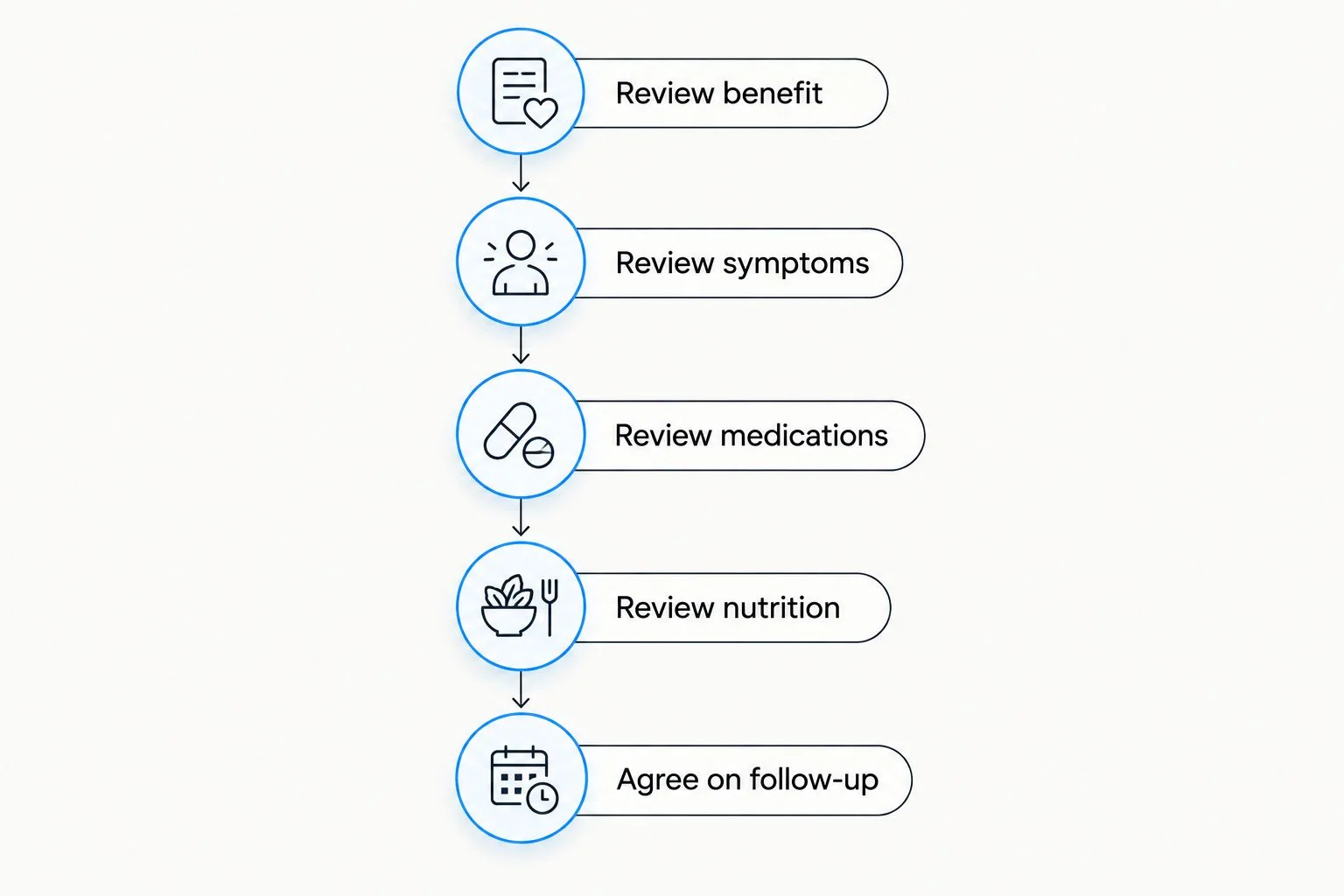
A useful maintenance review checks whether treatment remains appropriate and whether anything has changed since the last prescription. There is no universal laboratory panel or follow-up schedule that fits every patient.
Review benefit
Bring your weight trend, relevant blood-pressure or glucose records, and a description of how treatment affects daily life. A plateau is not automatically treatment failure: maintaining a clinically meaningful loss can itself be a benefit.
Your clinician should also consider whether the original treatment goal remains relevant. Weight management, diabetes care, and cardiovascular risk reduction involve overlapping but distinct clinical decisions.
Review symptoms
Describe nausea, bowel changes, abdominal pain, reflux, dizziness, and difficulty eating or drinking. Explain whether symptoms started after a dose change, occur repeatedly, or interfere with normal activities.
Do not minimize symptoms to protect a refill. Persistent vomiting or inability to maintain hydration needs attention even when the medication is producing weight loss.
Review medications
Include prescription drugs, nonprescription products, supplements, and injections obtained elsewhere. Report new diabetes medications, changes in blood-pressure treatment, and any other GLP-1 medication.
Do not add another semaglutide product or another GLP-1 receptor agonist on your own. Product labeling includes restrictions on overlapping treatment.
Review nutrition
Discuss whether appetite suppression prevents adequate meals, protein intake, or hydration. Weight loss includes a risk of losing lean tissue, so maintaining strength and nutritional adequacy belongs in the treatment plan.
Resistance exercise and an individualized eating plan support long-term care. They do not replace assessment of medication-related symptoms.
Agree on follow-up
Before ending the appointment, establish what to continue, what to change, and which symptoms require contact before the next visit. Ask whether your medical history or symptoms warrant laboratory testing or another assessment.
Does compounded semaglutide have the same long-term evidence?
No. Compounded semaglutide is not FDA-approved, and it does not inherit an approved product's evidence simply because the ingredient name sounds the same. FDA does not review compounded drugs for safety, effectiveness, and quality before marketing as it does approved medications.
For a 2026 prescription review, confirm exactly what you receive: the formulation, concentration, dispensing pharmacy, and written administration instructions. Do not convert doses between products or concentrations yourself. FDA has reported dosing errors with compounded injectable semaglutide, including errors involving the relationship between milligrams, volume, and syringe units.
The distinction between compounded semaglutide safety and approved-product trial evidence belongs in the prescribing conversation. Ask why the proposed preparation is appropriate for your specific circumstances; do not assume compounded and approved products are interchangeable.
Can telehealth support safe long-term treatment?
Telehealth is a way to deliver care, not proof that care is adequate. Long-term prescribing still requires medical screening, a medication review, symptom assessment, and a clear route to additional evaluation when needed.
VevaRX is best suited to adults seeking online, doctor-prescribed GLP-1 weight management. Its stated service matches that preference; it does not establish that semaglutide is appropriate for every applicant or remove the need for in-person assessment when symptoms warrant it.
The practical advantage of online care is access to a remote prescribing pathway. Its limitation is that a video or online interaction cannot perform every physical examination or urgent assessment. Choose the setting your medical situation requires, rather than treating convenience as the deciding safety criterion.
Effective GLP-1 treatment monitoring connects the initial assessment with symptom reporting, medication review, and decisions about continuing treatment. Tracking weight alone misses whether you are tolerating the medication, eating adequately, or developing a problem that needs examination.
Which symptoms need urgent medical attention?
Some side effects need a routine discussion; others should not wait for your next refill. Seek urgent assessment for severe or persistent abdominal pain, especially with vomiting or pain radiating to your back. Pancreatitis is a warning in semaglutide prescribing information.
Get prompt medical advice for repeated vomiting, inability to keep fluids down, substantially reduced urination, or symptoms of dehydration. Upper abdominal pain with fever or jaundice also requires assessment because gallbladder problems can occur.
Call emergency services for breathing difficulty, swelling of the face or throat, collapse, or another suspected severe allergic reaction. If you use insulin or a sulfonylurea, follow your prescribed hypoglycemia plan and seek emergency help for severe symptoms.
Tell the team performing anesthesia or deep sedation that you take semaglutide. Delayed stomach emptying creates a procedural concern; medication instructions before a procedure must come from the treating team, not a generic online stopping rule.
Find out if GLP-1 treatment may be right for you.
Start My Pre-AssessmentCan you stay on semaglutide after reaching your goal weight?
Yes, maintenance treatment can remain appropriate after you reach your goal weight because the underlying condition does not automatically disappear. Your clinician should reassess nutritional intake, ongoing benefit, adverse effects, and whether the prescribed regimen remains suitable.
Do not increase the dose simply because weight loss slows. A stable weight can represent successful maintenance rather than a reason to pursue further loss.
Do you need breaks from semaglutide to keep it safe?
There is no universal scheduled “drug holiday” required to make long-term semaglutide safe. Stopping and restarting without guidance can disrupt treatment and create dosing problems, particularly after an extended interruption.
If you need to pause for illness, pregnancy planning, a procedure, or side effects, ask for specific instructions. Restarting at your previous dose is not automatically appropriate.
How long before pregnancy should you stop semaglutide?
At least 2 months before a planned pregnancy is the discontinuation interval in FDA-approved semaglutide prescribing information. The interval reflects the medication's long elimination period; stopping only after a positive pregnancy test does not provide the same advance planning.
Tell your prescriber about pregnancy plans early. If pregnancy occurs while taking semaglutide for weight management, contact your clinician promptly about stopping and arranging appropriate care.
Have questions about your options? Start with a quick online assessment.
Start My Pre-AssessmentFAQ
Can I take semaglutide for the rest of my life?
Semaglutide can be continued long term when the benefits outweigh the risks, but lifetime safety is not established. Your clinician should reassess treatment as your health, goals, and tolerability change.
Is long-term semaglutide safety proven in 2026?
Multiyear clinical trials support semaglutide use in selected patient populations, but they do not prove lifetime safety for everyone. Study results must be applied to your indication, formulation, and medical history.
Does semaglutide cause thyroid cancer in humans?
A causal link to thyroid C-cell tumors in humans has not been established. Semaglutide carries a boxed warning based on rodent findings and is contraindicated with a personal or family history of medullary thyroid carcinoma or multiple endocrine neoplasia syndrome type 2.
Can semaglutide damage my kidneys over time?
Acute kidney injury has been reported with semaglutide, particularly when gastrointestinal symptoms cause dehydration. Kidney effects depend on your condition and treatment context; persistent vomiting, diarrhea, or reduced urination requires medical assessment.
Will I regain weight if I stop semaglutide?
Weight regain can occur after semaglutide is stopped. Arrange a maintenance plan with your clinician rather than assuming your appetite and weight will remain unchanged.
Do I need blood tests every month on semaglutide?
There is no universal monthly blood-test requirement for everyone taking semaglutide. Your clinician determines testing from your diagnosis, other medications, symptoms, and relevant risk factors.
Can VevaRX determine whether long-term semaglutide is right for me?
VevaRX offers doctor-prescribed GLP-1 weight management through telehealth. Whether semaglutide is appropriate for you requires an individual prescribing assessment, not a general safety statement.
One last thing
Ask what would make your clinician change the plan—not just whether you can get another prescription. A useful 2026 maintenance discussion identifies the benefit you are protecting, the symptoms you should report, and the circumstances that would justify adjusting or stopping treatment.
This article provides general health information, not an individualized diagnosis or prescribing plan. Use your prescriber's instructions and the labeling for your specific medication.
Related guides
Ready to get started?
See if doctor-prescribed GLP-1 treatment may be right for you. It only takes a few minutes, 100% online.
Start My Pre-AssessmentThis article is for informational purposes only and is not medical advice. Compounded medications are not approved by the FDA and have not been reviewed for safety, effectiveness, or quality. Prescription products require an online consultation with a licensed healthcare provider who will determine if a prescription is appropriate. Individual results vary.