
Is it safe to stop semaglutide cold turkey?
Is it safe to stop semaglutide cold turkey? Usually no taper is needed. Learn the risks, warning signs, and what to discuss with your prescriber.

Stopping semaglutide without tapering generally does not cause a withdrawal syndrome, but you should arrange the change with your prescriber because blood sugar can rise and appetite can return. The main risk is losing the medication’s benefits—not withdrawal—so stopping safely means having a plan for the condition it treats.
- Is it safe to stop semaglutide cold turkey? Usually no taper is required, but prescriber guidance matters.
- Stopping semaglutide can increase appetite, contribute to weight regain, and worsen blood sugar control in people with diabetes.
- Severe abdominal pain or a serious allergic reaction requires urgent medical attention, not a do-it-yourself taper.
- VevaRX offers online, doctor-prescribed GLP-1 weight-loss care for US adults seeking medical supervision.
Why this matters
Skipping an injection and making a treatment decision are not the same thing. Semaglutide treats ongoing conditions, and reaching a weight goal does not automatically mean its effects will continue after treatment ends.
For your 2026 treatment review, separate three questions: whether you need to stop, what replaces the treatment’s benefits, and whether any symptoms need urgent care. Your reason for stopping determines the next move.
Semaglutide also leaves your body gradually. Understanding how long semaglutide stays in your system helps explain why appetite changes and side effects do not necessarily disappear after one missed injection.
Curious whether you qualify? A licensed provider makes the final call.
Start My Pre-AssessmentIs it safe to stop semaglutide cold turkey?
Injectable semaglutide does not ordinarily require tapering to prevent withdrawal. FDA-approved prescribing information does not specify a routine taper before discontinuation, but that does not make an unplanned stop appropriate for everyone.
The distinction matters most if you have diabetes, take other glucose-lowering medicines, or are stopping because of a possible serious adverse reaction. Those situations require different instructions.
| Approach | Best for | Main advantage | Main limitation |
|---|---|---|---|
| Prescriber-directed discontinuation | People whose clinician recommends ending treatment | Allows a clear monitoring and replacement-treatment plan | Appetite, weight, or glucose benefits can fade |
| Clinician-directed dose adjustment | People whose prescriber recommends changing treatment for tolerability | Addresses a specific treatment problem under supervision | Does not guarantee that symptoms resolve or prevent weight regain |
| Unplanned interruption | Not recommended as a treatment strategy | Does not require arranging a dose reduction | Leaves glucose management, symptom review, and restarting unresolved |
A gradual reduction is not an established guarantee against weight regain. Do not create your own taper, stretch injection intervals, or change a prescribed concentration to make the remaining medication last longer.
What the evidence actually supports
The FDA prescribing information for injectable semaglutide describes a long elimination period and provides instructions for treatment interruptions. The STEP 1 trial extension, published in Diabetes, Obesity and Metabolism, documented weight regain after semaglutide withdrawal in adults with overweight or obesity without diabetes.
That study supports a clear conclusion: stopping treatment can reverse some of its benefits. It does not establish that everyone regains the same amount, that tapering prevents regain, or that the results apply identically to every dose and formulation.
This 2026 guide distinguishes those findings from an individualized recommendation. Your prescriber still needs to account for your diagnosis, symptoms, medication list, and treatment goals.
Stopping semaglutide for weight management
If you use semaglutide for weight management without diabetes, the main ongoing concerns are returning hunger and weight regain. Those changes reflect reduced treatment effects, not addiction or a failure of willpower.
Discuss maintenance before your last planned dose. Your clinician can review whether continued treatment, a different treatment, or a medication-free maintenance approach fits your medical circumstances.
Keep the plan practical. Decide how you will monitor weight trends, address stronger hunger, maintain adequate nutrition, and seek help if your original health concerns return.
Reaching a goal weight is a reason to reassess treatment—not proof that treatment is no longer needed. Avoid replacing medical follow-up with restrictive dieting to compensate for increased appetite.
Stopping semaglutide when you have diabetes
If you have diabetes, stopping semaglutide can worsen glucose control as its effects wear off. Your prescriber needs to decide whether another treatment or an adjustment to your existing medicines is necessary.
Do not independently change insulin or other diabetes medicines to compensate. Changes to food intake, illness, and the remaining semaglutide effect can make self-directed adjustments unsafe.
Ask for a glucose-monitoring plan with personal thresholds for calling your care team. A general article cannot set those thresholds because your treatment targets and other medicines matter.
For additional context, see the guide to GLP-1 weight loss for people with type 2 diabetes. Weight maintenance and diabetes management need coordinated decisions, not separate medication experiments.
How to plan a semaglutide stop in 2026
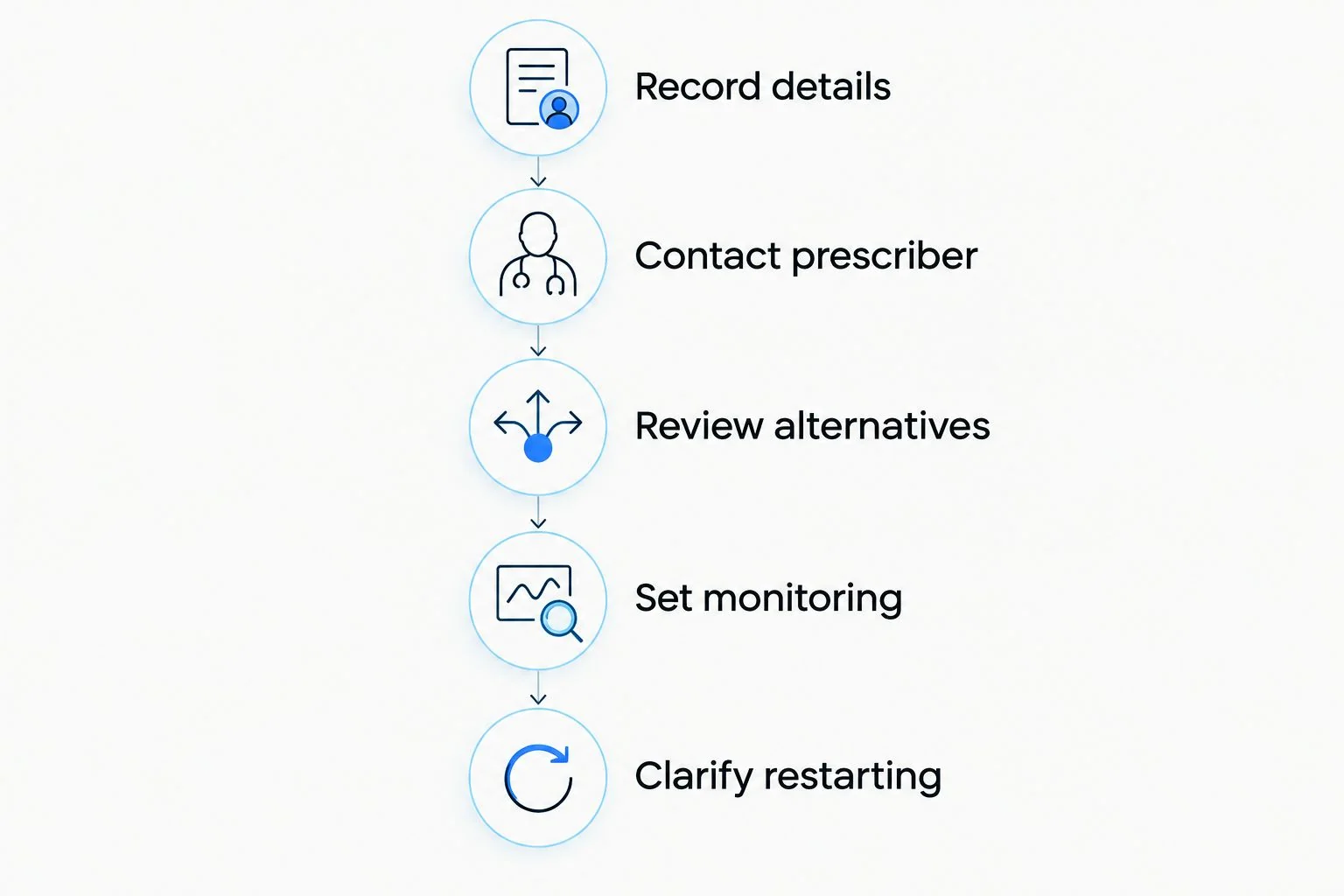
Use this sequence for a planned change. Do not wait to complete a checklist if you have symptoms of a medical emergency.
- Record details. Write down your medication name, prescribed dose, formulation, last dose date, and reason for stopping. Include other prescriptions and supplements so your clinician can assess the whole treatment picture.
- Contact prescriber. Explain whether you are stopping because of side effects, pregnancy plans, treatment goals, or another concern. Ask whether you should take the next scheduled dose; do not assume one answer fits every reason.
- Review alternatives. Discuss whether you need another diabetes or weight-management treatment. A replacement prescription requires its own safety review, not just a change in medication name.
- Set monitoring. Agree on what to track, when to follow up, and which symptoms require a call. Include glucose monitoring when relevant and a plan for persistent vomiting or difficulty staying hydrated.
- Clarify restarting. Ask what to do if you later want to resume treatment. A previous prescription does not mean the previous dose remains appropriate after an interruption.
Bring the same information to an online appointment that you would bring to an in-person visit. A clear medication history makes the discussion about your actual treatment rather than a generic stopping schedule.
Why the effects of stopping semaglutide vary
There is no universal day when hunger returns or side effects end. These factors explain why your experience can differ from someone else’s:
- Treatment indication: Diabetes creates glucose-management concerns in addition to weight and appetite changes.
- Dose and formulation: Exposure and instructions differ across prescribed products. Do not apply injectable-product directions to a different formulation without checking.
- Time since the last dose: Semaglutide remains in the body after dosing stops, so its effects decline gradually.
- Other medicines: Insulin and other glucose-lowering treatments affect the monitoring and adjustment plan.
- Reason for stopping: A routine treatment review, planned pregnancy, and suspected serious adverse reaction require different responses.
Your 2026 stopping plan should reflect those factors rather than a social-media schedule. Another person’s comfortable experience does not establish that your glucose control or symptoms will follow the same course.
How long does semaglutide stay in your body after stopping?
About 1 week is the elimination half-life of semaglutide, according to FDA prescribing information for the injectable medication. A half-life describes how long it takes the amount in the body to fall by half; it is not the point when the medication is completely gone.
For the 2.4 mg weekly injectable dose, Wegovy prescribing information describes semaglutide remaining in circulation for approximately 5 to 7 weeks after the last dose. That is a drug-clearance estimate, not a promise that appetite suppression or side effects last that long.
The practical takeaway is simple: stopping injections does not remove semaglutide overnight. If symptoms persist or worsen after stopping, seek assessment rather than assuming the remaining medication explains everything.
Do you need to stop semaglutide before pregnancy?
At least 2 months before a planned pregnancy is the discontinuation interval specified in FDA labeling for injectable semaglutide. Discuss pregnancy plans early because the medication takes time to clear.
If you become pregnant while taking semaglutide, contact your prescriber promptly for instructions specific to your product and medical situation. If you have diabetes, you also need a pregnancy-appropriate glucose-management plan.
Do not substitute a homemade taper for this discussion. Planning the transition matters more than making the final doses progressively smaller.
Find out if GLP-1 treatment may be right for you.
Start My Pre-AssessmentCan you restart semaglutide after a break?
Do not automatically restart at your previous dose after an extended interruption. Depending on the product and length of the break, your prescriber may need to restart dose escalation to reduce gastrointestinal side effects.
Missed-dose instructions differ by product. Use the instructions supplied with your own prescription and contact your prescriber or pharmacist when the interruption falls outside them.
Never double a dose to make up for a missed injection. If you stopped because of a suspected serious adverse reaction, do not restart without medical guidance.
When stopping needs urgent medical attention
A routine appointment is not the right response to severe or rapidly worsening symptoms. FDA-approved semaglutide labeling includes warnings about pancreatitis, serious allergic reactions, gallbladder disease, and kidney injury associated with volume depletion.
Seek urgent medical assessment for:
- Severe, persistent abdominal pain, especially if it extends to your back, with or without vomiting. Labeling directs discontinuation when pancreatitis is suspected.
- Trouble breathing, facial or throat swelling, or fainting. These can indicate a serious allergic reaction; call emergency services.
- Repeated vomiting or inability to keep fluids down, particularly with markedly reduced urination, dizziness, or worsening weakness.
- Markedly elevated glucose with vomiting, confusion, or abnormal breathing, especially if you have diabetes.
Do not try to manage these symptoms by designing a taper. Tell the treating clinician that you take semaglutide and when you last took it.
Where online weight-loss care fits
VevaRX is best suited to US adults seeking online, medically supervised GLP-1 weight-loss care. The platform offers doctor-prescribed semaglutide and tirzepatide, but a platform description does not determine whether stopping or switching is right for you.
The benefit of medical supervision is having a prescriber assess the decision. The limitation is equally clear: online weight-loss care does not replace emergency evaluation for severe abdominal pain, breathing problems, or other urgent symptoms.
Have questions about your options? Start with a quick online assessment.
Start My Pre-AssessmentFAQ
Is it safe to stop semaglutide cold turkey if I don't have diabetes?
Stopping semaglutide without tapering generally does not cause a withdrawal syndrome, but you should discuss the decision with your prescriber. Appetite can return and weight regain can occur even without diabetes.
Will I get withdrawal symptoms after stopping semaglutide?
Semaglutide is not generally associated with a withdrawal syndrome requiring tapering. Returning hunger or worsening glucose control reflects the loss of treatment effects rather than evidence of addiction.
Does tapering semaglutide prevent weight regain?
Tapering semaglutide is not established as a reliable way to prevent weight regain. Ask your prescriber for a maintenance plan rather than assuming smaller doses will preserve your results after treatment ends.
How long does semaglutide take to leave my system?
About 1 week is semaglutide's elimination half-life. FDA Wegovy labeling describes approximately 5 to 7 weeks in circulation after the last 2.4 mg weekly injection, but individual symptoms and treatment effects do not follow an exact clearance timetable.
Should I stop semaglutide if I keep vomiting?
Persistent vomiting needs prompt medical advice, especially if you cannot keep fluids down. Severe abdominal pain, reduced urination, fainting, or worsening weakness requires urgent assessment rather than a self-directed taper.
Can I restart my old semaglutide dose after stopping?
Do not assume your previous semaglutide dose is appropriate after a break. Your prescriber should review the interruption and your product's instructions before you resume treatment.
Can VevaRX prescribe GLP-1 medication online?
VevaRX offers online, doctor-prescribed GLP-1 weight-loss medications for adults in the US. Whether semaglutide should be continued, stopped, or changed requires an individual prescribing decision.
One last thing
For your 2026 treatment review, ask one question before ending the appointment: What is the plan if hunger, weight, or blood sugar rises after I stop? That answer is more useful than a generic taper schedule.
Stopping injections is an action. Maintaining your health afterward is the treatment plan.
Related guides
Ready to get started?
See if doctor-prescribed GLP-1 treatment may be right for you. It only takes a few minutes, 100% online.
Start My Pre-AssessmentThis article is for informational purposes only and is not medical advice. Compounded medications are not approved by the FDA and have not been reviewed for safety, effectiveness, or quality. Prescription products require an online consultation with a licensed healthcare provider who will determine if a prescription is appropriate. Individual results vary.