
Can you take semaglutide with birth control?
Can you take semaglutide with birth control? Generally yes. Learn when vomiting changes pill protection, why tirzepatide differs, and when to seek advice.

Yes, you can generally take semaglutide with birth control: injectable semaglutide has not been shown to reduce exposure to the hormones in a studied combined oral contraceptive. The practical concern is vomiting or severe diarrhea, which can interfere with birth control pill absorption. This 2026 guide explains when you need individualized backup advice, why tirzepatide has different instructions, and how to plan for pregnancy safely.
- Can you take semaglutide with birth control? Generally yes; vomiting and diarrhea require separate contraceptive advice.
- Injectable semaglutide has not shown reduced hormone exposure with a studied combined birth control pill.
- Tirzepatide requires nonoral contraception or a barrier method for 4 weeks after starting and each dose increase.
- Stop semaglutide at least 2 months before a planned pregnancy, with your prescriber’s guidance.
- VevaRX offers medically supervised weight-loss prescriptions; contraception decisions still require an individual clinical review.
Can you take semaglutide with birth control?
You do not automatically need to change contraception just because you start semaglutide. Injectable semaglutide prescribing information reports no clinically relevant interaction with the studied oral contraceptive containing ethinyl estradiol and levonorgestrel. That finding concerns medication exposure; it is not a guarantee against pregnancy.
Semaglutide slows stomach emptying, but that does not mean every oral medication becomes ineffective. Separate the direct drug-interaction question from the question of whether you kept your contraceptive pill down.
For online, doctor-prescribed weight-loss care, VevaRX is an option for adults seeking medical supervision rather than self-directed medication use. Tell your prescriber the exact contraceptive you use, including whether it is a pill, patch, ring, injection, implant, or intrauterine device.
| Medication | What matters for oral birth control | Practical action |
|---|---|---|
| Injectable semaglutide | No clinically relevant effect on exposure to the studied combined contraceptive | Continue contraception as prescribed; address vomiting, diarrhea, or missed pills separately |
| Oral semaglutide | Has specific administration instructions that affect when you take other oral medicines | Follow the exact product label and confirm your pill schedule with a pharmacist |
| Tirzepatide | Can reduce oral hormonal contraceptive effectiveness through delayed stomach emptying | Switch to nonoral contraception or add a barrier method for the specified periods |
The clinical references for this 2026 guide are FDA prescribing information for semaglutide and tirzepatide, plus CDC contraceptive practice recommendations. Your exact medication label and contraceptive instructions determine your personal plan.
Curious whether you qualify? A licensed provider makes the final call.
Start My Pre-AssessmentWhy this matters
An interaction warning is not the same as a side-effect warning. Semaglutide does not carry the same oral-contraceptive backup instructions as tirzepatide, even though both medications affect stomach emptying.
The distinction matters when you start treatment, increase a dose, or switch medications. Identify the actual drug before applying advice you saw about a different weight-loss injection. Brand names, ingredient names, and compounded preparations are not interchangeable descriptions.
Contraception also matters because semaglutide is not a weight-loss treatment for pregnancy. Discuss pregnancy intentions before your first prescription, not only after a missed period.
Injectable semaglutide: no routine backup requirement
Injectable semaglutide does not have a routine recommendation to add condoms solely because you begin treatment or increase your dose. The available interaction findings support continuing your prescribed contraception when you take it correctly and have no absorption-related problems.
That reassurance has limits. A study of a combined pill does not prove identical results for every contraceptive formulation, and it does not address missed pills, interacting medications, or repeated vomiting.
Bring your pill pack or a clear photo of its label to your appointment. Your clinician needs the active ingredients, not just a description such as a low-dose pill.
Do not stop birth control because you are starting semaglutide. Stopping creates a separate pregnancy risk and does not solve nausea or other treatment side effects.
Oral semaglutide: follow the tablet’s timing instructions
Oral semaglutide requires attention to administration timing. For oral semaglutide products whose labeling specifies it, wait at least 30 minutes after taking the tablet before taking other oral medications, including a contraceptive pill.
Confirm the instructions for your exact prescription rather than applying the injection schedule to a tablet. A pharmacist can help you move your contraceptive to a consistent time without creating missed doses.
Do not double a contraceptive dose or skip one to make room for semaglutide. Follow the contraceptive’s own instructions if changing your routine results in a late or missed pill.
The useful question is not simply whether the medicines can be taken on the same day. Ask how to take both correctly, with a schedule you can maintain.
Tirzepatide: backup for 4 weeks after starting or increasing
Tirzepatide has a different, explicit instruction. FDA prescribing information advises people using oral hormonal contraception to switch to a nonoral contraceptive method or add a barrier method for 4 weeks after starting tirzepatide and 4 weeks after each dose increase.
This is not a general rule for every GLP-1 medication. Do not transfer it automatically to semaglutide, and do not dismiss it because semaglutide did not require the same precaution.
Nonoral hormonal contraceptives are not expected to be affected by tirzepatide’s stomach-emptying effect. However, each method still has its own start-up, missed-use, and replacement instructions.
If your treatment changes during 2026, review contraception before the first dose of the new medication. A switch from semaglutide to tirzepatide changes the contraceptive discussion even when your birth control stays the same.
Why your birth control advice varies
Your clinician’s recommendation depends on the medication, the contraceptive, and what happened around each dose. These factors change the next step:
- Weight-loss medication: Semaglutide and tirzepatide have different oral-contraceptive instructions.
- Medication formulation: Oral semaglutide has administration requirements that injections do not.
- Contraceptive type: A combined pill, progestin-only pill, patch, ring, implant, and IUD do not share identical missed-use rules.
- Digestive symptoms: Vomiting and severe diarrhea raise concerns about oral pill absorption, not about an IUD being absorbed.
- Recent use: Late pills, missed pills, delayed replacement, and recent sex affect whether backup or emergency contraception is needed.
- Pregnancy plans: Trying to conceive requires a medication plan rather than simply stopping contraception.
Keep this information together in your phone or medication list. It gives your prescriber or pharmacist the details needed for specific advice instead of a generic answer about weight-loss drugs.
What should you do if you vomit after taking the pill?
Use your contraceptive’s vomiting, diarrhea, or missed-pill instructions—not a universal semaglutide rule. The action depends on the pill formulation, timing of vomiting, and duration of illness.
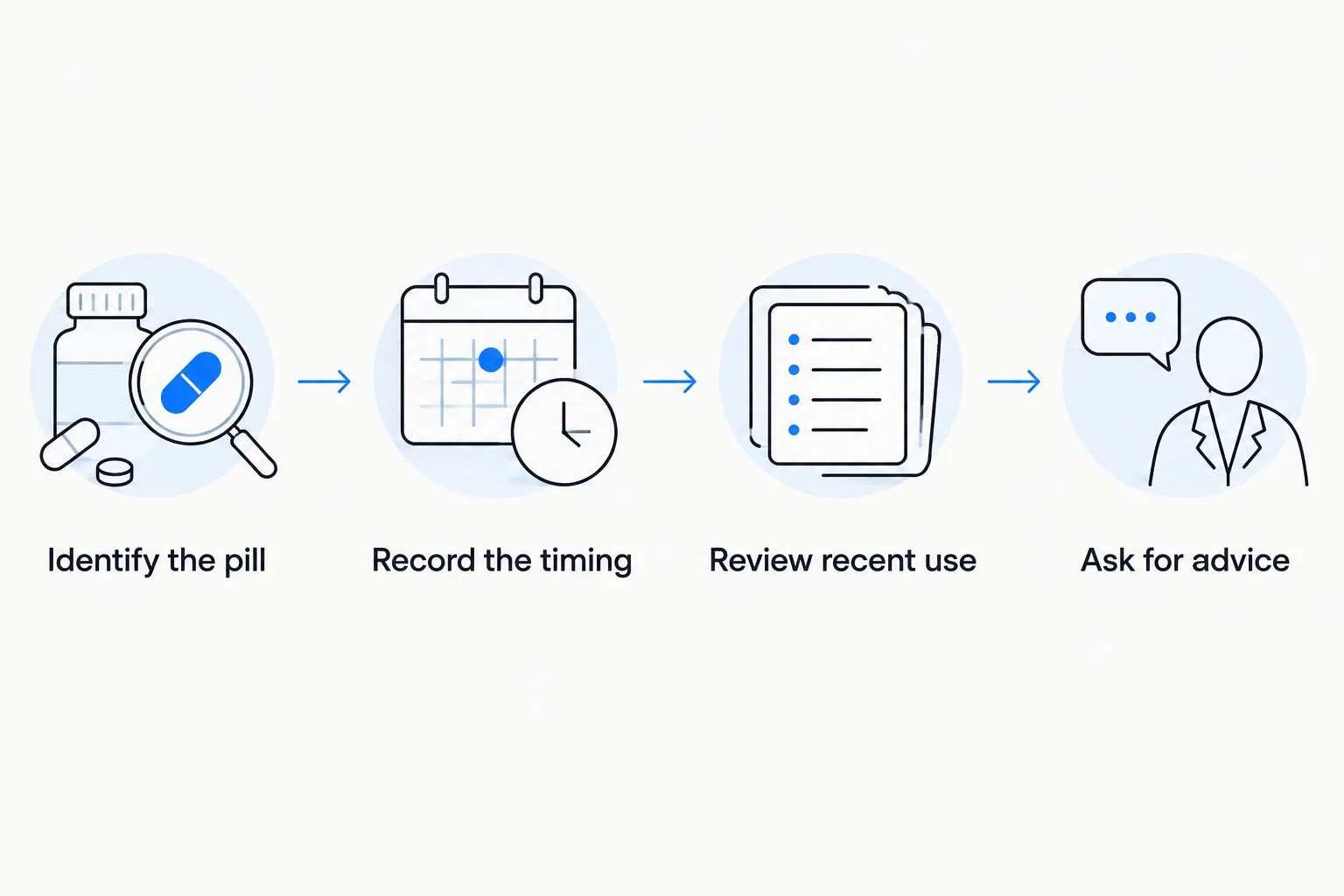
If you are unsure whether your pill was absorbed, take these steps:
- Identify the pill. Find the brand, active ingredients, and package instructions.
- Record the timing. Note when you took the contraceptive and when vomiting or severe diarrhea began.
- Review recent use. Include missed or late pills and whether you had sex without a barrier method.
- Ask for advice. Contact a pharmacist or contraceptive prescriber for instructions about replacement doses, backup, and emergency contraception.
Do not assume a single vomiting episode always requires the same response as persistent illness. Combined pills and different progestin-only pills have different instructions, so a blanket backup duration can be wrong for your prescription.
If you have had sex without reliable protection, seek advice promptly. Emergency contraception is time-sensitive, and some options can be used within 5 days after sex; suitability depends on the option and your circumstances.
Repeated vomiting also needs a review of your weight-loss treatment. Inability to keep fluids down, signs of dehydration, or severe persistent abdominal pain warrant urgent medical assessment rather than repeated attempts to manage symptoms alone.
Which birth control methods avoid the absorption issue?
Best for avoiding gastrointestinal absorption concerns: a nonoral contraceptive method that fits your medical history and preferences. That is a reason to discuss alternatives, not a reason to remove or replace a method that already works for you.
| Method | Best for | Advantage in this situation | Limitation to discuss |
|---|---|---|---|
| Oral contraceptive pill | People who prefer a daily oral method | Can generally continue with semaglutide | Vomiting, diarrhea, missed doses, and formulation-specific rules need attention |
| IUD or implant | People who prefer contraception without daily dosing | Does not depend on gastrointestinal absorption | Requires placement and individualized counseling about bleeding and other effects |
| Patch or vaginal ring | People who prefer a nonoral hormonal method | Avoids gastrointestinal absorption | Has replacement schedules and medical eligibility requirements |
| Condoms | People needing a barrier method or additional protection | Can provide backup and help reduce sexually transmitted infection risk | Requires correct use during each sexual encounter |
No method is best for everyone. Estrogen-containing contraception has medical eligibility considerations, and a method’s bleeding pattern or use requirements can matter as much as its route.
Ask your contraceptive clinician before switching. A transition without clear instructions can leave a protection gap even when both methods are appropriate individually.
Find out if GLP-1 treatment may be right for you.
Start My Pre-AssessmentHow long before pregnancy should you stop semaglutide?
At least 2 months before a planned pregnancy is the semaglutide prescribing-information recommendation. Arrange that plan with your prescriber while continuing effective contraception until you are ready to try.
Semaglutide remains in the body after the last dose, so stopping immediately before trying to conceive does not follow the recommended washout period. Your appointment should also cover nutrition, other medications, and any underlying diabetes.
If you become pregnant while using semaglutide for weight loss, stop the weight-loss treatment and contact your prescriber promptly. If semaglutide is part of diabetes care, obtain an immediate plan for blood glucose management rather than leaving diabetes untreated.
For pregnancy planning in 2026, put the intended last dose and contraception plan in writing. Do not use a late period alone to decide when to stop treatment or when pregnancy is possible.
Does taking semaglutide mean your pill has stopped working?
No: taking semaglutide alone does not mean your pill has stopped working. The relevant questions are whether you took the contraceptive correctly, experienced vomiting or severe diarrhea, or used another medication that affects it.
Do not use breakthrough bleeding as proof of contraceptive failure—or as proof that pregnancy is impossible. If pregnancy is possible, follow pregnancy-test instructions and contact your clinician about uncertain results or persistent symptoms.
What should you tell your weight-loss prescriber?
Bring a complete medication list, your contraceptive name, recent digestive symptoms, and pregnancy intentions. Include supplements and medications prescribed by other clinicians; the contraceptive review should not stop at semaglutide.
VevaRX is best for adults seeking online, doctor-prescribed weight-loss care rather than self-directed treatment. Its telehealth weight-loss service does not replace contraceptive-specific instructions from your pill label, pharmacist, or reproductive-health clinician.
Ask for a clear plan covering what to do after vomiting, whom to contact after a missed pill, and how contraception changes if you switch medications. Request those instructions before a problem occurs, while you have the package and medication list available.
Have questions about your options? Start with a quick online assessment.
Start My Pre-AssessmentFAQ
Can you take semaglutide with birth control pills in 2026?
Yes, semaglutide can generally be taken with birth control pills. Injectable semaglutide has not shown a clinically relevant effect on exposure to the studied combined pill, but vomiting, diarrhea, and missed doses require separate advice.
Do I need condoms when I start semaglutide?
Semaglutide does not routinely require condoms solely because you start treatment. Condoms can still provide backup when your contraceptive instructions require it and help reduce sexually transmitted infection risk.
Does semaglutide affect an IUD or implant?
Semaglutide’s effect on stomach emptying does not interfere with gastrointestinal absorption of an IUD or implant because these methods are not taken orally. Continue the method’s usual follow-up and replacement instructions.
Is tirzepatide different from semaglutide for birth control?
Yes, tirzepatide has specific oral-contraceptive precautions. Use a nonoral contraceptive or add a barrier method for 4 weeks after starting tirzepatide and 4 weeks after each dose increase.
What if I throw up after taking my birth control pill?
Follow your exact pill’s vomiting or missed-dose instructions and ask a pharmacist if you are unsure. The pill type, symptom timing, duration of illness, and recent sex determine whether replacement doses, backup, or emergency contraception are needed.
How long should I stop semaglutide before trying for a baby?
Stop semaglutide at least 2 months before a planned pregnancy, following your prescriber’s plan. If you use semaglutide for diabetes, arrange an appropriate blood glucose treatment plan as well.
Can I take oral semaglutide and my contraceptive together?
Follow the administration instructions for your exact oral semaglutide product rather than taking both automatically at the same time. Products with the 30-minute waiting instruction require that interval before other oral medicines.
One last thing
The most useful detail is often the name on your contraceptive pack, not the name of your weight-loss program. Save a photo of the ingredients and instructions before starting treatment.
For your next VevaRX weight-loss consultation, bring that photo and one question: what should you do if you cannot keep this specific pill down? A written answer is more useful than a general reassurance that the medications are compatible.
Related guides
Ready to get started?
See if doctor-prescribed GLP-1 treatment may be right for you. It only takes a few minutes, 100% online.
Start My Pre-AssessmentThis article is for informational purposes only and is not medical advice. Compounded medications are not approved by the FDA and have not been reviewed for safety, effectiveness, or quality. Prescription products require an online consultation with a licensed healthcare provider who will determine if a prescription is appropriate. Individual results vary.