
Can you take semaglutide while breastfeeding?
Can you take semaglutide while breastfeeding? Get a clinician's review first. Compare injection evidence, oral medication concerns, and questions to ask.

You should not start semaglutide while breastfeeding without a prescribing clinician reviewing your situation. In 2026, limited human evidence is reassuring for injectable semaglutide, but it does not establish safety for every nursing parent or infant. Oral semaglutide containing the absorption enhancer SNAC is a separate concern and is not recommended during breastfeeding.
- Can you take semaglutide while breastfeeding? Injectable semaglutide requires an individualized prescribing decision, not a blanket yes.
- A published study found no detectable semaglutide in breast milk from eight women using injections.
- The study does not establish safety for newborns, premature infants, or every prescribed dose.
- Oral semaglutide containing SNAC is not recommended during breastfeeding; injection findings do not apply to tablets.
Can you take semaglutide while breastfeeding?
Injectable semaglutide is an individualized medical decision during breastfeeding; oral semaglutide containing SNAC should be avoided. The distinction matters because the available human milk study evaluated injections, not tablets.
For the broader planning questions around recovery, nutrition, and treatment timing, see the GLP-1 weight-loss guide for postpartum moms. Breastfeeding safety still needs its own clinical assessment.
The following comparison separates the evidence from the treatment decision. Neither route earns a blanket recommendation for nursing parents.
| Option | Breastfeeding evidence | Main limitation | Decision to discuss |
|---|---|---|---|
| Injectable semaglutide | A small human study found no detectable semaglutide in sampled milk | Limited participants, doses, infant ages, and follow-up | Whether maternal benefit justifies treatment during lactation |
| Oral semaglutide containing SNAC | Injectable findings do not establish tablet safety | The absorption enhancer introduces an additional infant-exposure concern | Avoid during breastfeeding and discuss another treatment |
| Deferring semaglutide | Avoids semaglutide exposure during breastfeeding | Does not address an immediate need for diabetes medication | Whether postponement fits your diagnosis and health needs |
Best for someone considering semaglutide solely for weight loss: discuss postponement before starting. Best for someone needing diabetes treatment: arrange a medication review rather than leaving blood glucose untreated. These are different clinical problems, even when the medication under consideration is the same.
Why this matters
Breast milk transfer is only part of the decision. Your clinician also needs to consider why you need treatment, how your baby feeds, and whether medication side effects would interfere with your own nutrition and hydration.
A nursing parent managing diabetes needs effective treatment. A nursing parent considering elective weight-loss treatment has a different benefit-risk discussion. Do not stop an established diabetes treatment plan without arranging a replacement or review.
In 2026, the useful question is not simply whether semaglutide reaches milk. It is whether the specific formulation, dose, and treatment goal fit your breastfeeding situation.
What does the human breast milk study actually show?
The journal Nutrients published Subcutaneous Semaglutide during Breastfeeding: Infant Safety Regarding Drug Transfer into Human Milk in 2024. The study included 8 women using subcutaneous semaglutide at doses of 0.25–1 mg per week.
Researchers collected milk samples at 0, 12, and 24 hours after administration. Semaglutide was not detected in those samples. The infants were 4–23 months old, so the study did not evaluate exposure in newborns.
Those findings are reassuring within their scope. They do not prove that every milk sample at every dose contains no medication, and they do not establish long-term infant safety.
The National Library of Medicine's LactMed entry summarizes the study and distinguishes injectable semaglutide from oral formulations containing SNAC. For a 2026 treatment decision, use that evidence alongside the prescribing information for the exact medication being considered.
What the study supports
- Measured milk transfer: semaglutide was not detected in the collected samples.
- Route-specific evidence: the participants used injections, not oral semaglutide.
- A useful clinical discussion: the findings provide human data rather than relying entirely on theoretical transfer.
What the study does not establish
- Safety for newborns or premature infants.
- Safety across every maintenance dose or formulation.
- Effects on milk production across a full course of treatment.
- Long-term developmental outcomes in exposed infants.
Not detected is a laboratory finding, not an unrestricted safety clearance. Your clinician should explain both the reassuring result and the limits before you make a treatment decision.
Injectable semaglutide: limited evidence, individual review
Injectable semaglutide has the relevant human milk evidence. That makes its discussion different from oral semaglutide, but it does not make self-prescribing appropriate.
Ask your clinician to assess the exact prescription, your diagnosis, your infant's age and health, and the role breast milk plays in feeding. A healthy older infant receiving complementary foods is not the same clinical situation as an exclusively breastfed newborn.
The potential benefit is treatment of an established maternal health need. The limitation is that the breastfeeding evidence remains small and does not answer every exposure or nutritional question.
Do not use another person's prescription or an old prescription to restart treatment postpartum. Your current breastfeeding status belongs in the prescribing decision, even if you tolerated semaglutide before pregnancy.
Oral semaglutide: the injection findings do not apply
Oral semaglutide containing SNAC should not be treated as interchangeable with injectable semaglutide during breastfeeding. SNAC helps semaglutide absorb through the digestive tract, and LactMed identifies possible infant accumulation of this absorption enhancer as a concern.
Oral semaglutide containing SNAC is not recommended during breastfeeding. A study of injected semaglutide cannot establish the safety of a tablet that includes an additional absorption-enhancing ingredient.
Tablets offer a different administration route, but that convenience does not resolve the lactation concern. Ask the prescriber to identify the exact formulation rather than accepting a general statement that all semaglutide products are equivalent.
If you already take an oral product, contact the prescriber for a medication review. Do not switch yourself to injections or another weight-loss medication.
Why the breastfeeding recommendation varies
The 2026 discussion should account for these factors, not just the medication name:
- Treatment purpose: diabetes management and elective weight loss carry different immediate benefits and consequences of postponement.
- Medication formulation: injectable semaglutide and oral semaglutide containing SNAC have different evidence and ingredient concerns.
- Infant age and health: the published milk study included older infants, not newborns or premature infants.
- Feeding pattern: exclusive breastfeeding and mixed feeding create different exposure contexts; your clinician needs the actual feeding history.
- Maternal tolerability: nausea, vomiting, diarrhea, and reduced appetite can complicate eating and drinking during lactation.
- Prescribed dose: evidence from a limited dose range should not be presented as proof for every dose used in practice.
These factors explain why another parent's prescription is not a recommendation for you. They also explain why a single reassuring milk-transfer result does not replace a full clinical review.
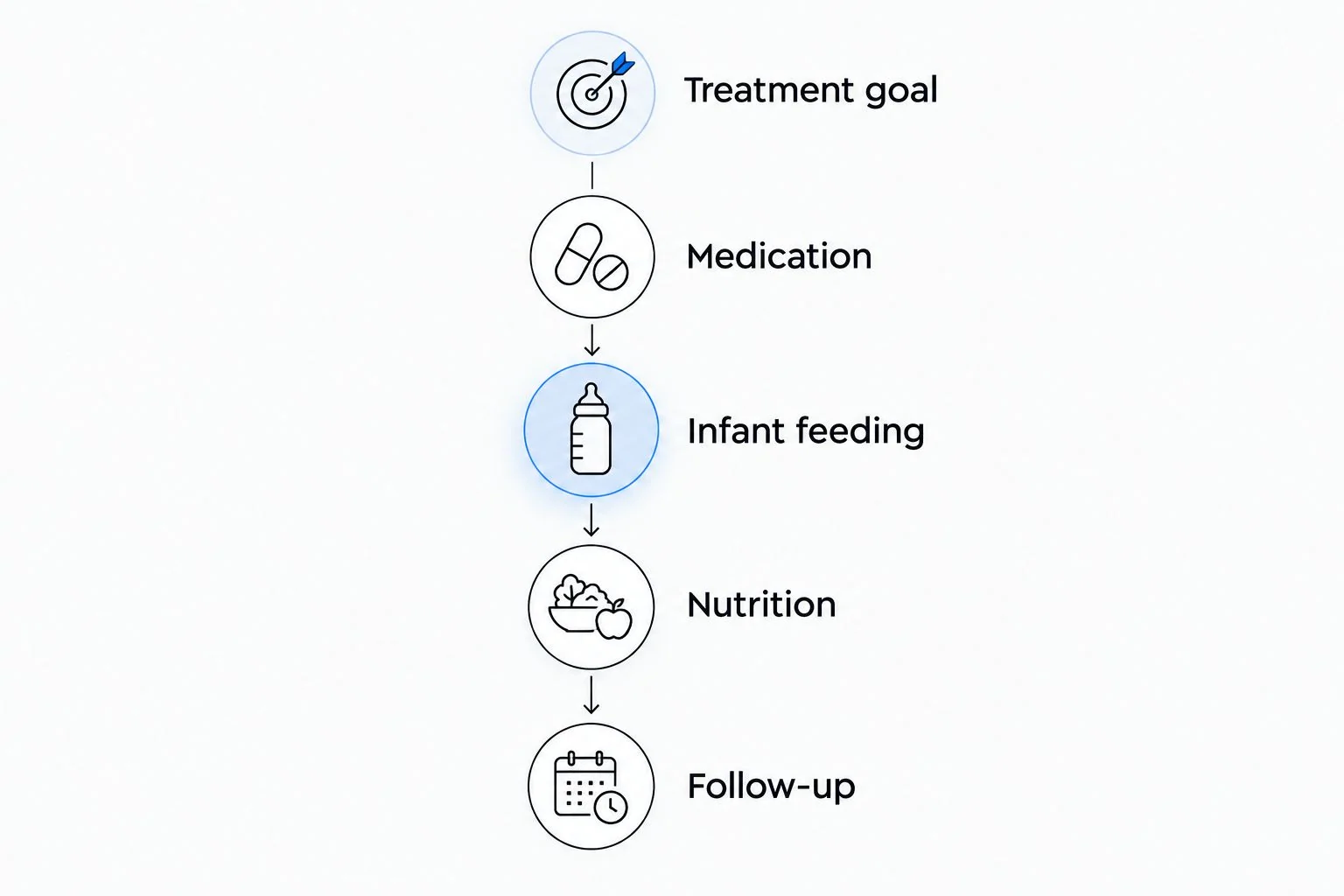
What should you tell your clinician before a decision?
Bring the information needed to make the discussion specific. In 2026, a useful appointment should end with a clear plan for treatment, monitoring, and follow-up—not just permission to proceed.
- State your treatment goal. Explain whether you need diabetes control, weight-management treatment, or a review of medication used before pregnancy.
- Identify the medication. Bring the product name, route, prescribed dose, and ingredient information. Do not describe every injection or tablet simply as semaglutide.
- Describe infant feeding. Include your baby's age, whether the baby was premature, any health concerns, and whether feeding is exclusive or mixed.
- Review your nutrition. Discuss appetite, vomiting, hydration, and any existing concerns about milk supply or infant growth.
- Agree on follow-up. Ask what symptoms should prompt contact, who will assess infant concerns, and what happens if treatment is postponed.
This sequence keeps the decision focused on the actual prescription and both patients: you and your baby. It also prevents a weight-loss consultation from overlooking lactation.
Where does online weight-loss care fit?
VevaRX is best suited to US adults seeking clinician-prescribed weight-loss treatment, not self-directed medication use while breastfeeding. The platform offers online prescriptions for GLP-1 weight-loss medications; that service description is not evidence that a particular breastfeeding patient qualifies.
Before considering VevaRX for GLP-1 weight-loss care, disclose breastfeeding and ask whether the clinician can assess your situation or needs to coordinate with your existing care team. Online access does not remove the need for a lactation-specific prescribing decision.
Should you pump and dump after a semaglutide injection?
Pumping and discarding milk is not an established workaround for semaglutide exposure. Semaglutide has an elimination half-life of approximately 1 week, so it is not a medication whose exposure can be assumed to end after a short feeding interruption.
Do not invent a safe interval based on injection timing or the study's sampling schedule. The collection times describe the research method, not a validated timetable for stopping and restarting breastfeeding.
If a clinician recommends interrupting breastfeeding, ask for a specific feeding and milk-expression plan. The instruction needs to account for your infant's nutrition and your milk supply.
Does semaglutide reduce breast milk supply?
The small human milk study does not establish whether semaglutide reduces milk supply. Low drug transfer and milk production are separate questions, and the evidence should not be stretched from one to the other.
Semaglutide can reduce appetite and cause gastrointestinal side effects. If you cannot eat or drink adequately, contact your clinician and a lactation professional rather than assuming the change is harmless or definitely caused by the medication.
Infant feeding, growth, and hydration deserve assessment when supply is a concern. Do not use weight loss alone as a sign that a postpartum treatment plan is working well.
What if you already took semaglutide while breastfeeding?
Contact your prescriber and your baby's pediatric clinician for an exposure review. Tell them the exact medication, dose, route, and time taken, plus your baby's age, health, and feeding pattern.
An exposure does not automatically establish infant harm, and it does not automatically mean breastfeeding must stop. The response depends on the product and clinical circumstances, particularly whether the medication was an injection or an oral formulation containing SNAC.
Seek prompt medical advice if your infant has concerning feeding changes, repeated vomiting, unusual sleepiness, or signs of dehydration. Do not wait for an online weight-loss consultation to address an unwell baby.
FAQ
Can you take semaglutide while breastfeeding in 2026?
Injectable semaglutide requires an individualized prescribing decision during breastfeeding in 2026. Limited milk-transfer evidence is reassuring, but it does not establish safety for every infant or dose; oral semaglutide containing SNAC is not recommended.
Does semaglutide pass into breast milk?
Semaglutide was not detected in milk samples from eight women using injections in a published study. That result applies to the sampled conditions and does not prove zero transfer at every dose or time.
Is oral semaglutide safer than the injection while nursing?
Oral semaglutide containing SNAC is not the safer breastfeeding alternative. The absorption enhancer creates an additional concern, and findings from injections do not establish tablet safety.
Can I use semaglutide while exclusively breastfeeding a newborn?
The published human milk study does not establish safety for an exclusively breastfed newborn. Discuss treatment with your prescriber and pediatric clinician before starting.
How long should I pump and dump after semaglutide?
There is no established pump-and-dump interval that makes semaglutide use safe during breastfeeding. Its approximately one-week half-life makes a brief interruption an unreliable workaround.
Should I stop breastfeeding if I already took a dose?
A dose of semaglutide does not automatically mean you must stop breastfeeding. Contact your prescriber and pediatric clinician with the exact product, route, dose, and infant details for an individualized plan.
Can an online weight-loss provider prescribe semaglutide if I am breastfeeding?
An online weight-loss service does not establish that semaglutide is appropriate during breastfeeding. Tell any provider, including VevaRX, that you are nursing before a prescribing decision and ask whether coordinated lactation care is needed.
One last thing
Ask which formulation the evidence covers before asking whether the medication is safe. The most consequential distinction on this page is injection versus oral semaglutide containing SNAC—not whether a provider offers convenient prescribing.
For a 2026 consultation with VevaRX or another prescriber, lead with breastfeeding status rather than your target weight. A useful decision includes your health needs, your baby's feeding situation, and a plan if treatment is deferred. This article provides general information, not a personal prescribing recommendation.
Related guides
This article is for informational purposes only and is not medical advice. Compounded medications are not approved by the FDA and have not been reviewed for safety, effectiveness, or quality. Prescription products require an online consultation with a licensed healthcare provider who will determine if a prescription is appropriate. Individual results vary.