
Can you take tirzepatide while breastfeeding?
Can you take tirzepatide while breastfeeding? Get a clinician's review first. Learn what milk-transfer research shows and what to ask before treatment.

Tirzepatide is not automatically ruled out during breastfeeding, but you should take it only after your prescriber reviews your medical need and your baby's situation. Human milk testing found very low transfer after a single dose, but that does not establish safety for breastfed infants during ongoing treatment. If you already took a dose, contact your prescriber and your baby's pediatrician rather than deciding on your own to stop treatment or breastfeeding.
- Can you take tirzepatide while breastfeeding? Get an individualized prescribing decision; low milk transfer does not prove infant safety.
- FDA prescribing information reports very low tirzepatide transfer after a single dose, not established safety during ongoing breastfeeding.
- NIH LactMed advises extra caution with newborn or premature infants.
- VEVArx offers prescribed GLP-1 weight-loss treatment; breastfeeding requires a separate clinical assessment.
Can you take tirzepatide while breastfeeding?
You can be considered for tirzepatide during breastfeeding when a clinician determines that the expected benefit justifies the uncertainty. This is not a blanket yes, and breastfeeding is not automatically a reason to discontinue a medically necessary treatment. The decision differs when you need glucose control versus when you want to begin elective postpartum weight-loss treatment.
For your 2026 decision, the most useful sources are the FDA-approved tirzepatide prescribing information and the National Library of Medicine's LactMed entry. They address different questions: the prescribing information describes measured drug transfer, while LactMed interprets the available evidence for breastfeeding care.
VEVArx offers doctor-prescribed GLP-1 weight-loss medications online. That service description does not establish whether tirzepatide is appropriate for you while nursing.
| Clinical situation | Potential benefit | Limitation or concern | Best for |
|---|---|---|---|
| Starting tirzepatide while breastfeeding | Treating a condition for which your clinician recommends tirzepatide | Infant safety and effects on milk production remain insufficiently established | Patients whose clinician identifies a treatment need that justifies the uncertainty |
| Deferring tirzepatide | Avoiding infant exposure to tirzepatide through milk | Delays this treatment and requires another plan for your health needs | Patients whose clinician agrees treatment can wait |
| Using a different treatment | Addressing the underlying condition with an option supported by more breastfeeding experience | Suitability depends on the diagnosis, health history, and treatment goals | Patients with an appropriate alternative identified by their clinician |
Curious whether you qualify? A licensed provider makes the final call.
Start My Pre-AssessmentWhy this matters
A low concentration in milk answers only part of the breastfeeding question. Your care team also needs to consider infant absorption, repeated exposure, feeding, growth, and your ability to maintain adequate nutrition.
Postpartum weight loss and diabetes treatment are not interchangeable goals. If you have diabetes, leaving high blood glucose untreated is not a safe substitute for reviewing medication choices. If your goal is weight loss without an urgent medical indication, discuss whether postponing medication better fits your feeding plans.
What does the human milk study actually show?
FDA-approved tirzepatide prescribing information describes a lactation study involving 11 healthy lactating women who received a single 5 mg dose. Tirzepatide was undetectable in most collected milk samples, and the cumulative amount detected in the remaining samples was less than 0.02% of the administered maternal dose.
That is reassuring evidence about milk transfer under the study conditions. It is not a study proving that infants exposed during months of treatment experience no adverse effects.
Low milk transfer is not the same as a proven safe infant dose
The less-than-0.02% figure describes the amount recovered in milk relative to the maternal dose. Do not reinterpret it as a measured infant blood concentration or a guarantee that every nursing infant receives the same exposure.
The FDA labeling also identifies gaps concerning effects on breastfed infants and milk production. Your clinician should interpret the finding alongside your baby's age, health, feeding pattern, and your reason for treatment.
A single dose does not represent ongoing treatment
A study using one 5 mg dose does not directly answer every question about repeated weekly dosing or dose increases. Tirzepatide's elimination half-life is approximately 5 days, according to its prescribing information, so the medicine does not disappear between individual nursing sessions.
For a 2026 treatment discussion, separate what researchers measured from what remains unknown. Very low milk transfer supports an individualized assessment; it does not support self-prescribing during breastfeeding.
Why the breastfeeding recommendation varies
Your clinician's recommendation depends on more than the medication name. Bring these factors into the discussion:
- Treatment need: Blood glucose management and elective weight loss require different benefit-risk discussions.
- Infant age: LactMed recommends particular caution when nursing a newborn or premature infant.
- Infant health: Feeding difficulties, growth concerns, or medical conditions belong in the pediatric assessment.
- Feeding pattern: Exclusive breastfeeding and partial breastfeeding create different exposure circumstances, without establishing a guaranteed safe threshold.
- Maternal nutrition: Nausea, vomiting, diarrhea, and reduced appetite can interfere with eating and drinking adequately.
- Treatment alternatives: Another approach might meet your medical needs with more established breastfeeding experience.
These factors explain why advice given to someone else is not your prescription. A healthy older infant who also eats complementary foods presents a different clinical situation from a premature newborn, but neither situation establishes safety on its own.
How should you discuss tirzepatide with your care team?
Use a shared plan involving your prescriber and your baby's pediatrician. A lactation professional can help assess feeding or supply concerns, but the prescribing decision belongs with a qualified clinician who knows your health history.
- Clarify treatment need. Explain whether you are seeking weight management, diabetes treatment, or both. Include current medications and relevant medical conditions.
- Review infant health. Share your baby's age, whether your baby was premature, and any feeding or growth concerns.
- Compare treatment options. Ask what happens if you delay tirzepatide and what other treatments fit your diagnosis during breastfeeding.
- Set follow-up. Agree on what to monitor, whom to contact, and what symptoms require prompt assessment.
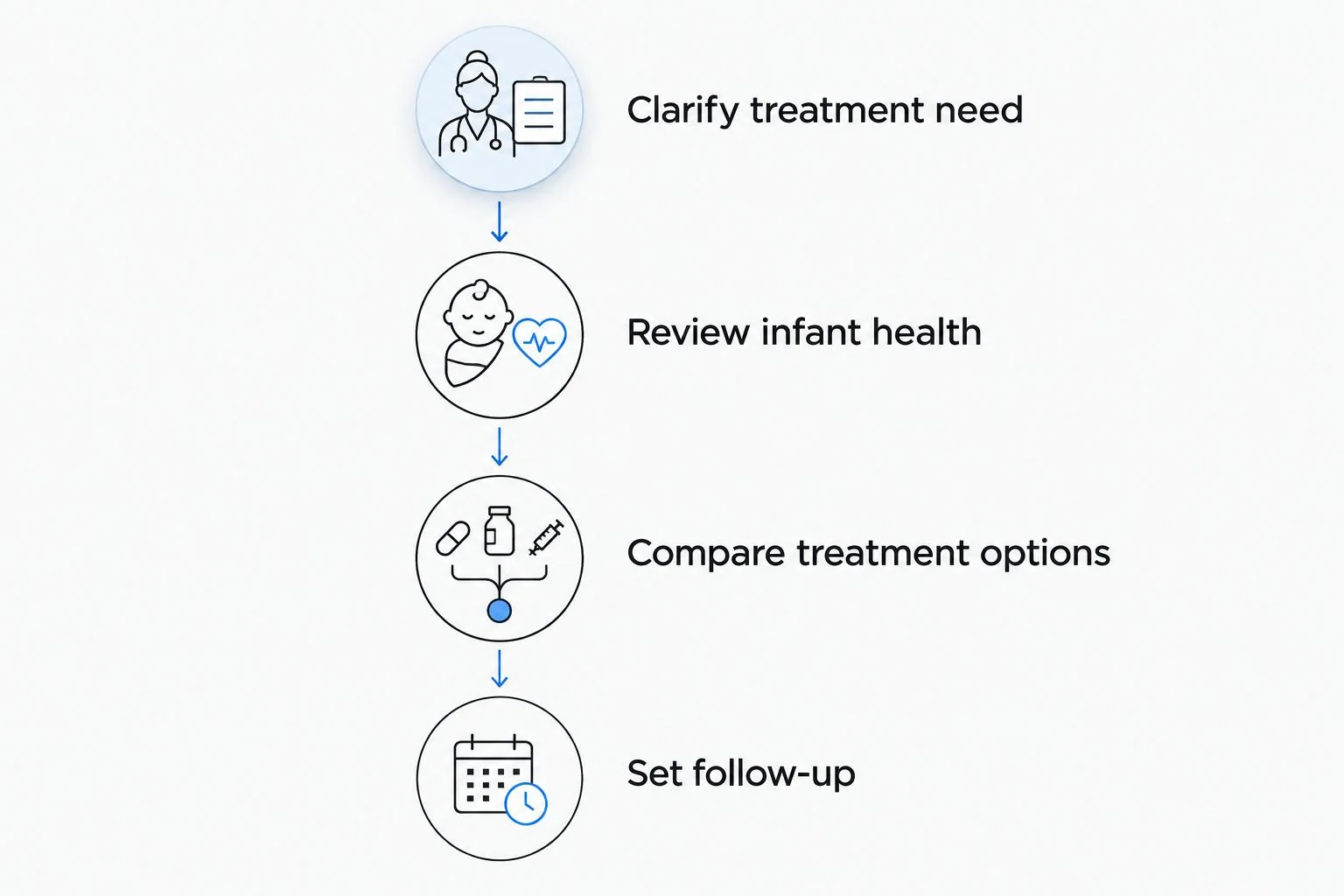
Bring the medication packaging or prescription details to the conversation. The exact formulation, dose, and timing matter, especially if you have already started treatment or obtained medication from more than one source.
Questions to bring to your appointment
Ask your clinician to make the plan specific enough that you know what to do after the appointment:
- What medical benefit makes tirzepatide appropriate for me now?
- What evidence applies to my baby's age and health?
- What treatment would you recommend if I defer tirzepatide?
- What changes in feeding, growth, or my own symptoms should trigger a call?
- Who will review the plan if my dose or feeding pattern changes?
A prescription alone does not answer these questions. In 2026, your breastfeeding status should remain part of medication review throughout treatment, not just at the first appointment.
Does tirzepatide reduce breast milk supply?
There is not enough evidence to establish tirzepatide's effect on human milk production. Do not treat either a guaranteed supply drop or a guarantee of no effect as an established fact.
Tirzepatide commonly causes gastrointestinal side effects and reduces appetite. If those effects make it difficult to eat or drink, contact your clinician; postpartum nutrition deserves attention independent of the amount of medicine measured in milk.
If you notice a feeding change, assess the whole situation with your pediatrician or lactation professional. Feeding effectiveness, your baby's growth, and changes in nursing or pumping patterns are more useful than assuming the medication explains every change.
Do not deliberately restrict food or fluids to speed up weight loss while nursing. Ask for nutrition guidance that accounts for breastfeeding, recovery, and any medical conditions.
Can you pump and dump after taking tirzepatide?
Pumping and discarding milk does not make tirzepatide leave your bloodstream faster. With an elimination half-life of approximately 5 days, tirzepatide is not a medication you can reliably manage by skipping a single feed after an injection.
There is no established universal pump-and-discard schedule that makes tirzepatide use safe during breastfeeding. Taking an injection immediately after nursing also does not establish a protected window for the next feed.
If your care team recommends interrupting breastfeeding, ask for an individualized feeding and pumping plan. The plan should address your baby's nutrition, maintaining milk production if appropriate, and the clinical criteria for resuming nursing.
Find out if GLP-1 treatment may be right for you.
Start My Pre-AssessmentWhat should you do if you already took tirzepatide?
An accidental exposure is a reason to contact your care team, not proof that your baby has been harmed. Record the medication name, dose, injection time, and whether you have taken previous doses.
Contact your prescriber and your baby's pediatrician before the next scheduled dose. Do not independently abandon necessary diabetes treatment or make a prolonged feeding change without a replacement plan.
Seek prompt pediatric assessment for poor feeding, repeated vomiting, unusual sleepiness, or signs of dehydration. These symptoms have many possible causes; a clinician needs to assess the baby rather than assume tirzepatide is responsible.
If your baby is difficult to wake, has trouble breathing, or appears seriously ill, seek emergency care. Do not wait for a routine telehealth reply.
What else should you review before postpartum tirzepatide treatment?
Your 2026 medication review should include contraception as well as breastfeeding. Tirzepatide can reduce the effectiveness of oral hormonal contraceptives because it delays gastric emptying.
FDA prescribing information advises switching to a non-oral contraceptive method or adding a barrier method for 4 weeks after starting tirzepatide and for 4 weeks after each dose increase. Ask your clinician which approach fits your postpartum circumstances.
Also disclose other glucose-lowering medicines. Tirzepatide used with insulin or an insulin secretagogue can increase hypoglycemia risk, and medication changes require a prescriber rather than a self-directed adjustment.
For people considering VEVArx GLP-1 weight-loss treatment, the practical next step is a prescribing discussion—not choosing an injection schedule around feeds. VEVArx is for US adults seeking medically supervised weight-loss treatment, not a substitute for infant-specific breastfeeding advice.
Have questions about your options? Start with a quick online assessment.
Start My Pre-AssessmentFAQ
Can you take tirzepatide while breastfeeding in 2026?
Tirzepatide during breastfeeding requires an individualized prescribing decision in 2026. Human milk testing found very low transfer after a single dose, but infant safety during ongoing treatment is not established.
How much tirzepatide passes into breast milk?
Less than 0.02% of the administered maternal dose was detected cumulatively in milk in the single-dose study described in FDA prescribing information. The study involved 11 healthy lactating women given 5 mg; that result does not establish a safe infant dose.
Is tirzepatide safer once my baby is older?
An older infant's situation differs from a newborn's, but age alone does not establish tirzepatide safety during breastfeeding. LactMed advises particular caution with newborn or premature infants.
Should I stop breastfeeding if I already took tirzepatide?
Do not automatically stop breastfeeding solely because you took a dose; contact your prescriber and your baby's pediatrician for individualized advice. Share the dose, timing, previous doses, and your baby's age and health.
Can I inject tirzepatide right after nursing to avoid exposure?
Injecting immediately after nursing does not establish an exposure-free feeding window. Tirzepatide's elimination half-life is approximately 5 days, so it remains in your body between feeds.
Is semaglutide a safe replacement while breastfeeding?
Semaglutide is not an automatic replacement for tirzepatide during breastfeeding. Its formulation and lactation evidence require a separate review with your clinician.
Can tirzepatide affect my birth control after delivery?
Tirzepatide can reduce the effectiveness of oral hormonal contraceptives. FDA labeling advises a non-oral method or an added barrier method for 4 weeks after starting and 4 weeks after each dose increase.
One last thing
Ask your clinician what would change the decision—not just whether the answer is yes or no. A recommendation to defer treatment should include a plan for your current health needs and a clear reason to reassess, such as a change in feeding or medical circumstances.
For any 2026 postpartum treatment plan, keep the maternal and infant questions separate. A medication can be effective for your health condition while still requiring additional caution during breastfeeding.
Related guides
Ready to get started?
See if doctor-prescribed GLP-1 treatment may be right for you. It only takes a few minutes, 100% online.
Start My Pre-AssessmentThis article is for informational purposes only and is not medical advice. Compounded medications are not approved by the FDA and have not been reviewed for safety, effectiveness, or quality. Prescription products require an online consultation with a licensed healthcare provider who will determine if a prescription is appropriate. Individual results vary.